If you have ever received a message containing “OTP” and wondered what it means, you are not alone. OTP is an abbreviation with several meanings, and the correct definition depends on where and how it is used.
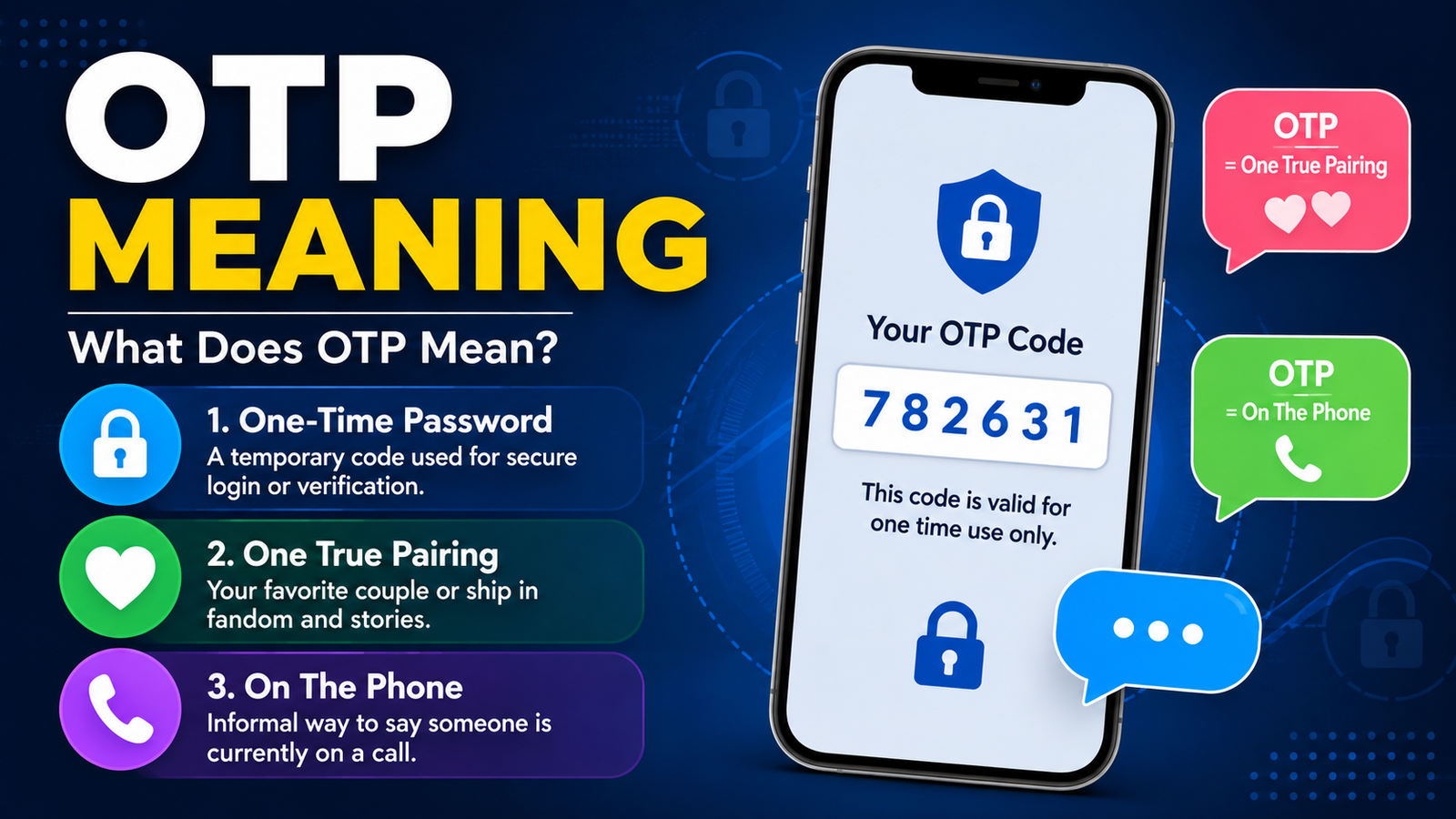
In a banking message, OTP usually means One-Time Password or One-Time Passcode. In fandoms, social media, and conversations about couples, it can mean One True Pairing. In some casual chats, people also use OTP to mean On the Phone.
That may sound confusing at first, but the surrounding conversation usually makes the intended meaning clear. This guide explains the OTP meaning, pronunciation, origin, examples, synonyms, antonyms, common usage, and the differences between its major meanings.
What Does OTP Mean?
OTP is an abbreviation, not a single word with only one definition. Its meaning changes according to context.
The three meanings you are most likely to encounter are:
- One-Time Password — a temporary security code used to verify identity.
- One True Pairing — a favorite romantic pairing, especially in fandom culture.
- On the Phone — an informal texting abbreviation indicating that someone is currently on a phone call.
The first meaning is particularly common in technology, banking, and account security. Cambridge defines OTP as an abbreviation for “one-time password” or “one-time passcode,” describing a code that can be used only once.
In social media and fandom conversations, however, OTP often refers to One True Pairing. The term describes two people or fictional characters whom someone considers an ideal couple or favorite pairing.
OTP Meaning in Simple English
In simple English, OTP means different things in different situations.
If your bank sends:
“Your OTP is 583921.”
it means One-Time Password. You use that temporary code to verify that you are authorized to log in or complete an action.
If your friend posts:
“They are my OTP!”
they probably mean One True Pairing. They are saying that the two people or characters are their favorite couple.
If someone texts:
“Sorry, OTP rn.”
they may mean On The Phone right now.
So, if you are asking, “What does OTP mean?”, the best answer is: look at the context first.
What Does OTP Mean in Text?
In text messages, OTP can have more than one meaning.
OTP = On The Phone
When used in a casual conversation, OTP can mean “On The Phone.” Someone may use it to explain why they cannot respond immediately.
For example:
“Can’t talk, OTP rn.”
This means the person is currently on a phone call.
Another example is:
“I was OTP with my sister.”
Here, OTP means the person was talking to their sister on the phone.
This usage is relatively straightforward, although many people now simply write “on a call” instead.
OTP = One True Pairing
In social media and fandom conversations, OTP can mean “One True Pairing.”
This phrase describes a pairing that a fan strongly supports. The pairing can involve fictional characters from a television show, movie, anime, book, or game. It can also sometimes refer to celebrities or real-life people.
For example:
“Those two characters are my OTP.”
The speaker means that the two characters are their favorite romantic pairing.
The phrase is closely connected to the internet concept of “shipping,” where fans support or imagine a relationship between two people or characters.
OTP = One-Time Password
If OTP appears in a message from a bank, website, shopping platform, or authentication service, it almost certainly means One-Time Password or One-Time Passcode.
An OTP is a temporary code associated with a particular login attempt, transaction, or verification process. It may be delivered by SMS or email, or generated by an authentication device or application.
For example:
“Enter the OTP sent to your registered mobile number.”
This has nothing to do with romance or texting slang. It is a security-related use of the abbreviation.
OTP Meaning in Social Media
On platforms such as TikTok, Instagram, Snapchat, Reddit, and fandom communities, OTP often has a completely different meaning from the banking definition.
A person might write:
“This couple is literally my OTP.”
They are expressing strong support for that pairing.
People use OTP when discussing:
- TV couples
- Movie characters
- Anime characters
- Book characters
- K-drama couples
- Celebrity pairings
- Fictional relationships
- Fan-created relationships
For example:
“I started watching the series yesterday and these two are already my OTP.”
The statement means that the viewer quickly became emotionally invested in that particular pairing.
OTP can therefore carry a strong emotional tone. It is usually more enthusiastic than simply saying, “I like this couple.”
What Is the Origin of OTP?
The history of OTP depends on which meaning you are discussing.
Origin of “One-Time Password”
The security meaning comes from computing and authentication. A one-time password is designed to be temporary rather than permanently reusable.
Modern OTP systems can send a code to a user’s phone or email, or generate one through an authentication device or application. The code is then entered during a login or verification process.
The basic idea is simple: a password that is valid for only one use or authentication event is harder to reuse if it has been exposed.
OTP technology is now common in online banking, account logins, e-commerce, and other services that need an additional identity check.
Origin of “One True Pairing”
The fandom meaning developed through online fan communities and shipping culture.
As internet communities grew around television shows, movies, books, anime, and other entertainment, fans began using shorthand to discuss relationships between characters. “One True Pairing” became a way to describe a person’s ultimate favorite pairing.
The expression became especially associated with online fandom communities and fan fiction culture in the late 1990s and early 2000s, before spreading through newer social platforms.
Today, the abbreviation is familiar far beyond older fan forums. It appears in social posts, comments, videos, memes, fan edits, and discussions about fictional relationships.
How Do You Pronounce OTP?
OTP is normally pronounced by saying each letter separately: “O-T-P.”
Cambridge gives the pronunciation as /ˌoʊ.tiːˈpiː/ in US English and /ˌəʊ.tiːˈpiː/ in UK English.
You generally do not pronounce OTP as a single word. Treat it as an initialism, similar to many other three-letter abbreviations.
OTP Examples in Everyday Conversation
Seeing examples is one of the easiest ways to understand the difference.
Example 1: Banking
“The website asked me to enter my OTP.”
Meaning: One-Time Password.
The user is being asked to enter a temporary verification code.
Example 2: Online Shopping
“I received an OTP before confirming the payment.”
Meaning: One-Time Password or One-Time Passcode.
The code is being used as part of a security or verification process.
Example 3: Fandom
“Those characters are my OTP.”
Meaning: One True Pairing.
The speaker strongly supports the two characters as a couple.
Example 4: Social Media
“This scene convinced me that they are my OTP.”
Meaning: One True Pairing.
The person is talking about a favorite relationship in a story.
Example 5: Texting
“Can’t answer right now, OTP.”
Meaning: On The Phone.
The person is currently speaking on a call.
Example 6: Account Login
“Enter the OTP we sent to your phone.”
Meaning: One-Time Password.
This is a security instruction, not slang.
How to Tell Which OTP Meaning Someone Intended
The easiest way to understand OTP is to examine the context.
| Where You See OTP | Most Likely Meaning |
|---|---|
| Bank SMS | One-Time Password |
| Login page | One-Time Password |
| Payment confirmation | One-Time Password |
| Security email | One-Time Password |
| Fan discussion | One True Pairing |
| TikTok about a couple | One True Pairing |
| TV or anime discussion | One True Pairing |
| Casual text about availability | On The Phone |
Context is especially important because the same three letters can describe something highly technical or something completely casual.
A message saying “Enter your OTP” is clearly security-related.
A comment saying “They are my OTP” is almost certainly about a relationship or pairing.
A message saying “I’m OTP right now” may mean the person is currently on a phone call.
OTP vs. One-Time Password
It is worth understanding the security meaning in a little more detail.
A one-time password is a temporary authentication code. Unlike a normal password, it is not intended to be reused indefinitely.
OTP systems are often part of two-factor authentication (2FA) or other verification processes. An authentication system may ask for a normal password and then request a temporary OTP as an additional check.
For example:
- You enter your username.
- You enter your password.
- The service sends or generates an OTP.
- You enter the OTP.
- The system verifies the code.
- You are allowed to continue.
MDN describes OTPs as codes tied to a particular login attempt and notes that they can be delivered through another channel or generated directly by the user’s device.
Is an OTP the Same as a Password?
Not exactly.
A traditional password is generally intended to remain valid until the user changes it or the service invalidates it.
An OTP is temporary and limited in use.
That is why you may receive a different six-digit code every time you log in or verify a transaction.
Why You Should Never Share a Security OTP
If OTP means One-Time Password, treat it as private security information.
For example, imagine you receive a message containing a verification code. Someone then calls you and claims to be from your bank, asking you to read the code aloud.
You should be extremely cautious.
The person may be attempting to use the code to access your account or authorize an action. A legitimate verification code should be entered only where you intentionally initiated the relevant process.
The important rule is simple:
Never give a security OTP to another person just because they ask for it.
OTP Meaning in Fandom Culture
The fandom meaning deserves special attention because it has become part of modern internet vocabulary.
When fans say two characters are their OTP, they are expressing more than simple approval. The phrase can communicate emotional attachment to a particular relationship.
For example:
“I know everyone has different opinions, but they will always be my OTP.”
This suggests that the person considers the pairing especially important or memorable.
The term can also appear alongside words such as:
- Ship
- Shipping
- Couple
- Pairing
- Fandom
- Fan edit
- Canon
- Headcanon
A ship is generally any pairing that a fan supports, while OTP often expresses a stronger personal preference for one particular pairing.
Synonyms for OTP
Because OTP has several meanings, its synonyms also depend on context.
Synonyms for One-Time Password
Common alternatives include:
- One-time passcode
- Verification code
- Security code
- Authentication code
- Temporary passcode
- Authorization code
These terms are related but may not always be technically identical in every system.
Synonyms for One True Pairing
Possible alternatives include:
- Favorite couple
- Favorite pairing
- Ideal couple
- Favorite ship
- Beloved pairing
- Perfect match
These are not exact dictionary synonyms, but they communicate similar ideas in casual fandom conversations.
Synonyms for On The Phone
Possible alternatives include:
- On a call
- On the phone
- Currently calling
- Talking on the phone
Antonyms of OTP
OTP does not have a single direct antonym because it is an abbreviation with multiple meanings.
For One True Pairing, an opposite idea could be a pairing someone dislikes, rejects, or does not support. In fandom language, someone might call a pairing a “notp,” a fan-community term used to indicate a pairing they strongly do not want or support.
For One-Time Password, there is no exact linguistic opposite. A useful contrast is a static password, which remains valid rather than being generated for a single use.
For On The Phone, an opposite situation would simply be available, offline from a call, or not on a call.
Common Mistakes When Using OTP
One common mistake is assuming that OTP always means One-Time Password.
That is understandable because the security meaning is extremely widespread. However, a social media comment about a fictional couple may be using the fandom meaning instead.
Another mistake is assuming that OTP always means One True Pairing simply because it appears online.
A message from a bank, shopping service, or authentication system is almost certainly using the security meaning.
The safest approach is to check the words surrounding the abbreviation.
Is OTP Formal or Informal?
Again, context matters.
One-Time Password is a formal technical term used in cybersecurity, banking, software, and authentication.
One True Pairing is informal internet and fandom language.
On The Phone is informal texting shorthand.
Therefore, you should not assume that all uses of OTP belong to the same level of language.
In a professional email, writing “one-time password” may be clearer than simply writing OTP if your audience may not know the abbreviation.
In a fandom comment, however, “OTP” is perfectly natural.
OTP on Different Platforms
OTP on TikTok
On TikTok, OTP may appear in videos, comments, captions, and fandom edits. When the surrounding content involves a couple or fictional characters, One True Pairing is the likely meaning.
OTP on Instagram
Instagram users may use OTP when discussing celebrity couples, fictional characters, or fan-created pairings.
However, OTP can also appear in direct messages about account verification, where it means One-Time Password.
OTP on Snapchat
Snapchat conversations can use OTP as casual shorthand, including fandom-related meanings. The exact interpretation depends on the conversation.
OTP on WhatsApp
WhatsApp may contain both meanings.
A friend saying “OTP rn” could mean On The Phone.
A bank or service sending a verification code is using One-Time Password.
OTP in Banking
In banking and financial services, OTP almost always refers to One-Time Password or a related one-time verification code.
This is the context where you should take the abbreviation most seriously because the code may protect access to an account or transaction.
Frequently Asked Questions About OTP Meaning
What does OTP mean in texting?
In texting, OTP can mean On The Phone or One True Pairing, depending on the conversation. If the message concerns a call, it may mean On The Phone. If it concerns a favorite couple, it likely means One True Pairing.
What does OTP mean on social media?
On social media, OTP commonly means One True Pairing when people are discussing couples, fictional characters, celebrities, movies, television shows, anime, or fandoms.
What does OTP mean in banking?
In banking, OTP usually means One-Time Password or One-Time Passcode. It is a temporary code used to verify your identity or authorize an action.
What does OTP mean in fandom?
In fandom culture, OTP means One True Pairing. It describes a romantic pairing that a fan strongly supports or considers their favorite.
Is OTP the same as 2FA?
Not exactly. OTP is a type of authentication code, while 2FA is a broader authentication method involving two different factors. An OTP can be used as one part of a two-factor authentication process.
Can OTP mean On The Phone?
Yes. On The Phone is another informal meaning found in some text conversations. It is less universal than the security meaning, so the surrounding words are important.
Is OTP a slang word?
OTP is better described as an abbreviation or initialism. Depending on the context, it can represent technical terminology such as One-Time Password or informal internet language such as One True Pairing.
What is the difference between OTP and a normal password?
A normal password is generally reusable until it is changed or invalidated. An OTP is designed for temporary or single-use authentication and normally expires after use or after a limited period.
Final Thoughts on OTP Meaning
So, what does OTP mean?
The answer depends on where you see it.
In banking, cybersecurity, and account verification, OTP usually means One-Time Password or One-Time Passcode.
In fandoms, social media, and conversations about couples, OTP often means One True Pairing.
In some casual text messages, OTP can mean On The Phone.
The three meanings may look confusing because they share exactly the same abbreviation, but context makes the difference surprisingly easy to recognize.
If you see a message saying “Enter your OTP,” think security code. If someone says “They are my OTP,” think favorite pairing. If a friend says “I’m OTP right now,” think phone call.
Understanding these differences helps you read texts, social media posts, and online conversations more confidently—and prevents a very simple three-letter abbreviation from causing unnecessary confusion.