
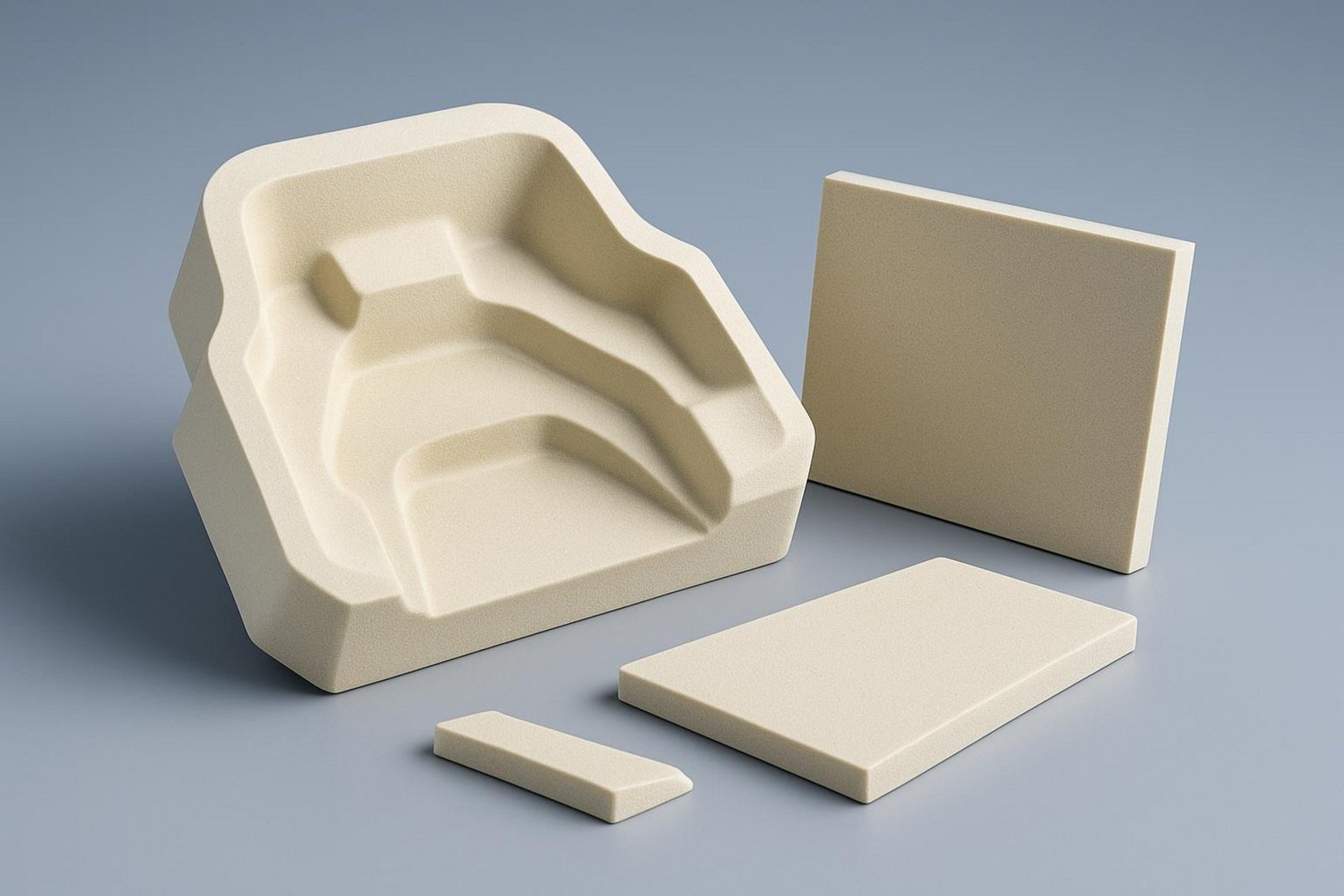
Engineers select PMI (polymethacrylimide) ROHACELL for composite applications because it balances low structural weight, resistance to high-temperature processing, and simpler manufacturing. It does more than act as a low-density spacer. It works as a structural core that can turn the production of complex sandwich parts into a streamlined, one-shot co-curing process. Since it can withstand high autoclave pressures and temperatures without cell collapse, avoids the moisture problems found in hollow structures, and delivers consistent mechanical loads in every direction, it lowers risk throughout the production and service life of advanced composite parts.
In performance-focused sectors such as commercial aviation, urban air mobility, satellite communications, and high-end automotive design, engineers often specify PMI ROHACELL to reduce structural mass while keeping a high level of rigidity. Its closed-cell structure creates a clean surface for bonding skins to the core, limits resin movement, and makes automated composite production easier.
What Is PMI ROHACELL and Why Does It Matter in Composite Design?
In modern composite engineering, sandwich construction is a leading method for achieving high stiffness with low weight. Lightweight cores are placed between thin, stiff face sheets, usually made from carbon-fiber or fiberglass prepregs. This arrangement copies the efficiency of an I-beam in three dimensions. The strength of a sandwich composite, however, depends greatly on the consistency of its inner core.
Polymethacrylimide (PMI) foam is a preferred option where standard foam cores or mechanical assemblies cannot handle the load. ROHACELL is a rigid, isotropic cellular plastic that provides a firm inner foundation. It lets composite skins carry their intended loads without early local buckling, wrinkling, or separation from the core.
PMI foam as a lightweight core for sandwich structures
PMI foam acts as a stiff, structural spacer inside a sandwich panel. When a panel bends, the outer skins carry the tension and compression, while the PMI core resists transverse shear and keeps the skins apart. Since the material is isotropic, its mechanical properties stay relatively consistent in different directions. This gives engineers more dependable results in parts with complex shapes.
Unlike open-cell materials or basic thermal insulation, high-grade PMI foam has a rigid molecular structure made from methacrylic acid and methacrylonitrile copolymers. During polymerization and thermal expansion, the polymer creates closed polygonal cells surrounded by strong imide ring groups. This chemical structure gives the core its stiffness and allows it to support sandwich parts exposed to demanding service conditions.
How ROHACELL differs from other structural foams
The structural foam market includes many polymers, including PVC (polyvinyl chloride), PET (polyethylene terephthalate), and PUR (polyurethane). PVC and PET foams are widely used in boat hulls and standard industrial panels because their raw-material costs are lower. They can reach their limits, however, during high-temperature cure cycles or under heavy shear loads. PVC foam, for example, starts to soften below common epoxy autoclave consolidation temperatures, which can lead to core crushing.
ROHACELL stands apart because of its high glass transition temperature (Tg) and strong dimensional stability during demanding processing. Unlike linear or loosely branched polymers, the dense imide ring structure of PMI keeps its specific shear strength and modulus under conditions that could liquefy or distort other cores. Its even closed-cell structure also limits deep resin absorption during vacuum infusion, helping prevent the unwanted weight increase seen with unevenly porous foams.
Why engineers evaluate strength-to-weight ratio, temperature, and process compatibility
Engineers rarely judge a core material by one property alone. A core with high room-temperature shear strength has little practical value if it collapses at a 180°C cure temperature or takes in kilograms of extra resin during high-pressure liquid molding. Design teams compare strength-to-weight performance with the material’s thermal, chemical, and processing limits.
Structural composites often use high-temperature resin systems to reach strong, tough matrices. Their core materials must handle pressures of up to 0.7 MPa and remain stable during long cure cycles without creeping. PMI is evaluated because it keeps its structural performance in high-temperature autoclaves, out-of-autoclave (OOA) vacuum-bag processes, and resin transfer molding (RTM). This helps the finished part match its digital design.
How PMI ROHACELL Improves Composite Performance
Improving structural performance often means removing unnecessary mass. Every extra gram of resin or internal support adds inertia, cuts useful payload, and consumes more energy during service. Parts made with a PMI core avoid much of this extra mass by using geometry efficiently: they increase the cross-sectional moment of inertia without adding much material volume.
Along with weight savings, ROHACELL parts provide consistent load transfer, strong resistance to ongoing vibration, and long-term chemical durability in demanding environments. These properties support reliable performance over long service periods.
Reduces structural weight without sacrificing stiffness
The bending stiffness of a composite sandwich rises quickly as its overall thickness increases, while its weight rises at a much slower, nearly linear rate. A lightweight PMI foam core separates high-modulus carbon-fiber skins, greatly increasing the section modulus with little weight compared with a solid composite laminate.
This allows engineers to replace thick, heavy carbon-fiber lay-ups with slim sandwich sections that act like hollow structures but resist buckling. Since the foam has a high specific modulus, thin laminates remain flat and stable under strong bending moments. This can deliver stiffness levels that would otherwise require heavy metal stiffeners or internal rib systems.
Supports high compressive and shear loads
A sandwich panel can carry load only if it resists out-of-plane compression and core shear. If the core yields under a transverse impact or shear force, the outer skins can crease or separate. PMI structural foam has high compressive strength even at low densities, helping support the skins against concentrated external forces.
Under high shear loads, such as those found in aircraft control surfaces, cantilevers, and wing ribs, the foam spreads stress across its three-dimensional cell network. Depending on the chosen density, from very light 30 kg/m³ grades to high-density grades above 200 kg/m³, PMI can provide enough shear and compressive strength to replace metal webs and heavily reinforced substructures without creating large stress concentrations.
Withstands elevated-temperature processing and operating conditions
High-performance aerospace and automotive composites often need cure cycles from 130°C to 180°C to create the required cross-link density in epoxy or bismaleimide matrices. ROHACELL grades are made to withstand these temperatures. They hold their shape under pressures of up to 0.7 MPa and remain intact during pressure-free post-cures reaching 210°C or 220°C.
During service, parts may face aerodynamic friction, heat from engine bays, or large seasonal temperature changes. PMI’s high heat deflection temperature helps parts exposed to hot and wet conditions keep their shape, compressive stiffness, and load-bearing ability without sagging or creeping under constant stress.
Resists moisture, chemicals, and fatigue over long service lives
Environmental damage is a continuing concern for composite structures used over many years. Open-cell foams and lower-grade cellular materials can take in water through capillary action or break down when exposed to de-icing fluids, hydraulic oils, and cleaning solvents. ROHACELL’s closed cells and natural chemical resistance limit fluid movement through the core.
Its resistance to repeated loading is another key benefit. Under cyclic stress, the even cell structure of PMI limits the start and spread of small cracks. Tests have shown that high-performance PMI cores can carry repeated shear loads above 50% of their static fracture limit for millions of cycles without cell collapse. This gives the material strong fatigue performance over decades of service.
Why ROHACELL Is an Alternative to Honeycomb Core Materials
For many years, Nomex and aluminum honeycomb were the standard cores for aerospace sandwich structures. Honeycomb materials offer very high axial compression strength along their open cell direction. Their hollow and direction-dependent structure, however, creates major production problems and service risks. As these maintenance issues have become clearer, many engineering teams have begun using PMI foam.
The main weakness of honeycomb comes from its open, connected cavities. Damaged honeycomb panels can collect fluids inside the core. This can reduce structural strength, create balance problems in rotating parts, and lead to costly field repairs.
Improves damage tolerance and impact resistance
When a honeycomb panel is hit by a dropped tool, runway stone, or hail, its thin cell walls can crush while the composite skin springs back. The damaged core may remain hidden below an apparently sound surface. Local shear stress around the crushed cells can also cause the skin to separate from the core, and that damage may spread under repeated flight loads.
PMI foam absorbs impact energy through controlled deformation of its closed-cell network. Since the core provides solid, isotropic support, the impact energy spreads through the cellular volume. This limits the spread of hidden fractures and helps the panel retain high compressive and shear strength after impact until scheduled maintenance can take place.
Makes impact damage easier to detect and inspect
In aerospace structures, visible damage is an important safety factor. With honeycomb cores, serious cell-wall buckling can happen below the surface while the outer skin returns to its original shape. This creates Barely Visible Impact Damage (BVID), which is difficult for visual inspection teams to find. Extra ultrasonic or thermal inspections are often needed.
Special grades such as ROHACELL HERO are made to deform in a way that matches the surface mark left by the impact. When an impact happens, the core deforms with the composite skin and leaves a clear dent. This connection between the visible mark and the underlying damage makes visual inspections easier and helps technicians judge the affected area without depending entirely on complex non-destructive testing (NDT).
Provides continuous support beneath composite skins
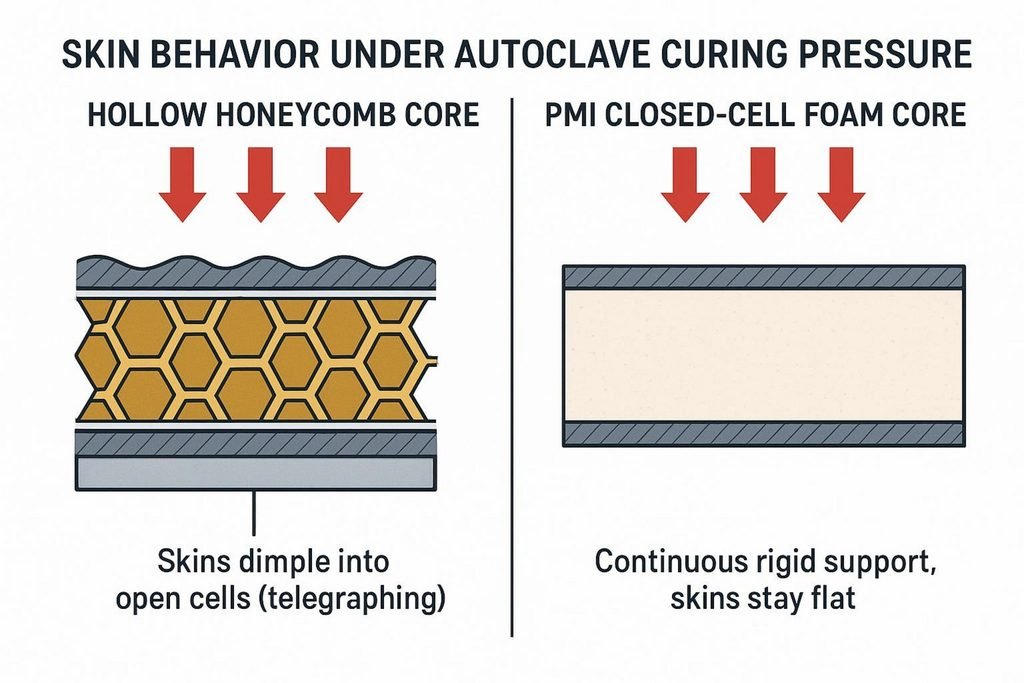
Honeycomb cores support a composite face sheet only where the vertical cell walls touch the skin. The hollow spaces between those walls have no direct support. This can cause a “telegraphing” effect: thin prepreg layers sag into the open hexagonal cells during autoclave curing and create surface dimples that disturb smooth airflow.
PMI foam provides a continuous, flat bonding surface across the full interface. Thin composite plies can cure under high pressure without sagging into the core, producing smoother aerodynamic surfaces. Since the whole surface bonds to the core, peel stress spreads across the panel instead of gathering along narrow adhesive fillets.
How ROHACELL Simplifies Composite Manufacturing
Raw material price is part of every purchasing review, but experienced manufacturing engineers also look at the full cost of making a qualified part. Structural assemblies made with low-cost materials can still require high labor input, several cure stages, and produce large amounts of scrap. These factors can damage production margins.
ROHACELL can simplify structural part production by supporting part consolidation. Its stiffness, heat resistance, and closed-cell structure remove many secondary steps needed for hollow cores and allow efficient one-shot curing.
Supports automated cutting and repeatable lay-up
Modern composite factories rely heavily on robotic automation, Automated Fiber Placement (AFP), and Automated Tape Laying (ATL) to reach production targets. Automated fiber placement on a soft or hollow core is difficult because the core bends under the compaction roller. This can cause wrinkles and incorrect fiber placement.
PMI structural foam has a high compressive modulus, giving automated lay-up heads a firm base that can resist compaction forces. CNC routers can also cut PMI blocks to close tolerances and create chamfers, different density zones, and three-dimensional contours. Evonik’s specialized shapes service provides ready-to-mold core blanks that robotic tools with vacuum cups can lift, check, and place directly on composite tooling.
Improves prepreg, infusion, and resin-transfer processing
Making traditional honeycomb parts with liquid resin infusion methods, such as VARTM (Vacuum Assisted Resin Transfer Molding) or high-pressure RTM, is difficult because resin would fill the empty honeycomb cells. This creates an unacceptable rise in weight. For this reason, honeycomb parts have generally been limited to prepreg and adhesive processing in autoclaves.
PMI is a closed-cell foam, so it works with modern liquid resin injection and infusion methods. Liquid resin can move across the core surface and wet the fiber preforms without entering the inner cells. Engineers can choose out-of-autoclave (OOA) liquid molding or conventional high-pressure prepreg curing without changing the basic core material.
Controls resin flow during core integration
Uncontrolled resin absorption adds weight and can leave areas of the laminate short of resin. Open-pore foams and rough-cut materials may draw large amounts of expensive structural resin into internal pores. This raises mass without adding useful strength.
Engineers manage this issue with PMI grades that use fine cell structures, including ROHACELL RIMA. The very small cells allow resin to enter only the surface cells opened during CNC machining. Resin uptake can stay low, often near 50 g/m². This creates a clean adhesive layer between the core and skins while limiting extra weight and preventing resin shortages in the fiber plies.
Where Engineers Use PMI ROHACELL in Composite Applications
With its mix of low weight, stiffness, environmental resistance, and simple processing, PMI foam is used across many areas of structural engineering. It began as a specialist material for aerospace prototypes and is now used in aerospace, urban mobility, renewable energy, and telecommunications.
Systems that face high dynamic loads and strict weight limits are well suited to PMI sandwich construction. The material is used in applications ranging from high-speed transport shells to high-frequency communication domes.
Aerospace and aviation structures
Aerospace is the main user of high-performance PMI structural foams. The material is used in secondary and primary airframe parts such as wing leading edges, spoilers, flap track fairings, belly fairings, and fuselage access panels. These parts may face bird strikes, hail, engine vibration, and rapid temperature changes from -55°C at cruising altitude to high temperatures on the ground.
One well-known application is the nose landing gear door on modern passenger aircraft. Replacing traditional multi-part, autoclave-cured honeycomb assemblies with single-shot, resin-infused PMI designs has produced structural weight reductions of nearly 19% and direct manufacturing cost reductions of 25%. PMI parts qualified to aerospace requirements, including Airbus AIMS and ABS standards, are also used in launch vehicle fairings, satellite payload structures, and helicopter rotor blades.
Future mobility and lightweight vehicle components
The move to electric powertrains and urban air mobility (UAM/eVTOL) has increased the need for low structural weight. In electric vehicles, lower curb weight can extend battery range or allow the use of smaller, less costly battery packs. In eVTOL passenger aircraft, every gram removed from the airframe can add to available battery payload and support mission performance.
In high-end sports cars and supercars, including monocoques and structural body panels for vehicles developed by Lamborghini and Audi, PMI cores such as ROHACELL Triple F are used in high-pressure compression molding systems. In eVTOL aircraft, PMI cores help create complex fuselages, crash-resistant cabin floors, and rotor covers as single-shot, high-rate parts for demanding production schedules.
Wind turbine blades and renewable-energy structures
Modern wind turbine blades now extend beyond 100 meters. Their own weight creates large gravitational and fatigue loads. To prevent these long rotating structures from buckling during hurricane-force wind gusts, blade designers need light cores that can resist repeated loading in blade shells, shear webs, and trailing edges.
Balsa wood and PET foams remain useful in thick interior sections. High-density PMI foams are used in heavily loaded blade areas and offshore wind systems where moisture and fatigue make organic cores unsuitable. PMI’s closed cells do not readily absorb water, helping offshore blades retain balance and avoid internal rot or moisture-related core shear failure over service lives of up to twenty years.
Communication equipment and radome components
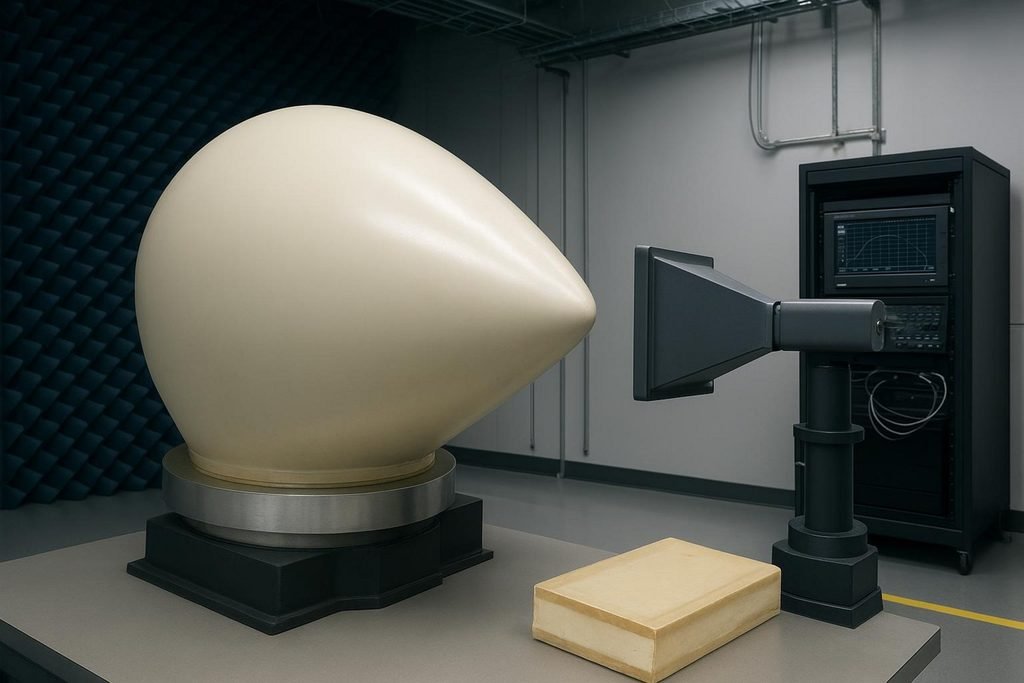
Radomes are protective housings for radar antennas on aircraft, naval vessels, and ground communication stations. They must meet several difficult requirements. A radome must act as a strong shell that can resist drag, bird impacts, and severe weather, while allowing radio-frequency (RF) energy to pass through with little interference.
Low-dielectric grades such as ROHACELL HF provide a useful balance of mechanical strength and electrical performance. Their dielectric constant (εr) and loss tangent (tan δ) are close to those of air across wide microwave and millimeter-wave ranges. This lets radar and 5G signals pass with very little attenuation, phase change, or reflection while the foam supports the outer weather skins.
What Are the Cost and Sustainability Benefits of PMI ROHACELL?
PMI structural foam usually costs more per kilogram than basic polyurethane, PET, or standard aluminum honeycomb. Judging a composite material only by its purchase price, however, gives an incomplete picture. Raw material cost is just one part of the total cost of owning and using a composite part.
When production cost, part consolidation, shorter cycle times, and energy use during service are included, PMI can deliver a lower total qualified-part cost than less expensive alternatives.
Balances material price against manufacturing efficiency
The cost of producing a sandwich composite is strongly affected by hands-on labor, process steps, cure time, and scrap. A conventional honeycomb part may require core cutting and splicing, edge filling, film adhesive application, local potting around fasteners, and several separate debulking and autoclave curing cycles.
ROHACELL removes most of these early steps. It can be machined into detailed three-dimensional profiles with built-in edge closeouts, reducing the need for syntactic potting compounds. One-shot co-curing and fast resin infusion also remove secondary cure cycles and adhesive film layers often used with honeycomb. These changes can cut total production time by 30% to 45%, which can make up for the higher purchase price of the core. That trade-off is worth discussing with a composite materials supplier such as Chem-Craft before choosing a core for a new part.
Reduces part weight, fuel use, and operating energy
Operating efficiency is closely tied to structural mass. In commercial aircraft, removing one kilogram of airframe weight can save thousands of liters of jet fuel over the aircraft’s service life. In electric commercial vehicles and eVTOL platforms, lighter sandwich construction can increase range, reduce battery size, and lower electricity use during operation.
Closed-cell PMI also cannot collect large amounts of moisture inside the core, so the structure does not gain hidden weight over time. Honeycomb parts used in humid, high-altitude flight conditions can take in condensation that collects inside the structure. Across an aircraft, this can add hundreds of kilograms of unwanted water weight. Limiting water uptake keeps energy use closer to the original design target.
Lowers maintenance costs through durable structures
Maintenance, Repair, and Overhaul (MRO) costs create a major burden for fleet operators. Honeycomb parts can suffer from water-freezing damage: moisture trapped in open cells freezes at high altitude below 0°C, expands, and separates the skin from the core. On hot runways above 80°C, the same water can become pressurized steam and speed up delamination.
PMI foam has closed cells that do not allow moisture to travel through the core. Even if an outer skin is punctured, moisture uptake remains limited to the cells near the cut. This helps prevent widespread core damage. Damaged PMI panels can often receive local scarf repairs with standard composite patches without first removing large amounts of trapped moisture, reducing aircraft downtime and MRO costs.
What Should Engineers Check Before Specifying ROHACELL?
PMI foam offers strong mechanical performance, but production use still calls for careful design work and controlled material handling. A structural foam core cannot be chosen from a standard list without analysis. Engineers must match the foam to the loads, processing conditions, and regulatory rules for the part.
Ignoring cure settings, moisture conditioning, or local core support can create production defects or lead to parts that fail approval requirements. Design teams use a qualification checklist before moving into production.
Match foam density and thickness to load requirements
ROHACELL is available in many structural densities, generally from 30 kg/m³ to more than 200 kg/m³. Higher density raises compressive strength, shear modulus, and impact energy absorption, but it also adds weight. Engineers must study local stress levels rather than use a heavy core across the entire part.
Modern methods such as joining cores with different densities or machining areas to different thicknesses let engineers match the core to local loads. Highly loaded attachment areas and hinges can use dense PMI inserts, while less loaded regions can use very light sheets. Finite element analysis (FEA) helps confirm that the selected density stays within core shear and skin-wrinkling limits without adding unnecessary mass.
Confirm temperature, fire, smoke, and regulatory requirements
Fire, smoke, and toxicity (FST) rules apply to many passenger aircraft interiors, rail cars, and marine structures. Standard PMI grades perform well in normal service conditions, but direct exposure to intense fire can cause thermal breakdown if the core does not have suitable protection.
For regulated interiors, engineers may select fire-retardant grades such as ROHACELL S, which meet self-extinguishing and vertical-burn requirements such as FAR 25.853. The full sandwich panel must be tested, including the outer plies, resin, coatings, and foam core. Fire performance depends on how all these materials react together under heat.
Check compatibility with the resin, skin, and manufacturing process
Process compatibility depends on the part’s temperature history, pressure levels, and moisture-control procedures. Standard PMI foam naturally takes in humidity from the air during storage. If a damp sheet is placed in a 180°C cure cycle without drying, the trapped moisture can turn into steam, lift the curing skin from the core, and damage the bond line.
Engineers must set clear shop procedures. Standard sheets should be baked and dried again at about 130°C before processing. Heat-treated grades such as HERO should be stored in sealed vapor-barrier bags. The selected process settings, whether for an autoclave, RTM press, or out-of-autoclave vacuum debulking, must also stay within the creep-resistance limits of the chosen PMI grade. This helps the part keep its intended dimensions during cure.
Emerging Frontiers and Life-Cycle Engineering for PMI Cores
As composite production moves toward 2030 and beyond, engineers face new demands for closed-loop recycling, digital production records, and very high production rates. PMI foams are developing along with these needs and continue to have a strong place in advanced material production.
Automated factories are pairing PMI preforms with machine-vision tracking, RFID production pallets, and sensors that monitor resin in real time during liquid molding. Milled PMI blanks can hold millimeter-level tolerances, allowing them to work well with robotic alignment systems. Research into chemical solvolysis and recycling is also exploring ways to recover unreacted monomers from production scrap. These methods may support more circular supply chains for high-performance foam.
Choosing PMI ROHACELL is a decision about the full design and production system. By looking beyond the purchase price and comparing life-cycle cost, manufacturing effort, structural reliability, and long-term durability, engineers can build very light, reliable composite systems that meet the demands of future service.
