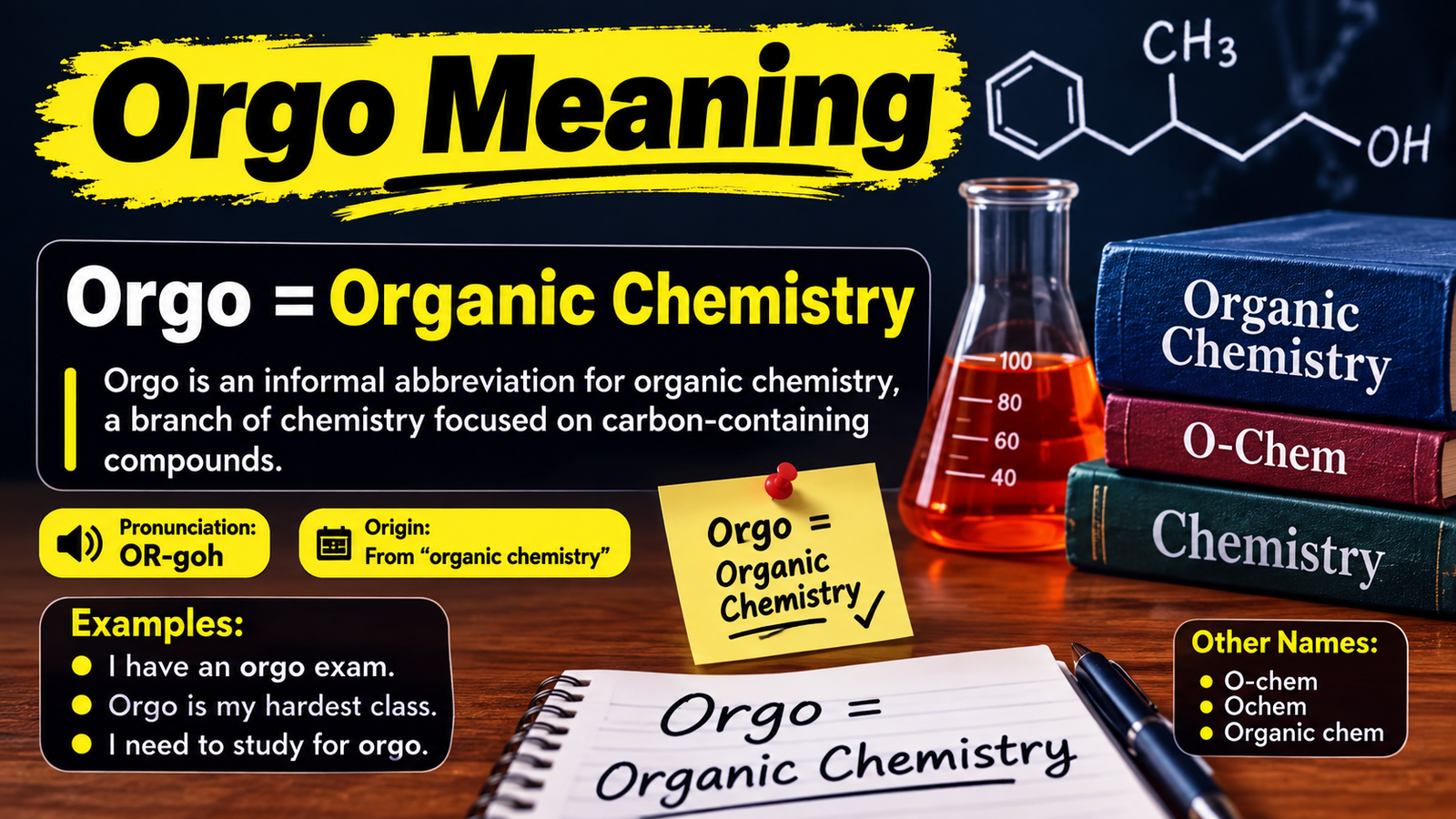
If you have seen the word “orgo” in a college conversation, text message, study group, or social media post, you may have wondered what it means. The good news is that the most common English meaning is quite simple: “orgo” is an informal abbreviation for organic chemistry.
Students often use “orgo” instead of saying the full phrase “organic chemistry,” especially when talking about classes, exams, laboratories, assignments, or studying. Wiktionary also records orgo as university slang for organic chemistry and lists O-chem as a synonym in that context.
Students often use “orgo” instead of saying the full phrase “organic chemistry,” especially when talking about classes, exams, laboratories, assignments, or studying. Wiktionary also records orgo as university slang for organic chemistry and lists O-chem as a synonym in that context.
For example, if a student says, “I have an orgo exam tomorrow,” they mean, “I have an organic chemistry exam tomorrow.”
However, “orgo” can have other meanings depending on the language and context. In English, its best-known use is the student abbreviation. This guide explains the orgo meaning, pronunciation, origin, examples, synonyms, antonyms, common usage, and frequently asked questions in simple English.
What Does Orgo Mean?
Orgo means organic chemistry when it is used as English university slang.
Organic chemistry is the branch of chemistry concerned with carbon-containing compounds, including their structures, properties, reactions, and synthesis.
Instead of repeatedly saying “organic chemistry,” students shorten the expression to “orgo.” It is informal rather than a formal scientific term.
Simple Definition of Orgo
Orgo = organic chemistry
For example:
- “I have orgo at 10 a.m.”
- “My orgo professor gave us a difficult assignment.”
- “I need to study for orgo tonight.”
- “Orgo is my hardest class this semester.”
In all of these examples, orgo refers to organic chemistry or an organic chemistry course.
The term is especially associated with university and college students, including students studying pre-medical subjects, biology, chemistry, and other STEM fields.
Orgo Pronunciation
Orgo is generally pronounced with two syllables.
The stress normally falls on the first syllable.
Because “orgo” is informal student vocabulary, you are much more likely to hear it in conversation than in formal academic writing.
What Is the Origin of Orgo?
The English slang orgo comes from shortening the word organic, particularly in the phrase organic chemistry.
Wiktionary gives its English etymology as “org(anic) + -o.” It records the word both as an informal adjective meaning “organic” and as university slang meaning organic chemistry.
This type of shortening is common in everyday English. People frequently turn long words or phrases into shorter forms that are easier to say.
For example:
- biology → bio
- chemistry → chem
- mathematics → math
- economics → econ
- psychology → psych
- calculus → calc
- organic chemistry → orgo
The exact history of everyday student usage is difficult to pin to one person or one moment. Rather than being a newly invented internet word, orgo developed as informal academic vocabulary used by students and university communities.
Why Do Students Say Orgo?
The main reason is convenience.
“Organic chemistry” is a relatively long phrase to repeat during conversations about a course that students may discuss several times a day. “Orgo” is shorter, easier, and immediately recognizable to many students.
There is also a social element to academic shorthand. Students studying the same subject develop their own vocabulary, abbreviations, jokes, and expressions.
For someone outside the class, a sentence such as “I have orgo after lunch” may sound confusing. For a chemistry student, the meaning is obvious.
This makes “orgo” a good example of how language naturally changes inside communities.
Orgo Meaning in Texting
In text messages, orgo usually means organic chemistry.
Students may use it when discussing homework, exams, lectures, laboratories, grades, or study plans.
Here are some realistic examples:
Example 1:
“Are you free tonight?”
“Not really. I have to study for orgo.”
Meaning: The person needs to study organic chemistry.
Example 2:
“How was your exam?”
“Honestly, orgo was brutal.”
Meaning: The organic chemistry exam was difficult.
Example 3:
“What class do you have next?”
“Orgo lab.”
Meaning: The person has an organic chemistry laboratory class.
Example 4:
“I finally passed orgo!”
Meaning: The student successfully passed organic chemistry.
Orgo Meaning on Social Media
On social media, orgo is often used by students discussing college life.
You might see posts such as:
- “Surviving orgo one chapter at a time.”
- “Three hours of orgo today.”
- “Orgo exam tomorrow. Wish me luck.”
- “Finally finished my orgo lab.”
- “Who else is struggling with orgo?”
In these situations, the word is usually not a mysterious internet abbreviation. It simply refers to organic chemistry.
Students may also use humor around the subject because organic chemistry has a reputation for being challenging. As a result, “orgo” can appear in memes, jokes, study posts, and conversations about academic stress.
Is Orgo a Slang Word?
Yes. In English, orgo is informal academic slang.
It is not normally the preferred term for formal scientific writing. A university course catalog, research paper, academic publication, or professional report would generally use “organic chemistry” rather than “orgo.”
However, informal does not mean incorrect.
If a student tells a friend, “I have orgo tomorrow,” the expression is perfectly understandable in the right context.
The distinction is mainly about register:
| Context | Preferred Term |
|---|---|
| Formal scientific writing | Organic chemistry |
| University course title | Organic Chemistry |
| Student conversation | Orgo |
| Text messages | Orgo |
| Study group | Orgo |
| Academic research paper | Organic chemistry |
| Casual social media post | Orgo |
Orgo vs. O-Chem
Another common abbreviation for organic chemistry is O-chem or ochem.
Both orgo and O-chem can refer to the same subject, but they are informal abbreviations rather than formal scientific names.
For example:
- “I have an orgo test Friday.”
- “I have an O-chem test Friday.”
Both sentences can mean that the student has an organic chemistry test.
Wiktionary specifically lists O-chem as a synonym for the university-slang noun orgo.
Which abbreviation people prefer can vary by school, region, and personal habit.
Orgo as an Adjective
There is another English use of orgo that is less common.
Wiktionary records orgo as an informal adjective meaning organic.
This use is much less common than the organic-chemistry meaning.
For example, someone might informally use “orgo” as a shortened form of “organic” when describing food or another organic product. However, this is not the meaning most people will assume when they hear the word in a college setting.
Context is therefore important.
If a student says:
“I have orgo tomorrow.”
They almost certainly mean organic chemistry.
If someone says:
“We bought orgo vegetables.”
The speaker may be using “orgo” as an informal shortening of organic.
Does Orgo Have a Different Meaning in Other Languages?
Yes. This is an important distinction.
The spelling orgo can appear in languages other than English with completely different meanings.
For example, Wiktionary records orgo as a Galician noun connected historically with the word for organ, particularly in musical contexts. Its etymology traces back through Old Galician-Portuguese to Latin organum.
That meaning should not be confused with the English university slang.
So, when someone searches for “orgo meaning,” the correct interpretation depends on the language and context.
For everyday English searches, particularly those involving college or texting, organic chemistry is the most useful definition.
Orgo Examples in Everyday Conversation
Here are more examples showing how the word naturally appears.
Talking About a Class
“I have orgo twice a week.”
This means the person has organic chemistry classes twice a week.
Talking About Homework
“Did you finish the orgo homework?”
This means organic chemistry homework.
Talking About an Exam
“I’m nervous about my orgo final.”
This means the speaker is nervous about their organic chemistry final exam.
Talking About a Professor
“Our orgo professor moves really fast.”
This means the professor teaching organic chemistry moves quickly through the material.
Talking About a Laboratory
“I have orgo lab this afternoon.”
This means the student has an organic chemistry laboratory session.
Talking About Studying
“I spent all weekend studying orgo.”
This means the person spent the weekend studying organic chemistry.
Synonyms for Orgo
Because orgo is an abbreviation rather than a standard word with a large synonym family, its closest alternatives are other ways of referring to organic chemistry.
Common alternatives include:
- Organic chemistry
- O-chem
- Ochem
- Organic chem
- Organic chemistry class
- Organic chemistry course
The most formal and universally clear option is organic chemistry.
O-chem and orgo are more casual.
Antonyms of Orgo
There is no direct antonym for “orgo” when it means organic chemistry.
An antonym is a word with an opposite meaning, but a course abbreviation does not naturally have an opposite.
If orgo is being used as an informal adjective meaning organic, then inorganic can be considered an opposite concept.
For example:
- Organic ↔ inorganic
However, this does not mean that “inorganic” is the antonym of “orgo” in every situation.
If someone says, “I have orgo tomorrow,” there is no opposite word that can replace “orgo.”
Common Mistakes About Orgo
One common mistake is assuming that orgo is a formal chemistry term.
It is not. The formal name of the subject is organic chemistry.
Another mistake is assuming that every appearance of “orgo” has exactly the same meaning. Context matters because the word can also appear as an informal shortening of “organic” and has unrelated meanings in other languages.
A third mistake is confusing orgo with a completely different company, product, username, or abbreviation. Search results can contain unrelated uses of the same spelling.
When the context is a college science conversation, however, organic chemistry is by far the most relevant interpretation.
Why Is Organic Chemistry Called Orgo?
The simple answer is shortening.
Students naturally shorten frequently used terms. Organic chemistry is commonly discussed in science programs, so a short nickname makes conversation faster.
The same pattern can be seen in words such as:
- bio for biology
- chem for chemistry
- calc for calculus
- stats for statistics
- psych for psychology
“Orgo” follows the same basic idea.
It is short, memorable, and convenient for students who use the term repeatedly.
Is Orgo Formal or Informal?
Orgo is informal.
Use organic chemistry when you need formal, professional, or academic language.
Use orgo when speaking casually with students, friends, classmates, or people who understand the abbreviation.
For example:
Formal:
“I am currently enrolled in an organic chemistry course.”
Informal:
“I’m taking orgo this semester.”
Both communicate the same basic idea, but the second sounds much more conversational.
Frequently Asked Questions About Orgo
What does orgo mean?
Orgo usually means organic chemistry. It is informal university slang commonly used by students when talking about the subject or course.
Is orgo short for organic chemistry?
Yes. In English academic slang, orgo is a shortened form associated with organic chemistry. The term developed as a convenient way to refer to the subject without saying the full phrase every time.
Is orgo the same as O-chem?
Generally, yes. Orgo and O-chem are informal terms for organic chemistry. Wiktionary lists O-chem as a synonym for the university-slang use of orgo.
What does orgo mean in texting?
In texting, orgo usually means organic chemistry, especially when the conversation involves college classes, exams, homework, labs, or studying.
For example, “I have orgo tomorrow” means “I have organic chemistry tomorrow.”
Is orgo a real word?
Yes, orgo is an attested English informal term, but it is not the formal name of the scientific subject. It is commonly treated as university slang for organic chemistry.
What is the synonym of orgo?
The closest synonyms are organic chemistry, O-chem, Ochem, and organic chem. The exact choice depends on how formal the conversation is.
What is the opposite of orgo?
There is no direct antonym when orgo means organic chemistry. If orgo is being used informally to mean “organic,” then inorganic represents the opposite concept.
Can orgo mean organic?
Yes. Wiktionary records an informal adjective use of orgo meaning organic, although the university-slang meaning referring to organic chemistry is more recognizable in English.
Is orgo used only by college students?
College and university students are the most obvious users, particularly those studying science-related subjects. However, teachers, graduates, and others familiar with academic slang may also use the word.
Final Thoughts on Orgo Meaning
The meaning of “orgo” is usually straightforward once you know the context.
In English, especially in college conversations, orgo means organic chemistry. It is an informal abbreviation that makes it easier for students to talk about a frequently studied subject.
The word can appear in conversations about classes, exams, homework, laboratories, professors, study sessions, and academic life. It is similar in style to shortcuts such as “bio,” “chem,” and “calc.”
The most important point is that orgo is informal. If you are writing a research paper, professional document, or formal academic text, organic chemistry is the better choice. In a text message or conversation with classmates, however, “orgo” is short, natural, and easy to understand.
There are also less common uses of the spelling in English and other languages, so context always matters. But if you encounter “orgo” in a college or science-related conversation, the intended meaning is almost certainly organic chemistry.
In short: Orgo = Organic Chemistry.