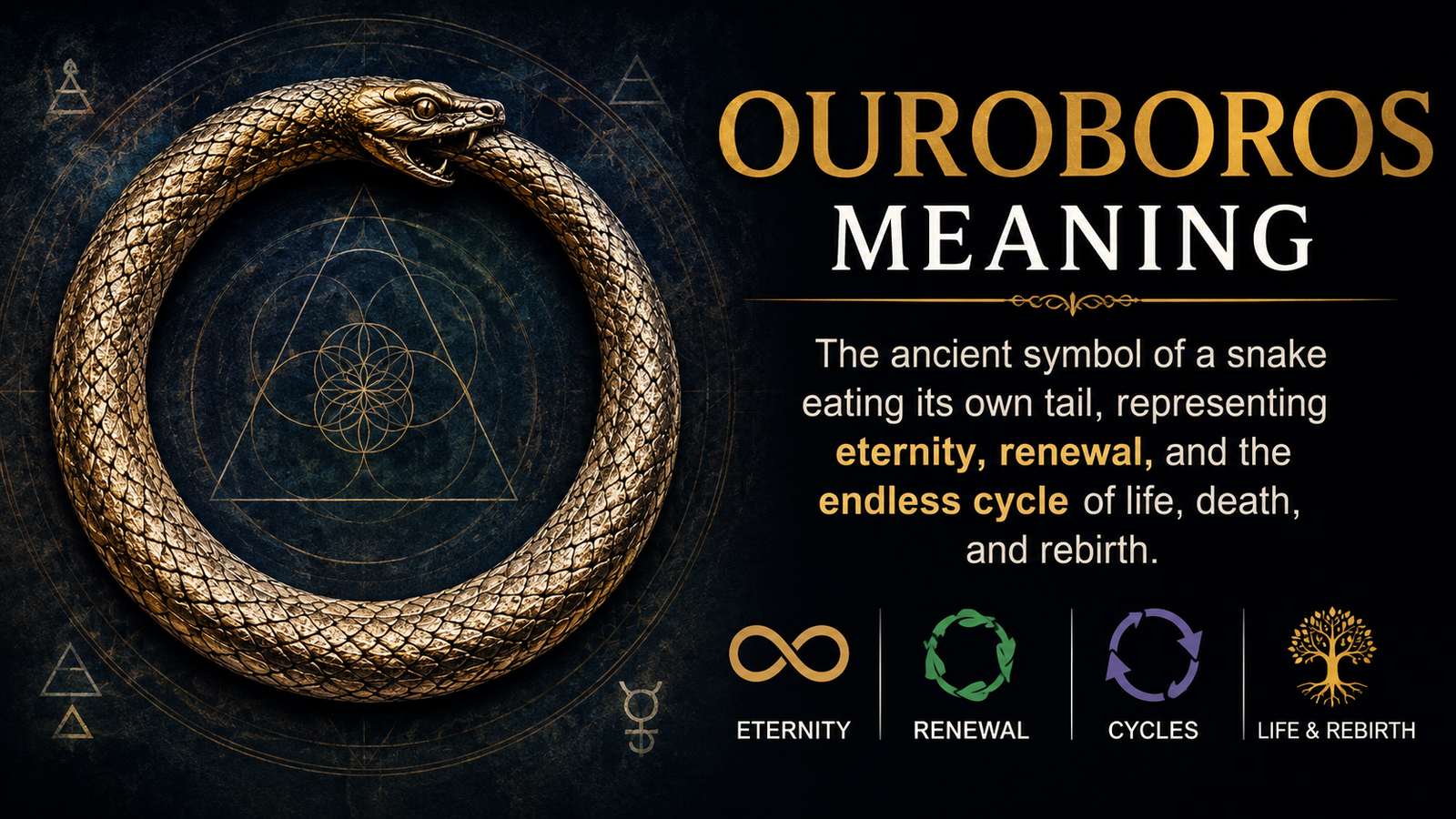
The ouroboros meaning is closely connected with the ideas of eternity, renewal, transformation, and the endless cycle of life. The symbol is usually shown as a snake or dragon eating its own tail and forming a complete circle. Because the beginning and ending meet, the image has been interpreted for centuries as a symbol of cycles, rebirth, unity, and infinity.
Today, people encounter the ouroboros in mythology, history, philosophy, psychology, literature, jewelry, tattoos, art, and popular culture. It can represent something as simple as a repeating cycle or as deep as the idea that destruction and creation are part of the same process.
This guide explains ouroboros meaning in simple English, including its pronunciation, origin, symbolism, history, examples, synonyms, antonyms, common usage, and frequently asked questions.
What Does Ouroboros Mean?
Ouroboros refers to an ancient symbol showing a snake or dragon eating its own tail. The creature forms a circle because its head meets its tail.
In simple English, the ouroboros can mean:
- Eternity
- An endless cycle
- Life, death, and rebirth
- Renewal and transformation
- Unity
- The connection between beginnings and endings
- Something that continually recreates itself
The image is powerful because the snake is both the beginning and the end of the circle. It consumes itself, yet the cycle never truly stops.
Cambridge Dictionary describes the ouroboros as an ancient circular symbol associated particularly with the continuous cycle of life, death, and rebirth.
Ouroboros Meaning in One Sentence
Ouroboros means an endless cycle in which the end becomes the beginning again.
For example, someone might use the symbol to represent personal transformation after a difficult period: an old version of life ends, and something new begins.
How Do You Pronounce Ouroboros?
The word ouroboros has more than one accepted pronunciation in English.
A common American pronunciation is approximately “or-uh-BOR-us.” Cambridge gives a US pronunciation beginning with the sounds represented by /ˌɔːr.əˈbɔːr.əs/, while British English uses a somewhat different vowel pattern.
The pronunciation can vary slightly between dictionaries and English-speaking regions, so hearing different versions does not necessarily mean one speaker is wrong.
The plural can be written as ouroboroi or ouroboroses.
What Is the Origin of the Word Ouroboros?
The word ouroboros comes from Ancient Greek. It is connected to oura, meaning “tail,” and -boros, meaning something like “devouring” or “eating.” In other words, the basic idea behind the name is “tail-devouring.”
The name is Greek, but the symbol itself is older than the Greek term.
One of the earliest securely known representations appears in an ancient Egyptian funerary context associated with the tomb of Tutankhamun, dating to the 14th century BCE. The ouroboros-like serpents appear in imagery connected with the underworld, divine renewal, and the cyclical nature of existence.
This distinction is important: the Greek word and the ancient symbol do not have exactly the same origin.
The History of the Ouroboros Symbol
The ouroboros has moved through several intellectual and religious traditions over thousands of years.
Ancient Egypt
Ancient Egyptian religious imagery provides some of the earliest known examples of the serpent forming a circle around a divine figure.
In the funerary material associated with Tutankhamun, the serpent imagery is connected with the relationship between the sun, the underworld, and renewal. The circular serpent could therefore express the idea that existence follows recurring patterns rather than moving in a simple straight line.
Egyptian culture placed enormous importance on cycles. The daily movement of the sun, seasonal changes, death, and hoped-for rebirth all contributed to ways of thinking about renewal.
Greek and Hellenistic Traditions
The Greek world later adopted and developed related serpent imagery. The Greek term ourobóros essentially described a serpent that devours its tail.
Over time, the image became connected with philosophical and mystical ideas about the universe, unity, and cyclical existence.
Gnosticism and Hermeticism
The symbol became particularly important in later mystical traditions, including Gnosticism and Hermeticism.
In these contexts, the ouroboros could represent the unity of existence and the idea that apparently separate opposites—such as beginning and ending—might actually belong to one larger whole.
Alchemy
Alchemy gave the ouroboros another important layer of meaning.
Alchemists used the symbol to express transformation, unity, and the cyclical nature of matter. One famous alchemical representation is associated with The Chrysopoeia of Cleopatra, an early alchemical text traditionally linked with the phrase “the all is one.”
For alchemists, the ouroboros was therefore more than a strange picture of a snake. It could represent the idea that matter changes form while remaining part of a greater whole.
Ouroboros Symbolism Explained
The ouroboros has many interpretations, and its meaning depends on the culture and context in which it appears.
1. Eternity
Because the snake forms a closed circle, the ouroboros is often associated with eternity.
There is no obvious starting point or ending point. If you choose any place on the circle as the beginning, you can continue around it indefinitely.
This makes the symbol a natural visual representation of endless time.
2. Life, Death, and Rebirth
One of the most common interpretations is the cycle of life, death, and rebirth.
The snake consumes itself, suggesting an ending, but the circular shape immediately brings the viewer back to the beginning.
In this sense, the ouroboros can symbolize the belief that an ending is not always final. Sometimes an ending creates the conditions for a new beginning.
3. Transformation
The ouroboros can also represent personal transformation.
Someone going through a major change might use the symbol to express the idea of leaving one stage of life behind and entering another.
The symbol does not necessarily mean that everything stays exactly the same. Instead, it can suggest that change itself is a natural and repeating part of existence.
4. Unity
The head and tail of the snake meet, turning separate points into one complete shape.
For this reason, the ouroboros can symbolize wholeness and unity.
It can also represent the relationship between opposites, such as creation and destruction or beginning and ending.
5. Infinity and Cycles
Although the ouroboros is not literally the mathematical infinity symbol, its circular structure can communicate a similar idea: something continuing without a clear endpoint.
It is especially useful as a metaphor for recurring events, repeating patterns, and cycles.
Ouroboros Meaning in Different Contexts
The meaning can change depending on where you see the symbol.
Ouroboros Meaning in Spirituality
In spiritual contexts, the ouroboros may represent renewal, eternity, spiritual transformation, and the unity of existence.
Some people interpret it as a reminder that life moves through cycles rather than remaining permanently fixed.
Ouroboros Meaning in Psychology
The symbol also became important in modern psychological discussions.
Carl Jung wrote about the ouroboros as an archetypal image connected with early psychic development and transformation. In Jungian thought, the symbol can be understood as an image of a state in which opposites have not yet become clearly separated.
This interpretation helped bring the ancient symbol into modern conversations about the unconscious mind and personal development.
Ouroboros Meaning in Alchemy
In alchemy, the ouroboros is strongly associated with transformation and unity.
The circular serpent can represent a process in which material or spiritual states change and return to another stage.
This is one reason the ouroboros remains strongly associated with alchemical artwork.
Ouroboros Meaning in Tattoos
An ouroboros tattoo often represents rebirth, personal growth, resilience, eternity, or a major life cycle.
For one person, it may mean overcoming a difficult chapter. For another, it may represent the belief that life continually changes and renews itself.
There is no single universal tattoo meaning. The personal story behind the tattoo is often more important than a dictionary definition.
Ouroboros Meaning in Literature and Art
Writers and artists use the ouroboros as a metaphor for repetition, circular storytelling, self-reference, and endless cycles.
A story that ends where it began, for example, may be described metaphorically as having an ouroboros-like structure.
Examples of Ouroboros in a Sentence
Here are some simple examples of how the word can be used.
- The ancient temple contained an image of an ouroboros, symbolizing eternity.
- She chose an ouroboros tattoo to represent personal transformation.
- The artist used the ouroboros to symbolize the endless cycle of life and death.
- The novel has an ouroboros-like structure because its ending returns to its beginning.
- The philosopher compared the repeating process to an ouroboros.
- The necklace featured a golden ouroboros wrapped into a perfect circle.
- In alchemical art, the ouroboros often represents unity and transformation.
Ouroboros as a Metaphor
You do not always have to use ouroboros to describe a literal snake.
The word can work as a metaphor for something that feeds back into itself.
For example:
The argument became an ouroboros: every claim depended on the conclusion it was supposed to prove.
Here, the word describes a circular process rather than an actual animal.
This metaphorical use is especially useful when discussing circular reasoning, repeating systems, self-reference, or endless cycles.
Ouroboros Synonyms
There is no perfect synonym for ouroboros because it is the specific name of a particular symbol. However, depending on the context, related words and expressions include:
- Self-eating serpent
- Tail-eating serpent
- Eternal cycle
- Endless cycle
- Circle of life
- Cycle of rebirth
- Symbol of eternity
- Circular symbol
- Serpent symbol
- Symbol of renewal
These are related expressions rather than exact dictionary synonyms.
For example, “eternal cycle” describes the concept behind the ouroboros, while “self-eating serpent” describes the visual object itself.
Ouroboros Antonyms
There is no single direct antonym for ouroboros because it is a proper symbolic term rather than an ordinary adjective.
However, when ouroboros is used to represent an endless cycle, contrasting concepts might include:
- Finality
- Ending
- Permanence
- One-way progression
- Linear time
- Irreversible change
- Beginning without return
These are conceptual opposites rather than strict linguistic antonyms.
For example, a linear process moves from point A to point B without returning to its starting point. An ouroboros, by contrast, represents a cycle in which the ending connects back to the beginning.
Is the Ouroboros a Good or Bad Symbol?
The ouroboros is not inherently good or evil.
Its meaning depends on the tradition and the person using it.
For many people, it represents positive ideas such as rebirth, growth, eternity, balance, and transformation. In other contexts, its self-consuming image can suggest destruction, obsession, repetition, or a cycle that is difficult to escape.
The symbol is therefore more complicated than simply calling it “good” or “bad.”
Its central idea is cyclicality.
Ouroboros vs. Infinity Symbol
The ouroboros and infinity symbol are sometimes compared because both can represent endlessness.
However, they are not the same.
The infinity symbol is an abstract mathematical and philosophical sign representing something without a finite limit.
The ouroboros is an ancient figurative image of a snake or dragon eating its own tail. Its symbolism includes infinity, but also death and rebirth, transformation, unity, and cyclical renewal.
In simple terms:
Infinity = endlessness.
Ouroboros = endlessness expressed through a cycle of self-consumption and renewal.
Ouroboros vs. Phoenix
The phoenix is another famous symbol of rebirth, but its imagery is different.
The phoenix is traditionally associated with a bird that dies or burns and then rises again.
The ouroboros represents renewal through a continuous circular cycle.
Both symbols can represent transformation, but the phoenix emphasizes rebirth after destruction, while the ouroboros emphasizes the continuing relationship between ending and beginning.
Why Is the Ouroboros Still Popular Today?
The ouroboros remains popular because its central message is surprisingly relevant to modern life.
People experience cycles constantly: careers change, relationships evolve, habits repeat, and difficult periods eventually give way to new stages.
The symbol offers a simple visual reminder that change does not always mean complete destruction. Sometimes one phase becomes the foundation for another.
It also works well visually. A snake forming a perfect circle is distinctive, mysterious, and easy to adapt for jewelry, tattoos, illustrations, logos, fantasy art, and fictional worlds.
The symbol has also appeared in modern discussions of science and self-reference. One famous historical story involves chemist August Kekulé, who later described a vision of a snake biting its own tail in connection with his thinking about the ring structure of benzene.
Common Misunderstandings About Ouroboros
The ouroboros is not simply an Egyptian symbol
Ancient Egyptian imagery contains some of the earliest known examples, but the symbol later became important in Greek, Gnostic, Hermetic, alchemical, and other traditions.
The ouroboros is not always a snake
It can be depicted as a dragon, serpent, or worm-like creature, depending on the artistic tradition.
It does not have only one meaning
Eternity is one important interpretation, but the symbol can also represent renewal, transformation, unity, cyclicality, creation and destruction, and the relationship between beginnings and endings.
It is not automatically a religious symbol
Although it has appeared in religious and mystical traditions, modern people may use it simply as an artistic or personal symbol.
Frequently Asked Questions About Ouroboros Meaning
What does ouroboros mean in simple English?
Ouroboros means a snake or dragon eating its own tail, usually symbolizing an endless cycle, eternity, renewal, or life, death, and rebirth.
What does the ouroboros symbolize?
The ouroboros commonly symbolizes eternity, cyclic renewal, transformation, unity, and the cycle of life and death. Its exact meaning can vary depending on the culture and context.
Is ouroboros Greek or Egyptian?
The word ouroboros comes from Ancient Greek, but the symbol has much older known Egyptian representations. One of the earliest securely dated examples is associated with the funerary material of Tutankhamun’s tomb.
What does an ouroboros tattoo mean?
An ouroboros tattoo can symbolize rebirth, personal transformation, eternity, resilience, or the continuous cycle of life. The exact meaning depends on the person wearing it.
Is ouroboros a synonym for infinity?
Not exactly. Ouroboros is the name of a specific serpent-or-dragon symbol. It can represent infinity or eternity, but its symbolism also includes cycles, renewal, transformation, and life and death.
Is the ouroboros a symbol of death?
It can be connected with death, but death is only one part of its symbolism. The ouroboros is especially associated with the relationship between death and renewal, suggesting that an ending can lead into another beginning.
What is the opposite of ouroboros?
There is no exact antonym. Conceptually, ideas such as finality, linear progression, irreversible change, or a permanent ending can contrast with the ouroboros’s symbolism of endless cycles.
Why does the snake eat its own tail?
The self-consuming image creates a continuous circle. Symbolically, this allows the ouroboros to represent a process in which the end connects back to the beginning.
Is the ouroboros a symbol of good luck?
Not universally. Some modern people may treat it as a positive symbol of renewal and protection, but historically and culturally its meanings are broader than good luck.
What is the main idea behind the ouroboros?
The central idea is that beginnings and endings can be part of the same continuous cycle. The symbol reminds us that change, destruction, creation, and renewal may be connected rather than completely separate.
Final Thoughts on Ouroboros Meaning
The ouroboros meaning goes far beyond a snake eating its own tail. At its heart, the symbol represents the powerful idea of cycles.
Something ends, something begins. Creation can follow destruction. A person can change without completely losing who they were. A difficult chapter can become the starting point for another stage of life.
That is why the ouroboros has remained meaningful for thousands of years. Its circular shape gives a simple visual form to a complicated human idea: the end is sometimes another beginning.
From ancient Egyptian imagery to Greek terminology, alchemy, psychology, art, literature, tattoos, and modern symbolism, the ouroboros continues to represent eternity, renewal, unity, transformation, and the never-ending cycle of existence.
If you remember only one definition, remember this:
Ouroboros is a symbol of a snake or dragon eating its own tail, representing an endless cycle of life, death, rebirth, and renewal.