Have you ever heard a soft whisper, gentle tapping, paper crinkling, or slow brushing and suddenly felt a pleasant tingling sensation around your scalp or neck? If so, you may have experienced ASMR.
The term ASMR has become a familiar part of internet culture, especially through YouTube, TikTok, podcasts, and short-form videos. But what does ASMR actually mean, and why do certain sounds make some people feel calm while others feel nothing at all?
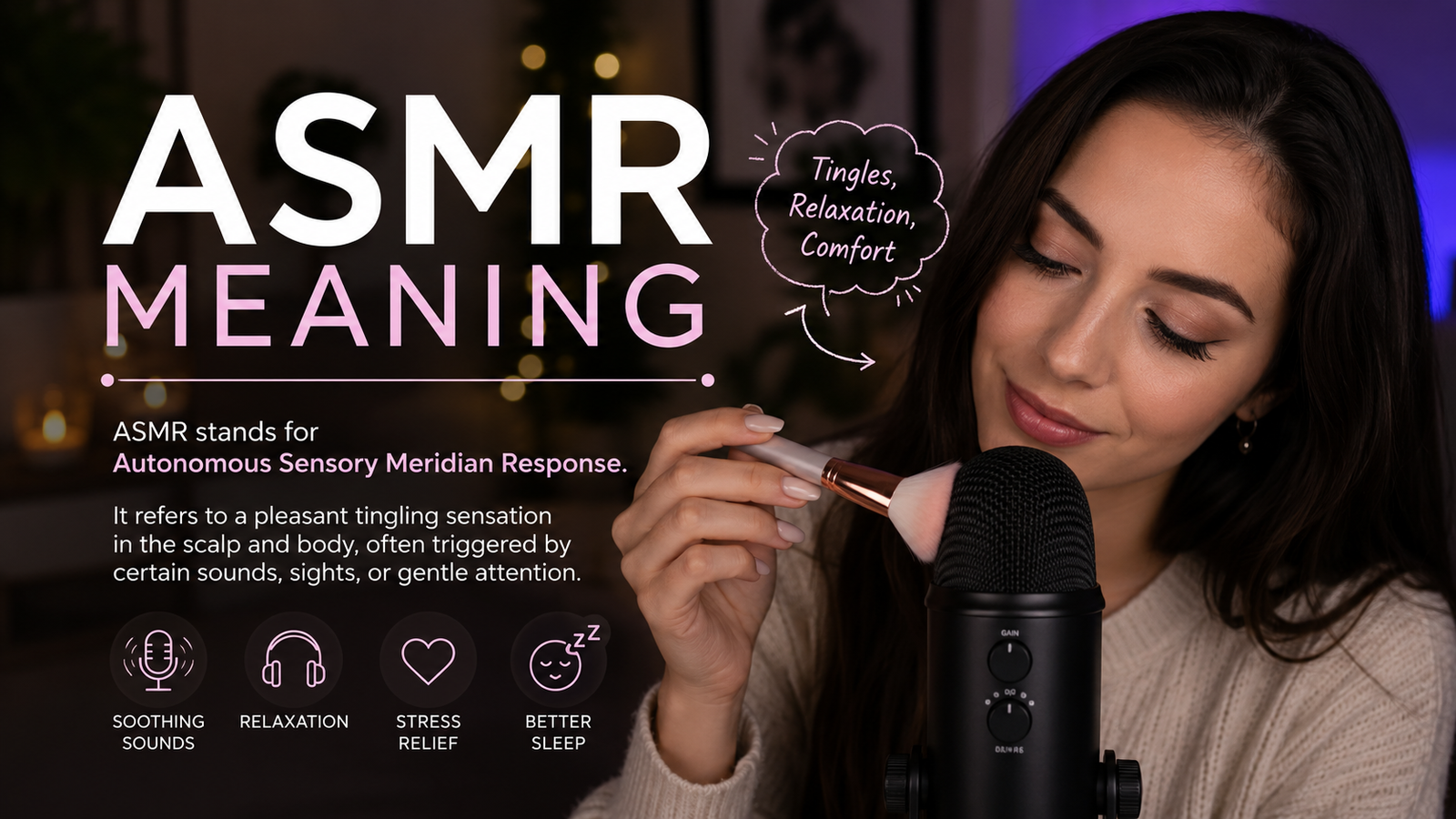
In simple English, ASMR means “Autonomous Sensory Meridian Response.” It describes a pleasant, tingling sensation that some people experience in response to particular sounds, sights, movements, or forms of personal attention. The sensation often begins around the scalp and can move down the neck and upper spine.
This guide explains the ASMR meaning, pronunciation, origin, common triggers, examples, related words, everyday usage, and frequently asked questions.
What Does ASMR Mean?
ASMR stands for Autonomous Sensory Meridian Response.
The phrase may sound complicated, but the basic idea is quite simple. ASMR is a sensory response that happens automatically when a person encounters a particular trigger.
For some people, a whispering voice can create a gentle tingling feeling. For others, the sound of someone tapping their fingernails on a surface, turning pages, brushing hair, or slowly handling an object may produce the same effect.
According to Merriam-Webster, ASMR refers to a pleasant tingling sensation that can begin on the back of the scalp and spread toward the neck and upper spine. It can also refer to something that produces that sensation, such as an ASMR video or sound.
Not everyone experiences ASMR. A particular sound that feels extremely relaxing to one person may seem completely ordinary—or even annoying—to someone else.
ASMR Meaning in Simple English
In very simple words:
ASMR is a relaxing or tingling feeling that some people get from certain sounds, sights, or gentle experiences.
For example, imagine someone speaking quietly near a microphone while slowly turning the pages of a book. If that sound gives you pleasant tingles and makes you feel relaxed, you may be experiencing ASMR.
ASMR Pronunciation
ASMR is usually pronounced by saying each letter separately:
You can pronounce it as:
A-S-M-R
The pronunciation is similar to saying the four letters of the abbreviation individually rather than treating ASMR as a normal word.
Cambridge Dictionary gives the English pronunciation as approximately “ay-es-em-ar.”
What Does ASMR Stand For?
Each word in the full phrase has a particular meaning.
Autonomous
Autonomous means something that happens independently or without conscious control.
In ASMR, the response is generally described as involuntary. You do not have to consciously decide to experience the tingling.
Sensory
Sensory relates to the senses, such as hearing, sight, touch, and other physical sensations.
ASMR commonly involves sounds and visual movements, although the experience itself is felt physically and emotionally.
Meridian
Meridian is the most unusual word in the expression. In this context, it was chosen to suggest a peak or high point of a pleasant sensation.
It does not mean that ASMR is connected to a medical “meridian” in the ordinary sense.
Response
Response simply means a reaction to something.
So, taken together, Autonomous Sensory Meridian Response describes an involuntary sensory reaction that can produce a pleasant, calming sensation.
What Does ASMR Feel Like?
People who experience ASMR describe it in different ways.
The most common description is a soft tingling sensation that begins around the scalp and sometimes travels down the back of the neck and spine. Some people describe it as goosebumps, a gentle electrical sensation, or a “brain tingling” feeling.
ASMR may also be accompanied by:
- Relaxation
- Calmness
- Sleepiness
- A sense of comfort
- Pleasant excitement
- Reduced feelings of stress
- A feeling of personal attention or connection
Cleveland Clinic explains that ASMR can combine relaxation with a mild sense of excitement, making it somewhat different from simply feeling sleepy.
The experience varies significantly from person to person.
Common ASMR Triggers
An ASMR trigger is something that may cause the ASMR response.
Some of the most popular triggers include:
1. Whispering
Soft whispering is probably one of the best-known ASMR triggers.
Creators may whisper stories, instructions, names, or ordinary conversations into sensitive microphones to produce a close and intimate sound.
2. Soft Speaking
Not everyone enjoys whispering. Some people prefer a quiet, gentle speaking voice.
A calm explanation of a topic can sometimes produce the same relaxing sensation.
3. Tapping
Tapping fingernails on glass, wood, plastic, books, or other objects is another common trigger.
The appeal often comes from the repetitive rhythm and distinct sound.
4. Paper Crinkling
The delicate sound of wrapping paper, tissue, magazines, or pages being handled can trigger ASMR for some listeners.
5. Hair Brushing
Watching or hearing someone slowly brush or comb hair is another frequently reported trigger.
The experience may be connected with the relaxing feeling associated with grooming and personal attention.
6. Personal Attention
Some ASMR videos simulate situations in which someone is carefully paying attention to you.
Examples include pretend haircuts, makeup appointments, spa treatments, eye examinations, or friendly conversations.
7. Repetitive Movements
Slow and predictable movements can also be triggers.
For example, a person might repeatedly fold towels, organize objects, clean a surface, or carefully demonstrate a task.
8. Crisp or Crunchy Sounds
Some people enjoy sounds such as crinkling foil, opening packaging, cutting objects, or handling certain foods.
However, these triggers are highly individual. A sound that creates tingles for one person may cause irritation for another.
Research and clinical reviews have identified whispering, personal attention, repetitive movements, grooming, tapping, and object exploration among commonly reported ASMR triggers.
Why Do People Watch ASMR Videos?
People watch ASMR content for different reasons.
For some, the primary goal is relaxation. They may play an ASMR video after a stressful day and use the quiet sounds as part of their bedtime routine.
Others enjoy ASMR because it helps them focus or creates a comforting background atmosphere.
Sleep is another common reason. Some viewers use quiet ASMR videos before going to bed because they find the experience calming.
However, ASMR should not be treated as a guaranteed treatment for insomnia, anxiety, depression, or another health condition. Research is still developing, and ASMR is not an established clinical treatment.
Is ASMR a Real Thing?
Yes, ASMR is a real reported sensory experience, but scientists are still studying exactly why it happens.
Researchers have documented physiological responses among people who experience ASMR, while the underlying mechanisms remain incompletely understood. Studies have explored changes involving brain activity, emotional responses, heart rate, and skin conductance.
At the same time, not everyone can experience ASMR.
That is important because ASMR is not simply a synonym for “relaxing sound.” A video can be labeled ASMR because it is designed to encourage the response, but an individual viewer may not actually experience tingles.
Is ASMR the Same as Goosebumps?
Not exactly.
ASMR and goosebumps can feel somewhat similar, but they are different experiences.
Goosebumps can occur because of cold temperatures, fear, excitement, music, or other emotional reactions. ASMR is generally described as a pleasant tingling sensation associated with particular sensory triggers.
Another related experience is frisson, often called musical chills. Frisson commonly occurs during emotionally powerful moments in music, while ASMR is more strongly associated with specific sensory triggers such as whispering or repetitive sounds.
Is ASMR the Same as Misophonia?
No.
ASMR is generally associated with pleasant or calming sensations.
Misophonia, by contrast, involves strong negative emotional reactions to particular sounds. Chewing, breathing, tapping, or other everyday noises can be extremely irritating to people with misophonia.
Although the two experiences involve reactions to sound, they are not the same phenomenon.
The Origin of the Term ASMR
The modern term ASMR has relatively recent roots.
The sensation itself was described by people before the name became popular, but the specific phrase “autonomous sensory meridian response” emerged through online communities.
Jennifer Allen is widely credited with coining the term in 2010. She chose a more neutral and clinical-sounding expression to describe the unusual sensation people were discussing online.
The term later spread through online communities and video platforms.
Merriam-Webster records the first known use of ASMR in its dictionary sense as 2011, reflecting the period when the term began entering wider public usage.
How ASMR Became Popular
The growth of video platforms played a major role in turning ASMR from a niche internet discussion into a global online phenomenon.
Creators began producing videos specifically designed around sensory triggers. These videos often use highly sensitive microphones to capture small sounds that ordinary microphones might miss.
Popular formats include:
- Whispering videos
- Tapping videos
- Haircut role-plays
- Spa role-plays
- Medical role-plays
- Cooking sounds
- Cleaning videos
- Drawing and painting sounds
- Object-handling videos
- Eating and chewing sounds
Today, the word ASMR is also commonly used as a description for content itself. Someone might say, “I watched an ASMR video,” even though the original meaning refers to the sensory response rather than the video.
ASMR Examples in Everyday Sentences
Here are some natural examples of how ASMR is used in English:
Example 1:
“I listen to ASMR before bed because it helps me relax.”
Example 2:
“She makes ASMR videos featuring soft whispering and tapping.”
Example 3:
“The sound of rain gives me an ASMR-like feeling.”
Example 4:
“I don’t experience ASMR, but I enjoy the sounds.”
Example 5:
“This video is designed to trigger ASMR.”
Example 6:
“Whispering is my favorite ASMR trigger.”
These examples show that ASMR can refer both to the sensation and, informally, to content created to encourage that sensation.
ASMR Synonyms and Related Terms
ASMR does not have a perfect synonym because it describes a specific sensory experience.
However, several words and phrases are closely related:
- Tingling sensation
- Brain tingles
- Relaxing sensation
- Sensory response
- Calming sensation
- Pleasant tingles
- Chills — related, but not identical
- Frisson — similar in some ways, but usually associated with emotional or musical chills
The phrase “brain tingles” is especially common in informal ASMR discussions.
It is important not to treat every related term as an exact synonym. ASMR has its own specific meaning.
ASMR Antonyms
There is no official direct antonym for ASMR.
However, several concepts can represent an opposite or contrasting experience.
Misophonia is one example because certain sounds can produce strong negative reactions rather than pleasant tingles.
Other contrasting terms might include:
- Irritation
- Sensory discomfort
- Sound aversion
- Stress response
- Anxiety
- Unpleasant sensory reaction
These are not dictionary antonyms of ASMR, but they describe experiences that contrast with its typical calming and pleasurable qualities.
Does Everyone Experience ASMR?
No.
Some people experience strong ASMR tingles, while others experience only relaxation. Some people do not notice any particular response at all.
This individual variation is one reason ASMR remains an interesting subject for researchers.
A person may also respond strongly to one trigger but dislike another. For example, someone may love whispering but dislike chewing sounds.
There is no single “correct” ASMR trigger.
Is ASMR Sexual?
ASMR itself is not inherently sexual.
The term describes a sensory experience that is generally associated with tingling, relaxation, and pleasant feelings. Some online content may combine ASMR with sexual themes, but that does not define ASMR itself.
Merriam-Webster specifically notes that the ASMR phenomenon is considered nonsexual, even though some internet content has used sexualized terminology around it.
For most people who use ASMR content, the purpose is relaxation, entertainment, comfort, concentration, or sleep.
ASMR and Sleep
Many people use ASMR videos as part of a nighttime routine.
The quiet pace, repetitive sounds, and predictable movements can create a relaxing environment. Some studies have reported potential associations between ASMR exposure and changes in mood, relaxation, and sleep-related experiences, but the evidence is still developing.
If ASMR helps you relax before bed, it can be used as one part of a healthy bedtime routine. It should not, however, replace professional medical care for persistent sleep problems.
Common Usage of ASMR in 2026
In 2026, ASMR is used far beyond traditional whispering videos.
The term appears in discussions of social media, entertainment, sound design, relaxation content, livestreaming, and sensory experiences.
You may see phrases such as:
- ASMR video
- ASMR sounds
- ASMR creator
- ASMR artist
- ASMR trigger
- ASMR experience
- ASMR content
- ASMR channel
- ASMR for sleep
- ASMR for relaxation
The word has become so recognizable that people often use it casually to describe any especially satisfying or soothing sound.
Frequently Asked Questions About ASMR
What does ASMR mean?
ASMR means Autonomous Sensory Meridian Response. It describes a pleasant tingling sensation that some people experience after particular sounds, sights, movements, or forms of personal attention.
How do you pronounce ASMR?
ASMR is pronounced by saying the letters separately: A-S-M-R, approximately “ay-es-em-ar.”
What does ASMR feel like?
People commonly describe ASMR as gentle tingles beginning around the scalp and sometimes moving down the neck and upper spine. It can also produce feelings of relaxation and comfort.
What are common ASMR triggers?
Common triggers include whispering, soft speaking, tapping, paper crinkling, hair brushing, personal attention, repetitive movements, and object handling.
Who invented the term ASMR?
Jennifer Allen is widely credited with coining the term “autonomous sensory meridian response” in 2010.
Is ASMR good for sleep?
Some people find ASMR relaxing and use it before sleeping. Research has reported possible benefits involving relaxation and sleep, but ASMR is not currently an established medical treatment for insomnia.
Does ASMR work for everyone?
No. ASMR is an individual sensory experience. Some people experience strong tingles, some experience relaxation without tingles, and others feel no noticeable response.
Is ASMR the same as frisson?
No. Both can involve pleasant chills or tingling, but frisson is commonly associated with emotionally powerful music or experiences, while ASMR is usually associated with specific sensory triggers such as whispering and repetitive sounds.
Is ASMR a medical condition?
ASMR is generally discussed as a sensory phenomenon rather than a recognized disease or disorder. Researchers are still investigating its causes and possible effects.
Conclusion: ASMR Meaning Explained
So, what does ASMR mean?
ASMR stands for Autonomous Sensory Meridian Response, a term describing the pleasant tingling and relaxing sensation that some people experience in response to particular sounds, sights, movements, or personal-attention scenarios.
The most common triggers include whispering, soft speaking, tapping, hair brushing, paper sounds, repetitive movements, and gentle personal attention.
The modern term emerged from online communities around 2010 and later became widely recognized through YouTube and other digital platforms. Although researchers have found interesting physiological and psychological responses associated with ASMR, there is still much to learn about exactly why certain people experience it.
Most importantly, ASMR is highly personal. A sound that creates wonderfully relaxing tingles for one person may do absolutely nothing for another. That individual nature is part of what makes ASMR such a fascinating modern sensory phenomenon.