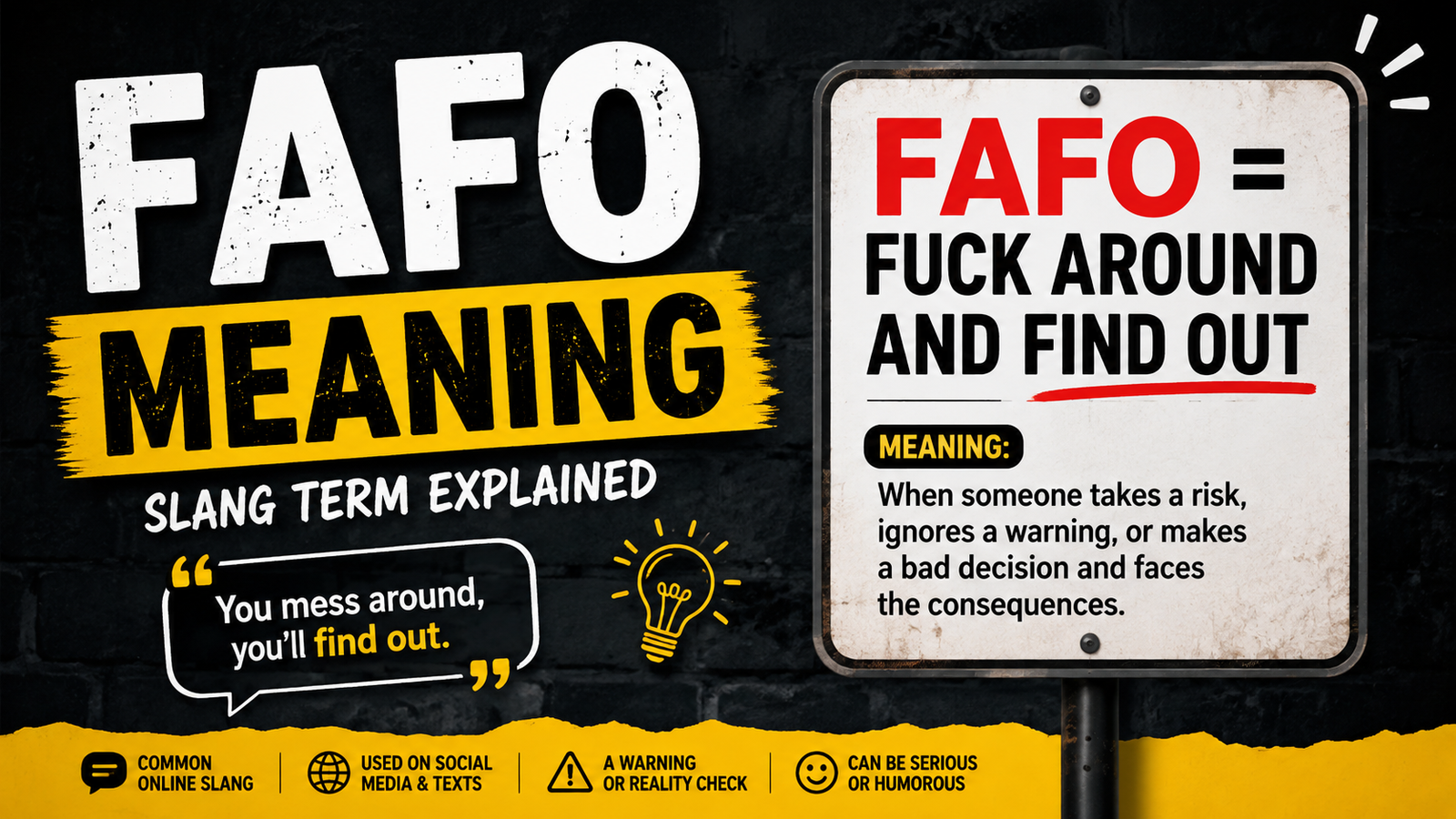
If you have seen FAFO in a TikTok comment, meme, text message, Reddit post, or social media argument, you may have wondered what these four letters actually mean. FAFO is a popular slang abbreviation that stands for “Fuck Around and Find Out.” A less offensive version is sometimes written as “Fool Around and Find Out.”
In simple English, FAFO means that if you keep taking risks, ignoring warnings, crossing boundaries, or making questionable choices, you will eventually experience the consequences. It can be serious, humorous, sarcastic, or even playful depending on the situation.
The expression has become especially common in internet culture. People often write “FAFO” when someone ignores a warning and then gets exactly the result they were warned about. Merriam-Webster describes it as an informal abbreviation used particularly as a harsh way of saying that someone’s actions have led, or will lead, to predictable negative consequences.
What Does FAFO Mean?
FAFO stands for “Fuck Around and Find Out.”
The basic idea is straightforward:
You do something risky or foolish → you ignore the possible consequences → you eventually discover what happens.
For example, imagine someone repeatedly ignores a warning not to touch a hot surface. They touch it anyway and get burned. Someone watching might jokingly say, “FAFO.”
The phrase does not always refer to something dangerous. It can describe everyday mistakes, online arguments, bad decisions, relationship drama, workplace situations, gaming, politics, or funny videos.
In many cases, FAFO carries an attitude of “You were warned, so now you have to deal with the result.”
That is what gives the expression its strong personality.
FAFO Meaning in Simple English
The easiest way to understand FAFO is:
“If you keep pushing your luck, you will eventually find out what happens.”
Another simple interpretation is:
“Actions have consequences.”
However, FAFO is much more informal and aggressive than simply saying “actions have consequences.” The original wording contains profanity, so the expression can sound blunt or confrontational.
Depending on context, FAFO can mean:
- You were warned.
- Don’t push your luck.
- You made your choice, so accept the result.
- Keep going and see what happens.
- You learned the hard way.
- You got the consequences you were asking for.
The exact meaning depends heavily on the situation and the relationship between the people using it.
How Do You Pronounce FAFO?
FAFO does not have one universally agreed pronunciation.
Because it is an abbreviation, some people pronounce it letter by letter, while others say it more like a single word. Merriam-Webster notes that there is not yet complete agreement about whether it should be pronounced as an acronym, such as “FAFF-oh,” or as an initialism with each letter spoken separately.
In casual online conversation, you may hear:
“FAFF-oh”
or:
“F-A-F-O”
Both can be understood.
What Does Each Letter in FAFO Stand For?
The abbreviation comes directly from the first letters of the words:
- F = Fuck
- A = Around
- F = Find
- O = Out
Together:
FAFO = Fuck Around and Find Out
Because the first word is profanity, some people use alternative versions such as “Fool Around and Find Out.” This softer version keeps the same basic meaning without using offensive language. Merriam-Webster lists both forms.
Where Did FAFO Come From?
The exact origin of the phrase is difficult to pin down. Like many slang expressions, “fuck around and find out” existed in informal speech before it became a major internet abbreviation.
Merriam-Webster says that usage of the abbreviation originated in African American English and later became widespread.
The phrase also has documented online usage going back years. Know Your Meme traces the modern internet spread of the expression to the late 2010s and early 2020s, while noting that its precise origin is unclear. One early online association involved parody versions of the Gadsden flag using the phrase as a humorous counterpart to “Don’t Tread on Me.”
This history is important because FAFO did not suddenly appear because of one meme or one social-media platform. Rather, an existing slang expression was shortened into an easy-to-type acronym and then spread rapidly through internet culture.
How FAFO Became Popular Online
Social media helped turn FAFO from relatively informal slang into a recognizable internet expression.
The acronym is short, memorable, and easy to add to a comment. It works particularly well with videos or photographs showing someone making a bad decision and then dealing with the consequences.
A major boost came from meme culture. Know Your Meme documents the phrase’s growing online popularity during the 2020s, including a viral 2022 video by Roger Skaer that humorously illustrated the relationship between “fucking around” and “finding out.”
Today, FAFO can appear in:
- TikTok comments
- Instagram captions
- Reddit discussions
- X posts
- Facebook comments
- YouTube comments
- Gaming chats
- Memes
- Political discussions
- Text messages
- Online arguments
Its meaning remains centered on consequences, even when the context changes.
What Does FAFO Mean on TikTok?
On TikTok, FAFO usually means that someone took a risk or ignored a warning and then experienced the predictable result.
For example, a person might post a video of someone attempting a ridiculous stunt and getting into trouble. A viewer could comment:
“FAFO.”
The comment basically means:
“They took the risk, and now they are dealing with the result.”
TikTok users may also use FAFO jokingly when the consequences are harmless. A person who eats an extremely spicy food despite being warned could become the subject of a humorous FAFO comment.
The tone is therefore not always hostile.
What Does FAFO Mean in Texting?
In texting, FAFO is usually a short response to someone’s decision or behavior.
For example:
Person A: “I’m going to ignore the warning and see what happens.”
Person B: “FAFO 😂”
Here, the second person is essentially saying, “Go ahead, but don’t complain when you discover the consequences.”
It can also be used after something has already happened:
“He ignored everyone’s advice and lost the money. FAFO.”
In that example, the speaker believes the person’s outcome was predictable.
FAFO Examples in Everyday Conversation
Here are some simple examples showing how people might use the term.
Example 1: Ignoring a Warning
“She was told not to touch the wet paint, but she did it anyway. FAFO.”
Meaning: She ignored the warning and experienced the obvious consequence.
Example 2: Online Argument
“He kept insulting people in the comments and eventually got blocked. FAFO.”
Meaning: His behavior led to the result he received.
Example 3: Risky Decision
“They knew the road was closed but drove through anyway. FAFO.”
Meaning: They knowingly took a risk and discovered why the warning existed.
Example 4: Humorous Situation
“He challenged his little brother to eat the hottest chips. Five minutes later, he was crying. FAFO.”
Meaning: He created the situation himself and then suffered the result.
Example 5: Text Message
“You can keep ignoring your alarm, but FAFO.”
Meaning: Keep doing that and you may be late or miss something important.
FAFO as a Warning
One of the most common uses of FAFO is as a warning.
When someone says “FAFO,” they may be communicating that another person is approaching a limit.
For example:
“Keep messing with me and FAFO.”
This has a much more threatening tone than:
“Please stop.”
It suggests that the speaker believes consequences will follow if the behavior continues.
Because of this, FAFO should not automatically be treated as a harmless joke. In an argument, it can sound aggressive or threatening.
FAFO as Humor
FAFO is also frequently used for comedy.
Internet users often put the acronym under videos where someone makes an obviously questionable decision. The humor comes from the fact that the viewer already knows what is going to happen.
For example, someone might see a video of a person trying to jump over a puddle while carrying a large box. If the person falls into the puddle, commenters may write:
“FAFO.”
The comment does not necessarily mean the person deserved serious harm. In many cases, it is simply a humorous way of saying that the person took a silly risk.
This humorous use has helped make FAFO one of the more recognizable expressions in online slang.
Is FAFO a Bad Word?
FAFO contains profanity in its original form.
The word represented by the first “F” is considered vulgar in standard English. As a result, FAFO is generally unsuitable for formal communication.
It may be fine in casual conversations between people who are comfortable with profanity, but it is usually better to avoid it in:
- Professional emails
- Job applications
- Academic writing
- Formal reports
- Business presentations
- Customer-service communication
- Official documents
If you want the same basic idea without profanity, you can say:
“Fool around and find out.”
You can also simply say:
“Actions have consequences.”
Is FAFO a Threat?
Sometimes, yes.
The meaning depends on context.
If someone posts “FAFO” under a funny video, it may simply be a joke.
If someone tells another person “Keep doing that and FAFO,” it can sound like a warning that the speaker intends to retaliate or that something unpleasant will happen.
Therefore, context matters.
The phrase has a confrontational edge because it suggests that the other person’s behavior will eventually produce consequences. Merriam-Webster specifically describes the term as a harsh expression connected with predictable and deserved negative consequences.
FAFO in Politics and Public Discussion
FAFO has also moved beyond memes and casual conversations into political discussion.
People have used the expression to describe political decisions, government actions, international disputes, protests, elections, tariffs, and other situations in which one side is believed to be taking a risky action and will eventually face consequences.
Its political meaning is generally the same as its everyday meaning:
“You took this action, so now you are going to deal with what follows.”
The expression has been used by people across different political communities, which shows how far it has traveled from its earlier internet subcultures. Recent coverage has also described FAFO as part of political rhetoric rather than merely an internet meme.
FAFO as a Verb, Noun, and Adjective
Although FAFO began as an abbreviation, online users have become flexible with it.
Merriam-Webster notes that the expression can function as an adjective, verb, noun, interjection, and hashtag.
For example:
Noun:
“That was a real FAFO moment.”
Verb:
“He FAFO’d after ignoring the warning.”
Adjective:
“She has a FAFO attitude.”
Interjection:
“FAFO!”
These uses are informal and are much more common online than in traditional English.
Synonyms for FAFO
There is no perfect one-word synonym for FAFO because its tone is quite specific. However, several expressions communicate a similar idea.
Common Alternatives
- Actions have consequences
- You reap what you sow
- What goes around comes around
- Play stupid games, win stupid prizes
- Don’t push your luck
- You asked for it
- You were warned
- Learn the hard way
- Live with the consequences
- What did you expect?
Some are much less aggressive than FAFO.
For formal or polite communication, “actions have consequences” is usually the safest alternative.
Antonyms of FAFO
An exact opposite of FAFO would be an attitude of avoiding unnecessary risks or consequences.
Possible opposite ideas include:
- Think before you act
- Play it safe
- Use caution
- Avoid unnecessary risks
- Follow the warning
- Learn from others
- Take precautions
- Make responsible choices
For example, instead of saying “FAFO,” a cautious person might say:
“Think about the consequences before you do that.”
The difference is mainly in attitude. FAFO emphasizes learning through consequences, while its opposites emphasize avoiding those consequences in the first place.
When Should You Use FAFO?
FAFO works best in casual, informal settings.
You can use it when:
- Talking with friends
- Commenting on memes
- Reacting to funny videos
- Discussing internet drama
- Talking about someone ignoring obvious advice
- Making a joking comment
- Describing a predictable consequence
Before using it, consider your audience.
Because the original phrase contains profanity and can sound aggressive, it is not appropriate for every situation.
When Should You Avoid FAFO?
Avoid FAFO when you need to sound professional, respectful, or diplomatic.
For example, telling a customer “FAFO” would almost certainly sound rude. Writing it in a formal business email would also be inappropriate.
Instead, use language such as:
“Please be aware that this decision may have consequences.”
or:
“We recommend considering the potential risks before proceeding.”
These phrases communicate a similar idea without the slang or confrontational tone.
Why Is FAFO So Popular?
The popularity of FAFO comes partly from its simplicity.
The expression compresses a complete idea into four letters. It communicates risk, warning, consequences, and attitude at the same time.
It is also highly adaptable. The same acronym can be funny under a meme, serious during an argument, sarcastic in a political discussion, or playful among friends.
Internet language tends to reward expressions that are short and easy to recognize. FAFO fits that pattern perfectly.
Is FAFO the Same as “Play Stupid Games, Win Stupid Prizes”?
They are very similar, but not identical.
“Play stupid games, win stupid prizes” means that foolish behavior can produce foolish results.
FAFO carries a similar message but usually has a stronger, more confrontational tone. It can suggest that someone knowingly pushed boundaries and is now experiencing the consequences.
Both expressions communicate the broader idea that choices have consequences.
Frequently Asked Questions About FAFO
What does FAFO mean?
FAFO means “Fuck Around and Find Out.” It is slang for the idea that someone who takes unnecessary risks, ignores warnings, or pushes boundaries will eventually face the consequences.
What does FAFO mean on social media?
On social media, FAFO is commonly used as a reaction to someone experiencing the result of their own actions. It can be serious, sarcastic, humorous, or critical depending on the post.
Is FAFO a swear word?
The acronym itself is slang, and its original full phrase contains profanity. A softer version is “Fool Around and Find Out.”
How do you pronounce FAFO?
FAFO can be pronounced “FAFF-oh” or by saying each letter individually, “F-A-F-O.” Merriam-Webster notes that both styles are encountered because there is not complete agreement about its pronunciation.
Where did FAFO originate?
The precise origin is uncertain. Merriam-Webster identifies its usage as originating in African American English before becoming widespread, while internet-history sources document its growing visibility online during the late 2010s and 2020s.
Is FAFO appropriate for work?
Generally, no. Because the original phrase contains profanity and can sound confrontational, it is better suited to informal conversations. In professional settings, phrases such as “actions have consequences” or “please consider the risks” are more appropriate.
What is another way to say FAFO?
Depending on the context, you can say “you were warned,” “don’t push your luck,” “actions have consequences,” or “you reap what you sow.”
Is FAFO always negative?
Not necessarily. FAFO usually involves consequences, but people often use it humorously for harmless situations. The tone depends on the context, the relationship between the speakers, and what happened.
Final Thoughts on FAFO Meaning
FAFO means “Fuck Around and Find Out,” a slang expression built around a simple idea: actions have consequences.
Someone makes a risky choice, ignores a warning, crosses a boundary, or keeps pushing their luck—and eventually discovers what happens.
The expression can be funny when used under a meme, sarcastic when commenting on someone’s mistake, or serious when used as a warning. Because the original phrase contains profanity, it belongs mainly in informal communication.
Its rise through social media shows how quickly slang can move from niche communities into mainstream internet language. Today, FAFO appears in memes, comments, conversations, political discussions, and everyday online interactions. Merriam-Webster now includes it as an established informal abbreviation, reflecting how widely recognized the term has become.
Ultimately, the simplest translation of FAFO is:
“Keep pushing your luck, and you will eventually find out what happens.”
That combination of warning, humor, attitude, and consequence is exactly why four letters can say so much.