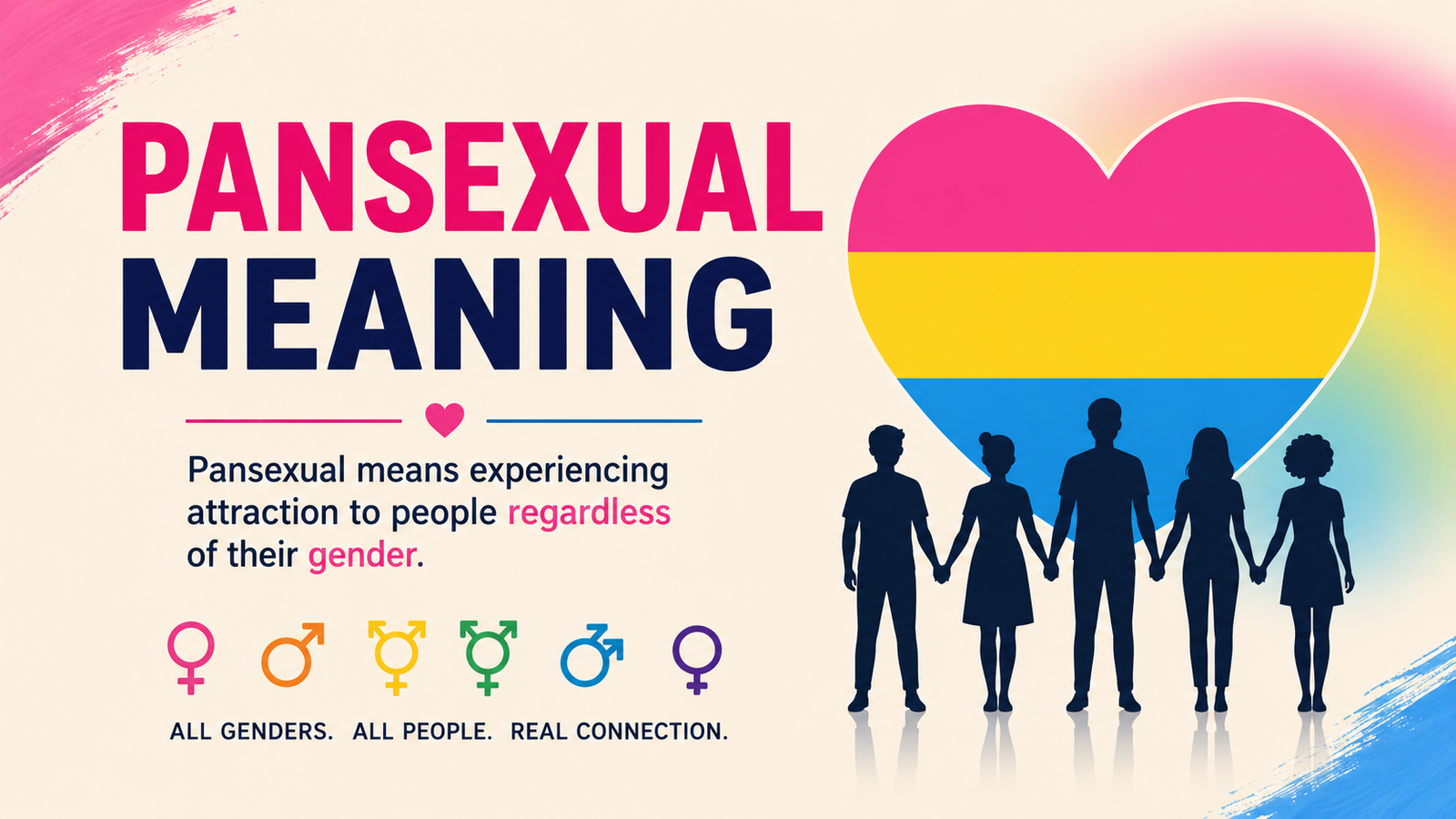
If you have searched for “pansexual meaning,” you may have seen several different explanations online. In simple terms, pansexual describes a person who can experience emotional, romantic, or sexual attraction to people regardless of their gender. For some pansexual people, gender is simply not an important factor when they develop attraction.
The word is increasingly common in conversations about relationships, identity, entertainment, social media, and LGBTQ+ terminologyhttps://dictionary.cambridge.org/dictionary/english/terminology. However, understanding the term does not require complicated language.
This guide explains pansexual meaning in simple English, including its pronunciation, origin, examples, related words, common usage, and the difference between pansexual and bisexual.
Pansexual Meaning in Simple English
Pansexual means having the potential to be attracted to people of different or all genders, with gender not necessarily determining that attraction.
A pansexual person may be attracted to a man, woman, nonbinary person, or another person whose gender identity is different from their own. The important point is that gender does not limit the people they can potentially find attractive.
For example, imagine someone saying:
“I can fall in love with someone regardless of their gender.”
That person might describe themselves as pansexual.
Being pansexual does not mean being attracted to everyone. It also does not mean that a person will automatically be attracted to people of every gender. Attraction is personal and varies from one individual to another.
The term describes a person’s capacity for attraction, not a list of people they must be attracted to.
How Do You Pronounce Pansexual?
The word pansexual is commonly pronounced approximately like pan-SEK-shoo-uhl.
It can be broken into three easy parts:
- pan
- sex
- ual
The emphasis generally falls on the second syllable: pan-SEK-shoo-uhl.
The noun pansexuality is pronounced similarly, with the ending changing to -ality.
What Does the Word Pansexual Mean?
The word has two important parts.
The prefix pan- comes from Greek pan, meaning “all.” The modern identity-related meaning of pansexual developed over time. The term is therefore often understood in connection with attraction that is not restricted by gender.
However, its history is more complicated than simply translating pan- as “all.”
An early use of pansexualism appeared in psychological discussions in the early 20th century. That older usage referred to a controversial idea that sexual instinct influenced human behavior broadly. It was not the same as today’s meaning of pansexual as a sexual orientation.
The identity-related use became more established during the 1960s and 1970s, eventually developing into the meaning commonly used today. Some LGBTQ+ terminology resources specifically trace the identity term to the 1970s.
This distinction matters because the modern meaning should not simply be projected backward onto every historical use of the word.
Pansexual Definition
A straightforward definition is:
Pansexual: An adjective describing a person who may experience emotional, romantic, or sexual attraction to people regardless of gender.
The American Psychological Association’s 2026 definition describes pansexuality as a sexual orientation involving the capacity for sexual and/or romantic attraction to people of all genders, where gender is not a determining factor in attraction.
Different people may explain their identity in slightly different ways. Some say gender does not influence their attraction. Others say they can be attracted to people of any gender. Both descriptions can fit the broader meaning of pansexuality.
What Does Pansexuality Mean?
Pansexuality is the noun form of pansexual.
It refers to a sexual orientation in which a person’s potential for romantic, emotional, or sexual attraction is not limited by the person’s gender.
For example:
Pansexual: “She identifies as pansexual.”
Pansexuality: “Pansexuality describes attraction that can include people of all genders.”
Pansexuality can include romantic attraction, sexual attraction, emotional attraction, or combinations of these, depending on the individual. The APA notes that pansexuality may involve sexual attraction, romantic attraction, or both.
Examples of Pansexual Meaning
Examples can make the definition easier to understand.
Example 1: Attraction Regardless of Gender
Someone might say:
“Gender isn’t a factor in who I develop feelings for.”
That person may identify as pansexual.
Example 2: Romantic Attraction
A person could develop romantic feelings for people of different genders and feel that gender does not determine whom they can love.
They might describe themselves as pansexual.
Example 3: Sexual Attraction
Someone may experience sexual attraction toward people of different genders without having their attraction restricted to particular gender categories.
They may identify as pansexual.
Example 4: Personal Identity
A person might say:
“I identify as pansexual because I can be attracted to someone regardless of whether they are a man, woman, or nonbinary person.”
This is a common way of explaining the identity.
Example 5: Everyday Conversation
Person A: “What does pansexual mean?”
Person B: “It generally means someone can be attracted to people regardless of gender.”
That is a simple and respectful explanation.
Pansexual vs. Bisexual
One of the most common questions about pansexuality is how it differs from bisexuality.
The short answer is that the terms overlap, and there is no single definition that every person uses.
Historically, bisexual was sometimes explained as attraction to men and women. Modern definitions, however, can be broader. GLAAD describes bisexuality as the capacity for attraction to people of the same gender and people of another gender, while recognizing pansexuality as one identity within the broader bi+ landscape.
Pansexual is commonly used by people who want to emphasize that gender itself is not a limiting factor in their attraction.
A simplified comparison looks like this:
| Term | Simple meaning |
|---|---|
| Bisexual | Attraction to more than one gender |
| Pansexual | Attraction that can occur regardless of gender |
| Heterosexual | Attraction primarily toward a different gender |
| Homosexual | Attraction primarily toward the same gender |
| Asexual | Little or no sexual attraction, depending on the individual |
These descriptions are simplified. Real experiences are more diverse, and some people use bisexual and pansexual interchangeably, while others strongly prefer one term. Georgetown University’s LGBTQ Resource Center notes that the terms can overlap and that people may define them differently.
The most respectful approach is to let people choose the identity that best describes them.
Is Pansexual the Same as Bisexual?
Not necessarily.
The two terms have significant overlap, but many people use them to communicate slightly different experiences or understandings of attraction.
A pansexual person may emphasize that gender is not a determining factor in their attraction.
A bisexual person may describe attraction to more than one gender, which can include people of many or all genders.
Neither definition automatically tells you how an individual experiences attraction. Some people identify as bisexual, some as pansexual, and some use both terms.
There is no need to decide that one label is “more inclusive” or “more correct.” Sexual-orientation labels are personal descriptions, and people can choose the word that feels most accurate to them.
Pansexual vs. Omnisexual
Another related term is omnisexual.
Both pansexuality and omnisexuality can involve attraction to people of all genders. The distinction is often described in terms of how a person experiences gender within attraction.
A pansexual person may feel that gender is not a significant factor in their attraction.
An omnisexual person may experience attraction to people of all genders while still noticing or experiencing gender as part of that attraction.
These distinctions are not universal. People use identity labels differently, so the best source for someone’s definition is the person themselves.
Pansexual vs. Polysexual
Polysexual and pansexual are also related but are not identical terms.
Polysexual generally refers to attraction to multiple genders, but not necessarily every gender.
Pansexuality can describe attraction to people regardless of gender or across all genders.
For example, a person attracted to several genders but not all genders might choose the term polysexual. Someone who does not consider gender a limiting factor might prefer pansexual.
Again, personal definitions can vary.
Is Pansexual an LGBTQ+ Identity?
Yes. Pansexual is commonly recognized as an LGBTQ+ sexual-orientation identity.
LGBTQ+ is an umbrella term that includes many sexual orientations and gender identities. Pansexuality is one of the identities commonly represented within the broader LGBTQ+ community.
However, not every pansexual person has the same experiences, preferences, or relationship history.
A person’s sexual orientation is about their pattern of attraction and identity. They do not need to have dated or had sexual experiences with people of multiple genders before using the label.
PFLAG notes that a person’s attraction and self-identification matter, and that a pansexual person does not need previous sexual experience to identify as pansexual.
Common Misunderstandings About Pansexuality
Several myths can make the word confusing.
Myth 1: Pansexual Means Attracted to Everyone
This is incorrect.
Being pansexual does not mean finding every person attractive. It means a person’s attraction is not necessarily restricted by gender.
Myth 2: Pansexual Means “Gender Blind”
Some pansexual people use language such as “gender doesn’t matter to me,” but not everyone describes themselves that way.
A person can recognize gender while still experiencing attraction regardless of gender.
Myth 3: Pansexual People Cannot Be Monogamous
Sexual orientation and relationship structure are different things.
A pansexual person can be monogamous, married, single, dating, or in another consensual relationship structure. Being capable of attraction to multiple genders does not determine how someone chooses to conduct a relationship.
Myth 4: You Must Date Different Genders to Know
A person does not need a particular dating history to understand or describe their orientation.
People can recognize their patterns of attraction without having relationships with everyone they could potentially be attracted to.
Myth 5: Pansexual and Bisexual Are Opposites
They are not opposites.
There is considerable overlap between the terms, and some people identify with both.
Synonyms and Related Words for Pansexual
There is no perfect synonym for pansexual, because identity labels can carry personal meaning.
However, related terms include:
- Pansexuality
- Pan
- Bisexual — sometimes used similarly, depending on the person’s definition
- Omnisexual — related but not necessarily identical
- Plurisexual — a broader category involving attraction to multiple genders
- Panromantic — focused specifically on romantic attraction to people of all genders
The word pan is sometimes used informally as a shortened form of pansexual.
For example:
“I’m pan.”
This generally means:
“I’m pansexual.”
Antonyms of Pansexual
There is no exact antonym for pansexual.
Sexual orientations do not form a simple dictionary system in which every identity has one opposite word.
Depending on the context, people may contrast pansexuality with orientations that describe attraction restricted primarily to particular genders.
For example:
- Heterosexual generally describes attraction to a different gender.
- Homosexual generally describes attraction to the same gender.
- Asexual describes little or no sexual attraction, although asexuality is a broad spectrum.
These should not be treated as strict linguistic opposites of pansexual. They describe different patterns of attraction.
Common Usage of the Word Pansexual
The word pansexual is commonly used as an adjective.
Correct examples include:
- “He is pansexual.”
- “She identifies as pansexual.”
- “They describe their orientation as pansexual.”
- “Pansexual people can experience attraction regardless of gender.”
- “The character is portrayed as pansexual.”
The noun pansexuality is also common:
- “Pansexuality is a sexual orientation.”
- “She learned more about pansexuality.”
It is generally better to use the term respectfully rather than treating it as a curiosity or making assumptions about someone’s private relationships.
Why the Word Pansexual Matters
Language gives people a way to describe experiences that may otherwise be difficult to explain.
For some people, the word pansexual provides a useful way to communicate that gender does not determine who they may be attracted to. For others, another label may feel more accurate.
Modern LGBTQ+ terminology continues to evolve. Georgetown University’s LGBTQ Resource Center emphasizes that these definitions can change and that different people may use terms differently.
That is why definitions should be informative without becoming rigid rules.
A label can be helpful, but a person is always more complicated than a single word.
Frequently Asked Questions About Pansexual Meaning
1. What does pansexual mean in simple words?
Pansexual means a person can experience romantic, emotional, or sexual attraction to people regardless of gender. Gender may not be a determining factor in their attraction.
2. How do you pronounce pansexual?
Pansexual is commonly pronounced pan-SEK-shoo-uhl.
3. What is the difference between pansexual and bisexual?
Bisexual commonly means attraction to more than one gender, while pansexual often emphasizes attraction regardless of gender. The definitions overlap, and some people use both terms.
4. Is pansexual part of LGBTQ+?
Yes. Pansexuality is commonly recognized as a sexual orientation within the broader LGBTQ+ community.
5. Does pansexual mean attracted to everyone?
No. Pansexuality does not mean being attracted to every person. It describes the range of genders a person may potentially be attracted to.
6. Can pansexual people fall in love?
Yes. Pansexual people can experience romantic and emotional attraction, just as people with other sexual orientations can. The nature and intensity of attraction differs from person to person.
7. Is pansexual a sexual orientation?
Yes. The American Psychological Association describes pansexuality as a sexual orientation involving potential sexual and/or romantic attraction to people of all genders.
8. Does someone have to date different genders to be pansexual?
No. A person does not need a particular dating or sexual history to identify as pansexual. Attraction and self-identification are important parts of how people understand their orientation.
9. Is pansexual the same as omnisexual?
They are related, but some people use them differently. Pansexuality is often described as attraction regardless of gender, while omnisexuality may involve attraction to all genders while still experiencing gender as relevant to attraction.
10. What is the opposite of pansexual?
There is no exact opposite. Heterosexual, homosexual, and asexual describe different patterns of attraction rather than being strict antonyms of pansexual.
Conclusion: Pansexual Meaning Explained Clearly
So, what is the pansexual meaning?
In simple English, pansexual describes a person who can experience emotional, romantic, or sexual attraction to people regardless of gender. For many pansexual people, gender is not a determining factor in attraction.
The word has a longer history than its modern identity meaning, with earlier psychological uses and a later development into the LGBTQ+ terminology used today. The modern identity-related sense became more established during the second half of the 20th century.
Pansexuality also overlaps with terms such as bisexual, omnisexual, and polysexual, but people may choose different labels because those words communicate different aspects of their experiences.
Most importantly, pansexual does not mean attracted to everyone. It describes the potential range of attraction in relation to gender.
If you remember only one definition, remember this:
Pansexual means being capable of attraction regardless of gender.