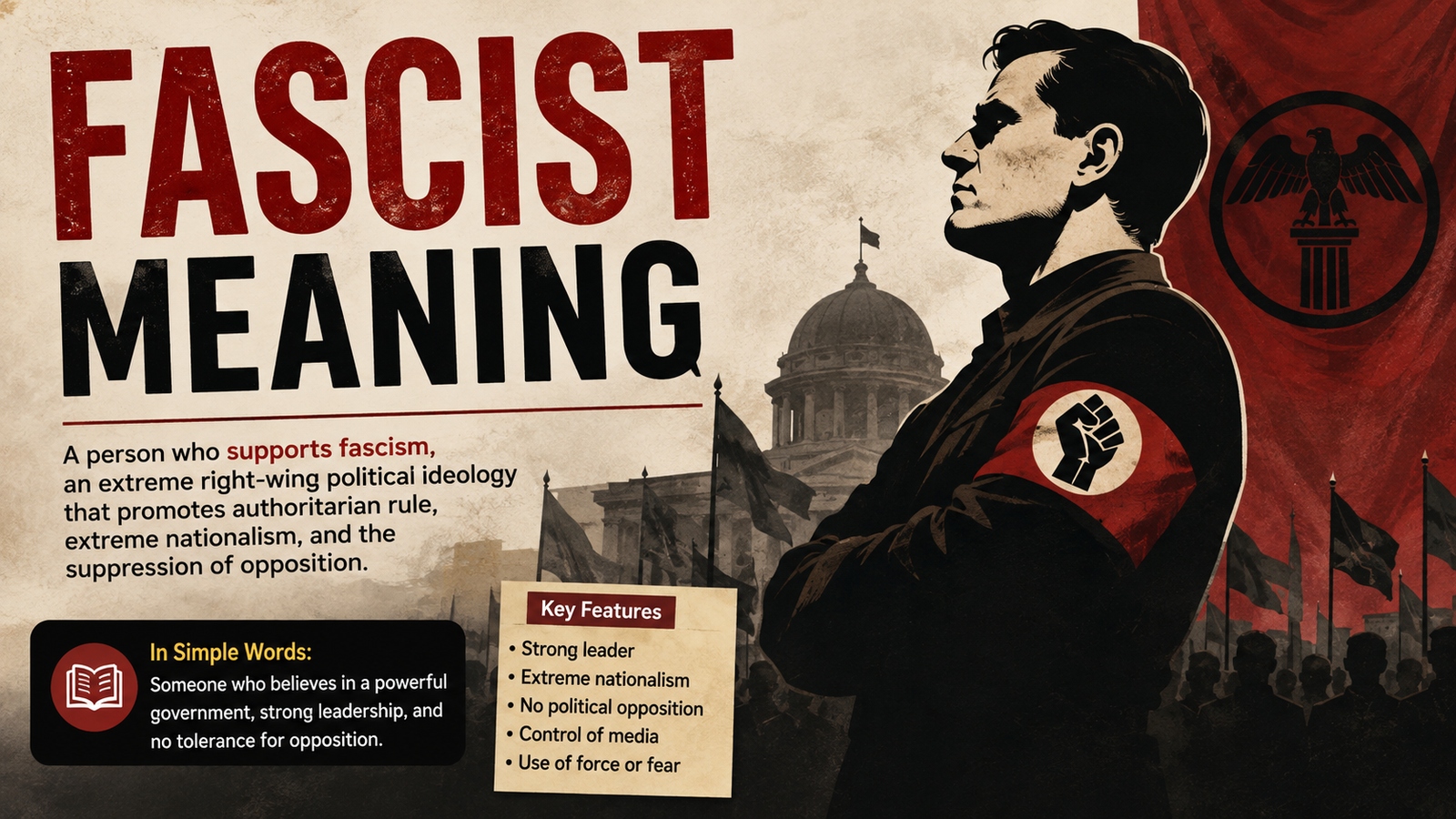
The word fascist is commonly used in discussions about politics, history, government, and social behavior. It is also a word that is sometimes used too casually, so understanding its exact meaning is important.
In simple English, a fascist is a person who supports or follows fascism, a political ideology associated with authoritarian rule, extreme nationalism, suppression of political opposition, and strong control by a centralized state or dictatorial leader. Oxford defines a fascist as a person who supports fascism, while also noting that the word is sometimes used more loosely as an insulting description for someone considered extremely right-wing or controlling.
The term has a specific historical background. It became strongly associated with Benito Mussolini’s political movement in Italy after World War I and later became a broader term for related political movements.
This guide explains the fascist meaning, pronunciation, origin, history, characteristics, examples, synonyms, antonyms, common usage, and frequently asked questions in clear and simple English.
What Does Fascist Mean?
Fascist can be used as both a noun and an adjective.
As a noun, a fascist is a person who supports fascism.
For example:
He was accused of being a fascist because he supported a dictatorship and wanted opposition parties banned.
As an adjective, fascist describes something connected with or supportive of fascism.
For example:
The country was ruled by a fascist government.
The word is closely connected to fascism, which generally involves authoritarian or dictatorial leadership, intense nationalism, political repression, and the suppression of opposition. Merriam-Webster describes fascism as a political philosophy or regime associated with centralized autocratic government, a dictatorial leader, social and economic control, and forcible suppression of opposition.
Fascist Meaning in Simple English
In very simple terms:
Fascist means supporting a system in which a powerful authoritarian government or leader demands strong loyalty, limits opposition, and places the nation or collective identity above individual freedoms.
However, fascism is more specific than simply being strict, conservative, or authoritarian. Historians and political scholars debate its precise boundaries, but extreme nationalism, hostility toward pluralistic democracy, political violence or intimidation, and the suppression of opponents are important elements in many definitions.
Fascist Pronunciation
The English pronunciation of fascist is:
FASH-ist
It is commonly represented in dictionaries as /ˈfæʃɪst/.
The word has two syllables:
fash + ist
The related word fascism is pronounced approximately:
FASH-iz-um
Oxford gives the pronunciation of fascism as /ˈfæʃɪzəm/.
What Is Fascism?
To understand fascist meaning, it helps to understand the word fascism.
Fascism is a political ideology and form of political organization historically associated with authoritarian leadership, extreme nationalism, rejection of political pluralism, and suppression of opposition.
Fascist movements generally reject the idea that political disagreements should be handled through open democratic competition. Instead, they tend to emphasize unity, obedience, national strength, and centralized authority.
The exact features can differ between historical movements. Italian Fascism under Mussolini and German Nazism, for example, were related but were not identical political systems. Scholars therefore caution against treating every authoritarian government as automatically fascist.
Origin of the Word Fascist
The history of fascist goes back to Italy.
The Italian word fascista became associated with political movements connected with Benito Mussolini. Merriam-Webster explains that the English words fascist and fascism entered English in the early twentieth century, with fascist first cited in 1919 and fascism in 1921.
The Italian word fascio means “bundle” and could also mean a group or association. It ultimately comes from the Latin fasces, associated with a bundle of rods carried by certain Roman officials as a symbol of authority.
Mussolini’s movement adopted the imagery of the fasces, helping establish the association between the symbol, political unity, and state authority.
Importantly, the history is more complicated than the simple claim that Mussolini invented the word. The Italian term fascio had already been used for political and social groups before Mussolini’s 1919 movement, and the word fascisti had entered political usage before the formation of the Fascist movement that eventually took power in Italy.
Historical Meaning of Fascist
The modern political meaning of fascist developed particularly strongly after World War I.
Mussolini founded the Fasci di combattimento in 1919. His movement grew rapidly in the political instability that followed the war, and the Fascists eventually came to power in Italy in 1922.
Fascism then became an important political phenomenon in Europe during the 1920s and 1930s.
The term is particularly associated with Mussolini’s Italy and is also frequently discussed in relation to Nazi Germany. However, Nazism and Italian Fascism should not simply be treated as identical, even though they shared important authoritarian, nationalist, and anti-democratic characteristics.
Understanding this history helps explain why fascist is a powerful and historically serious word rather than merely another word for “strict.”
Main Characteristics Associated With Fascism
There is no single checklist accepted by every scholar, but several characteristics commonly appear in discussions of fascism.
1. Strong Authoritarian Leadership
Fascist systems typically concentrate political power in a strong leader or highly centralized government.
The leader is presented as representing the nation and is often portrayed as someone who can solve national problems through decisive action.
2. Extreme Nationalism
Fascism generally places exceptional importance on the nation.
National identity can be presented as more important than individual interests, political differences, or minority identities. Some fascist movements have also connected national identity with race or ethnicity.
3. Suppression of Opposition
A major feature associated with fascism is opposition to political pluralism.
Independent political organizations, opposition parties, protest movements, or critical voices may be restricted, threatened, or violently suppressed.
4. Rejection of Democratic Constraints
Fascist politics typically rejects important democratic safeguards when those safeguards limit the power of the movement or its leader.
This can include attacks on independent institutions, political competition, courts, media organizations, or other checks on executive power.
5. Political Propaganda
Fascist movements have historically made extensive use of propaganda.
Propaganda can promote national unity, glorify leaders, identify enemies, and create a simple story about the nation’s problems.
6. Political Violence and Intimidation
Violence and intimidation have played an important role in several historical fascist movements.
Rather than treating political disagreement as something to be resolved through debate, extremist movements can portray opponents as enemies who must be defeated or eliminated.
Fascist vs. Authoritarian
The words fascist and authoritarian are related, but they are not perfect synonyms.
Authoritarian is a broader term for systems or leaders that concentrate power and restrict political freedoms.
Fascist usually refers to a more specific political tradition associated with extreme nationalism, authoritarian leadership, rejection of political pluralism, and suppression of opposition.
Therefore, every fascist system is authoritarian, but not every authoritarian government is necessarily fascist.
This distinction matters because calling every strict or undemocratic government “fascist” can make the word less precise.
Fascist vs. Dictator
A dictator is a person who holds extensive political power, usually without meaningful democratic accountability.
A fascist is someone who supports fascism.
A fascist movement may support a dictator, but the two terms do not mean exactly the same thing.
For example, dictatorship describes a form of political rule, while fascism describes a political ideology and movement with a particular historical and ideological character.
Examples of Fascist in a Sentence
Here are several examples showing how the word can be used correctly.
- The historian studied the rise of fascist movements in Europe during the twentieth century.
- The novel describes a fictional fascist government that suppresses political opposition.
- Mussolini’s Fascist movement transformed Italian politics after World War I.
- The government was criticized for using political violence and propaganda in ways that historians associated with fascist movements.
- Calling someone fascist is a serious political accusation, so the term should be used carefully.
- The documentary examines how fascist propaganda influenced public opinion.
These examples show that fascist can describe a person, political organization, government, ideology, or characteristic associated with fascism.
Common Usage of the Word Fascist
Today, fascist has two broad types of usage.
The first is historical or political. In this context, the word refers to people, movements, or governments connected with fascism.
The second is informal and often insulting. People sometimes call someone a “fascist” because they believe that person is excessively controlling, intolerant, or authoritarian.
Oxford specifically notes this broader and disapproving usage.
For example, someone might jokingly call a person a “food fascist” because that person is extremely strict about what others eat.
However, this casual usage can be misleading. A person being strict, bossy, conservative, or unpleasant does not automatically make that person a fascist.
Why Context Matters
Consider these two sentences:
“The historian described the regime as fascist.”
This is a political and historical statement.
“My teacher is a fascist because she does not allow phones in class.”
This is probably an exaggerated insult rather than a literal political description.
The second sentence uses the word loosely. In serious writing, it is better to reserve fascist for situations where the political meaning is actually relevant.
Synonyms for Fascist
There is no perfect synonym for fascist, because the word carries a specific historical and political meaning.
Depending on the context, related words include:
- Authoritarian
- Dictatorial
- Totalitarian
- Despot
- Tyrant
- Extremist
- Ultranationalist
- Anti-democratic
These words should not always be substituted directly.
For example, authoritarian is broader than fascist, while totalitarian describes an especially comprehensive form of political control. Tyrant generally describes a cruel or oppressive ruler rather than a specific ideology.
Antonyms of Fascist
Again, there is no single perfect opposite of fascist.
Depending on the context, possible contrasting terms include:
- Democratic
- Liberal
- Pluralist
- Libertarian
- Anti-authoritarian
- Pro-democracy
The best antonym depends on what aspect of fascism is being contrasted.
If the focus is political freedom, democratic may be the clearest opposite.
If the focus is centralized authority, anti-authoritarian may be more appropriate.
Is Fascist the Same as Nazi?
No.
Nazism was the ideology and political movement associated with Adolf Hitler and the National Socialist German Workers’ Party.
It shared important characteristics with fascism, including authoritarian leadership, extreme nationalism, political repression, propaganda, and rejection of liberal democracy. However, Nazi ideology had distinctive racial and antisemitic doctrines and developed in a particular German historical context.
Therefore, Nazi and fascist are related terms, but they are not interchangeable in every context.
Is Fascist a Bad Word?
In most modern contexts, fascist is strongly negative.
When used literally, it identifies support for an ideology historically connected with dictatorship, repression, political violence, and the destruction of democratic freedoms.
It can also be used as an insult. Because of this, calling someone a fascist can be a serious accusation rather than a neutral description.
Using the word accurately makes communication clearer and avoids turning an important political term into a vague insult.
Fascist Meaning in Everyday English
If you encounter the word fascist online or in conversation, the meaning can usually be understood from context.
If the conversation is about history or politics, it probably refers to fascism as an ideology or political movement.
If someone says “fascist government,” they are normally describing a government they believe has characteristics associated with fascism.
If someone says “he’s a fascist” during an argument, the speaker may be making a literal political claim or simply using the word as an insult.
Looking at the surrounding context is therefore essential.
Why Understanding Fascist Meaning Matters
Political words can become confusing when they are used casually.
The term fascist has a real historical meaning connected with political movements that emerged in Europe after World War I. At the same time, its informal use has expanded to describe controlling or intolerant behavior.
Knowing the difference helps readers understand history, political discussions, news reports, and online debates more accurately.
It also prevents a common mistake: assuming that every authoritarian, conservative, nationalist, or strict person is automatically fascist.
Scholars themselves debate how broadly fascism should be defined, which makes historical context especially important.
Frequently Asked Questions About Fascist Meaning
What does fascist mean in simple words?
Fascist generally means a person who supports fascism, a political ideology associated with authoritarian leadership, extreme nationalism, suppression of opposition, and rejection of democratic pluralism.
How do you pronounce fascist?
Fascist is pronounced approximately “FASH-ist.” Oxford lists the pronunciation as /ˈfæʃɪst/.
Where did the word fascist come from?
The word comes from Italian fascista, associated with Mussolini’s political movement. It is related to Italian fascio, meaning “bundle” or “group,” and ultimately to the Latin fasces.
Is fascist the same as authoritarian?
No. Authoritarian is a broader term for concentrated political power and restricted freedom. Fascism is a more specific political tradition that usually combines authoritarianism with extreme nationalism and suppression of opposition.
Is fascist the same as Nazi?
No. Nazism is a specific German political ideology associated with Hitler. It shared several characteristics with fascism but had its own distinctive ideology, especially its racial and antisemitic doctrines.
What is the opposite of fascist?
There is no single exact opposite. Depending on the context, democratic, pluralist, or anti-authoritarian may express the contrasting idea.
Can fascist be used as an insult?
Yes. In everyday speech, people sometimes use fascist as an insult for someone they consider extremely controlling or intolerant. Dictionaries recognize this broader use, but it can be misleading when the person’s actual political beliefs do not fit fascism.
What is the difference between fascism and fascist?
Fascism is the ideology, political system, or movement.
Fascist describes a person who supports fascism or something connected with fascism.
For example:
“Fascism is a political ideology.”
“He was a fascist politician.”
Conclusion
The fascist meaning is more specific and historically significant than simply being “strict” or “mean.”
A fascist is, in its literal political sense, a person who supports fascism. Fascism is associated with authoritarian or dictatorial leadership, extreme nationalism, suppression of opposition, political intolerance, and rejection of democratic pluralism.
The word originated in the political environment of early twentieth-century Italy and became closely associated with Benito Mussolini’s Fascist movement. Its roots can be traced to Italian fascio, meaning “bundle” or “group,” and ultimately to the Latin fasces.
Today, the word appears frequently in historical discussions, political debates, journalism, and everyday conversation. Because it can also be used as a general insult for someone perceived as controlling or extreme, context is essential.
The simplest way to remember it is:
Fascist = a person who supports fascism.
Fascism = an authoritarian, nationalist political ideology historically associated with dictatorship, suppression of opposition, and extreme state-centered politics.
Using the word carefully helps preserve its historical meaning and makes political communication more accurate.