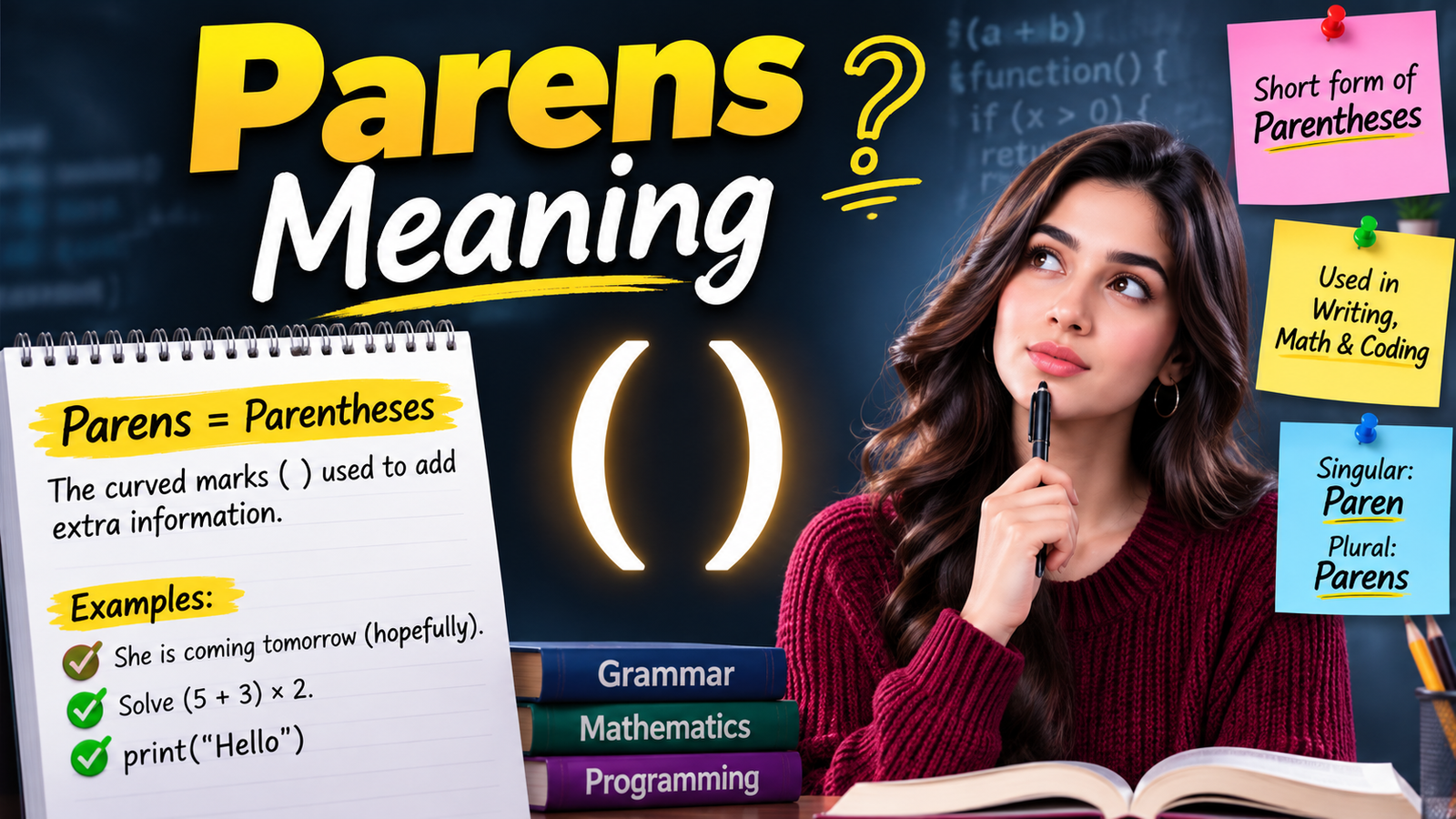
Parens Meaning: What Does “Parens” Mean in English?
If you have seen the word “parens” in a writing guide, coding tutorial, math lesson, or editing note, you may have wondered what it means. The answer is surprisingly simple: in modern English, parens is an informal shortened form of “parentheses,” meaning the curved punctuation marks ( ).
The word is especially common in writing, mathematics, programming, and technical conversations. For example, someone might say, “Put the explanation in parens,” meaning that the explanation should be placed inside parentheses.
There is also another meaning worth knowing. Parens is a Latin word meaning “parent,” “father,” or “mother,” and it appears in historical and legal expressions such as parens patriae. This Latin word is related to the origin of the English word “parent,” but it is not the usual meaning of “parens” in everyday modern English.
This guide explains the parens meaning, pronunciation, origin, examples, synonyms, antonyms, common usage, and frequently asked questions in simple English.
What Does Parens Mean?
The most common modern English meaning of parens is parentheses.
Parentheses are the curved punctuation marks:
( )
They are used to add extra information, clarify a statement, group information, or separate certain parts of a sentence.
For example:
Sarah went to the store (after finishing her homework).
The words “after finishing her homework” are inside parentheses. In an informal conversation about writing, someone could call these marks parens.
Merriam-Webster defines paren as a shortened form of parenthesis, with parens as the plural.
So, in simple terms:
Parens = parentheses = ( )
The singular form is generally paren, while the plural form is parens.
Quick Definition
| Term | Meaning |
|---|---|
| Paren | One parenthesis |
| Parens | Parentheses, usually referring to the pair or multiple parentheses |
| Parenthesis | One curved punctuation mark or a pair considered as a unit |
| Parentheses | The plural of parenthesis |
| ( ) | The symbols called parentheses |
Parens Pronunciation
The word parens is commonly pronounced approximately like “puh-renz.”
The pronunciation can vary slightly depending on the speaker’s accent, but the first syllable is generally unstressed and the word ends with a z sound.
Merriam-Webster gives the pronunciation of paren as pəˈren, while Dictionary.com lists parens approximately as puh-renz.
If you are learning English, the easiest way to remember the pronunciation is to think of it as a short spoken version of parentheses.
What Are Parens Used For?
Parens are used whenever someone wants to refer informally to parentheses without saying the longer word.
They are especially common in technical fields.
1. In Writing
Writers use parentheses to add information that is useful but not essential to the main sentence.
Example:
The meeting starts at 9 a.m. (please arrive ten minutes early).
Here, the information inside the parentheses adds an extra instruction.
An editor might say:
“Move that phrase into parens.”
This means the phrase should be enclosed in parentheses.
2. In Mathematics
Parentheses are important in mathematics because they can show which operations should be performed together.
For example:
(5 + 3) × 2 = 16
The parentheses tell you to add 5 and 3 first.
A math teacher might informally say:
“Solve what’s inside the parens first.”
In this context, parens simply means parentheses.
3. In Computer Programming
Programmers frequently use the word paren or parens because programming languages use parentheses extensively.
For example:
print("Hello")The characters ( ) after print are parentheses.
A programmer might say:
“You forgot the closing paren.”
That means the closing ) is missing.
Similarly:
“Check the parens in this function.”
This means the programmer should check whether the opening and closing parentheses are correctly placed.
4. In Editing and Proofreading
Editors may use parens as shorthand when discussing punctuation.
For example:
“Put this clarification in parens.”
This is quicker than repeatedly saying:
“Put this clarification inside parentheses.”
Because editors often discuss punctuation many times during the revision process, abbreviations and shortened terms can be convenient.
Parens vs. Parentheses
The biggest difference is formality.
Parentheses is the standard full term.
Parens is an informal shortened version.
For example:
Formal or standard:
Put the additional information in parentheses.
Informal or technical:
Put the additional information in parens.
Both sentences communicate essentially the same idea.
If you are writing an academic paper, professional report, or formal document, parentheses is usually the safer choice. In casual communication, editing discussions, programming communities, and technical conversations, parens is perfectly understandable.
Is “Parens” Singular or Plural?
This can be confusing.
The singular form is usually paren, while parens is the plural.
For example:
I forgot a closing paren.
This means one parenthesis is missing.
I need to check the parens.
This refers to multiple parentheses or the use of parentheses generally.
The full forms work similarly:
One parenthesis
Two parentheses
So you can remember the relationship this way:
paren → singular
parens → plural
Merriam-Webster specifically identifies paren as a noun whose plural is parens.
Origin of the Word “Parens”
The modern English punctuation meaning of parens comes from shortening the word parenthesis. Dictionary sources describe its etymology simply as “by shortening.”
However, there is an interesting linguistic detail: the word parens also exists independently in Latin.
In Classical Latin, parēns meant a parent, father, or mother, and it could also refer to a progenitor or ancestor. Historical Latin dictionaries record these meanings.
This Latin word is connected to the history of the English word parent.
Merriam-Webster traces English parent through Middle English and Anglo-French back to Latin parent- / parens, meaning “father or mother” or “progenitor.”
So there are two things that look exactly alike but have different histories in modern usage:
parens = shortened English term for parentheses
parēns = Latin word meaning parent
Context tells you which meaning is intended.
Parens and the Latin Word for Parent
The Latin parēns is historically important because it contributed to words related to parent and parental.
For example, the English word parental ultimately comes from Latin parentalis, meaning “of parents.”
The Latin word could refer to a father or mother. Historical sources also show broader meanings such as ancestor, relative, founder, or progenitor in certain contexts.
This should not normally be confused with the modern English abbreviation parens.
If you see parens in a programming article, it almost certainly refers to parentheses.
If you encounter parens in a Latin phrase or historical legal expression, the Latin meaning may be relevant.
Parens in “Parens Patriae”
One important expression containing the Latin word is parens patriae.
The phrase is traditionally translated as “parent of the country” or “parent of the nation.”
It is a legal concept in which the state may act in a protective role toward people who cannot adequately protect their own interests, especially children or individuals who lack legal capacity.
Here, parens is not being used as the modern English abbreviation for parentheses. It comes from the Latin word meaning parent.
This distinction is useful because someone searching for “parens meaning” may encounter both meanings online.
Examples of Parens in Sentences
Here are some natural examples of the modern English use of parens:
- Please put the extra information in parens.
- I think there is a missing paren in this line of code.
- Check the parens before running the program.
- The editor suggested moving the phrase into parens.
- Remember to solve the numbers inside the parens first.
- The function has too many opening parens.
- Make sure every opening paren has a matching closing paren.
These examples show why the term is particularly useful in technical conversations.
Examples in Programming
Programming is one of the places where you are most likely to encounter paren and parens.
Consider this example:
calculate(10, 20)The symbols around 10, 20 are parentheses.
A programmer could describe them as parens.
For example:
“The function call needs closing parens.”
Another common expression is:
“There’s an unmatched paren.”
This means one opening or closing parenthesis does not have a corresponding partner.
Because programming languages rely heavily on punctuation and syntax, short terms like paren make technical communication faster.
Examples in Mathematics
Mathematics also provides many examples.
Consider:
(10 + 5) ÷ 3
The parentheses group 10 + 5 together.
Someone explaining the calculation informally might say:
“Calculate what’s inside the parens first.”
Another example is:
4 × (7 − 2)
Here, the parentheses make it clear that 7 − 2 should be calculated before multiplying by 4.
In this setting, parens is simply a convenient abbreviation for parentheses.
Synonyms for Parens
Because parens is itself a shortened term, its synonyms are mostly related to the punctuation or the full word.
Common alternatives include:
- Parentheses
- Parenthesis — singular
- Round brackets
- Curved brackets
- Brackets — sometimes used informally, though this can be ambiguous
- Punctuation marks
- Grouping marks
The best direct synonym is parentheses.
In British English, round brackets is also commonly used to describe ( ).
Antonyms of Parens
Strictly speaking, parens does not have a true antonym.
An antonym is a word with an opposite meaning, such as “hot” and “cold.” Since parens names a punctuation term, there is no single opposite word.
However, depending on context, you could contrast parentheses with other punctuation marks, such as:
- Brackets [ ]
- Braces { }
- Quotation marks “ ”
- Dashes —
- Commas ,
These are not true antonyms. They are simply different punctuation marks.
Parens vs. Brackets vs. Braces
These terms are often confused.
Parentheses: ( )
Parentheses are commonly used to add extra information or group material.
Example:
She arrived early (before everyone else).
Brackets: [ ]
Brackets are often used for editorial additions, quotations, mathematical notation, and other specialized purposes.
Example:
He said that “[the team] performed well.”
Braces: { }
Braces are frequently used in mathematics, programming, and sets.
Example:
{1, 2, 3, 4}
The names and conventions can vary between countries and fields, so context matters.
Common Usage of Parens in Everyday English
You are more likely to see parens in informal or specialized communication than in polished general writing.
Common environments include:
Programming: Developers talk about opening and closing parens.
Mathematics: Teachers and students may use the term informally.
Copyediting: Editors may refer to text placed in parens.
Online discussions: People often shorten technical terms to save time.
Documentation: Technical writers sometimes use “paren” when discussing syntax.
In everyday conversation, however, many people simply say parentheses.
Is Parens a Formal Word?
Parens is an accepted English word, but it is generally informal.
It is a shortened form of parentheses, and dictionaries recognize it.
That does not mean it is appropriate in every situation.
For a formal essay, business report, academic assignment, or official document, writing parentheses is usually clearer.
For a coding conversation or casual editing discussion, parens is natural and efficient.
Formal Example
Please place the additional information in parentheses.
Informal Example
Put the extra info in parens.
The meaning is the same, but the tone is different.
Why Do People Say “Parens”?
The main reason is convenience.
Parentheses is a relatively long word, especially when someone needs to say it repeatedly.
In programming, for example, developers may discuss opening and closing parentheses dozens of times. Saying paren is quicker.
The same applies to editors, mathematicians, teachers, and technical writers.
Language naturally develops shortened forms when speakers need a faster way to refer to familiar concepts.
Common Mistakes About Parens Meaning
One common mistake is assuming that parens always means parents.
In modern English, that is usually incorrect.
If someone says:
“Check the parens in your code.”
They are almost certainly talking about parentheses, not someone’s mother and father.
Another mistake is treating paren and parenthesis as completely unrelated words. In the punctuation sense, paren is simply a shortened form of parenthesis.
A third mistake is assuming parens is always a formal term. It is accepted, but parentheses remains the standard full word.
Parens Meaning in Simple English
If you want the shortest possible explanation, remember this:
Parens means parentheses, the curved punctuation marks ( ).
It is an informal shortened form used especially in writing, mathematics, programming, and editing.
The singular is generally paren, while the plural is parens.
There is also a separate Latin word parēns, meaning parent, which is related to the history of the English word parent.
Frequently Asked Questions About Parens
What does parens mean?
Parens is an informal shortened form of parentheses, the curved punctuation marks ( ). It is commonly used in writing, mathematics, programming, and editing.
Is parens short for parentheses?
Yes. In modern English, parens is commonly used as a shortened form of parentheses. The singular form paren refers to one parenthesis.
How do you pronounce parens?
Parens is commonly pronounced approximately like “puh-renz.” Pronunciation can vary slightly by accent.
What is the difference between paren and parens?
Paren is generally singular, meaning one parenthesis. Parens is plural and refers to parentheses or multiple parenthesis marks.
Is parens a formal word?
It is an accepted English term, but it is generally more informal than parentheses. The full word is usually better for formal academic or professional writing.
What does parens mean in programming?
In programming, parens means parentheses, the symbols ( ) used in functions, expressions, conditions, and other parts of programming syntax.
Does parens mean parents?
Usually, no. In modern English, parens normally refers to parentheses. However, parēns is also a Latin word meaning “parent,” which is the source of the English word parent.
What are parens used for?
Parens are used to add extra information in writing, group mathematical expressions, and organize syntax in programming languages.
Are parens and brackets the same?
Not exactly. Parens usually means parentheses ( ). Brackets commonly refer to [ ], while braces refer to { }. Usage can vary depending on the country and field.
Final Thoughts on Parens Meaning
The meaning of parens is straightforward once you know the context. In modern English, it is most commonly an informal shorthand for parentheses, the curved punctuation marks ( ).
You may encounter the term while reading about grammar, proofreading, mathematics, or programming. A programmer might mention a missing paren, while an editor may ask you to put a phrase in parens.
The word also has an interesting historical connection to Latin. Parēns was a Latin word meaning parent, father, or mother, and it is related to the history of English parent. That older Latin meaning appears in expressions such as parens patriae, but it should not be confused with the modern English abbreviation for parentheses.
So, if you simply want to remember one definition, remember this:
Parens = an informal word for parentheses ( ).
Once you understand that distinction, the word becomes easy to recognize in writing, math, coding, and everyday technical conversations.If you have seen the word “parens” in a writing guide, coding tutorial, math lesson, or editing note, you may have wondered what it means. The answer is surprisingly simple: in modern English, parens is an informal shortened form of “parentheses,” meaning the curved punctuation marks ( ).
The word is especially common in writing, mathematics, programming, and technical conversations. For example, someone might say, “Put the explanation in parens,” meaning that the explanation should be placed inside parentheses.
There is also another meaning worth knowing. Parens is a Latin word meaning “parent,” “father,” or “mother,” and it appears in historical and legal expressions such as parens patriae. This Latin word is related to the origin of the English word “parent,” but it is not the usual meaning of “parens” in everyday modern English.
This guide explains the parens meaning, pronunciation, origin, examples, synonyms, antonyms, common usage, and frequently asked questions in simple English.
What Does Parens Mean?
The most common modern English meaning of parens is parentheses.
Parentheses are the curved punctuation marks:
( )
They are used to add extra information, clarify a statement, group information, or separate certain parts of a sentence.
For example:
Sarah went to the store (after finishing her homework).
The words “after finishing her homework” are inside parentheses. In an informal conversation about writing, someone could call these marks parens.
Merriam-Webster defines paren as a shortened form of parenthesis, with parens as the plural.
So, in simple terms:
Parens = parentheses = ( )
The singular form is generally paren, while the plural form is parens.
Quick Definition
| Term | Meaning |
|---|---|
| Paren | One parenthesis |
| Parens | Parentheses, usually referring to the pair or multiple parentheses |
| Parenthesis | One curved punctuation mark or a pair considered as a unit |
| Parentheses | The plural of parenthesis |
| ( ) | The symbols called parentheses |
Parens Pronunciation
The word parens is commonly pronounced approximately like “puh-renz.”
The pronunciation can vary slightly depending on the speaker’s accent, but the first syllable is generally unstressed and the word ends with a z sound.
Merriam-Webster gives the pronunciation of paren as pəˈren, while Dictionary.com lists parens approximately as puh-renz.
If you are learning English, the easiest way to remember the pronunciation is to think of it as a short spoken version of parentheses.
What Are Parens Used For?
Parens are used whenever someone wants to refer informally to parentheses without saying the longer word.
They are especially common in technical fields.
1. In Writing
Writers use parentheses to add information that is useful but not essential to the main sentence.
Example:
The meeting starts at 9 a.m. (please arrive ten minutes early).
Here, the information inside the parentheses adds an extra instruction.
An editor might say:
“Move that phrase into parens.”
This means the phrase should be enclosed in parentheses.
2. In Mathematics
Parentheses are important in mathematics because they can show which operations should be performed together.
For example:
(5 + 3) × 2 = 16
The parentheses tell you to add 5 and 3 first.
A math teacher might informally say:
“Solve what’s inside the parens first.”
In this context, parens simply means parentheses.
3. In Computer Programming
Programmers frequently use the word paren or parens because programming languages use parentheses extensively.
For example:
print("Hello")The characters ( ) after print are parentheses.
A programmer might say:
“You forgot the closing paren.”
That means the closing ) is missing.
Similarly:
“Check the parens in this function.”
This means the programmer should check whether the opening and closing parentheses are correctly placed.
4. In Editing and Proofreading
Editors may use parens as shorthand when discussing punctuation.
For example:
“Put this clarification in parens.”
This is quicker than repeatedly saying:
“Put this clarification inside parentheses.”
Because editors often discuss punctuation many times during the revision process, abbreviations and shortened terms can be convenient.
Parens vs. Parentheses
The biggest difference is formality.
Parentheses is the standard full term.
Parens is an informal shortened version.
For example:
Formal or standard:
Put the additional information in parentheses.
Informal or technical:
Put the additional information in parens.
Both sentences communicate essentially the same idea.
If you are writing an academic paper, professional report, or formal document, parentheses is usually the safer choice. In casual communication, editing discussions, programming communities, and technical conversations, parens is perfectly understandable.
Is “Parens” Singular or Plural?
This can be confusing.
The singular form is usually paren, while parens is the plural.
For example:
I forgot a closing paren.
This means one parenthesis is missing.
I need to check the parens.
This refers to multiple parentheses or the use of parentheses generally.
The full forms work similarly:
One parenthesis
Two parentheses
So you can remember the relationship this way:
paren → singular
parens → plural
Merriam-Webster specifically identifies paren as a noun whose plural is parens.
Origin of the Word “Parens”
The modern English punctuation meaning of parens comes from shortening the word parenthesis. Dictionary sources describe its etymology simply as “by shortening.”
However, there is an interesting linguistic detail: the word parens also exists independently in Latin.
In Classical Latin, parēns meant a parent, father, or mother, and it could also refer to a progenitor or ancestor. Historical Latin dictionaries record these meanings.
This Latin word is connected to the history of the English word parent.
Merriam-Webster traces English parent through Middle English and Anglo-French back to Latin parent- / parens, meaning “father or mother” or “progenitor.”
So there are two things that look exactly alike but have different histories in modern usage:
parens = shortened English term for parentheses
parēns = Latin word meaning parent
Context tells you which meaning is intended.
Parens and the Latin Word for Parent
The Latin parēns is historically important because it contributed to words related to parent and parental.
For example, the English word parental ultimately comes from Latin parentalis, meaning “of parents.”
The Latin word could refer to a father or mother. Historical sources also show broader meanings such as ancestor, relative, founder, or progenitor in certain contexts.
This should not normally be confused with the modern English abbreviation parens.
If you see parens in a programming article, it almost certainly refers to parentheses.
If you encounter parens in a Latin phrase or historical legal expression, the Latin meaning may be relevant.
Parens in “Parens Patriae”
One important expression containing the Latin word is parens patriae.
The phrase is traditionally translated as “parent of the country” or “parent of the nation.”
It is a legal concept in which the state may act in a protective role toward people who cannot adequately protect their own interests, especially children or individuals who lack legal capacity.
Here, parens is not being used as the modern English abbreviation for parentheses. It comes from the Latin word meaning parent.
This distinction is useful because someone searching for “parens meaning” may encounter both meanings online.
Examples of Parens in Sentences
Here are some natural examples of the modern English use of parens:
- Please put the extra information in parens.
- I think there is a missing paren in this line of code.
- Check the parens before running the program.
- The editor suggested moving the phrase into parens.
- Remember to solve the numbers inside the parens first.
- The function has too many opening parens.
- Make sure every opening paren has a matching closing paren.
These examples show why the term is particularly useful in technical conversations.
Examples in Programming
Programming is one of the places where you are most likely to encounter paren and parens.
Consider this example:
calculate(10, 20)The symbols around 10, 20 are parentheses.
A programmer could describe them as parens.
For example:
“The function call needs closing parens.”
Another common expression is:
“There’s an unmatched paren.”
This means one opening or closing parenthesis does not have a corresponding partner.
Because programming languages rely heavily on punctuation and syntax, short terms like paren make technical communication faster.
Examples in Mathematics
Mathematics also provides many examples.
Consider:
(10 + 5) ÷ 3
The parentheses group 10 + 5 together.
Someone explaining the calculation informally might say:
“Calculate what’s inside the parens first.”
Another example is:
4 × (7 − 2)
Here, the parentheses make it clear that 7 − 2 should be calculated before multiplying by 4.
In this setting, parens is simply a convenient abbreviation for parentheses.
Synonyms for Parens
Because parens is itself a shortened term, its synonyms are mostly related to the punctuation or the full word.
Common alternatives include:
- Parentheses
- Parenthesis — singular
- Round brackets
- Curved brackets
- Brackets — sometimes used informally, though this can be ambiguous
- Punctuation marks
- Grouping marks
The best direct synonym is parentheses.
In British English, round brackets is also commonly used to describe ( ).
Antonyms of Parens
Strictly speaking, parens does not have a true antonym.
An antonym is a word with an opposite meaning, such as “hot” and “cold.” Since parens names a punctuation term, there is no single opposite word.
However, depending on context, you could contrast parentheses with other punctuation marks, such as:
- Brackets [ ]
- Braces { }
- Quotation marks “ ”
- Dashes —
- Commas ,
These are not true antonyms. They are simply different punctuation marks.
Parens vs. Brackets vs. Braces
These terms are often confused.
Parentheses: ( )
Parentheses are commonly used to add extra information or group material.
Example:
She arrived early (before everyone else).
Brackets: [ ]
Brackets are often used for editorial additions, quotations, mathematical notation, and other specialized purposes.
Example:
He said that “[the team] performed well.”
Braces: { }
Braces are frequently used in mathematics, programming, and sets.
Example:
{1, 2, 3, 4}
The names and conventions can vary between countries and fields, so context matters.
Common Usage of Parens in Everyday English
You are more likely to see parens in informal or specialized communication than in polished general writing.
Common environments include:
Programming: Developers talk about opening and closing parens.
Mathematics: Teachers and students may use the term informally.
Copyediting: Editors may refer to text placed in parens.
Online discussions: People often shorten technical terms to save time.
Documentation: Technical writers sometimes use “paren” when discussing syntax.
In everyday conversation, however, many people simply say parentheses.
Is Parens a Formal Word?
Parens is an accepted English word, but it is generally informal.
It is a shortened form of parentheses, and dictionaries recognize it.
That does not mean it is appropriate in every situation.
For a formal essay, business report, academic assignment, or official document, writing parentheses is usually clearer.
For a coding conversation or casual editing discussion, parens is natural and efficient.
Formal Example
Please place the additional information in parentheses.
Informal Example
Put the extra info in parens.
The meaning is the same, but the tone is different.
Why Do People Say “Parens”?
The main reason is convenience.
Parentheses is a relatively long word, especially when someone needs to say it repeatedly.
In programming, for example, developers may discuss opening and closing parentheses dozens of times. Saying paren is quicker.
The same applies to editors, mathematicians, teachers, and technical writers.
Language naturally develops shortened forms when speakers need a faster way to refer to familiar concepts.
Common Mistakes About Parens Meaning
One common mistake is assuming that parens always means parents.
In modern English, that is usually incorrect.
If someone says:
“Check the parens in your code.”
They are almost certainly talking about parentheses, not someone’s mother and father.
Another mistake is treating paren and parenthesis as completely unrelated words. In the punctuation sense, paren is simply a shortened form of parenthesis.
A third mistake is assuming parens is always a formal term. It is accepted, but parentheses remains the standard full word.
Parens Meaning in Simple English
If you want the shortest possible explanation, remember this:
Parens means parentheses, the curved punctuation marks ( ).
It is an informal shortened form used especially in writing, mathematics, programming, and editing.
The singular is generally paren, while the plural is parens.
There is also a separate Latin word parēns, meaning parent, which is related to the history of the English word parent.
Frequently Asked Questions About Parens
What does parens mean?
Parens is an informal shortened form of parentheses, the curved punctuation marks ( ). It is commonly used in writing, mathematics, programming, and editing.
Is parens short for parentheses?
Yes. In modern English, parens is commonly used as a shortened form of parentheses. The singular form paren refers to one parenthesis.
How do you pronounce parens?
Parens is commonly pronounced approximately like “puh-renz.” Pronunciation can vary slightly by accent.
What is the difference between paren and parens?
Paren is generally singular, meaning one parenthesis. Parens is plural and refers to parentheses or multiple parenthesis marks.
Is parens a formal word?
It is an accepted English term, but it is generally more informal than parentheses. The full word is usually better for formal academic or professional writing.
What does parens mean in programming?
In programming, parens means parentheses, the symbols ( ) used in functions, expressions, conditions, and other parts of programming syntax.
Does parens mean parents?
Usually, no. In modern English, parens normally refers to parentheses. However, parēns is also a Latin word meaning “parent,” which is the source of the English word parent.
What are parens used for?
Parens are used to add extra information in writing, group mathematical expressions, and organize syntax in programming languages.
Are parens and brackets the same?
Not exactly. Parens usually means parentheses ( ). Brackets commonly refer to [ ], while braces refer to { }. Usage can vary depending on the country and field.
Final Thoughts on Parens Meaning
The meaning of parens is straightforward once you know the context. In modern English, it is most commonly an informal shorthand for parentheses, the curved punctuation marks ( ).
You may encounter the term while reading about grammar, proofreading, mathematics, or programming. A programmer might mention a missing paren, while an editor may ask you to put a phrase in parens.
The word also has an interesting historical connection to Latin. Parēns was a Latin word meaning parent, father, or mother, and it is related to the history of English parent. That older Latin meaning appears in expressions such as parens patriae, but it should not be confused with the modern English abbreviation for parentheses.
So, if you simply want to remember one definition, remember this:
Parens = an informal word for parentheses ( ).
Once you understand that distinction, the word becomes easy to recognize in writing, math, coding, and everyday technical conversations.