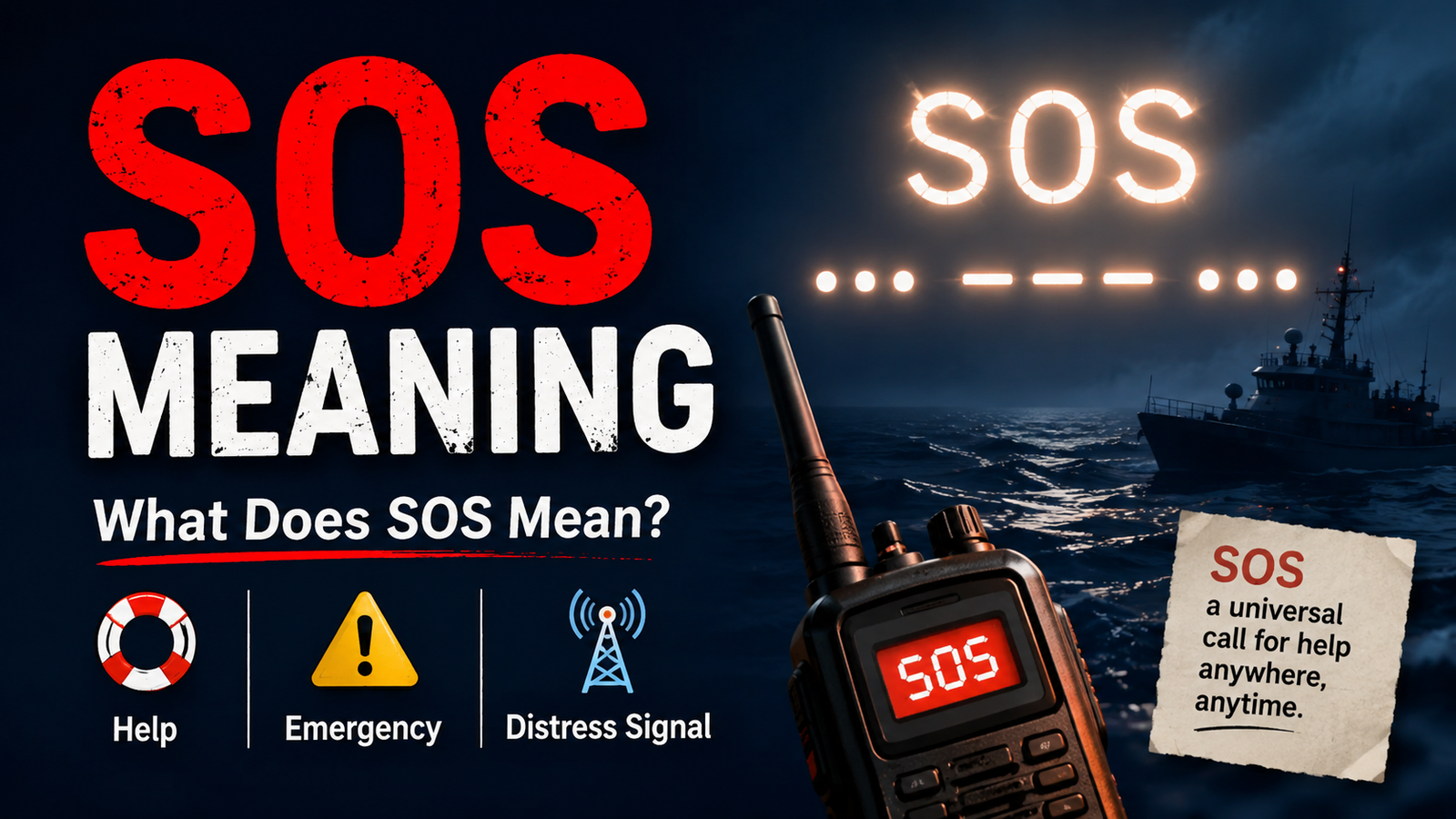
SOS meaning is commonly understood as a message asking for immediate help or rescue. You may see “SOS” in emergency situations, text messages, social media posts, movies, and everyday conversations.
Although many people believe SOS stands for “Save Our Souls” or “Save Our Ship,” that is not its original meaning. SOS was created as a simple Morse-code distress signal because its pattern was easy to recognize and difficult to confuse with other signals.
Today, the term has a much broader meaning. Someone might send “SOS!” to a friend who needs help with homework, ask for assistance at work, or use it jokingly when they are having a difficult day.
Today, the term has a much broader meaning. Someone might send “SOS!” to a friend who needs help with homework, ask for assistance at work, or use it jokingly when they are having a difficult day.
Today, the term has a much broader meaning. Someone might send “SOS!” to a friend who needs help with homework, ask for assistance at work, or use it jokingly when they are having a difficult day.
This guide explains SOS meaning, pronunciation, origin, history, examples, synonyms, antonyms, texting usage, and common questions in simple English.
What Does SOS Mean?
SOS means a request for immediate help or assistance, especially during an emergency.
In its original use, SOS was a distress signal used by ships and other forms of communication to indicate serious danger and the need for immediate assistance.
The signal is written as:
SOS
In Morse code, it is represented by:
··· ––– ···
That means three short signals, followed by three long signals, followed by three short signals.
The pattern became famous because it is simple, distinctive, and easy to recognize.
Today, SOS is also used figuratively. For example:
“SOS! I have no idea how to fix this computer.”
Here, the person is not necessarily in physical danger. They simply mean “I really need help.”
SOS Meaning in Simple English
In simple English, SOS means “Help!” or “I need immediate assistance.”
The exact meaning depends on the situation.
In an emergency
SOS can communicate that someone is in serious danger and needs rescue.
For example:
“The hikers sent an SOS after becoming stranded.”
In texting
In a text message, SOS usually has a less serious meaning.
“SOS, what should I wear tonight?”
This means:
“Help me decide what to wear.”
On social media
People often use SOS dramatically or humorously:
“SOS, my phone battery is at 1%.”
The person is usually joking rather than reporting an actual emergency.
How Do You Pronounce SOS?
SOS is normally pronounced by saying each letter separately:
S-O-S
It is not usually pronounced as one ordinary English word.
When spoken aloud, people may say:
“Send an S-O-S.”
The pronunciation is straightforward because SOS is an initialism made from three letters.
What Is the Origin of SOS?
The history of SOS goes back to the early days of wireless communication.
Before SOS became internationally recognized, different radio operators and organizations used different distress signals. One notable signal was CQD, which was associated with the Marconi wireless system.
In 1905, German radio regulations introduced the distinctive Morse pattern that became SOS. In 1906, an international conference in Berlin adopted it as an international maritime distress signal.
The important point is that SOS was not originally an abbreviation for a phrase.
It was selected because its Morse-code pattern—three dots, three dashes, and three dots—was simple and unmistakable. The letters “SOS” later became the familiar way of representing that Morse pattern.
Does SOS Stand for “Save Our Souls”?
Not originally.
You may have heard explanations such as:
- Save Our Souls
- Save Our Ship
- Save Our Seamen
These phrases are memorable and helped people associate the letters with an emergency. However, they were not the reason the signal was originally selected.
According to historical material from the International Telecommunication Union, SOS was essentially chosen as a distinctive Morse-code signal rather than as an abbreviation with a particular phrase behind it.
So, if someone asks, “What does SOS stand for?”, the most accurate answer is:
SOS does not originally stand for a specific phrase. It is a distress signal represented by the Morse-code pattern ··· ––– ···.
Why Was SOS Chosen?
The biggest advantage of SOS was its simplicity.
In Morse code:
- S = ···
- O = –––
- S = ···
The resulting pattern is:
··· ––– ···
It is symmetrical, recognizable, and relatively easy for an operator to transmit.
The International Telecommunication Union explains that the signal was chosen because it was simple and unmistakable.
That simplicity mattered enormously in an emergency. A distress signal needed to be understood quickly, even when communication conditions were poor.
SOS and the Titanic
One of the most famous associations with SOS is the sinking of the Titanic in 1912.
During the disaster, Titanic’s wireless operators used the older CQD distress signal as well as the newer SOS signal. The assistant wireless operator Harold Bride reportedly suggested using SOS, and the signal was transmitted during the emergency.
The Titanic disaster helped demonstrate the importance of standardized emergency communication.
Following the tragedy, international authorities introduced additional maritime safety measures, including procedures for ships to monitor distress communications.
However, it is a common misconception that Titanic was the reason SOS was invented. SOS had already been adopted internationally in 1906.
SOS in Morse Code
SOS is one of the most recognizable Morse-code signals.
Its pattern is:
··· ––– ···
Breaking it down:
First S
···
Three dots.
O
–––
Three dashes.
Final S
···
Three dots again.
Together:
··· ––– ···
The pattern can be sent repeatedly to attract attention.
Is SOS Still Used Today?
The meaning of SOS remains widely recognized, but its original role in maritime Morse communication has changed.
Modern emergency communication relies heavily on technologies such as satellite systems, digital communications, radio voice procedures, emergency beacons, and other systems.
The official use of Morse-code SOS as the maritime distress signal ended on January 1, 1998, as modern satellite-based systems and voice communications took over.
Even though its official historical role has changed, SOS remains a powerful international symbol of distress and a request for help.
SOS Meaning in Texting
On social media and in text messages, SOS usually means “I need help” or “help me quickly.”
However, the situation determines how serious the message is.
For example:
“SOS! I forgot my presentation is today.”
This usually means the person is stressed and wants advice.
Another example:
“SOS, can someone pick me up?”
This could be a genuine request for assistance.
The term has become popular in digital communication because it is short, recognizable, and emotionally expressive.
Examples of SOS in Everyday Conversation
Here are some natural examples:
- “SOS! I can’t find my keys.”Meaning: I really need help finding my keys.
- “Send an SOS if you need me.”Meaning: Contact me immediately if you need help.
- “I need an SOS from my best friend.”Meaning: I need urgent help or advice from my friend.
- “The hikers sent an SOS.”Meaning: The hikers sent a distress signal requesting assistance.
- “SOS, my laptop stopped working.”Meaning: Help! My laptop is not working.
- “This is an SOS situation.”Meaning: This situation requires urgent attention.
SOS Meaning in Relationships
People sometimes use SOS casually in romantic relationships or friendships.
For example:
“SOS, I don’t know what to text him.”
Here, SOS simply means “I need your advice.”
Another person might say:
“SOS, my girlfriend is upset. What should I do?”
Again, the term does not necessarily indicate danger. It adds urgency and emotion to the request.
SOS Meaning on Social Media
On platforms such as Instagram, TikTok, Facebook, X, and messaging apps, SOS is often used as slang.
A person might write:
“SOS, I’m so tired.”
Or:
“SOS, who knows a good restaurant?”
In these cases, SOS is usually an informal way of saying:
“Help me!”
The expression can be serious, exaggerated, playful, or humorous depending on the context.
SOS vs. Mayday
SOS and Mayday are both associated with emergencies, but they are not exactly the same.
SOS originated as a Morse-code distress signal.
Mayday is a spoken radiotelephone distress call. Historical ITU regulations distinguish between the Morse distress signal SOS and the spoken distress signal MAYDAY.
In simple terms:
| Term | Main use |
|---|---|
| SOS | Historical Morse-code distress signal |
| Mayday | Spoken distress call |
| Help | General request for assistance |
| Emergency | General description of a dangerous situation |
Synonyms of SOS
The best synonym depends on the context.
Common alternatives include:
- Help
- Distress signal
- Emergency call
- Call for help
- Urgent request
- Request for assistance
- Cry for help
- Warning
- Alert
For casual texting, “help” is the closest simple synonym.
For historical or maritime contexts, “distress signal” is more accurate.
Antonyms of SOS
SOS does not have a perfect opposite because it is a signal rather than an ordinary adjective or verb.
Depending on the context, possible conceptual opposites include:
- Safety
- All clear
- No emergency
- Everything is fine
- Assistance not needed
- Safe
For example:
“SOS” suggests a need for help.
By contrast:
“All clear” suggests that there is no immediate danger.
Common Mistakes About SOS
Mistake 1: Saying SOS officially means “Save Our Souls”
This is probably the most common misunderstanding.
Although “Save Our Souls” is a popular backronym, it was not the original reason for choosing SOS.
Mistake 2: Thinking Titanic invented SOS
SOS existed before the Titanic disaster.
The international adoption of the signal occurred in 1906, while Titanic sank in 1912.
Mistake 3: Thinking SOS is only used at sea
Historically, its major role was maritime distress communication, but the expression later became a general symbol of emergency.
Today, people use SOS in ordinary speech, texting, online posts, signs, and other contexts.
Mistake 4: Assuming every “SOS” message is a real emergency
Online, people frequently use SOS humorously.
Always consider the context before deciding whether someone is actually in danger.
Why Is SOS Still Popular?
SOS has survived because it is incredibly easy to recognize.
Three letters communicate a powerful idea with almost no explanation: something is wrong and help is needed.
Its historical connection with rescue and emergency communication also gives it emotional weight.
Even though technology has changed dramatically since the early days of wireless radio, the basic human message behind SOS remains relevant.
People still need help. The way they ask for it has simply evolved.
SOS Meaning: Quick Summary
If you need the answer quickly, remember these points:
- SOS means a distress signal or urgent request for help.
- It is commonly associated with emergencies.
- Its Morse-code form is ··· ––– ···.
- SOS was internationally adopted as a maritime distress signal in 1906.
- It was not originally an abbreviation for “Save Our Souls” or “Save Our Ship.”
- Titanic used both CQD and SOS during its 1912 disaster.
- Today, SOS is commonly used in texting and social media to mean “Help!”
- The official maritime use of Morse-code SOS ended on January 1, 1998.
Frequently Asked Questions About SOS Meaning
What does SOS mean?
SOS is a widely recognized distress signal meaning that someone needs immediate help or assistance. In modern informal communication, it can simply mean “Help!”
What does SOS stand for?
SOS does not originally stand for a phrase. It represents the Morse-code distress pattern ··· ––– ···. Phrases such as “Save Our Souls” are later interpretations rather than the original source of the signal.
What does SOS mean in texting?
In texting, SOS usually means “I need help” or “Help me quickly.” It is often used casually or humorously.
What is SOS in Morse code?
SOS in Morse code is three dots, three dashes, and three dots: ··· ––– ···.
Why is SOS associated with emergencies?
SOS was internationally adopted as a maritime distress signal because its Morse-code pattern was simple and unmistakable.
Is SOS still an official emergency signal?
The historical Morse-code maritime use of SOS ended in 1998, with modern communication and satellite systems taking its place. However, SOS remains widely recognized as a symbol of distress and an urgent need for assistance.
Did Titanic use SOS?
Yes. Titanic’s wireless operators used the older CQD signal and also transmitted the newer SOS signal during the disaster.
Is “Save Our Souls” the real meaning of SOS?
No. “Save Our Souls” is a popular phrase associated with SOS, but the original signal was selected for its distinctive Morse-code pattern rather than because the letters represented those words.
What is another word for SOS?
Depending on the context, alternatives include help, distress signal, emergency call, alert, call for assistance, and cry for help.
Conclusion
The SOS meaning is simple: a signal or message asking for help, especially in an emergency.
Its history, however, is more interesting than the three letters suggest. SOS began as a carefully chosen Morse-code pattern rather than an abbreviation for “Save Our Souls” or “Save Our Ship.” It was internationally adopted in 1906 because it was simple, distinctive, and easy to recognize.
The signal later became strongly associated with famous maritime disasters, including the Titanic, and eventually entered everyday language.
Today, when someone types “SOS!” in a group chat, they may not be floating in the middle of the ocean. They might simply be asking a friend for advice. But the core idea remains the same: something is wrong, and help is needed.
That is why SOS remains one of the most recognizable expressions of urgency in the English language.