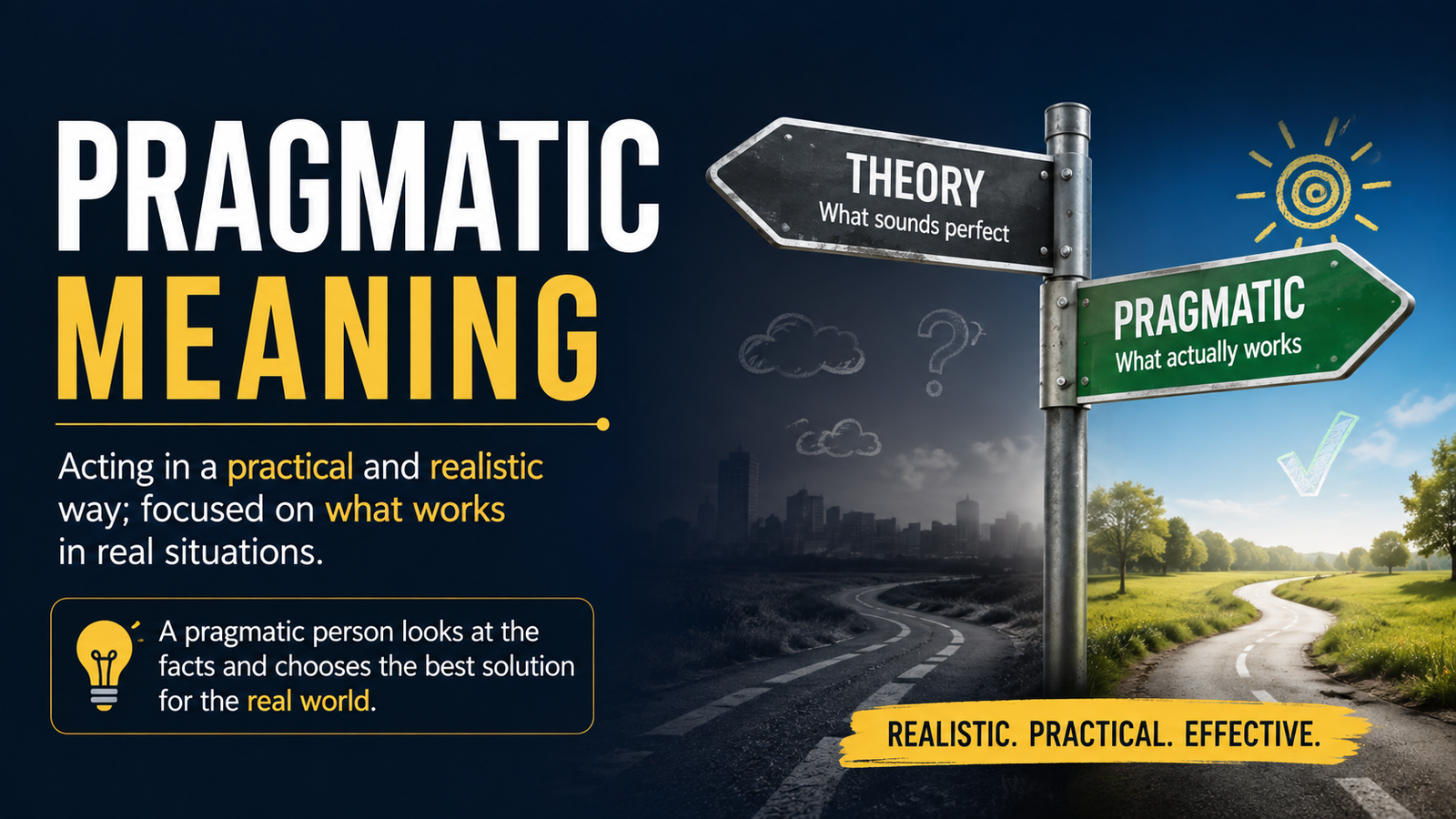
If you have ever heard someone say, “We need a more pragmatic approach,” you may have wondered what pragmatic meaning actually is. In simple English, pragmatic means practical, realistic, and focused on what works in a real situation rather than what sounds perfect in theory.
A pragmatic person looks at the facts, considers the circumstances, and chooses a solution that is likely to work. They do not necessarily ignore ideals or emotions, but they usually give more attention to real-world results.
For example, imagine two people are planning a trip. One wants to visit every attraction on the list, while the other points out that they only have one day. Choosing the most important places instead of trying to see everything would be a pragmatic decision.
The word is common in everyday English, business, politics, education, relationships, and professional conversations. Cambridge defines pragmatic as solving problems in a sensible way that fits the conditions that actually exist, while Oxford describes it as solving problems practically and sensibly rather than following fixed theories or ideas.
What Does Pragmatic Mean?
Pragmatic means dealing with problems and situations in a practical and sensible way.
In other words, a pragmatic person asks:
- What is realistic?
- What can we actually do?
- What solution is most likely to work?
- What are the facts?
- What will produce the best practical result?
The key idea behind pragmatic meaning is the difference between an ideal solution and a workable solution.
Suppose a company wants to reduce expenses. An idealistic approach might be to eliminate every unnecessary cost immediately. A pragmatic approach would examine the company’s finances, identify the biggest problems, and make changes that can realistically be implemented without damaging the business.
That is why pragmatic is often associated with words such as practical, realistic, sensible, reasonable, and down-to-earth.
Pragmatic Meaning in Simple English
In very simple English:
Pragmatic = practical and realistic.
It describes someone who focuses on what works in real life, rather than becoming too focused on theories, dreams, rules, or perfect solutions.
For example:
“She took a pragmatic approach to the problem.”
This means she looked at the actual situation and chose a practical solution.
Another example:
“He is pragmatic about money.”
This means he thinks realistically about money and makes decisions based on what is financially possible.
Pragmatic Pronunciation
The word pragmatic is pronounced with the main stress on the second syllable.
Cambridge gives the UK pronunciation as /præɡˈmæt.ɪk/ and the US pronunciation as /præɡˈmæt̬.ɪk/. Oxford lists the pronunciation as /præɡˈmætɪk/.
The pronunciation can be thought of as three syllables, with the strongest stress on -mat-.
A common mistake is to put too much stress on the first part of the word. The middle syllable should receive the main emphasis.
Origin and Etymology of Pragmatic
The history of pragmatic is closely connected with the idea of action and practical affairs.
The word ultimately comes from the ancient Greek pragmatikos, which was related to pragma, meaning a deed, act, fact, thing, or matter. The Greek root is connected with a verb meaning to do or act. It passed into Latin as pragmaticus, a word associated with practical affairs, business, and law.
English began using pragmatic centuries ago. Interestingly, its earliest English meanings were not exactly the same as today’s common meaning. Merriam-Webster notes that older senses included meanings such as “busy,” “meddlesome,” and “opinionated.” These uses are now considered archaic.
Over time, the word developed toward its modern sense of being concerned with facts, practical matters, and real-world results.
The modern meaning became especially established during the 19th century. The word is also closely related to pragmatism, the philosophical tradition that emphasizes practical consequences and real-world effects.
Pragmatic vs. Practical: What’s the Difference?
Pragmatic and practical are very similar, but they are not always interchangeable.
Practical usually describes something that is useful, workable, or suitable for actual use.
Pragmatic often describes a way of thinking or making decisions based on circumstances and consequences.
For example:
- “This is a practical car.”
This means the car is useful and suitable for everyday needs. - “She made a pragmatic decision.”
This means she considered the situation and selected a realistic option.
A practical object can be useful, while a pragmatic person usually thinks realistically about what should be done.
What Is a Pragmatic Person?
A pragmatic person is someone who focuses on realistic solutions instead of getting stuck on ideal outcomes.
They usually consider:
- The facts of a situation
- Available resources
- Possible consequences
- Time and limitations
- What is realistically achievable
Being pragmatic does not mean being cold, selfish, or careless. A person can care deeply about others while still making practical decisions.
For instance, a parent may want to buy an expensive gift for a child but realize that it would create financial problems. Choosing a less expensive gift may be a pragmatic decision.
Examples of Pragmatic in Everyday Sentences
Here are some simple examples of how pragmatic is used:
- We need a pragmatic solution to this problem.
- She is very pragmatic when it comes to managing money.
- The manager took a pragmatic approach to the company’s financial problems.
- His pragmatic decision saved the team a lot of time.
- Instead of arguing about the perfect plan, they chose a pragmatic option.
- A pragmatic student focuses on both good grades and useful skills.
- The government adopted a pragmatic policy to deal with the crisis.
- He is idealistic about his goals but pragmatic about how to achieve them.
- Her pragmatic attitude helped the family solve the problem quickly.
- We should be pragmatic and work with the resources we have.
These examples show that the word can describe a person, attitude, approach, decision, solution, policy, or strategy.
Pragmatic Meaning in a Sentence
Consider this sentence:
“John was pragmatic about his career choice.”
This means John did not choose a career based only on dreams or emotions. He probably considered factors such as job opportunities, income, skills, education, and long-term stability.
Another example:
“The company needs a pragmatic strategy.”
Here, pragmatic means the strategy should be realistic and achievable rather than simply ambitious on paper.
Pragmatic in Business
The word pragmatic is especially common in business.
Businesses deal with budgets, deadlines, employees, customers, competition, and changing market conditions. Because of this, companies often need solutions that work in practice.
A pragmatic business leader might change a plan when market conditions change instead of stubbornly following the original strategy.
For example:
“The CEO took a pragmatic approach to declining sales.”
This suggests that the CEO examined the actual problem and considered realistic ways to improve the company’s performance.
A pragmatic approach in business may involve reducing unnecessary expenses, changing a product, adjusting prices, improving customer service, or entering a more suitable market.
Pragmatic Meaning in Relationships
Pragmatic can also describe relationships and personal decisions.
For example, someone might say:
“She is pragmatic about relationships.”
This could mean that she considers compatibility, communication, trust, lifestyle, and long-term goals rather than relying only on romantic feelings.
However, being pragmatic does not mean removing emotion from relationships. It simply means balancing feelings with reality.
A pragmatic person might think:
“I care about this person, but we also need to consider whether our goals and circumstances are compatible.”
Pragmatic Meaning in Politics
The word is frequently used in political discussions.
A pragmatic politician is generally someone who is willing to compromise or adjust policies when necessary to achieve a practical result.
For example:
“The politician took a pragmatic position on the issue.”
This could mean the politician focused on what could realistically be achieved instead of insisting on an absolute position.
In politics, pragmatic can therefore suggest flexibility, compromise, and attention to practical consequences.
Pragmatic Meaning in Education
Students and teachers can also use the word.
A pragmatic approach to education focuses on skills and knowledge that students can actually apply.
For example:
“The school introduced a pragmatic approach to career preparation.”
This might involve internships, practical projects, communication skills, computer skills, or job-related training.
A student can also be pragmatic by thinking about both academic interests and future career opportunities.
Pragmatic vs. Idealistic
One of the most useful ways to understand pragmatic is to compare it with idealistic.
An idealistic person may focus on how things should be according to their values, hopes, or principles.
A pragmatic person focuses more strongly on what can realistically be done under current conditions.
For example, imagine a town has a limited budget for road repairs.
An idealistic approach might be:
“Every road should be repaired immediately.”
A pragmatic approach might be:
“We only have enough money to repair the most dangerous roads this year, so let’s prioritize them.”
Neither approach is automatically good or bad. Idealism can inspire positive change, while pragmatism can help turn goals into workable action.
In many real-life situations, the strongest approach combines both.
Pragmatic Synonyms
Common synonyms for pragmatic include:
- Practical
- Realistic
- Sensible
- Reasonable
- Down-to-earth
- Level-headed
- Rational
- Real-world
- Functional
- Matter-of-fact
- Workable
- Results-oriented
The best synonym depends on the sentence.
For example, realistic works well when discussing expectations, while practical is often appropriate for solutions or decisions.
Oxford specifically lists realistic as a synonym for pragmatic in its learner’s dictionary.
Pragmatic Antonyms
Words that can work as antonyms of pragmatic include:
- Idealistic
- Impractical
- Unrealistic
- Theoretical
- Unreasonable
- Unrealistic
- Imprudent
- Abstract
- Unworkable
The strongest opposite depends on context.
For example:
Pragmatic: “Let’s choose a solution we can afford.”
Unrealistic: “Let’s choose the most expensive solution even though we have no budget.”
Similarly:
Pragmatic: “We have limited time, so let’s focus on the most important tasks.”
Idealistic: “We should complete everything perfectly, regardless of how long it takes.”
Common Collocations With Pragmatic
You will often see pragmatic used with certain nouns and phrases.
Common examples include:
- pragmatic approach
- pragmatic solution
- pragmatic decision
- pragmatic choice
- pragmatic person
- pragmatic attitude
- pragmatic strategy
- pragmatic policy
- pragmatic response
- pragmatic way
- pragmatic thinking
- pragmatic leadership
Among these, pragmatic approach and pragmatic solution are especially common.
Pragmatic vs. Pragmatism
These two words are related but have different grammatical roles.
Pragmatic is usually an adjective.
Example:
“She has a pragmatic approach.”
Pragmatism is a noun.
Example:
“His decision was based on pragmatism.”
Oxford defines pragmatism as thinking about solving problems in a practical and sensible way rather than following fixed ideas or theories.
Pragmatism can also refer specifically to the philosophical tradition associated with thinkers such as Charles Sanders Peirce, William James, and John Dewey.
Is Being Pragmatic a Good Thing?
In most everyday contexts, being pragmatic is considered positive.
A pragmatic person can often avoid wasting time, resources, or energy on unrealistic plans. They are usually willing to adapt when circumstances change.
However, pragmatism can have limits.
If someone becomes too focused on practical results, they may ignore ethics, emotions, principles, or long-term consequences.
For example, a person might argue that a decision is financially beneficial while ignoring whether it is fair.
The healthiest form of pragmatism is usually practical thinking combined with good judgment and strong values.
How to Use Pragmatic Correctly
Use pragmatic when you want to describe something that is based on realistic circumstances and practical results.
Correct:
“We need a pragmatic solution.”
Correct:
“She is pragmatic about her career.”
Correct:
“The team took a pragmatic approach.”
A common mistake is using pragmatic simply to mean “good” or “smart.” The word has a more specific meaning: it emphasizes practicality and real-world conditions.
Frequently Asked Questions About Pragmatic Meaning
What does pragmatic mean in simple words?
Pragmatic means practical and realistic. A pragmatic person focuses on what can actually work in a particular situation.
What is an example of a pragmatic person?
Someone who has a limited budget but chooses an affordable and reliable option instead of buying something expensive just because it looks better is being pragmatic.
Is pragmatic positive or negative?
Usually, pragmatic has a positive meaning because it suggests sensible and realistic thinking. However, excessive pragmatism can sometimes be criticized if it causes someone to ignore principles or emotions.
What is the opposite of pragmatic?
Common opposites include idealistic, impractical, unrealistic, theoretical, and unworkable. The exact antonym depends on the context.
What is the difference between pragmatic and practical?
Both words relate to real-world usefulness. Practical often means useful or workable, while pragmatic more specifically describes a realistic way of thinking, deciding, or solving problems.
How do you pronounce pragmatic?
The main stress falls on the second syllable. Cambridge gives the UK pronunciation as /præɡˈmæt.ɪk/ and the US pronunciation as /præɡˈmæt̬.ɪk/.
What is the origin of pragmatic?
Pragmatic ultimately comes from Greek pragmatikos, related to pragma, meaning a deed, act, fact, or matter. It passed through Latin before entering English.
Can pragmatic describe a person?
Yes. A pragmatic person makes decisions based on realistic conditions and likely results instead of relying only on ideals or theories.
Conclusion
The simplest way to understand pragmatic meaning is practical, realistic, and focused on what works.
A pragmatic person looks at the situation as it really is. They consider available resources, limitations, consequences, and possible results before making a decision.
The word has a long history connected to action, deeds, business, and practical affairs. Its modern English meaning developed toward the idea of dealing with real-world problems sensibly.
Whether you encounter pragmatic in a business article, political discussion, classroom, relationship conversation, or everyday speech, the central idea remains the same: focus on reality and choose a workable path forward.
In short, being pragmatic does not mean giving up on your dreams. It means understanding reality well enough to find a practical way to move toward them.