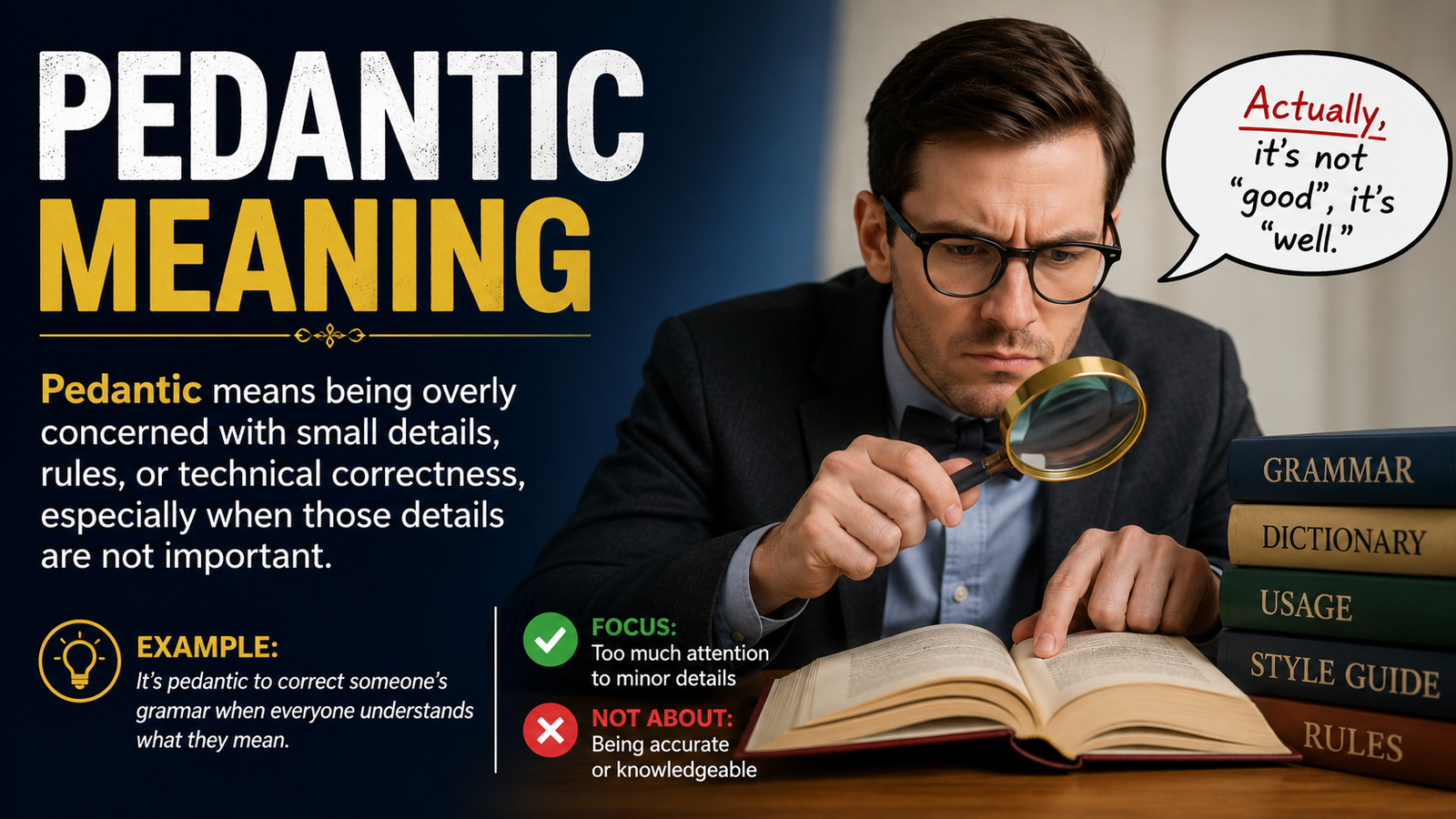
If someone calls a person pedantic, they usually mean that the person pays too much attention to small details, strict rules, or technical correctness. The word often describes someone who focuses on minor points even when those points are not important to the main conversation.
If someone calls a person pedantic, they usually mean that the person pays too much attention to small details, strict rules, or technical correctness. The word often describes someone who focuses on minor points even when those points are not important to the main conversation.
For example, if someone says, “The meeting started around 9,” and another person immediately responds, “Actually, it started at exactly 9:03,” that correction could be described as pedantic if the exact time does not matter.
The word can be useful when talking about language, education, writing, academic discussions, workplace conversations, or everyday arguments. It is usually disapproving, although being careful and accurate is not automatically a bad thing.
In this guide, you will learn the pedantic meaning, pronunciation, origin, examples, synonyms, antonyms, common usage, and the difference between being pedantic and simply being precise.
What Does Pedantic Mean?
Pedantic means being overly concerned with small details, formal rules, or technical correctness, especially when those details are not important to the bigger picture.
Cambridge Dictionary defines pedantic as giving too much attention to formal rules or small details. Oxford similarly describes it as being too worried about small details or rules.
In simple English, pedantic means caring too much about little details or rules.
A pedantic person may correct other people’s grammar, pronunciation, facts, calculations, or wording even when the correction does not help the situation.
For example:
“I said the movie was released about ten years ago.”
A pedantic response might be:
“Actually, it was released nine years and eleven months ago.”
The second person may be completely correct. However, if the exact date is irrelevant, their correction can seem unnecessarily fussy.
That is the important idea behind pedantic: the problem is not necessarily accuracy itself. The problem is giving too much importance to minor accuracy or formal correctness.
Pedantic Meaning in Simple Words
The easiest way to understand pedantic is:
Too focused on small details, rules, or technical correctness.
Imagine that a friend tells you:
“I have been waiting for an hour.”
You know they mean they have been waiting for a long time. A pedantic response might be:
“Technically, it has only been 57 minutes.”
The statement may be accurate, but the correction probably does not add anything useful.
So, being pedantic is often about how and when someone uses their knowledge, not simply how much knowledge they have.
A knowledgeable person can explain something clearly and helpfully. A pedantic person may use that knowledge to point out tiny mistakes or demonstrate that they know the technically correct answer.
Pedantic Pronunciation
The pronunciation of pedantic varies slightly between English accents.
The word is commonly pronounced with the stress on the second syllable in American English. Cambridge lists British pronunciation as /pəˈdæn.tɪk/ and American pronunciation as /pedˈæn.tɪk/ in its dictionary entries.
When learning the word, focus on the stressed middle syllable. The ending sounds like the ending in words such as “romantic” or “semantic.”
Is Pedantic a Positive or Negative Word?
Pedantic is usually negative or disapproving.
Calling someone pedantic normally suggests that they are being unnecessarily concerned with details, rules, or technical points.
For example:
- Neutral: “She is very precise when preparing financial reports.”
- Negative: “She is pedantic about every tiny formatting mistake.”
Both people may be careful, but the second sentence suggests that the person’s attention to detail has become excessive.
Merriam-Webster also describes pedantic as disapproving and connects it with being overly concerned with minor details or being narrowly scholarly.
However, context matters. Someone may jokingly call themselves pedantic when they enjoy correcting a small factual detail.
For example:
“I know this is pedantic, but technically that word has a different meaning.”
Here, the speaker recognizes that the correction may be unnecessarily detailed.
Origin and History of the Word Pedantic
The word pedantic comes from the noun pedant combined with the adjective-forming suffix -ic.
Dictionary sources trace pedantic to the late 16th or early 17th century. Dictionary.com gives the first recorded period as around 1590–1600, while Merriam-Webster records its first known use in 1628.
The older word pedant referred to a teacher or schoolmaster. Etymonline traces it through French pédant and Italian pedante, with the older sense connected to a teacher or schoolmaster. Over time, pedant developed a more negative meaning: a person who emphasizes minor points of learning or displays knowledge in an excessive way.
That history helps explain the modern meaning of pedantic. The word became associated not simply with education, but with someone who makes a show of knowledge or places excessive importance on academic details.
What Is a Pedantic Person?
A pedantic person is someone who frequently focuses on technical details, strict rules, or small mistakes.
They might:
- Correct minor grammatical mistakes.
- Insist on an exact definition.
- Point out tiny factual errors.
- Focus heavily on rules.
- Interrupt conversations to make technical corrections.
- Care more about wording than the main idea.
- Display specialized knowledge when it is unnecessary.
- Argue over distinctions that have little practical importance.
For example:
“He is so pedantic that he corrects everyone’s pronunciation during casual conversations.”
This does not necessarily mean the person is unintelligent or wrong. In fact, a pedantic person may be highly knowledgeable. The criticism is that their attention to technical details becomes excessive or unhelpful.
Pedantic Examples in Everyday Sentences
Here are some natural examples of pedantic in everyday English:
- “His pedantic approach to grammar made the conversation uncomfortable.”
- “I don’t want to sound pedantic, but that isn’t technically the correct definition.”
- “The teacher was knowledgeable without becoming pedantic.”
- “Her pedantic insistence on following every rule slowed the project down.”
- “It seems pedantic to argue about one minute when everyone knows the approximate time.”
- “He gave such a pedantic explanation that nobody understood the simple answer.”
- “The editor was careful, but not pedantic.”
- “Stop being pedantic and look at the bigger issue.”
- “His comments were technically accurate but unnecessarily pedantic.”
- “She can be a little pedantic when discussing grammar.”
These examples show that pedantic usually describes a behavior or attitude rather than simply describing someone who is intelligent or educated.
Examples of Pedantic Behavior
Pedantic behavior can appear in many situations.
In Conversation
Someone says:
“I have been working here for about five years.”
A pedantic person might reply:
“Actually, it will be five years next month.”
The correction may be technically accurate, but the exact difference is probably unimportant.
In School
A teacher may spend several minutes correcting a student’s tiny wording mistake instead of explaining the main concept.
That teaching style could be described as pedantic.
At Work
Imagine a team discussing an important business problem. One employee spends ten minutes arguing about whether a colleague used the word “strategy” or “plan.”
If the distinction does not affect the decision, coworkers may consider that discussion pedantic.
Online
Social media discussions frequently produce pedantic arguments. Someone may make a general statement, and another person responds by focusing on one tiny technical exception.
The correction may be true, but it can distract from the main point.
Pedantic vs. Precise
One of the most important distinctions is between pedantic and precise.
Being precise means being exact and careful, usually for a good reason.
Being pedantic suggests being excessively concerned with exactness, especially when the detail does not matter.
For example:
Precise:
“A medical report needs the exact dosage because the information affects patient safety.”
Pedantic:
“It’s pedantic to interrupt a casual conversation just to correct an insignificant wording choice.”
Precision is often valuable. Pedantry is usually criticized because the precision is excessive or poorly timed.
Pedantic vs. Meticulous
Meticulous means extremely careful and attentive to detail. It is often positive.
For example:
“She is meticulous when checking the company’s financial records.”
That usually sounds like a compliment.
By contrast:
“She is pedantic about every tiny detail in a casual email.”
This sounds negative.
A meticulous person pays attention to details because the details matter. A pedantic person may pay attention to details even when they do not matter much.
Pedantic vs. Picky
The word picky means being difficult to please or choosing very carefully.
Someone can be picky about food, clothing, design, or other personal preferences.
Pedantic, however, is more strongly connected with knowledge, rules, definitions, correctness, and technical details.
For example:
- “He is picky about what he eats.”
- “He is pedantic about grammar.”
The first concerns preference. The second concerns correctness and rules.
Synonyms of Pedantic
Depending on the context, useful synonyms include:
- Nitpicking
- Fussy
- Finicky
- Punctilious
- Hairsplitting
- Overly meticulous
- Academic
- Scholarly
- Pompous
- Dogmatic
- Bookish
- Scholastic
- Didactic
Cambridge’s thesaurus includes terms such as pompous, academic, scholastic, didactic, dogmatic, punctilious, hairsplitting, nitpicking, and overly meticulous among related words.
Not every synonym has exactly the same meaning. Nitpicking, for example, strongly emphasizes finding tiny faults, while pompous focuses more on an inflated sense of importance.
Antonyms of Pedantic
Some useful opposites include:
- Straightforward
- Simple
- Succinct
- Pithy
- General
- Informal
- Practical
- Broad-minded
- Flexible
Cambridge lists succinct, pithy, straightforward, vague, general, and comprehensive among antonym-related terms.
The best opposite depends on the context. If pedantic means overly complicated and detail-focused, straightforward may be the best contrast. If it refers to excessive concern with formal rules, flexible may express the opposite idea more naturally.
Common Ways to Use Pedantic
The word is commonly used in phrases such as:
“Being pedantic”
“I’m being pedantic, but technically that isn’t correct.”
This phrase is often used when someone knows they are focusing on a small technical point.
“A pedantic person”
“He is a pedantic person who corrects every little mistake.”
“A pedantic approach”
“The company’s pedantic approach to paperwork created unnecessary delays.”
“Pedantic about”
“She is pedantic about grammar.”
“Pedantic distinction”
“That seems like a pedantic distinction in this situation.”
This last expression is especially common when two ideas are technically different but practically similar.
When Should You Use the Word Pedantic?
Use pedantic when you want to describe unnecessary attention to minor rules, technicalities, or details.
It is especially useful when discussing:
- Grammar
- Language
- Education
- Academic debates
- Writing
- Workplace rules
- Technical discussions
- Arguments
- Definitions
- Factual corrections
However, remember that the word usually carries criticism. If you simply want to compliment someone for being careful, words such as precise, thorough, accurate, meticulous, or careful may be better choices.
Is Being Pedantic Always Bad?
Not necessarily.
There are situations where extreme accuracy is genuinely useful. Scientists, engineers, lawyers, editors, doctors, programmers, accountants, and researchers may need to pay close attention to details.
The same behavior can be useful in one situation and pedantic in another.
For example, checking the exact wording of a legal contract is not necessarily pedantic because small differences can have major consequences.
On the other hand, arguing about whether someone said “nearly 100” instead of “approximately 100” during a casual conversation may be pedantic if the distinction has no practical value.
The key question is:
Does the detail actually matter in this situation?
If it does, careful attention can be valuable. If it does not, excessive correction may come across as pedantic.
Pedantic in Modern English
The word pedantic remains common in modern English, especially when people discuss education, writing, grammar, criticism, and intellectual debates.
Current dictionary examples continue to use it for people and approaches that become excessively focused on procedure, technical correctness, or minor points. Merriam-Webster’s current entry also distinguishes several related senses, including narrow scholarly behavior and an unimaginative or dull style.
Online communication has also made the concept easy to recognize. Comment sections, forums, and social media often contain debates where someone corrects a minor detail that was not central to the original point.
That does not mean every correction is pedantic. A correction becomes more likely to seem pedantic when it is unnecessary, overly technical, or distracting from the main issue.
Frequently Asked Questions About Pedantic Meaning
What does pedantic mean in simple English?
Pedantic means being too concerned with small details, rules, or technical correctness, especially when those details are not important.
Is pedantic a negative word?
Yes. Pedantic is usually a negative or disapproving word. It often suggests that someone is unnecessarily focused on minor details or is showing off their knowledge.
What is an example of a pedantic person?
A person who constantly interrupts conversations to correct tiny grammar mistakes, exact dates, definitions, or technical details may be described as pedantic.
What is the difference between pedantic and precise?
Precise usually means accurately and carefully stated or done. Pedantic suggests excessive concern with accuracy or rules when that level of detail is unnecessary.
What are the synonyms of pedantic?
Common synonyms include nitpicking, fussy, punctilious, hairsplitting, academic, pompous, scholarly, and overly meticulous, depending on the context.
What is the opposite of pedantic?
Possible opposites include straightforward, simple, flexible, succinct, and general. The best antonym depends on the sentence.
Can pedantic be used for a teacher?
Yes. A teacher may be called pedantic if they focus excessively on minor rules or technical details instead of helping students understand the larger concept. However, careful teaching itself is not pedantic.
Is pedantic the same as picky?
No. Picky usually describes someone who is difficult to please or selective about preferences. Pedantic specifically relates more to rules, knowledge, technical correctness, and minor details.
What does “don’t be pedantic” mean?
“Don’t be pedantic” means “Don’t focus unnecessarily on a small technical detail or minor correction.” It often tells someone to focus on the main idea instead.
Final Thoughts on Pedantic Meaning
The simplest way to remember pedantic is: too much attention to small details or rules when that level of attention is unnecessary.
The word is usually negative, but it does not mean that accuracy, intelligence, or education is bad. The difference is mainly about proportion and context.
A precise person gets the details right because they matter. A meticulous person carefully checks important information. A pedantic person may insist on tiny distinctions even when those distinctions add little value.
So, if someone says, “You’re being pedantic,” they are usually not saying that you are wrong. They are saying that you are too focused on a minor point.
Understanding that distinction makes it much easier to use the word naturally in everyday English, academic writing, workplace conversations, and online discussions.