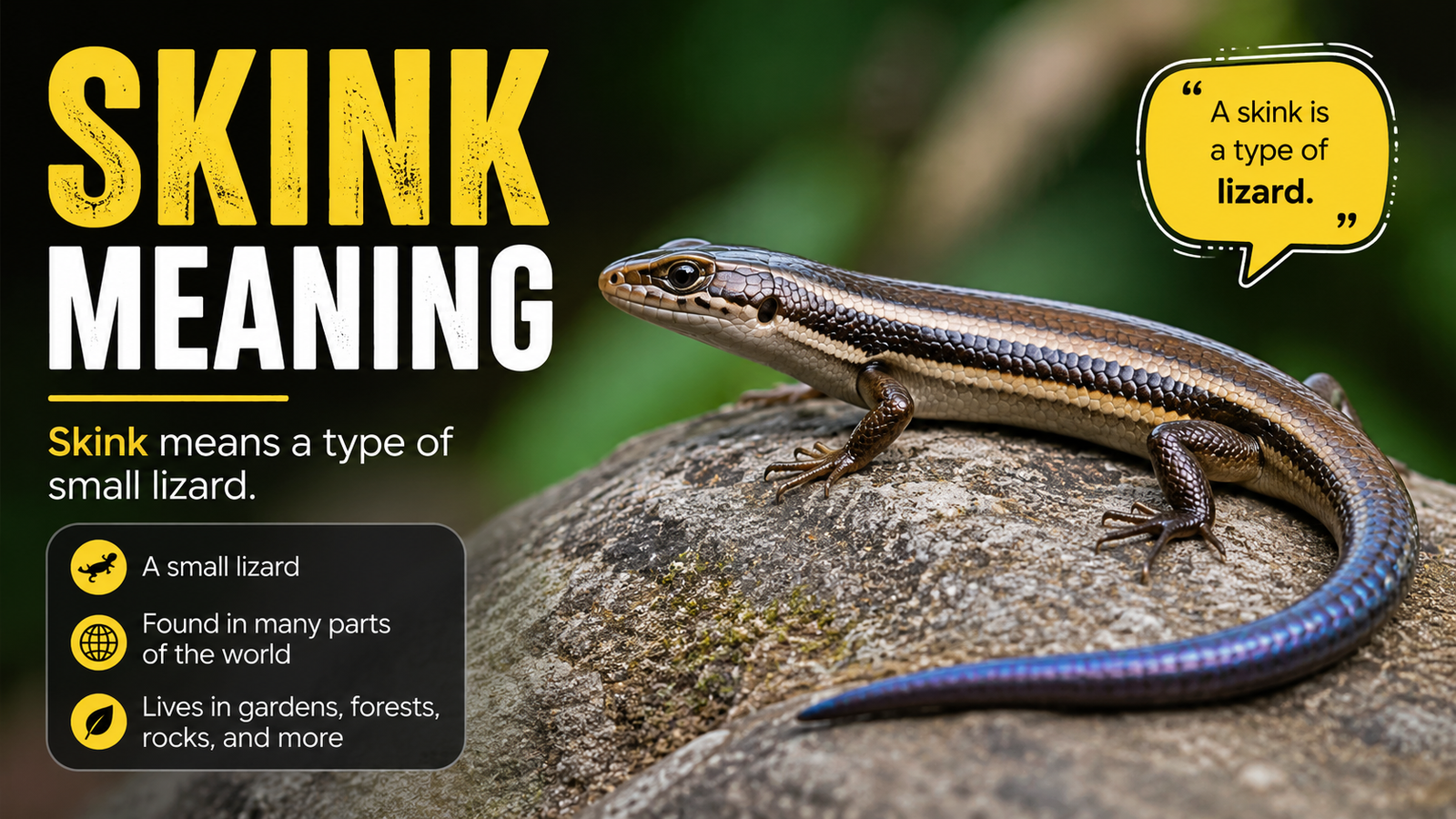
If you have come across the word “skink” and wondered what it means, you are not alone. It is a less common English word, but it refers to a real and fascinating group of reptiles.
The simplest skink meaning is a small lizard with a long body, short legs, and a smooth or shiny appearance. Skinks belong to the lizard family and are found in many warm parts of the world. Cambridge Dictionary defines a skink as a small lizard found in various hot regions.
The word can appear in conversations about animals, wildlife, nature, biology, pets, and outdoor environments. Although skinks are lizards, they can look quite different from the lizards people commonly imagine.
In this guide, we will explain skink meaning, pronunciation, origin, examples, synonyms, antonyms, common usage, and related questions in clear and simple English.
What Does Skink Mean?
A skink is a type of small to medium-sized lizard. Skinks are reptiles and are known for their elongated bodies, relatively short legs, and smooth-looking scales.
In simple words:
Skink = a type of lizard.
For example:
“We saw a skink moving through the garden.”
In this sentence, skink refers to a particular kind of lizard.
Skinks come in many different shapes, sizes, and colors. Some have stripes, while others have plain bodies. Depending on the species, they may live in forests, grasslands, deserts, rocky areas, gardens, or other suitable habitats.
The word is normally used as a noun. Cambridge lists skink as a countable noun, meaning you can say a skink, one skink, or several skinks.
Skink Meaning in Simple English
If you need an easy definition, remember this:
A skink is a small lizard with a long body and short legs.
It is not the name of one single animal. Instead, skink is a general term used for many species of lizards.
Skink Pronunciation
The word skink is pronounced:
/skɪŋk/
It has one syllable and rhymes closely with words such as “think” and “sink.” Cambridge gives the same pronunciation for both British and American English.
The pronunciation can be broken down into three main sound parts:
- sk — like the beginning of “skin”
- i — the short vowel sound heard in “sit”
- nk — like the ending of “sink”
A common mistake is to pronounce skink as though it were “skunk.” These are completely different words.
A skink is a lizard, while a skunk is a small mammal known for producing a strong unpleasant smell as a defense.
What Is a Skink?
A skink is a reptile belonging to the lizard group. Skinks are particularly interesting because their bodies often look more streamlined than those of many familiar lizards.
Many species have:
- Long bodies
- Short legs
- Long tails
- Smooth or overlapping scales
- Small heads
- Four legs, although some species have very reduced limbs
- Different colors and patterns
Not every skink looks exactly the same. The group contains a wide variety of species adapted to different environments.
Some skinks spend much of their time on the ground, while others climb, burrow, or live among vegetation.
Their diets also vary by species. Depending on the skink, food may include insects, other small animals, fruits, plants, or a mixture of different foods.
Where Are Skinks Found?
Skinks occur in many parts of the world, particularly in warmer regions.
They can be found in places such as:
- Australia
- Africa
- Asia
- Europe
- North America
- Pacific islands
- Other warm or temperate areas
Their habitats can be extremely different. Some species prefer dry environments, while others live in forests, wetlands, gardens, rocky areas, or grasslands.
This variety is one reason the word skink does not describe one specific appearance.
When someone says, “I saw a skink,” they have identified the animal as belonging to a particular group of lizards, but they have not necessarily identified its exact species.
Skink Origin and Etymology
The word skink has a long history in English. It is an old term connected with names used for these lizards in earlier forms of English and through historical European usage.
The scientific group containing skinks is commonly associated with the family Scincidae. The English word skink, however, is the everyday name used for members of this group.
The history of animal names can sometimes be complicated because words change spelling and pronunciation over centuries. A word may also pass between languages before becoming established in English.
For modern English speakers, the important point is that skink has been used as a name for a type of lizard for a very long time.
Skink vs. Lizard: Are They the Same?
This is one of the most common questions about the word.
The short answer is:
A skink is a type of lizard, but not every lizard is a skink.
Think of it this way:
Lizard = broad group
Skink = one type of lizard
This is similar to saying that a robin is a bird, but not every bird is a robin.
Skinks belong within the larger world of lizards and reptiles. Dictionaries also place skinks among reptile and amphibian names.
Skink vs. Skunk
Because the words skink and skunk look and sound somewhat similar, they are sometimes confused.
However, they describe completely different animals.
Skink
A skink is a type of lizard.
Skunk
A skunk is a small black-and-white mammal, especially associated with North America. It can release a strong unpleasant smell as a defense mechanism.
For example:
“The skink crawled across the rock.”
This sentence is about a lizard.
“The skunk ran away when it was disturbed.”
This sentence is about a mammal.
Remembering this distinction can help prevent spelling and vocabulary mistakes.
Examples of Skink in a Sentence
Here are several natural examples showing how skink is used.
- We spotted a small skink near the rocks.
- The skink quickly disappeared under a pile of leaves.
- A blue-tailed skink was moving across the garden.
- The children watched the skink from a safe distance.
- Scientists studied the skink’s behavior in its natural habitat.
- The skink uses its surroundings to hide from predators.
- I thought it was an ordinary lizard, but it was actually a skink.
- Several skinks were seen warming themselves in the sunlight.
These examples show that skink is primarily used when talking about wildlife or reptiles.
Common Usage of the Word Skink
The word skink is most commonly used in contexts involving animals and nature.
You may encounter it in:
Wildlife Articles
Wildlife websites and nature publications often use skink when discussing particular lizard species.
Example:
“The area provides an ideal habitat for several skink species.”
Biology
Students and researchers may use the word when studying reptiles, animal behavior, habitats, or evolution.
Example:
“The researchers recorded the behavior of local skinks.”
Gardening and Outdoor Conversations
People may notice skinks in gardens, yards, parks, or around rocks and fallen leaves.
Example:
“There is a skink living under the wooden deck.”
Pet and Reptile Communities
Some skink species are kept by reptile enthusiasts. In these settings, people may discuss their diet, habitat, care, behavior, and appearance.
Nature Photography
Photographers and wildlife enthusiasts may use the term when identifying reptiles they encounter outdoors.
Is Skink a Common English Word?
Skink is a real English word, but it is not an especially common everyday word.
Most people are more familiar with words such as lizard, snake, turtle, or frog.
You are more likely to encounter skink in:
- Animal articles
- Wildlife documentaries
- Biology textbooks
- Reptile websites
- Nature guides
- Scientific discussions
- Pet-reptile communities
Because the word is less common, someone who has never studied reptiles may not immediately know what it means.
That does not make it slang or an incorrect word. It is a standard noun used to identify a group of lizards.
Synonyms for Skink
There is no perfect everyday synonym for skink because it is the established name of a particular group of lizards.
However, depending on the context, related terms include:
- Lizard
- Reptile
- Small lizard
- Scincid — a more technical term related to the skink family
The most useful simple substitute is usually lizard, although it is less specific.
For example:
“I saw a skink in the garden.”
Could become:
“I saw a small lizard in the garden.”
The second sentence is understandable, but it does not identify the animal as specifically as the word skink does.
Antonyms of Skink
Technically, skink does not have a true antonym.
Antonyms are words with opposite meanings, such as:
- Hot / cold
- Big / small
- Fast / slow
- Light / dark
Since skink is the name of an animal group, there is no single word that means the opposite of skink.
You might find words for completely different types of animals, such as mammal, bird, or fish, but these are not true antonyms.
For example, fish is not the opposite of skink. It is simply a different type of animal.
Related Words and Terms
If you are learning vocabulary connected with skink, several words may be useful.
Lizard
A reptile with a long body, tail, and usually four legs.
Reptile
A broad animal group that includes lizards, snakes, turtles, and crocodilians.
Scales
Small protective structures covering the skin of many reptiles.
Habitat
The natural environment where an animal lives.
Predator
An animal that hunts another animal for food.
Species
A group of organisms that share important biological characteristics and can generally reproduce with one another.
Understanding these related words makes it easier to understand articles about skinks and other reptiles.
Why Do People Search for “Skink Meaning”?
People may search for “skink meaning” for several reasons.
A student might encounter the word in a biology lesson. Someone reading a wildlife article might see it for the first time. A person might also hear the word in a documentary or notice it while identifying an animal.
Another reason is that skink looks similar to skunk, leading people to wonder whether the words have related meanings.
The answer is no. A skink is a lizard, while a skunk is a mammal.
What Does Skink Mean in a Sentence?
When skink appears in a sentence, it almost always refers to the animal.
For example:
“The skink hid beneath the stone.”
Here, skink is the subject of the sentence and identifies a particular reptile.
Another example:
“We saw three skinks in the garden.”
Here, the plural form is skinks.
This is a normal English plural: simply add -s.
Singular and Plural Forms
Singular: skink
Plural: skinks
Examples:
“A skink crossed the path.”
“Several skinks crossed the path.”
Is Skink a Slang Word?
No. Skink is not primarily a slang word.
It is a standard noun used for a type of lizard.
However, English sometimes gives ordinary words additional meanings in particular regions, professions, or informal communities. If you encounter skink in an unusual context, the surrounding sentence should be checked to determine what the writer means.
For the overwhelming majority of dictionary and wildlife contexts, skink means a type of lizard.
Interesting Facts About Skinks
Skinks are more diverse than their simple definition might suggest.
1. Skinks Come in Many Forms
There is no single “standard” skink appearance. Different species can have dramatically different colors, patterns, sizes, and body shapes.
2. Some Have Striking Tails
Certain skinks have colorful or strongly patterned tails, which can make them easy to recognize.
3. Their Legs Can Vary
Most familiar skinks have four legs, but some species have reduced limbs or body shapes adapted for burrowing and moving through narrow spaces.
4. They Live in Different Habitats
Skinks have adapted to a wide range of environments, from dry landscapes to forests and other habitats.
5. They Are Lizards, Not Snakes
Some skinks have long, narrow bodies and short legs, which can make them look unusual. Nevertheless, they belong to the lizard group.
Common Mistakes With “Skink”
There are a few easy mistakes to avoid.
Mistake 1: Confusing Skink With Skunk
These are different animals.
Skink = lizard
Skunk = mammal
Mistake 2: Thinking Skink Means Every Lizard
A skink is a particular type of lizard, not a synonym for every lizard.
Mistake 3: Assuming It Is Slang
The word is a standard English animal term.
Mistake 4: Using “Skink” as an Adjective
In ordinary English, skink is primarily a noun.
For example:
Correct: “We found a skink.”
Not:
“The animal is very skink.”
Frequently Asked Questions About Skink Meaning
What does skink mean?
Skink means a type of small or medium-sized lizard. Skinks are reptiles found in many warm and temperate parts of the world.
How do you pronounce skink?
The standard pronunciation is /skɪŋk/ in both British and American English. It is a one-syllable word.
Is a skink a lizard?
Yes. A skink is a type of lizard. The term is used for members of a diverse group of reptiles.
Is skink the same as skunk?
No. A skink is a lizard, while a skunk is a small mammal known for its strong defensive odor.
What is the plural of skink?
The plural is skinks.
Example: “Several skinks were hiding under the leaves.”
Is skink a reptile?
Yes. Skinks are reptiles because they belong to the lizard group within Reptilia.
Is skink a common word?
It is a standard English word, but it is less common in everyday conversation than the broader word lizard.
What is another word for skink?
The closest simple term is lizard, although it is less specific. In technical contexts, scincid may also be used.
Do skinks have legs?
Many skink species have four legs, although some species have reduced limbs and unusual body shapes.
Where do skinks live?
Skinks live in many different environments around the world, including forests, grasslands, dry regions, rocky areas, and other suitable habitats.
Final Thoughts on Skink Meaning
The skink meaning is simple once you know the basic definition: a skink is a type of lizard.
The word is mainly used in wildlife, biology, reptile, and nature-related contexts. It is pronounced /skɪŋk/ and should not be confused with skunk, which refers to a completely different kind of animal.
Skinks are a diverse group, so they can differ significantly in size, color, habitat, diet, and physical appearance. That is why the word skink is more specific than simply saying lizard.
If you remember only one thing, remember this:
Skink = a type of lizard.
That simple definition will help you understand the word whenever you encounter it in a book, article, conversation, nature documentary, or biology lesson.