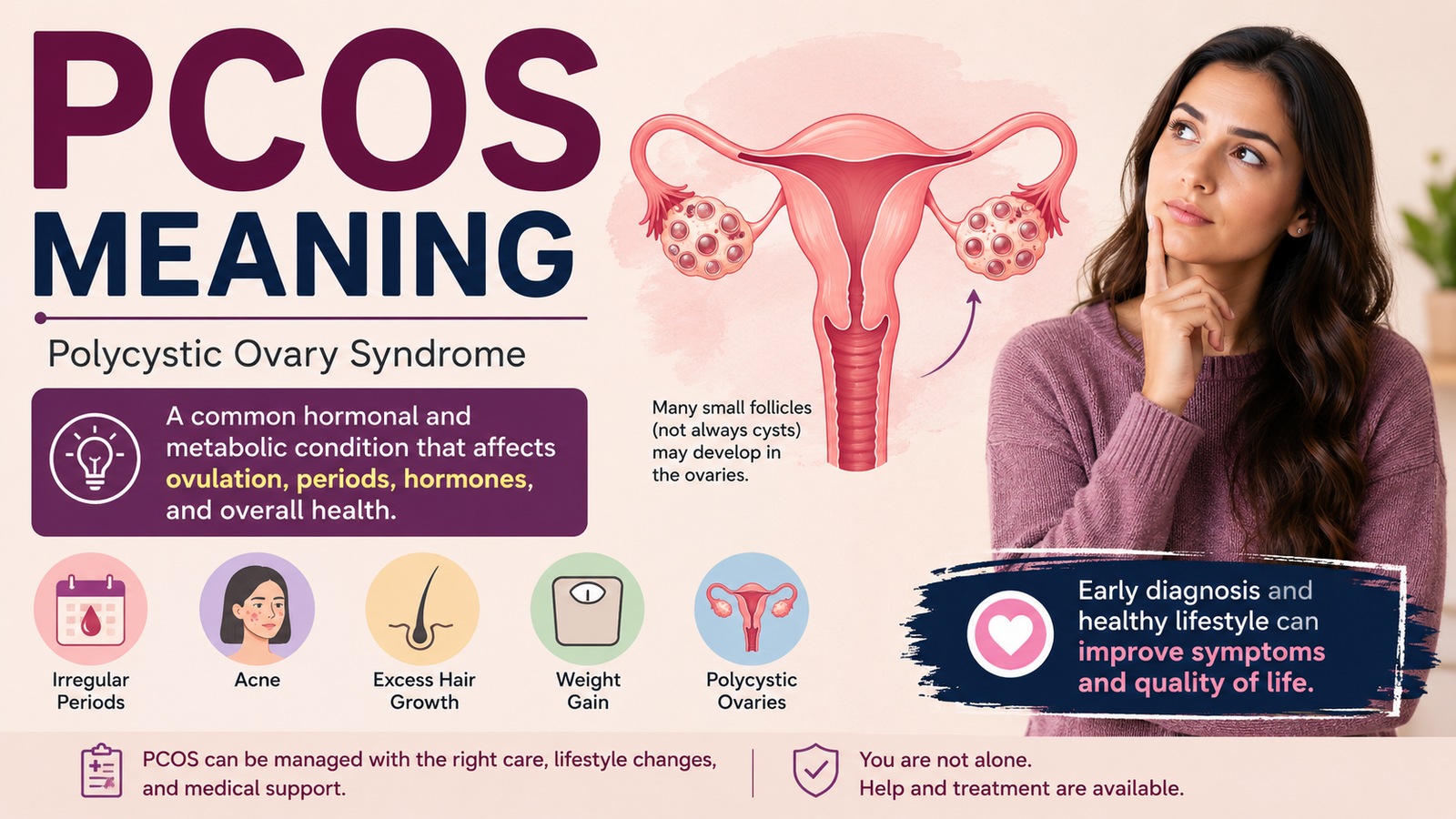
If you have searched for “PCOS meaning,” you may have seen the abbreviation in health articles, social media posts, medical reports, or conversations about periods and fertility. PCOS stands for polycystic ovary syndrome, a common hormonal and metabolic condition that can affect menstrual cycles, ovulation, skin, hair growth, fertility, and long-term health.
The name can also be confusing. Despite the word “cystic,” a person does not need to have ovarian cysts to have PCOS. Some people with PCOS have many small ovarian follicles, while others do not have this finding at all.
This guide explains PCOS meaning in simple English, including its pronunciation, origin, symptoms, causes, diagnosis, treatment, common usage, related words, examples, and frequently asked questions.
Medical note: This article is for general education and is not a substitute for advice, diagnosis, or treatment from a qualified healthcare professional.
What Does PCOS Mean?
PCOS means “polycystic ovary syndrome.”
It is a condition involving hormonal and metabolic changes that can affect the ovaries and the wider body. Common features include irregular or absent ovulation, higher-than-normal androgen activity, and certain changes in the ovaries.
In simple English, PCOS means a hormonal condition that can interfere with periods, ovulation, fertility, skin, hair growth, and metabolism.
PCOS is common. The World Health Organization estimates that it affects approximately 10% to 13% of women of reproductive age worldwide, and many people with the condition remain undiagnosed.
What Does Each Part of PCOS Mean?
The full term can be understood by breaking it into three parts:
- Poly means “many.”
- Cystic relates to cyst-like structures.
- Ovary refers to one of the reproductive organs that stores and releases eggs.
- Syndrome means a group of signs and symptoms that commonly occur together.
However, the name does not tell the whole story. PCOS is more than an ovarian condition. It can also involve hormones, insulin sensitivity, metabolism, and reproductive health.
PCOS Pronunciation
The abbreviation PCOS is commonly pronounced by saying each letter separately: P-C-O-S.
The full medical term is polycystic ovary syndrome.
When speaking casually, healthcare professionals and patients usually use the shorter term PCOS rather than saying the full name every time.
Origin of the Term PCOS
The term polycystic ovary syndrome comes from the medical description of features that can occur in the ovaries.
The word polycystic literally suggests “many cysts,” but modern understanding of PCOS is more nuanced. The ovarian structures seen in PCOS are often groups of immature follicles rather than conventional ovarian cysts. Some people with PCOS do not have polycystic-appearing ovaries at all.
The word syndrome is important because PCOS represents a collection of related symptoms and biological changes rather than one single symptom.
Today, medical organizations view PCOS as a complex condition involving reproductive and metabolic health.
PCOS Meaning in Simple English
Imagine that the body’s hormone signals are not working in their usual pattern.
For some people, this can make ovulation irregular. Periods may become unpredictable or disappear for months. Higher androgen levels may contribute to acne or increased facial and body hair. Some people also experience insulin resistance or changes in weight and metabolism.
That is the basic idea behind PCOS.
Importantly, PCOS does not look exactly the same in everyone. One person may mainly experience irregular periods, while another may struggle with acne, unwanted hair growth, fertility, or metabolic problems.
Common Symptoms of PCOS
PCOS symptoms can vary considerably from person to person. Some common signs include:
1. Irregular Periods
Periods may arrive infrequently, become unpredictable, or stop for periods of time. Some people can also experience heavy or prolonged bleeding.
2. Ovulation Problems
PCOS can interfere with ovulation, meaning an egg may not be released regularly. This is one reason PCOS is a major cause of infertility related to lack of ovulation.
3. Excess Facial or Body Hair
Higher androgen activity can contribute to increased hair growth on areas such as the face, chest, abdomen, or thighs. This is medically known as hirsutism.
4. Acne and Oily Skin
Some people with PCOS develop persistent acne, including acne that begins or continues after adolescence. Oily skin can also occur.
5. Hair Thinning
Changes in androgen activity can contribute to thinning hair or female-pattern hair loss in some people.
6. Weight and Metabolic Changes
PCOS can be associated with insulin resistance, obesity, and other metabolic risk factors. However, PCOS can occur in people of different body sizes, so body weight alone cannot diagnose or rule out the condition.
7. Darkened Skin Patches
Some people develop thickened, dark, velvety areas of skin, a condition called acanthosis nigricans, which can be associated with insulin resistance.
What Causes PCOS?
The exact cause of PCOS is still not fully understood.
Research suggests that genetic and environmental factors may contribute to its development. PCOS also tends to run in some families.
Hormonal changes and insulin-related problems can play important roles. For example, increased androgen activity can interfere with normal ovulation, while insulin resistance can cause the body to produce more insulin than usual.
This means PCOS is not simply caused by one food, one lifestyle choice, or one mistake.
Is PCOS the Same as Ovarian Cysts?
No.
This is one of the most common misunderstandings about the condition.
PCOS can involve many small ovarian follicles, but these are not necessarily the same as the ovarian cysts people usually mean when discussing ovarian cysts. More importantly, polycystic ovaries are not required for every PCOS diagnosis.
Therefore, someone can have PCOS without having “cysts” visible on an ultrasound.
How Is PCOS Diagnosed?
There is no single test that automatically confirms PCOS.
Healthcare professionals usually consider a person’s symptoms, medical history, examination, blood tests, and sometimes ultrasound findings.
In adults, commonly used diagnostic approaches look for at least two of three major features after other possible causes have been excluded:
- Irregular or absent ovulation
- High androgen levels or signs of increased androgen activity
- Polycystic-appearing ovaries on ultrasound
The exact diagnostic process can vary, particularly for adolescents.
A healthcare professional may also order blood tests to assess hormones, glucose-related health, and other possible causes of irregular periods or related symptoms.
PCOS Treatment
There is currently no single cure for PCOS, but treatments can manage symptoms, improve fertility when needed, and reduce certain long-term health risks.
Treatment depends on the individual’s symptoms, health, and whether pregnancy is desired.
Lifestyle Changes
Regular physical activity and balanced eating can support overall metabolic health. The WHO emphasizes healthy lifestyle behaviors for people with PCOS, even when they do not result in weight loss.
If someone has overweight or obesity, healthcare-guided weight management may improve some symptoms and metabolic markers. However, treatment should not be reduced to weight loss alone.
Medicines
Depending on the situation, healthcare professionals may recommend medicines to help regulate periods, manage androgen-related symptoms, improve insulin sensitivity, or support fertility.
For example, hormonal contraceptives can help regulate periods and may improve acne and excess hair growth for some people. Metformin may be used in certain circumstances to address insulin-related problems.
People trying to become pregnant may need a different treatment approach, so fertility goals should always be discussed with a healthcare professional.
PCOS and Fertility
PCOS can make pregnancy more difficult because irregular ovulation means eggs may not be released consistently.
However, having PCOS does not mean that pregnancy is impossible.
Many people with PCOS become pregnant naturally, while others may benefit from fertility treatment. Medical treatment can help support ovulation when appropriate.
Anyone experiencing difficulty becoming pregnant can discuss fertility testing and treatment options with a doctor or fertility specialist.
PCOS and Long-Term Health
PCOS is not only about periods and fertility.
The condition is associated with an increased risk of several longer-term health problems, including insulin resistance, type 2 diabetes, obesity, and cardiovascular risk factors.
People with irregular or absent periods may also have an increased risk of changes to the lining of the uterus. This is one reason appropriate medical evaluation and long-term management matter.
Common Usage of “PCOS”
The abbreviation PCOS is widely used in everyday and medical conversations.
Here are some natural examples:
- “My doctor thinks I may have PCOS.”
- “PCOS can cause irregular periods.”
- “She was diagnosed with PCOS after several months of irregular cycles.”
- “Can PCOS affect fertility?”
- “What are the symptoms of PCOS?”
- “I am learning how PCOS affects hormones.”
Online, people may also use phrases such as “PCOS symptoms,” “PCOS diet,” “PCOS treatment,” “PCOS fertility,” and “PCOS meaning.”
PCOS Synonyms and Related Terms
PCOS does not have a perfect synonym because it is the official name of a specific medical condition.
Common equivalent or related terms include:
- Polycystic ovary syndrome
- PCOS
- Polycystic ovarian syndrome — an older or alternative wording sometimes encountered
- Hormonal disorder — a broad descriptive term, not an exact synonym
- Reproductive and metabolic disorder — a broader description
It is better to use PCOS or polycystic ovary syndrome when referring specifically to the medical condition.
PCOS Antonyms
There is no true antonym for PCOS.
A medical condition does not usually have an opposite word in the same way that words such as “hot” and “cold” do.
For general comparison, phrases such as regular ovulation, regular menstrual cycles, or absence of PCOS may describe situations in which PCOS-related features are not present. These are descriptions rather than formal antonyms.
PCOS vs. Normal Menstrual Irregularity
An occasional change in your menstrual cycle does not automatically mean you have PCOS.
Periods can change for many reasons, including stress, pregnancy, breastfeeding, changes in exercise, certain medications, puberty, perimenopause, and other medical conditions.
PCOS is diagnosed by considering a pattern of symptoms and clinical findings rather than one unusual period.
If periods are repeatedly irregular, absent, unusually heavy, or accompanied by symptoms such as excessive hair growth or persistent acne, discussing the pattern with a healthcare professional can be helpful.
Why Understanding PCOS Meaning Matters
Understanding PCOS meaning is more than learning what four letters stand for.
Because PCOS can affect several areas of health at once, recognizing its possible signs can encourage people to seek appropriate medical advice instead of dismissing symptoms as “just bad periods” or ordinary acne.
At the same time, not every irregular period or acne problem means PCOS. Proper diagnosis matters because several other conditions can produce similar symptoms.
The best approach is to look at the whole picture.
Frequently Asked Questions About PCOS Meaning
What does PCOS stand for?
PCOS stands for polycystic ovary syndrome, a common hormonal and metabolic condition that can affect ovulation, menstrual cycles, fertility, skin, hair growth, and long-term health.
What does PCOS mean in simple words?
In simple words, PCOS is a condition in which hormone and metabolic changes can interfere with regular ovulation and cause symptoms such as irregular periods, acne, or increased facial and body hair.
Is PCOS a disease or syndrome?
PCOS is called a syndrome because it involves a collection of related signs, symptoms, and biological changes rather than one single symptom.
Does PCOS mean you have ovarian cysts?
No. Having ovarian cysts is not required for a PCOS diagnosis. Some people with PCOS have polycystic-appearing ovaries, while others do not.
Can someone with PCOS get pregnant?
Yes. PCOS can make ovulation irregular and may make conception more difficult, but many people with PCOS become pregnant naturally or with appropriate fertility treatment.
Is there a cure for PCOS?
There is currently no single cure for PCOS, but symptoms and associated health risks can often be managed with lifestyle measures, medicines, and fertility treatments when needed.
Is PCOS only a fertility problem?
No. PCOS can affect reproductive health as well as metabolic and cardiovascular health. It is associated with risks such as insulin resistance and type 2 diabetes, so long-term care can be important.
Can thin people have PCOS?
Yes. PCOS can affect people of different body sizes. Weight alone cannot confirm or rule out PCOS.
Conclusion
The PCOS meaning is polycystic ovary syndrome, a common and complex hormonal condition that can affect periods, ovulation, fertility, skin, hair growth, and metabolism.
One of the most important things to remember is that PCOS does not look the same in everyone. Some people experience severe menstrual problems, while others primarily notice acne, excess hair, fertility difficulties, or metabolic changes.
The word “polycystic” can also be misleading because ovarian cysts are not required for diagnosis. PCOS is better understood as a broader hormonal and metabolic condition.
If you are experiencing persistent irregular periods, unusual bleeding, difficulty becoming pregnant, increased facial or body hair, severe acne, or other concerning symptoms, a qualified healthcare professional can help determine the cause.
Understanding the meaning of PCOS is the first step. Getting the right evaluation is what turns that knowledge into useful healthcare.