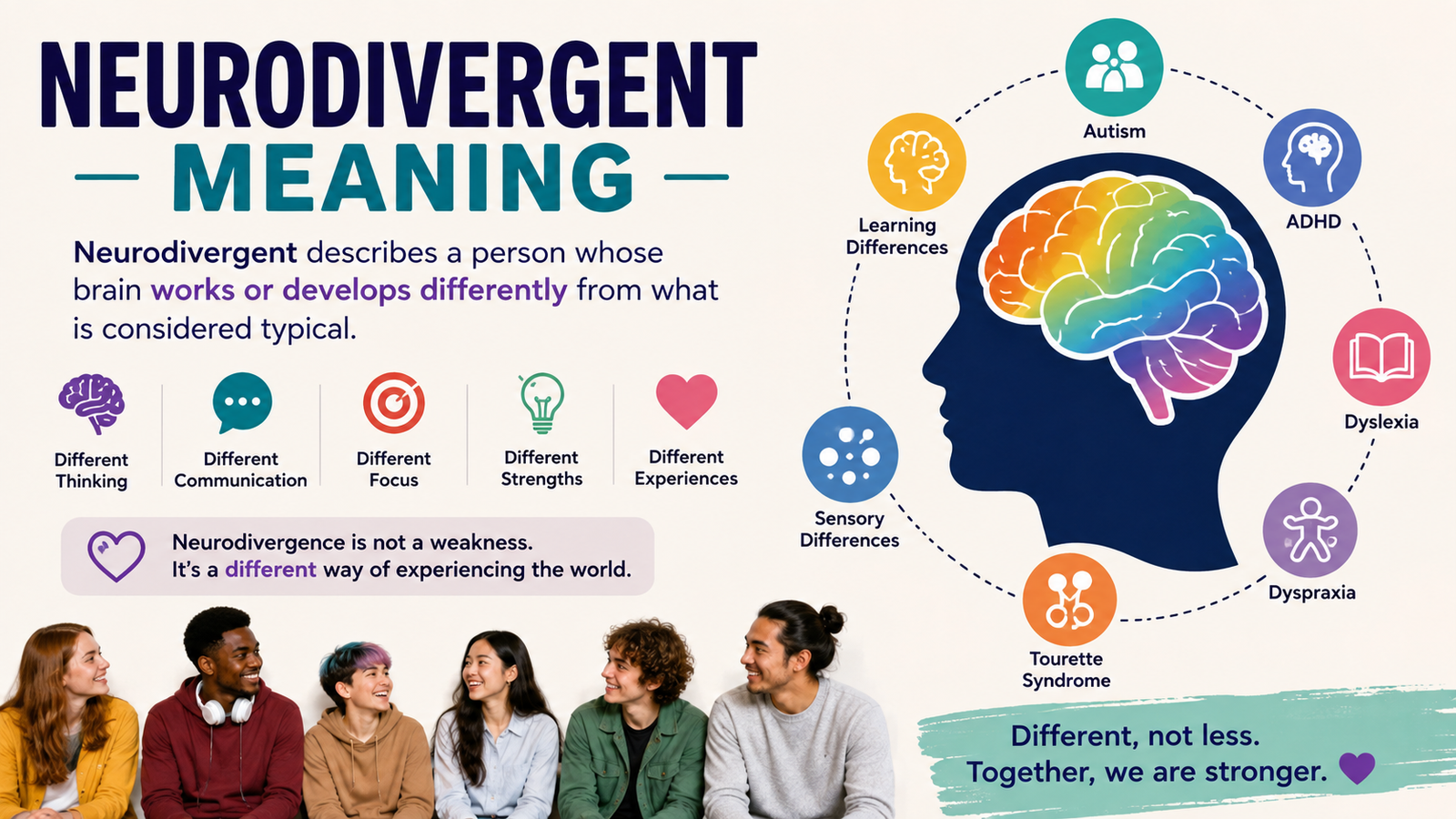
The word neurodivergent is becoming more common in conversations about autism, ADHD, dyslexia, learning differences, mental health, and the many ways people experience the world. But what does neurodivergent actually mean?
In simple English, neurodivergent describes a person whose brain develops or works differently from what is considered typical. It is a broad, nonmedical term rather than a diagnosis. Someone may use the word because of a diagnosed condition, while another person may identify as neurodivergent without having a formal diagnosis.
The term can help people talk about neurological differences without automatically describing those differences as something “wrong” with a person. At the same time, being neurodivergent can involve genuine challenges, disabilities, or support needs. The word does not mean that every difference is a special ability or that difficulties should be ignored.
This guide explains the neurodivergent meaning, pronunciation, origin, examples, related terms, synonyms, antonyms, common usage, and frequently asked questions in simple English.
What Does Neurodivergent Mean?
Neurodivergent means having a brain or pattern of neurodevelopment that differs from what is generally considered typical.
The word is often used when talking about people whose thinking, learning, communication, attention, sensory processing, or behavior differs from common expectations.
For example, a person with autism may experience social communication and sensory information differently. Someone with ADHD may have differences involving attention, impulse control, activity levels, and executive functioning. A person with dyslexia may process written language differently.
Neurodivergent is not itself a medical diagnosis. It is an umbrella term that people may choose to describe their experiences. There is also no single medical test that determines whether someone is “neurodivergent.”
The important point is that neurodivergent does not simply mean intelligent, gifted, disabled, or mentally ill. It refers broadly to differences in neurological development or functioning.
Neurodivergent Pronunciation
The pronunciation of neurodivergent can be learned by listening to the word and breaking it into its natural syllables.
Stress is generally placed near the beginning of the word, and the ending sounds like the word “divergent.”
When speaking, try not to rush through the middle of the word. Saying it slowly at first can make the longer word easier to pronounce.
Neurodivergent Meaning in Simple English
If you want the simplest possible definition:
Neurodivergent means a person’s brain works or develops differently from the typical pattern.
Think about it this way: human brains do not all process information in exactly the same way. People can differ in how they concentrate, communicate, remember information, experience sounds and textures, learn, socialize, or organize tasks.
Some differences can create significant challenges. Others may come with particular strengths. Often, a person experiences both.
For example, someone may be exceptionally focused on a subject they love but struggle to switch between tasks. Another person may find reading difficult but be very strong at visual or three-dimensional thinking.
These examples show why the word neurodivergent is broader than simply saying someone has a particular diagnosis.
Neurodivergent vs. Neurotypical
The opposite or contrasting term commonly used with neurodivergent is neurotypical.
A neurotypical person generally has neurological development and functioning that falls within the range commonly considered typical.
A neurodivergent person has neurological development or functioning that differs from that typical range.
However, these terms are not meant to divide people into two completely separate types. Human brains exist across a wide range of characteristics, and people can have different strengths and difficulties even when they share the same diagnosis.
The academic literature commonly describes neurodiversity as the natural variation in human neurodevelopment and neurodivergent people as those whose neurodevelopment falls outside what is usually considered typical.
What Is Neurodiversity?
Neurodiversity and neurodivergent are related, but they do not mean exactly the same thing.
Neurodiversity refers to the variation that exists among human brains and ways of thinking.
Neurodivergent describes an individual or group whose neurological development differs from the typical pattern.
A simple comparison is:
- Neurodiversity: The idea that human brains naturally vary.
- Neurodivergent: A person whose brain develops or functions differently from the typical pattern.
- Neurotypical: A person whose neurological development is generally within the typical range.
The concept of neurodiversity developed within disability and autism advocacy communities during the 1990s. Judy Singer is widely credited with developing and popularizing the concept, but more recent scholarship emphasizes that its origins were collective and involved autistic people, advocates, online communities, journalists, and researchers rather than one person alone.
Origin and History of the Word Neurodivergent
The history of neurodivergent is connected to the earlier word neurodiversity.
The term neurodiversity emerged in the late 1990s. Judy Singer’s 1998 work is often associated with the development of the concept, while journalist Harvey Blume also used the word in print in 1998. Researchers now point to evidence that related ideas of “neurological diversity” were circulating in autistic communities before the term became widely known.
The word neurodivergent itself became associated with autistic activist Kassiane Asasumasu around 2000. It was created as a broader way to describe people whose neurological development differed from what society considered typical.
Over time, the word expanded beyond autism. Today, many people use neurodivergent when discussing autism, ADHD, dyslexia, dyspraxia, Tourette syndrome, and other neurological or developmental differences.
Because the term is not a formal medical category, its exact boundaries can vary depending on the person, community, or context.
Examples of Neurodivergent
Here are some simple examples of how the word may be used.
Example 1: Autism
“She is neurodivergent and prefers predictable routines.”
This could describe an autistic person who finds changes in routine difficult and feels more comfortable when expectations are clear.
Example 2: ADHD
“He describes himself as neurodivergent because he has ADHD.”
ADHD can affect attention, organization, impulse control, and executive functioning. Some people with ADHD use neurodivergent as an identity term.
Example 3: Dyslexia
“Being neurodivergent means she learns written information differently.”
A person with dyslexia may have difficulty processing written language while having strengths in other areas.
Example 4: Workplace
“The company created a quieter workspace for neurodivergent employees.”
Here, neurodivergent is being used as an umbrella term rather than referring to one particular diagnosis.
Example 5: Everyday conversation
“I recently learned more about neurodivergence and understood why certain environments feel overwhelming to me.”
This usage focuses on personal experience rather than labeling someone based solely on a medical diagnosis.
Which Conditions Are Considered Neurodivergent?
There is no universal medical checklist for deciding who is neurodivergent. However, people commonly use the term in connection with conditions and differences such as:
- Autism spectrum disorder
- ADHD
- Dyslexia
- Dyscalculia
- Dysgraphia
- Dyspraxia
- Tourette syndrome
- Intellectual disabilities
- Sensory processing differences
- Some other developmental, neurological, or mental health conditions
Cleveland Clinic notes that neurodivergent is a nonmedical term and that people who use it can have a wide variety of conditions and experiences.
Not everyone with one of these conditions identifies as neurodivergent, and not everyone who identifies as neurodivergent has the same needs.
That distinction matters because a label should describe a person’s experience, not replace an individualized understanding of that person.
Is Neurodivergent a Medical Diagnosis?
No. Neurodivergent is not a medical diagnosis.
A doctor, psychologist, or other qualified professional may diagnose conditions such as ADHD or autism, depending on the applicable diagnostic criteria. But there is no formal diagnosis called “neurodivergent.”
This is one reason the word can be useful in everyday conversation. It allows someone to discuss neurological differences without having to name a specific diagnosis.
However, if someone is experiencing difficulties that affect school, work, relationships, daily life, or wellbeing, a qualified professional can help determine whether an underlying condition may be involved.
Neurodivergent Synonyms
There is no perfect synonym for neurodivergent, because the word has a specific social and cultural meaning.
Depending on the context, related expressions include:
- Neurologically different
- Neuroatypical
- Different neurodevelopment
- Different cognitive processing
- Neurological minority
- Neurodiverse person — sometimes used informally, although technically “neurodivergent” is more precise for an individual
Some terms can carry different meanings, so they should not automatically be treated as interchangeable.
For example, neurodiverse technically refers to a group or population containing different neurological types, while neurodivergent generally refers to an individual or group whose neurodevelopment differs from the typical pattern.
Neurodivergent Antonyms
The most common contrasting term is:
Neurotypical
Other phrases such as typically developing or neurologically typical may also appear depending on context.
However, “neurotypical” does not mean that a person has no challenges. Neurotypical people can experience learning difficulties, mental health problems, stress, disabilities, and many other challenges.
The distinction is specifically about neurological development or functioning, not whether someone’s life is easy or difficult.
Neurodivergent vs. Disabled
These words are related but are not identical.
Some neurodivergent people are disabled, while others may not consider themselves disabled.
For example, an autistic person may have substantial support needs and meet the legal or medical definition of disability in a particular country. Another neurodivergent person may experience differences that do not significantly limit everyday activities.
The word neurodivergent focuses on neurological difference. The word disabled focuses more broadly on impairment and the interaction between a person’s abilities and barriers in society.
It is therefore better not to assume that every neurodivergent person has the same level of disability or support needs.
Common Usage of Neurodivergent
You may see the word neurodivergent in many different settings.
Social media
People often use it when discussing personal identity, self-discovery, autism, ADHD, sensory experiences, or mental health.
Education
Teachers and schools may use the term when discussing different learning styles, classroom accommodations, and inclusive education.
Workplaces
Employers may use neurodiversity-related language when talking about accessibility, workplace accommodations, communication styles, and inclusive hiring.
Healthcare
Healthcare professionals may use the term informally to discuss neurological differences, although it should not be confused with a formal diagnosis.
Everyday conversation
Someone may simply say, “I’m neurodivergent,” as a concise way of explaining that their brain processes certain experiences differently.
Why Do People Use the Word Neurodivergent?
Language can influence how people understand themselves and others.
The neurodiversity framework was partly developed in response to approaches that focused heavily on deficits and the idea of what counts as “normal.” It encourages people to recognize differences while still acknowledging disability, difficulties, and the need for support.
For many people, the term provides a neutral and respectful way to describe their experiences.
At the same time, it is important not to romanticize neurodivergence. Saying that neurological differences can involve strengths does not mean that every neurodivergent person has extraordinary abilities or that serious challenges are unimportant.
A balanced approach recognizes both differences and support needs.
Is Neurodivergent a Positive or Negative Word?
Generally, neurodivergent is intended as a neutral or respectful descriptive term.
It does not automatically mean “better” or “worse.” It simply points to a difference from what is considered typical.
Some people strongly prefer identity-first language such as “I am autistic”, while others prefer person-first language such as “I am a person with autism.” Preferences vary from person to person.
The safest approach is to respect how an individual describes themselves.
Neurodivergent Meaning in a Sentence
Here are several natural sentences:
- “My brother is neurodivergent and benefits from a quiet study environment.”
- “The school offers additional support for neurodivergent students.”
- “She learned that she was neurodivergent after receiving an ADHD diagnosis.”
- “The company wants to create a more neurodivergent-friendly workplace.”
- “Not every neurodivergent person has the same strengths or challenges.”
- “Understanding neurodivergence helped him explain why certain sensory experiences were difficult.”
These examples show that the word can describe people, communities, experiences, and accessibility needs.
Common Misunderstandings About Neurodivergent
Neurodivergent does not mean “genius”
Some people associate neurodivergence with exceptional intelligence or unusual talents. That stereotype can be harmful because neurodivergent people have different abilities just like everyone else.
Neurodivergent does not mean “broken”
The term is often used to move away from automatically treating neurological differences as personal defects.
Neurodivergent does not mean “autistic”
Autism is one form of neurodivergence, but the two words are not synonyms.
Neurodivergent does not describe everyone
The term is not simply another word for “unique.” It is generally used for neurological or neurodevelopmental differences rather than ordinary personality differences.
Neurodivergence does not eliminate the need for support
A person can value their neurodivergent identity while also needing therapy, medication, accommodations, educational support, or other assistance.
Frequently Asked Questions
What is the simple meaning of neurodivergent?
Neurodivergent means having a brain that develops or works differently from what is generally considered typical.
Is ADHD neurodivergent?
Yes. Many people with ADHD identify as neurodivergent because ADHD involves differences in attention, executive functioning, and other aspects of brain development and functioning.
Is autism neurodivergent?
Yes. Autism is commonly included under the broader concept of neurodivergence.
What is the opposite of neurodivergent?
The commonly used contrasting term is neurotypical. It generally describes someone whose neurological development falls within the range considered typical.
Is neurodivergent a medical term?
No. Neurodivergent is a nonmedical umbrella term, not a formal diagnosis.
Can someone be neurodivergent without a diagnosis?
Yes. Because neurodivergent is not itself a medical diagnosis, some people use the term to describe their experiences without having a formal diagnosis. However, self-identification should not be confused with receiving a professional diagnosis for a specific condition.
When did the term neurodivergent originate?
The word is generally associated with the early development of the neurodiversity movement around the late 1990s and early 2000s. The concept of neurodiversity has multiple origins, and the term “neurodivergent” is commonly associated with activist Kassiane Asasumasu around 2000.
Is neurodivergent the same as neurodiverse?
Not exactly. Neurodiversity describes the variation among human brains, while neurodivergent generally describes an individual whose neurological development differs from the typical pattern.
Final Thoughts on Neurodivergent Meaning
The neurodivergent meaning is ultimately about neurological difference. It describes people whose brains develop or function differently from what society generally considers typical.
The word has become useful because it can provide a broader way to talk about autism, ADHD, dyslexia, and other differences without reducing an entire person to a diagnosis.
At the same time, neurodivergence should not be romanticized or treated as a single experience. Every neurodivergent person is different. One person may need substantial support, another may need only minor accommodations, and another may simply use the term as part of their identity.
Understanding the word is therefore about more than memorizing a definition. It is about recognizing that human brains vary, people experience those differences in different ways, and respectful language should leave room for both individual strengths and genuine challenges.