If you have ever seen someone remain completely calm while everyone else is nervous, excited, or worried, you may have heard them described as nonchalant. The word is often used to describe a person’s attitude, facial expression, behavior, or response when they appear relaxed and unconcerned.
But what exactly does nonchalant meaning refer to? Is being nonchalant always a good thing? Does it mean someone does not care, or can it simply mean they are confident and calm?
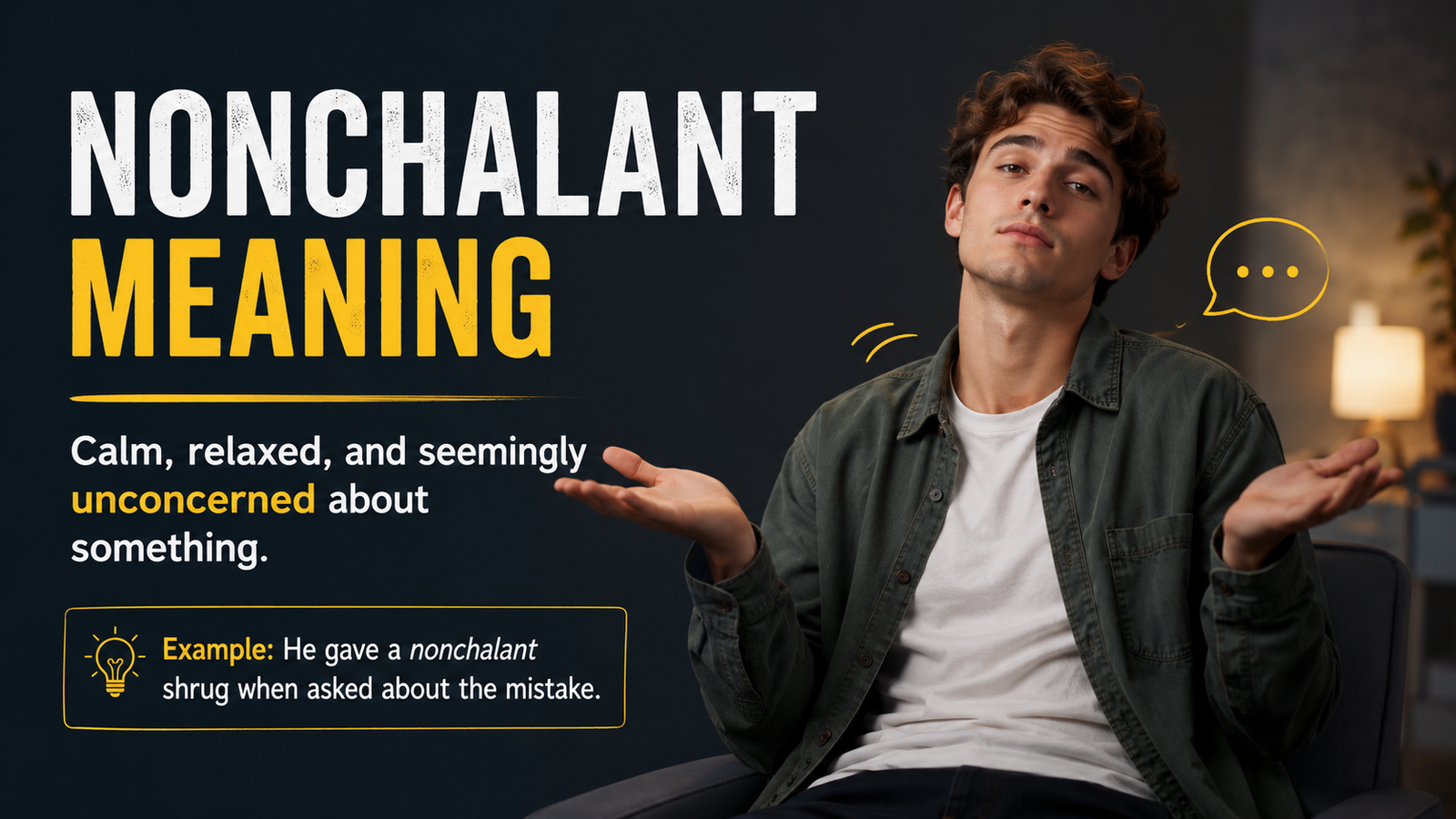
In simple English, nonchalant means calm, relaxed, and seemingly unconcerned about something. Depending on the situation, it can describe someone positively as confident and composed, or negatively as careless or indifferent. Cambridge defines it as behaving calmly in a way that can suggest a lack of interest or concern, while Merriam-Webster describes it as having an air of easy unconcern or indifference.
This guide explains the nonchalant meaning, pronunciation, origin, examples, synonyms, antonyms, common usage, and related forms in clear and simple English.
What Does Nonchalant Mean?
Nonchalant is an adjective used to describe someone who appears calm, relaxed, and not worried or bothered by something.
In everyday language, a nonchalant person may act as though a situation is not a big deal. They might respond casually to exciting news, remain calm during a stressful moment, or simply shrug instead of showing a strong emotional reaction.
For example:
She gave a nonchalant shrug when asked about the mistake.
This means she shrugged casually, giving the impression that the mistake did not worry or bother her.
Another example is:
He remained nonchalant before the important interview.
Here, nonchalant suggests that he looked calm and relaxed instead of nervous.
Oxford similarly defines the word as behaving in a calm and relaxed way while giving the impression that you are not worried.
Nonchalant Meaning in Simple English
The easiest way to understand the word is:
Nonchalant = calm and unconcerned, sometimes appearing as if you do not care.
It can describe someone’s:
- Attitude
- Behavior
- Manner
- Expression
- Reaction
- Response
- Approach
- Style
For example, someone might have a nonchalant attitude, give a nonchalant shrug, or answer a question in a nonchalant manner.
Nonchalant Pronunciation
The pronunciation can look confusing because the spelling does not immediately tell English learners how to say it.
In American English, it is commonly pronounced approximately:
non-shuh-LAHNT
The stress is usually placed toward the end of the word.
Cambridge gives the American pronunciation as approximately /ˌnɑːn.ʃəˈlɑːnt/ and the British pronunciation as /ˈnɒn.ʃə.lənt/.
How to Say Nonchalant
Break it into simple parts:
non + shuh + lahnt
Say it smoothly rather than pronouncing every letter individually.
A common mistake is to pronounce the ending like “lant” with a strong English vowel. In standard American pronunciation, the final syllable sounds closer to “lahnt.”
What Is the Origin of Nonchalant?
The history of nonchalant is particularly interesting because the word is connected to the idea of not being concerned.
The English word came from French nonchalant, which developed from the Old French verb nonchaloir, meaning roughly to disregard or be unconcerned. The word ultimately connects to Latin calēre, meaning “to be warm.”
Merriam-Webster records the first known English use of nonchalant around 1734.
The history helps explain the modern meaning. Over time, the word became associated with a person who appears cool, unconcerned, or unaffected by circumstances.
Interestingly, the prefix non- can make English speakers assume that “chalant” must be the opposite. However, chalant is not a normal English word meaning the opposite of nonchalant. Merriam-Webster specifically notes that words such as concerned and interested can express the opposite meaning.
Is Nonchalant a Positive or Negative Word?
The answer depends on context.
Nonchalant can be positive, neutral, or negative.
When someone stays calm under pressure, being nonchalant can suggest confidence and self-control.
For example:
The experienced pilot remained nonchalant during the difficult landing.
In this sentence, the word can sound positive because the pilot’s calm behavior suggests professionalism.
However, if someone ignores another person’s feelings or treats a serious problem as unimportant, nonchalant can sound critical.
For example:
He was nonchalant about her concerns.
Here, the word suggests that he did not seem sufficiently concerned about something that mattered to another person.
Merriam-Webster also notes this difference: nonchalant behavior can be admirable when it shows calmness during a difficult task, but it can be negative when it suggests indifference toward someone’s pain or an important problem.
Nonchalant Meaning in Different Situations
The meaning can become clearer when you see how the word works in different situations.
1. Nonchalant About Something
The phrase nonchalant about is very common.
She was nonchalant about the criticism.
This means she appeared calm and did not seem bothered by the criticism.
Another example:
He seemed nonchalant about the upcoming exam.
He did not appear nervous or worried about the exam.
2. Nonchalant Attitude
A nonchalant attitude is a relaxed or unconcerned way of behaving.
His nonchalant attitude made everyone think he was not taking the situation seriously.
Here, the attitude could be viewed negatively.
3. Nonchalant Shrug
A nonchalant shrug is a casual shrug that suggests a person is not particularly worried or interested.
She gave a nonchalant shrug and walked away.
The shrug communicates something like, “It is not a big deal.”
4. Nonchalant Behavior
Nonchalant behavior means behavior that appears calm, casual, or unconcerned.
His nonchalant behavior surprised everyone because the situation was serious.
5. Nonchalant in Texting
In modern conversations, someone may describe another person’s texting style as nonchalant.
For example:
He replied with “okay” in a very nonchalant way.
The speaker may mean that the response seemed extremely casual or emotionally detached.
However, context matters. A short text does not automatically prove that someone is indifferent. A person may simply have a relaxed communication style.
Examples of Nonchalant in Sentences
Here are several natural examples:
- She looked nonchalant even though she was extremely nervous inside.
- He gave a nonchalant smile and continued working.
- The player remained nonchalant after scoring the winning goal.
- She tried to sound nonchalant when talking about her new job.
- His nonchalant attitude made his friends wonder whether he cared.
- The actor appeared nonchalant during the interview.
- He casually walked into the room with a nonchalant expression.
- She was surprisingly nonchalant about the unexpected news.
- The student acted nonchalant before the final examination.
- His nonchalant response made the situation seem less serious than it really was.
- She gave a nonchalant shrug when asked where she had been.
- Despite the pressure, the coach stayed nonchalant.
- He tried to look nonchalant after making an embarrassing mistake.
- Her nonchalant manner made her seem confident and self-assured.
- The employee’s nonchalant reaction worried his manager.
Synonyms of Nonchalant
Several English words have similar meanings to nonchalant, although they are not always interchangeable.
Calm
Calm means free from excitement, nervousness, or agitation.
She remained calm during the emergency.
Unlike nonchalant, calm does not necessarily suggest that the person does not care.
Unconcerned
Unconcerned means not worried or not troubled by something.
He seemed unconcerned about the delay.
This is one of the closest synonyms for nonchalant.
Casual
Casual can describe relaxed behavior that does not seem formal, serious, or carefully planned.
He gave a casual answer.
Indifferent
Indifferent means showing little interest, concern, or emotional reaction.
She seemed indifferent to the criticism.
This is usually more negative than nonchalant.
Carefree
Carefree describes someone who appears free from worry or responsibility.
They enjoyed a carefree afternoon at the beach.
Composed
Composed means calm and in control of your emotions.
She remained composed during the difficult conversation.
This is generally more positive than nonchalant.
Unruffled
Unruffled describes someone who stays calm despite difficulty or disturbance.
He remained unruffled despite the criticism.
Merriam-Webster lists several related words, including casual, composed, collected, unruffled, and imperturbable, while emphasizing that nonchalant particularly suggests an easy, casual coolness that may imply indifference.
Antonyms of Nonchalant
The opposite of nonchalant depends on what aspect of the word you mean.
Common antonyms include:
- Concerned
- Worried
- Anxious
- Interested
- Attentive
- Serious
- Excited
- Agitated
- Caring
- Involved
For example:
Nonchalant:
He was nonchalant about the result.
Opposite:
He was extremely concerned about the result.
Another example:
Nonchalant:
She gave a casual, nonchalant response.
Opposite:
She gave a serious and concerned response.
Nonchalant vs. Calm: What Is the Difference?
These words are similar, but there is an important distinction.
Calm mainly describes a person’s emotional state. A calm person may care deeply about what is happening but still control their emotions.
Nonchalant often adds the idea that the person appears unconcerned or uninterested.
Consider these two sentences:
She remained calm during the crisis.
This suggests emotional control.
She remained nonchalant during the crisis.
This may suggest that she seemed unusually unconcerned about the crisis.
Therefore, calm is not always nonchalant, and nonchalant is not always simply calm.
Nonchalant vs. Indifferent
These words are also closely related.
Indifferent usually means that someone does not care very much about something.
Nonchalant focuses more on the way someone behaves or appears.
For example:
He was indifferent to the result.
This strongly suggests a lack of interest.
He gave a nonchalant response to the result.
This tells us more about his outward manner. He appeared relaxed or unconcerned.
Someone can actually care deeply while appearing nonchalant.
How to Use Nonchalant Correctly
Nonchalant is an adjective, so it normally describes a noun or person.
Correct:
She has a nonchalant attitude.
Correct:
He looked nonchalant.
Correct:
They gave a nonchalant response.
Incorrect:
He nonchalant answered the question.
Because nonchalant is an adjective, you would normally use the adverb nonchalantly here:
He answered the question nonchalantly.
Related Forms
The main forms are:
Nonchalant — adjective
She seemed nonchalant.
Nonchalantly — adverb
He walked away nonchalantly.
Nonchalance — noun
Her nonchalance surprised everyone.
Cambridge lists nonchalance as the noun and nonchalantly as the adverb.
What Does Nonchalant Mean in Texting?
On social media and in texting, nonchalant is often used to describe someone who seems emotionally relaxed, detached, or difficult to impress.
For example:
She texted “sure” and sounded so nonchalant.
The speaker may mean that her message seemed casual and did not show much excitement.
Another example:
He acted nonchalant after getting the good news.
This means he did not appear especially excited, even though the news was positive.
Online, people may sometimes use nonchalant to describe a person who intentionally acts like they do not care. In such cases, the person may actually have strong feelings but choose not to show them.
That distinction is important: looking nonchalant does not necessarily mean feeling nothing.
What Does It Mean When Someone Is Nonchalant?
When someone is described as nonchalant, they generally appear relaxed, casual, and unconcerned.
Their behavior may include:
- Speaking casually during a stressful situation
- Shrugging instead of reacting strongly
- Showing little visible excitement
- Remaining calm under pressure
- Acting as though something is not important
- Responding without obvious emotional intensity
The exact interpretation depends on the situation and tone.
A person can be nonchalant because they are confident, experienced, emotionally controlled, naturally relaxed, or genuinely uninterested.
Is Nonchalant the Same as Not Caring?
Not necessarily.
This is one of the most important points about the word.
Nonchalant describes how someone appears or behaves. It does not always reveal what they actually feel inside.
For example, imagine a student waiting for exam results. She may look relaxed and joke with her friends. Someone might describe her as nonchalant.
However, she could secretly be very nervous.
In this situation, nonchalant describes her outward behavior rather than her private emotions.
Why Do People Act Nonchalant?
People can behave nonchalantly for many reasons.
Some people naturally have relaxed personalities. Others have learned to control visible emotional reactions.
A person may also act nonchalant because they do not want others to know that they are nervous, excited, embarrassed, or emotionally affected.
In social situations, someone might deliberately appear nonchalant to seem confident or avoid looking overly interested.
This is especially common when people want to protect their emotions. Someone who is excited about a new opportunity, for example, may intentionally respond casually so they do not appear desperate.
Frequently Asked Questions About Nonchalant Meaning
What is the simple meaning of nonchalant?
Nonchalant means calm, relaxed, and apparently unconcerned about something. It can suggest that someone is not worried or does not seem to care.
Is nonchalant a positive word?
It can be either positive or negative. It can describe admirable calmness and confidence, but it can also suggest carelessness or indifference when the situation deserves concern.
How do you pronounce nonchalant?
In common American English, nonchalant is pronounced approximately non-shuh-LAHNT. Cambridge lists the American pronunciation as /ˌnɑːn.ʃəˈlɑːnt/.
What is the opposite of nonchalant?
Common opposites include concerned, worried, anxious, interested, attentive, and serious. The best antonym depends on the sentence.
What is a synonym for nonchalant?
Common synonyms include unconcerned, casual, calm, carefree, indifferent, composed, and unruffled. However, each word has slightly different shades of meaning.
Can nonchalant mean confident?
Yes. In some contexts, nonchalant behavior can suggest confidence because the person remains relaxed and unaffected under pressure.
What is the noun form of nonchalant?
The noun form is nonchalance.
For example:
His nonchalance impressed everyone during the stressful situation.
What is the adverb form of nonchalant?
The adverb is nonchalantly.
For example:
She nonchalantly walked into the room.
Is “chalant” the opposite of nonchalant?
No. Chalant is not the standard English opposite of nonchalant. Although the word looks as though it contains the prefix “non-,” English did not develop a normal antonym called “chalant.” Words such as concerned or interested are better opposites.
Final Thoughts on Nonchalant Meaning
The simplest way to remember nonchalant meaning is:
Nonchalant means appearing calm, relaxed, and unconcerned, especially when other people might expect a stronger reaction.
The word can describe someone who confidently keeps their cool, but it can also describe behavior that seems careless or indifferent. The surrounding context determines whether the word sounds complimentary or critical.
For example, calling an experienced professional nonchalant under pressure may praise their composure. Calling someone nonchalant about another person’s serious problem may criticize their lack of concern.
The word comes from French and ultimately traces back to Old French nonchaloir, meaning to disregard or be unconcerned. English has used nonchalant since the 18th century, and its modern meaning remains closely connected to the idea of easy unconcern.
So, whenever you see nonchalant in a conversation, article, movie, or social media post, think of someone who is keeping their cool and showing little outward concern.
That person may genuinely not care—or they may simply be very good at not showing that they do.