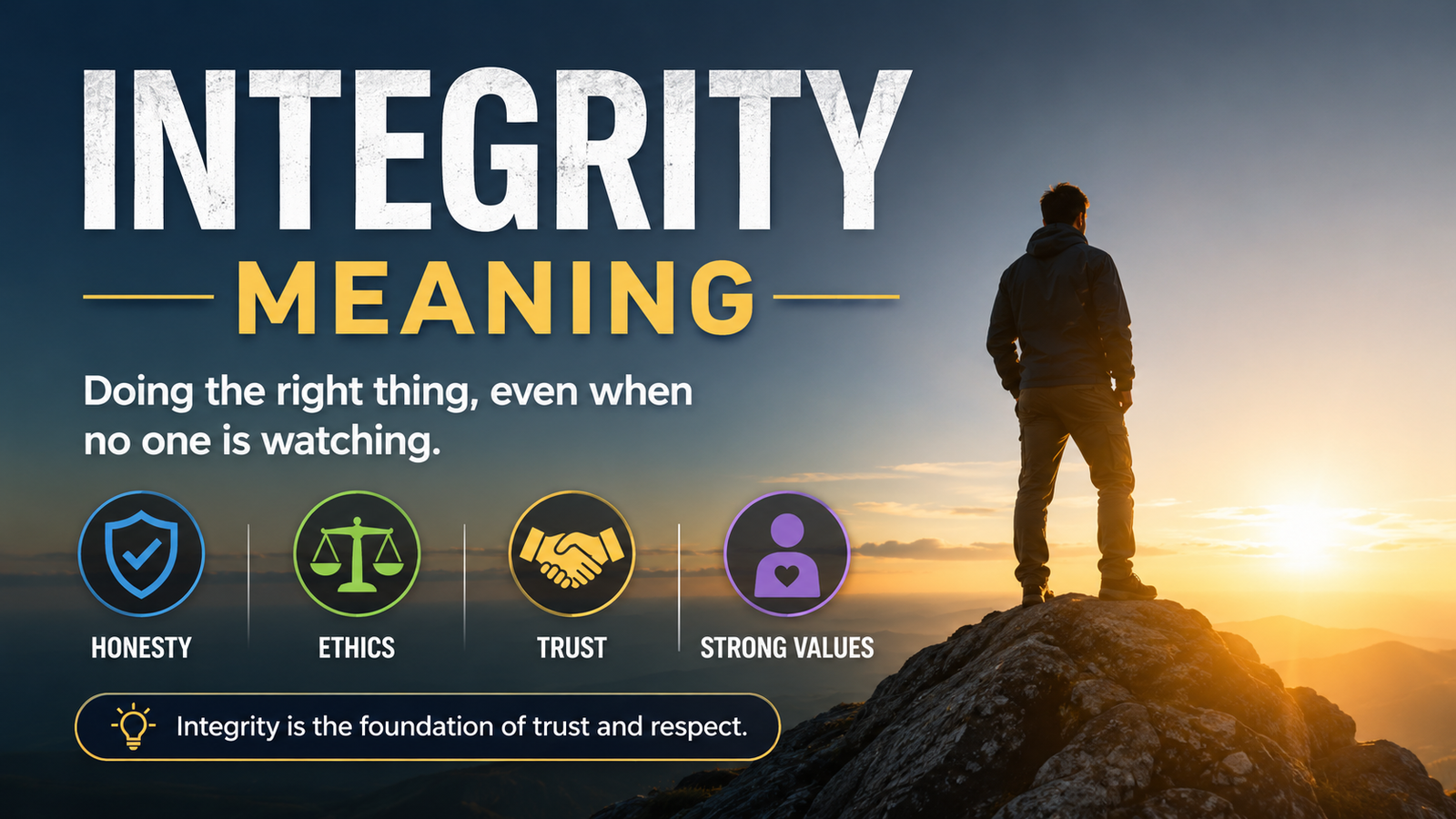
When people talk about a person having integrity, they usually mean that person can be trusted to do what is right, even when nobody is watching. Integrity is closely connected with honesty, strong moral principles, fairness, and consistency between what someone says and what they actually do.
The word is common in everyday English, education, business, relationships, leadership, and professional life. It can also describe something that is whole, complete, or not damaged, such as the structural integrity of a building.
In simple terms, integrity means being honest and doing the right thing consistently.
This guide explains the integrity meaning, pronunciation, origin, examples, synonyms, antonyms, common phrases, and practical uses of the word in simple English.
What Does Integrity Mean?
Integrity means honesty, strong moral principles, and the willingness to stick to those principles.
A person with integrity does not change their values simply because doing so would be easier or more profitable. They try to make their actions match their words.
For example, imagine someone finds a wallet full of money. Nobody saw them pick it up, and they could easily keep the money. If they return the wallet because they know it is the right thing to do, that is an example of integrity.
Cambridge Dictionary defines integrity as the quality of being honest and having strong moral principles that a person refuses to change. It also uses the word to describe the quality of something being whole and complete.
Merriam-Webster similarly connects integrity with firm adherence to moral or artistic values, incorruptibility, soundness, and completeness.
Simple Definition of Integrity
A simple definition is:
Integrity = doing what is right, being honest, and staying true to your principles.
It is not only about telling the truth. Integrity also involves keeping promises, accepting responsibility, treating people fairly, and refusing to compromise important values for personal advantage.
Integrity Pronunciation
The word integrity is pronounced approximately as:
in-TEG-ri-tee
The standard pronunciation is represented in dictionaries as /ɪnˈteɡ.rə.ti/ in British English and /ɪnˈteɡ.rɪ.t̬i/ in American English.
The stress falls on the second syllable: TEG.
Example:
She is known for her integrity.
Here, “integrity” refers to her honesty and strong moral character.
What Is Integrity in Simple English?
In very simple English, integrity means being a good and honest person who does the right thing even when there is no reward for doing it.
It can be helpful to think of integrity as a connection between three things:
- What you believe
- What you say
- What you do
When these three things are consistent, a person is showing integrity.
For instance, a manager who says employees should be treated fairly but gives special treatment to friends is not demonstrating much integrity. A manager who applies the same rules to everyone is showing greater integrity.
This is why integrity is strongly associated with trust.
Origin and History of the Word Integrity
The word integrity has a long history. Merriam-Webster traces it through Middle English integrite, Middle French intégrité, and Latin integritas, from the Latin word integer, meaning “entire” or “whole.”
Etymonline records the English word around the early 15th century, originally carrying meanings related to innocence, purity, soundness, and completeness. The moral sense involving upright character and truthfulness developed later.
This history helps explain why integrity has two important meanings today.
The first is moral integrity: being honest, principled, and trustworthy.
The second is wholeness or soundness: something remaining complete, undamaged, or undivided.
For example:
- He is a person of integrity.
This refers to moral character. - Engineers checked the structural integrity of the bridge.
This refers to the physical condition of the bridge.
The two meanings are different, but they share the underlying idea of something being whole and sound.
Examples of Integrity in Everyday Life
Integrity is easier to understand through real-life situations.
1. Telling the Truth
If you make a mistake at work and admit it instead of blaming someone else, you are showing integrity.
Example:
“I accidentally sent the wrong report, so I told my manager and corrected it.”
2. Keeping a Promise
Keeping your word is another important part of integrity.
Example:
“If you promise to help a friend move, you show integrity by keeping your promise even when you would rather stay home.”
3. Returning Something That Does Not Belong to You
Suppose you find money in a classroom or office. Returning it rather than keeping it demonstrates honesty and integrity.
4. Doing the Right Thing When Nobody Is Watching
This is one of the clearest examples.
A person may behave honestly when other people are watching because they want praise. Integrity becomes more meaningful when there is no audience and no obvious reward.
5. Taking Responsibility
Someone with integrity does not always try to avoid blame.
If they make a poor decision, they can acknowledge it, apologize, and try to fix the situation.
6. Being Fair
Integrity also means treating people fairly rather than changing your behavior based on someone’s wealth, status, popularity, or influence.
Integrity Examples in Sentences
Here are several natural examples of the word integrity:
- She is respected for her honesty and integrity.
- The company expects all employees to act with integrity.
- He showed great integrity by admitting his mistake.
- A good leader should lead with integrity.
- The journalist refused to compromise her professional integrity.
- His actions raised questions about his integrity.
- They trusted him because he had a reputation for integrity.
- Academic integrity is important in every educational institution.
- The engineers tested the structural integrity of the building.
- The organization is working to protect the integrity of its data.
These examples show that integrity can describe people, professional standards, academic behavior, physical structures, information, and institutions.
Integrity in Personal Life
Integrity plays an important role in relationships and personal character.
A person with integrity generally tries to be honest with friends, family members, and partners. They do not deliberately make promises they have no intention of keeping.
Integrity does not mean being perfect. Everyone makes mistakes.
Instead, integrity is often revealed by how a person responds to those mistakes. Someone who admits the truth, accepts responsibility, and tries to make things right can still demonstrate strong integrity.
In this sense, integrity is not about never failing. It is about remaining committed to honest and responsible behavior.
Integrity in the Workplace
Integrity is especially important in professional life.
Employers often value people who can be trusted with responsibilities, confidential information, money, customers, and important decisions.
A worker demonstrates integrity by:
- Being honest about their work
- Giving accurate information
- Following professional rules
- Taking responsibility for mistakes
- Treating colleagues respectfully
- Avoiding dishonest shortcuts
- Giving credit to others for their contributions
- Keeping confidential information private
- Refusing inappropriate benefits or favors
A professional may have excellent technical skills, but without integrity, those skills can become difficult to trust.
This is why expressions such as professional integrity, business integrity, and academic integrity are common in modern English.
Integrity in Leadership
Good leadership requires more than authority or intelligence.
A leader’s behavior often becomes an example for everyone around them. If a leader demands honesty but behaves dishonestly, employees may lose trust.
A leader with integrity tries to make decisions according to clear principles rather than personal convenience.
For example, if a manager admits that a decision was wrong and changes course after receiving better information, that can demonstrate integrity.
Integrity also helps build credibility. People are more likely to trust leaders when their actions consistently support their stated values.
Academic Integrity Meaning
Academic integrity refers to honesty and ethical behavior in education.
It includes doing your own work, properly acknowledging sources, avoiding plagiarism, and not cheating on tests or assignments.
For example, a student who writes an assignment independently and correctly credits information from other sources is practicing academic integrity.
The opposite would include dishonest behavior such as copying another student’s work or presenting someone else’s writing as one’s own.
Professional Integrity Meaning
Professional integrity means following ethical standards and behaving responsibly in your professional role.
For example, a doctor, lawyer, teacher, accountant, journalist, engineer, or business professional may face situations where personal interests conflict with professional responsibilities.
Integrity means taking those responsibilities seriously and avoiding dishonest or unethical behavior.
The exact rules vary by profession, but the central idea remains the same: be trustworthy and do not deliberately compromise important professional standards.
Structural Integrity Meaning
Integrity does not always refer to morality.
Structural integrity means that a physical structure remains strong, stable, and capable of performing its intended function.
For example:
“Engineers inspected the bridge to make sure it had structural integrity.”
Here, integrity does not mean honesty. It means the bridge is physically sound and not dangerously damaged.
Other examples include:
- Building integrity
- Aircraft structural integrity
- Bridge integrity
- Data integrity
- System integrity
- Territorial integrity
Oxford also identifies a formal meaning of integrity as the state of being whole and not divided, such as territorial integrity.
Data Integrity Meaning
In technology, data integrity refers to the accuracy, consistency, and reliability of data.
For example, if information stored in a database becomes accidentally altered, duplicated incorrectly, or corrupted, its integrity may be compromised.
The expression is common in computing, cybersecurity, databases, business systems, and information management.
So, just as a person can have moral integrity, information can have data integrity.
Synonyms of Integrity
Several words have similar meanings to integrity, although they are not always perfect substitutes.
Common synonyms include:
- Honesty
- Honour
- Morality
- Virtue
- Probity
- Uprightness
- Rectitude
- Decency
- Good character
- Trustworthiness
- Righteousness
- Principled behavior
Merriam-Webster lists words such as morality, virtue, honesty, goodness, character, honor, probity, uprightness, and rectitude among related terms.
Integrity vs. Honesty
Honesty usually means telling the truth and avoiding lies or deception.
Integrity is broader.
A person can be honest in a particular conversation but still behave without integrity in other situations. Integrity involves a consistent commitment to moral principles.
For example, returning lost property, keeping promises, accepting responsibility, and treating people fairly can all demonstrate integrity.
Antonyms of Integrity
Common opposites of integrity include:
- Dishonesty
- Deceit
- Corruption
- Hypocrisy
- Immorality
- Untrustworthiness
- Deception
- Fraud
- Insincerity
- Dishonour
The exact opposite depends on the context.
For moral integrity, dishonesty, corruption, and deceit are common contrasts.
For structural integrity, the opposite may be damage, weakness, instability, or failure.
Common Phrases With Integrity
Here are some common expressions using the word:
“A person of integrity”
This describes someone who is considered honest and morally trustworthy.
Example:
“She is a person of integrity who always keeps her promises.”
“With integrity”
This means behaving honestly and according to strong principles.
Example:
“He handled the situation with integrity.”
“High integrity”
This describes someone or something with a strong reputation for honesty or soundness.
Example:
“The organization is known for its high standards of integrity.”
“Compromise your integrity”
This means doing something that goes against your moral or professional principles.
Example:
“He refused to compromise his integrity for financial gain.”
“Academic integrity”
This refers to honesty and ethical conduct in education.
“Structural integrity”
This refers to the strength and soundness of a physical structure.
Why Is Integrity Important?
Integrity matters because trust is difficult to build and easy to lose.
People want to know that the words they hear match the behavior they see. When someone consistently behaves honestly and responsibly, others can rely on them.
Integrity can strengthen:
- Personal relationships
- Professional reputation
- Leadership
- Teamwork
- Customer trust
- Academic credibility
- Business relationships
It also provides a personal standard for decision-making.
When a difficult choice appears, integrity can help a person ask a simple question:
“What is the right thing to do?”
That question does not always produce an easy answer, but it can help people make decisions based on principles rather than short-term benefits.
How to Develop Integrity
Integrity is not something reserved for famous leaders or successful professionals. It can be practiced through ordinary decisions.
Start by being honest about small things.
If you make a mistake, admit it. If you promise something, try to keep your word. If you cannot keep a promise, communicate honestly rather than disappearing.
Give people credit for their work instead of taking credit yourself.
Also, avoid changing your values simply to gain approval. Listening to other perspectives is healthy, but abandoning important principles simply because they are inconvenient can damage trust.
Most importantly, remember that integrity is built through repeated actions.
One honest decision may seem small, but hundreds of honest decisions can create a strong reputation.
Frequently Asked Questions About Integrity
What is the simple meaning of integrity?
Integrity means being honest, trustworthy, and guided by strong moral principles. It also means trying to make your actions match your values and words.
What is an example of integrity?
Returning something that does not belong to you is a simple example. Admitting a mistake instead of blaming someone else is another example.
Is integrity the same as honesty?
Not exactly. Honesty mainly concerns truthfulness and avoiding deception. Integrity is broader and includes honesty, responsibility, fairness, consistency, and commitment to ethical principles.
What is the opposite of integrity?
Common opposites include dishonesty, deceit, corruption, hypocrisy, and untrustworthiness. The best antonym depends on the context.
What does “a person of integrity” mean?
It means a person who is considered honest, trustworthy, principled, and morally reliable.
What does integrity mean in the workplace?
Workplace integrity means behaving honestly and responsibly, following professional standards, taking responsibility for mistakes, and treating colleagues and customers fairly.
What does academic integrity mean?
Academic integrity means being honest in educational work. It includes avoiding cheating and plagiarism and properly acknowledging information taken from other sources.
What does structural integrity mean?
Structural integrity means that a physical structure is sufficiently strong and sound to perform its intended function safely.
Why is integrity important?
Integrity helps create trust. When people consistently act according to their values and responsibilities, others can depend on them.
Conclusion: Integrity Meaning Explained
The simplest way to understand integrity meaning is honesty combined with strong moral principles and consistent behavior.
A person with integrity does not simply say what sounds good. They try to act according to what they believe is right, even when doing so is difficult or offers no immediate reward.
The word also has a second important meaning: wholeness, completeness, or soundness. That is why we can talk about someone’s moral integrity, a company’s professional integrity, academic integrity, data integrity, or the structural integrity of a building.
Ultimately, integrity is about being whole and trustworthy. It connects values with actions and words with behavior. That is why integrity remains one of the most respected qualities in personal relationships, education, leadership, and professional life.