If you have seen the term ADHD in a text message, social media post, medical article, or everyday conversation, you may have wondered: What does ADHD mean?
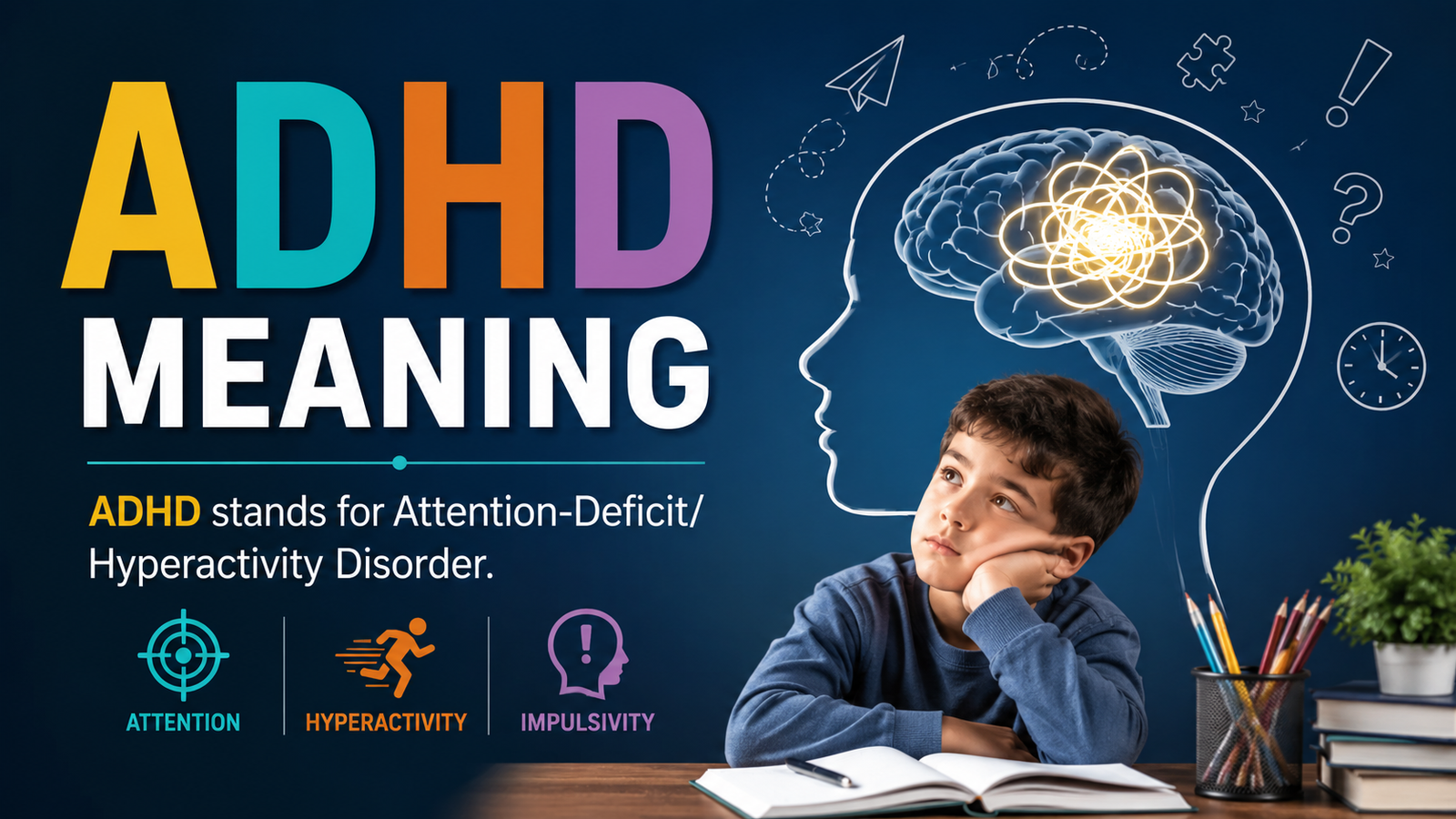
ADHD stands for Attention-Deficit/Hyperactivity Disorder. It is a developmental disorder associated with ongoing patterns of inattention, hyperactivity, and/or impulsivity that can affect everyday life. ADHD can begin in childhood and may continue through the teenage years and adulthood.
The word is now common in everyday English, but it is also a medical term. Because people sometimes use “ADHD” casually to describe being distracted, energetic, or forgetful, it is important to understand what the term actually means.
This guide explains ADHD meaning, pronunciation, origin, examples, synonyms, antonyms, common usage, related terms, and frequently asked questions in simple English.
What Does ADHD Mean?
ADHD means Attention-Deficit/Hyperactivity Disorder.
It describes a developmental condition in which a person has a persistent pattern of difficulties involving attention and/or hyperactivity and impulsivity. These difficulties can interfere with activities such as school, work, relationships, organization, and daily responsibilities.
ADHD is not simply the same as being occasionally distracted.
Almost everyone forgets something, loses focus, interrupts someone, or feels restless from time to time. With ADHD, these patterns are more persistent and can occur in more than one area of life.
For example, someone with ADHD may regularly struggle to:
- Stay focused on a long task
- Organize work or personal activities
- Remember appointments or everyday responsibilities
- Finish projects
- Control impulsive reactions
- Sit still for extended periods
- Wait for their turn
- Avoid distractions
However, having one or two of these experiences does not automatically mean someone has ADHD. Diagnosis requires a professional evaluation.
ADHD Pronunciation
The abbreviation ADHD is usually pronounced by saying each letter separately:
The full term is pronounced:
Attention-Deficit/Hyperactivity Disorder
In everyday conversation, most people simply say “ADHD” rather than the full name.
What Does Each Part of ADHD Stand For?
The full name becomes easier to understand when you break it into three parts.
Attention
Attention refers to the ability to focus on information, activities, or tasks.
A person with ADHD may find it difficult to maintain attention, especially during tasks that are repetitive or require sustained concentration.
Deficit
Deficit means a difficulty or reduced ability in a particular area. In ADHD, the term refers to difficulties with attention and related executive-function skills.
It does not mean that a person has no ability to pay attention.
Hyperactivity
Hyperactivity refers to unusually high levels of physical or mental restlessness or activity.
It can include excessive movement, talking, fidgeting, or feeling unable to remain still.
Disorder
Disorder is a medical term used when a pattern of symptoms causes meaningful difficulties in everyday functioning.
This is why ADHD should not be confused with ordinary moments of distraction or high energy.
ADHD Meaning in Simple English
In very simple English:
ADHD is a condition that can make it harder for a person to focus, control impulses, stay organized, or manage restlessness.
Some people mainly experience attention-related difficulties. Others experience more hyperactivity and impulsivity, while some experience a combination.
According to the National Institute of Mental Health, the three presentations are commonly described as predominantly inattentive, predominantly hyperactive-impulsive, and combined.
The Main Symptoms Associated With ADHD
ADHD symptoms generally fall into three broad areas.
1. Inattention
Inattention can involve difficulty:
- Paying close attention to details
- Staying focused during lengthy tasks
- Following instructions
- Organizing activities
- Managing time
- Completing assignments or projects
- Remembering everyday responsibilities
- Keeping track of personal belongings
- Ignoring distractions
An inattentive person may appear to be listening but lose track of what is being said. They may also start several tasks without finishing them.
2. Hyperactivity
Hyperactivity can involve:
- Excessive movement
- Fidgeting
- Restlessness
- Talking frequently
- Difficulty participating quietly in certain activities
- Feeling a strong need to stay active
Hyperactivity does not always look the same at every age. In adults, it can sometimes appear more like internal restlessness than obvious running or climbing.
3. Impulsivity
Impulsivity involves acting or responding without adequately considering the consequences.
Examples include:
- Interrupting people
- Answering before a question is finished
- Difficulty waiting for a turn
- Making quick decisions
- Acting on an immediate urge
These symptoms can affect relationships, school, work, and other areas of daily life.
Examples of ADHD in Everyday Sentences
Here are some natural examples showing how the term is used.
Example 1:
“My brother was diagnosed with ADHD when he was a child.”
Example 2:
“She has ADHD, so she uses organizational tools to help manage her daily tasks.”
Example 3:
“I’ve been learning more about ADHD because I want to understand how attention difficulties can affect adults.”
Example 4:
“ADHD can affect both school performance and relationships.”
Example 5:
“People sometimes use ADHD as a joke for being distracted, but the condition is more complex than ordinary forgetfulness.”
ADHD Meaning in Texting and Social Media
On social media and in texting, ADHD usually keeps its medical meaning: Attention-Deficit/Hyperactivity Disorder.
However, people sometimes use phrases such as:
“My ADHD brain”
or
“That gave me ADHD.”
These expressions may be intended humorously to describe distraction, rapid topic changes, or difficulty concentrating.
It is worth remembering that casual online usage does not define the medical condition. ADHD involves a persistent pattern of symptoms that can interfere with functioning, rather than simply having a busy mind or occasionally losing focus.
Is ADHD Only a Childhood Condition?
No.
ADHD is often identified during childhood, but symptoms can continue into adolescence and adulthood. Adults can experience difficulties with attention, organization, time management, restlessness, impulsivity, appointments, work tasks, and completing projects.
This is one reason the phrase “adult ADHD” is commonly searched online.https://topoftopic.com/pda-meaning/
An adult who was never diagnosed as a child may recognize certain long-standing patterns later in life and decide to seek a professional evaluation.
ADHD Meaning in Adults
In adults, ADHD may look different from the stereotypical image of a constantly energetic child.
An adult might experience:
- Chronic procrastination
- Difficulty managing time
- Frequent forgetfulness
- Problems organizing tasks
- Losing keys, phones, or other belongings
- Difficulty completing large projects
- Restlessness
- Frequent interruptions
- Difficulty maintaining attention during meetings
- A tendency to seek immediate rewards
NIMH notes that adult ADHD can interfere with home life, work, relationships, and other areas of functioning.
ADHD Origin and History
The history of ADHD is complicated because descriptions of attention and behavior difficulties existed long before the modern diagnosis.
The terminology used to describe the condition has changed over time. Earlier medical classifications used different names, including terms associated with attention problems, hyperactivity, and impulsive behavior.
The modern name Attention-Deficit/Hyperactivity Disorder emphasizes the combination of attention-related and hyperactive-impulsive symptoms.
Today, ADHD is understood as a developmental disorder, with research examining genetic, neurological, and environmental factors that may contribute to it. Researchers do not consider there to be one single cause of ADHD.
What Causes ADHD?
There is no single cause that explains every case of ADHD.
Research suggests that genetics play an important role, while scientists also investigate differences in brain development and neurobiology and possible environmental risk factors.
This means ADHD should not be reduced to simple explanations such as “bad parenting,” laziness, or a lack of discipline.
It is also important not to diagnose yourself based solely on online symptom lists. Other issues, including sleep problems, anxiety, depression, stress, and some physical conditions, can produce symptoms that resemble ADHD.
How Is ADHD Diagnosed?
There is no single test that can establish ADHD by itself.
A qualified healthcare professional considers symptoms, developmental history, medical and mental health history, and how difficulties affect different parts of life.
NIMH explains that ADHD symptoms must begin in childhood and that diagnostic criteria consider factors such as duration, presence across settings, and interference with functioning.
For this reason, an online quiz may help someone decide whether to seek professional advice, but it cannot replace a proper evaluation.
ADHD Synonyms and Related Terms
Strictly speaking, ADHD does not have a perfect synonym because it is the name of a specific medical diagnosis.
However, related terms include:
- Attention-deficit/hyperactivity disorder
- Attention deficit disorder (ADD) — an older/common term that some people still use
- Inattentive presentation
- Hyperactive-impulsive presentation
- Combined presentation
- Attention difficulties
- Executive-function difficulties — related to skills such as planning, organization, and self-management
Is ADD the Same as ADHD?
You may still hear people say ADD.
ADD was once commonly used to describe attention difficulties, particularly when hyperactivity was not prominent. Today, ADHD is the official umbrella term, with different presentations used to describe a person’s symptom pattern.
So if someone says they have “ADD,” they may be referring to what is now called ADHD, predominantly inattentive presentation.
ADHD Antonyms
Because ADHD is a specific medical condition rather than an ordinary adjective, it does not have a true antonym.
Still, when discussing the opposite of individual ADHD-related traits, people might use words such as:
- Focused
- Attentive
- Organized
- Patient
- Calm
- Self-controlled
- Methodical
- Consistent
These words describe qualities that may contrast with certain symptoms, but they are not medical opposites of ADHD.
For example, being highly organized does not prove that someone does not have ADHD.
Common Misunderstandings About ADHD
“Everyone gets distracted, so everyone has ADHD.”
Not true.
Occasional distraction is normal. ADHD involves persistent symptoms that can significantly interfere with functioning.
“ADHD means someone cannot concentrate.”
Not exactly.
People with ADHD can concentrate intensely, especially when something is interesting or highly stimulating. The difficulty can be controlling attention consistently and directing it toward tasks when needed.
“ADHD is only for children.”
False.
ADHD can continue into adulthood, and adults can experience significant symptoms.
“ADHD is just laziness.”
No.
Difficulty starting, organizing, or completing tasks can be related to attention and executive-function challenges. Calling someone lazy does not explain the underlying issue.
“You can diagnose ADHD from a TikTok or online checklist.”
No.
Only a qualified professional can make an appropriate diagnosis after considering the person’s broader history and symptoms.
Why Understanding ADHD Matters
Understanding ADHD can change how people view themselves and others.
Someone who repeatedly forgets appointments may not simply be careless. A student struggling to finish assignments may not simply lack intelligence or motivation. A colleague who interrupts frequently may not intentionally be disrespectful.
At the same time, ADHD does not mean that every difficult behavior should automatically be attributed to the condition.
The most useful approach is to replace quick judgments with accurate information and, when appropriate, professional support.
Effective treatments and interventions can help people manage ADHD symptoms. NIMH describes approaches that may include medication and psychosocial interventions such as cognitive behavioral therapy, parent training, and school-based interventions.
Frequently Asked Questions About ADHD Meaning
What does ADHD stand for?
ADHD stands for Attention-Deficit/Hyperactivity Disorder.
It is a developmental disorder associated with persistent patterns of inattention and/or hyperactivity and impulsivity.
What is ADHD in simple words?
In simple words, ADHD is a condition that can make attention, organization, impulse control, and activity regulation more difficult.
The experience varies significantly from person to person.
How do you pronounce ADHD?
ADHD is normally pronounced by saying each letter separately: “A-D-H-D.”
What is the difference between ADHD and ADD?
ADD is an older term that is still used informally. Modern diagnostic terminology uses ADHD, including an inattentive presentation for people whose symptoms are mainly related to attention rather than obvious hyperactivity.
Can adults have ADHD?
Yes. ADHD can continue from childhood into adolescence and adulthood. Adults may experience problems with attention, organization, time management, impulsivity, restlessness, and completing tasks.
Is ADHD a mental illness?
ADHD is generally described by major health organizations as a developmental disorder or neurodevelopmental disorder. It affects brain development and functioning and can interfere with daily activities.
Does ADHD mean someone is unintelligent?
No. ADHD does not mean a person lacks intelligence. It primarily involves patterns of attention, activity, and impulse regulation that can affect functioning.
Can ADHD go away?
ADHD symptoms can change with age, and some people experience fewer or different symptoms as they grow older. However, ADHD can continue into adulthood. Treatment and practical strategies can help people manage symptoms and improve daily functioning.
Final Thoughts on ADHD Meaning
The simplest answer to “What does ADHD mean?” is Attention-Deficit/Hyperactivity Disorder, a developmental condition associated with persistent difficulties involving inattention, hyperactivity, and impulsivity.
But the meaning goes beyond the four letters.
ADHD is not simply being forgetful, energetic, distracted, or impatient once in a while. It is a recognized condition that can affect school, work, relationships, organization, and everyday life. Symptoms can look different from one person to another, and they can change as a person gets older.
If you recognize several ADHD-related patterns in yourself or someone you know, an online article cannot determine whether ADHD is the reason. A qualified healthcare professional can evaluate the symptoms and consider other possible explanations.
Understanding the term accurately is a good first step—and replacing stereotypes with reliable information is even more important.