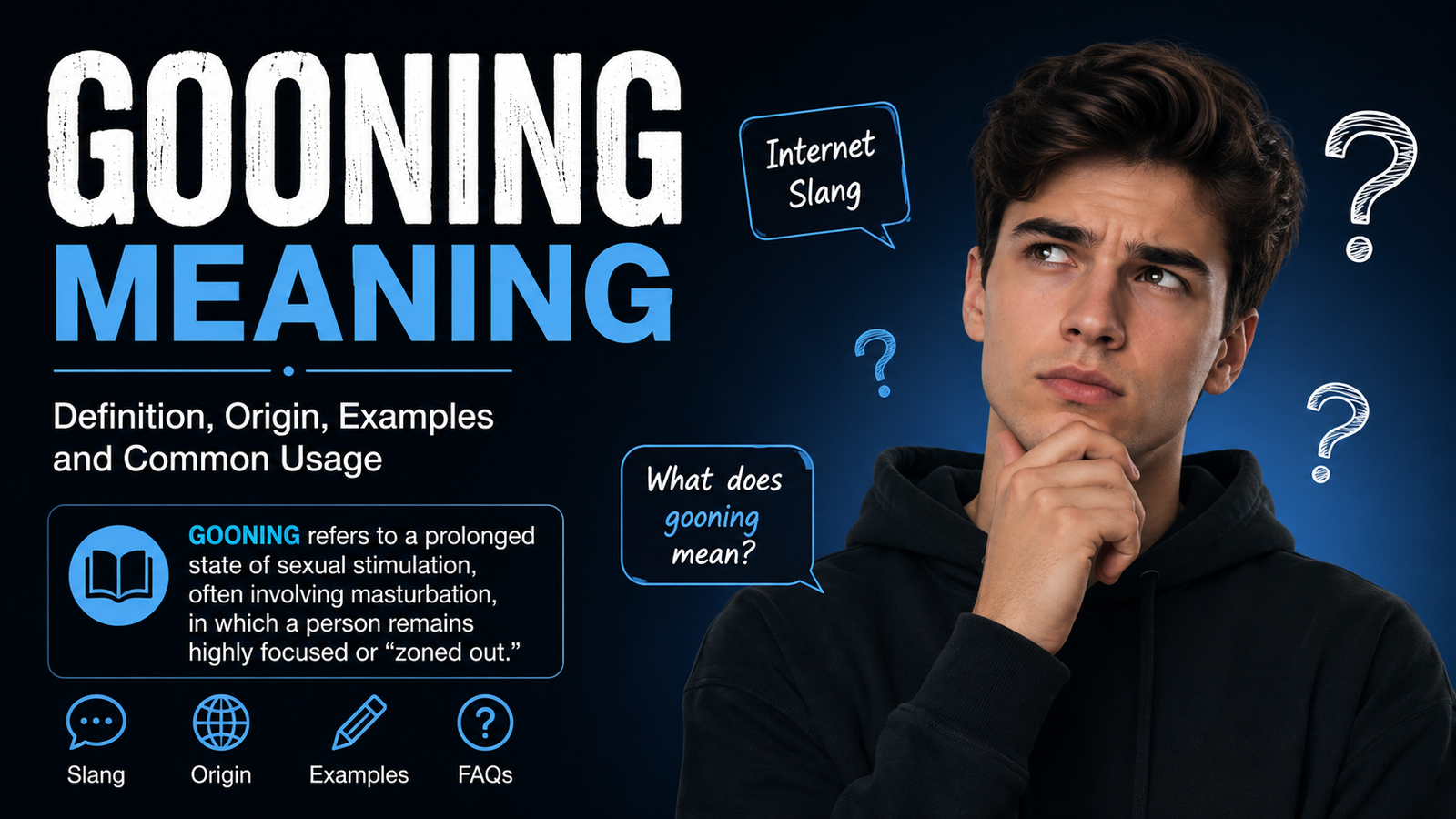
If you have seen the word “gooning” on TikTok, Reddit, Discord, memes, or other online communities, you may have wondered what it actually means. The term can be confusing because it has both a specific adult slang meaning and a broader, joking use in internet culture.
In its original and most established modern slang sense, gooning refers to prolonged sexual stimulation, usually involving masturbation, in a highly absorbed or trance-like state.
However, online users sometimes use the word more loosely to describe being extremely absorbed in something, such as a game, video, celebrity, meme, or endless scrolling. Because of this shift, the meaning depends heavily on the context in which you encounter it.
This guide explains gooning meaning, pronunciation, origin, examples, synonyms, antonyms, common usage, and FAQs in simple English.
What Does Gooning Mean?
Gooning is internet slang for a prolonged state of sexual stimulation in which a person becomes intensely absorbed in the experience. The term is especially associated with delaying orgasm and remaining in that heightened state for an extended period.
The word is informal and should not be confused with a medical or psychological diagnosis. It belongs primarily to internet and adult slang.
There is also a non-sexual, humorous use. In memes and casual online conversations, someone may say they are “gooning over” a game, song, character, or other interest to exaggerate how obsessed or fascinated they are.
Simple Definition
In simple English:
Gooning = becoming intensely absorbed in prolonged sexual stimulation; in some memes, it can jokingly mean being extremely obsessed or zoned in on something.
The adult meaning is the safer interpretation when the term appears in an explicitly NSFW context.
Gooning Pronunciation
The word gooning is pronounced with a long “oo” sound, similar to the vowel sound in “moon.”
It has two syllables, with the main stress on the first syllable.
The spelling comes from goon + -ing, just as other English verbs can be formed by adding “-ing.”
Where Did the Word Gooning Come From?
Understanding the history of gooning requires separating it from the older word goon.
The word goon has been used in English since the early 20th century. Dictionary sources connect it with meanings such as a foolish or awkward person and, in another sense, a hired thug or enforcer. Dictionary.com dates the noun to around 1920–25 and connects it with older dialectal forms such as “gooney.”
The word was also influenced by Alice the Goon, a character from E. C. Segar’s Thimble Theatre comic series.
The modern sexual meaning of gooning developed much later in online adult communities. Sources place its emergence in internet culture around the late 2000s and early 2010s, although dictionaries and slang references vary on the exact first-use date.
Over time, the term moved beyond niche communities and became increasingly visible in memes and social media.
How Gooning Became Internet Slang
Internet language changes quickly. A word can begin inside a small online community and later become recognizable to millions of people.
That is what happened with gooning.
Originally, the term was strongly associated with adult internet communities and prolonged sexual stimulation. As meme culture grew, users began taking the word out of its original context and using it humorously.
Today, you may see someone use “gooning” as an exaggerated way of describing extreme fascination or obsessive attention.
For example:
“He has been gooning over that new game all weekend.”
In a meme context, the sentence may simply mean that the person is completely obsessed with the game.
That does not necessarily mean the speaker is using the word in its original adult sense.
Gooning Meaning on TikTok
The meaning of gooning on TikTok can be especially confusing because TikTok has a large meme and “brainrot” vocabulary.
Some users employ the word jokingly to describe being intensely focused on a video, celebrity, fictional character, game, or trend. Other uses deliberately reference the word’s adult meaning.
Therefore, context matters.
If the surrounding comments are clearly sexual or NSFW, the adult definition is probably intended. If the word appears alongside memes about gaming, scrolling, or obsessive fandom, it may be used as exaggerated internet humor.
Because the term has an established adult meaning, it is not always appropriate for professional, school, workplace, or family conversations.
Gooning Meaning in Texting
In texting, gooning can have different meanings depending on who is speaking and what the conversation is about.
A private NSFW conversation may use it in its original sexual sense.
A meme-heavy conversation may use it jokingly to mean someone is excessively fascinated by something.
For example:
“Bro has been gooning over that trailer for three hours.”
Here, the speaker may simply be exaggerating the person’s obsession with the trailer.
Another important clue is the surrounding vocabulary. If the conversation contains other adult slang, the sexual meaning becomes much more likely.
Common Examples of Gooning
Because the word has an adult origin, examples should be understood according to context rather than assuming every online use is sexual.
Example 1: Adult Internet Context
In an adult discussion, “gooning” can refer to prolonged sexual stimulation and an intensely absorbed state.
This is the primary modern slang meaning documented by slang and dictionary references.
Example 2: Meme Culture
“He’s gooning over that new game.”
In this context, it may be humorous slang for being extremely obsessed with the game.
Example 3: Social Media
“I opened one video and started gooning through memes for hours.”
Here, the speaker may be using the term jokingly to describe being completely absorbed in online content.
Example 4: Fandom
“Everyone is gooning over the new character design.”
Depending on the community, this could suggest intense attraction, exaggerated admiration, or simply obsessive enthusiasm.
These examples demonstrate why context is essential when interpreting the word.
Gooning vs. Being Obsessed
The words can overlap in informal internet language, but they are not exact synonyms.
Being obsessed is a general expression that can describe intense interest in almost anything.
Gooning, on the other hand, has a specific adult slang history and can carry an NSFW meaning even when someone is using it jokingly.
For that reason, saying “I’m obsessed with this game” is much more neutral than saying “I’m gooning over this game.”
Synonyms for Gooning
The appropriate synonym depends on which meaning is intended.
For the adult slang meaning, related informal terms can include:
- Edging
- Prolonged masturbation
- Extended sexual stimulation
For the non-sexual internet meaning, possible alternatives include:
- Obsessing
- Fixating
- Hyper-focusing
- Being absorbed
- Being zoned in
- Being fascinated
- Overindulging
These words are not perfect replacements in every sentence because gooning has a distinctive internet-culture meaning.
Antonyms for Gooning
There is no single perfect antonym because the term has multiple uses.
For the general meaning of extreme absorption, possible opposites include:
- Ignoring
- Disinterest
- Detachment
- Indifference
- Distraction
- Moderation
- Self-control
For example, if someone is “completely absorbed” in something, being disengaged or indifferent would express the opposite idea.
Is Gooning a Medical Term?
No.
Gooning is internet slang, not a recognized medical diagnosis. It is used informally to describe a particular behavior or state of intense absorption.
It is therefore inaccurate to automatically describe someone as having a medical condition simply because they use or experience the term.
If sexual behavior becomes difficult to control or starts interfering with someone’s everyday responsibilities, relationships, sleep, work, or studies, that is a broader behavioral or well-being question rather than something that can be diagnosed simply by using the slang word.
Why Do People Use the Word Gooning?
There are several reasons the word has become popular online.
Internet Humor
Internet communities often take unusual or niche words and turn them into jokes. The strange sound of “gooning” makes it particularly easy to use as exaggerated meme language.
Shock Value
Some slang becomes popular precisely because it sounds inappropriate or unexpected. Using an adult term in an obviously non-adult situation can create humor through contrast.
Online Community Language
Different communities develop their own vocabulary. Once a term becomes familiar within one group, it can spread through memes, videos, comments, and reposts.
Changing Meanings
Modern slang rarely stays fixed. A word can maintain its original meaning while developing a second, ironic meaning.
That appears to be happening with gooning.
Is Gooning a Bad Word?
It depends on the context, but gooning is generally considered informal and potentially NSFW slang.
Because of its established sexual meaning, it is not a word you should casually use in a formal email, school assignment, workplace presentation, or professional conversation.
A person may use it harmlessly as a meme, but another person may understand the original adult meaning.
If you are unsure, choose a neutral word such as obsessed, fascinated, absorbed, or focused.
Gooning vs. Goon
Although the words are related linguistically, they do not mean the same thing.
Goon is an older slang noun that can mean a foolish or awkward person, or a thug/enforcer.
Gooning is a newer internet slang formation that developed a separate adult meaning.
So seeing the word goon does not automatically mean the person is talking about the sexual meaning of gooning.
Context is the key.
Common Mistakes About Gooning
One common mistake is assuming that every use of “gooning” is sexual.
That is not necessarily true in meme culture. Some people deliberately use the word as exaggerated slang for intense fascination.
Another mistake is assuming that the word is completely harmless because it appears in a meme.
Its original modern meaning is adult, so people unfamiliar with the meme usage may interpret it differently.
A third mistake is treating the word as a medical term. It is not.
How to Understand Gooning in a Sentence
When you encounter the word online, ask three simple questions:
1. What Is the Conversation About?
If the discussion is clearly NSFW, the adult meaning is probably intended.
2. Is the Context a Meme?
If people are joking about games, celebrities, food, movies, or internet trends, the word may be being used metaphorically.
3. Who Is Using It?
Internet communities have different vocabularies. A term used ironically by one group may be interpreted literally by another.
This quick context check can prevent a lot of confusion.
Gooning Meaning: Quick Summary
| Term | Meaning |
|---|---|
| Gooning | Modern internet slang with an adult meaning involving prolonged sexual stimulation |
| Meme usage | Sometimes used jokingly to mean extreme obsession or absorption |
| Pronunciation | Two syllables, with the first syllable stressed |
| Origin | Modern internet slang built from “goon,” an older English slang word |
| Tone | Informal, internet-based, and potentially NSFW |
| Neutral alternatives | Obsessed, absorbed, fascinated, fixated |
| Medical term? | No |
Frequently Asked Questions About Gooning
What does gooning mean in simple English?
Gooning is internet slang for becoming intensely absorbed in prolonged sexual stimulation. In memes, people sometimes use it more loosely to mean being extremely obsessed or fascinated by something.
What does gooning mean on TikTok?
On TikTok and similar platforms, gooning can be used as meme slang for being intensely absorbed in something, although the word also retains its adult meaning in some contexts.
Is gooning a bad word?
It is informal and potentially NSFW slang. Because it has an established adult meaning, it is best avoided in formal or professional conversations.
What is another word for gooning?
The answer depends on context. In its adult sense, related slang includes terms connected with prolonged sexual stimulation. In meme usage, alternatives include obsessing, fixating, hyper-focusing, or being absorbed.
Where did the word gooning come from?
The modern slang term developed through online communities, particularly adult internet spaces. It is built from the older word goon, which historically referred to a foolish person or, in another usage, a thug or enforcer.
Does gooning always mean something sexual?
No. Contextual and meme usage can be non-sexual, especially when people use the term to exaggerate their obsession with games, entertainment, trends, or other interests. However, its established adult meaning means the word can still carry an NSFW interpretation.
Is gooning a psychological diagnosis?
No. Gooning is internet slang rather than a medical or psychological diagnosis.
Conclusion
The meaning of gooning is more complicated than it first appears. In its established modern slang sense, it refers to prolonged sexual stimulation accompanied by intense absorption or a trance-like feeling.
At the same time, internet and meme culture have broadened the word. Some users now employ “gooning” humorously to describe extreme fascination, obsession, or being completely absorbed in something.
The most important point is context. If the word appears in an NSFW discussion, its adult meaning is likely intended. If it appears in a meme about gaming, entertainment, or internet culture, it may be an exaggerated joke.
Because the term carries an adult association, neutral alternatives such as obsessed, fascinated, absorbed, or fixated are usually better choices in everyday and professional communication.
Ultimately, understanding the difference between the original slang meaning and its newer meme usage makes it much easier to interpret gooning correctly when you encounter it online.