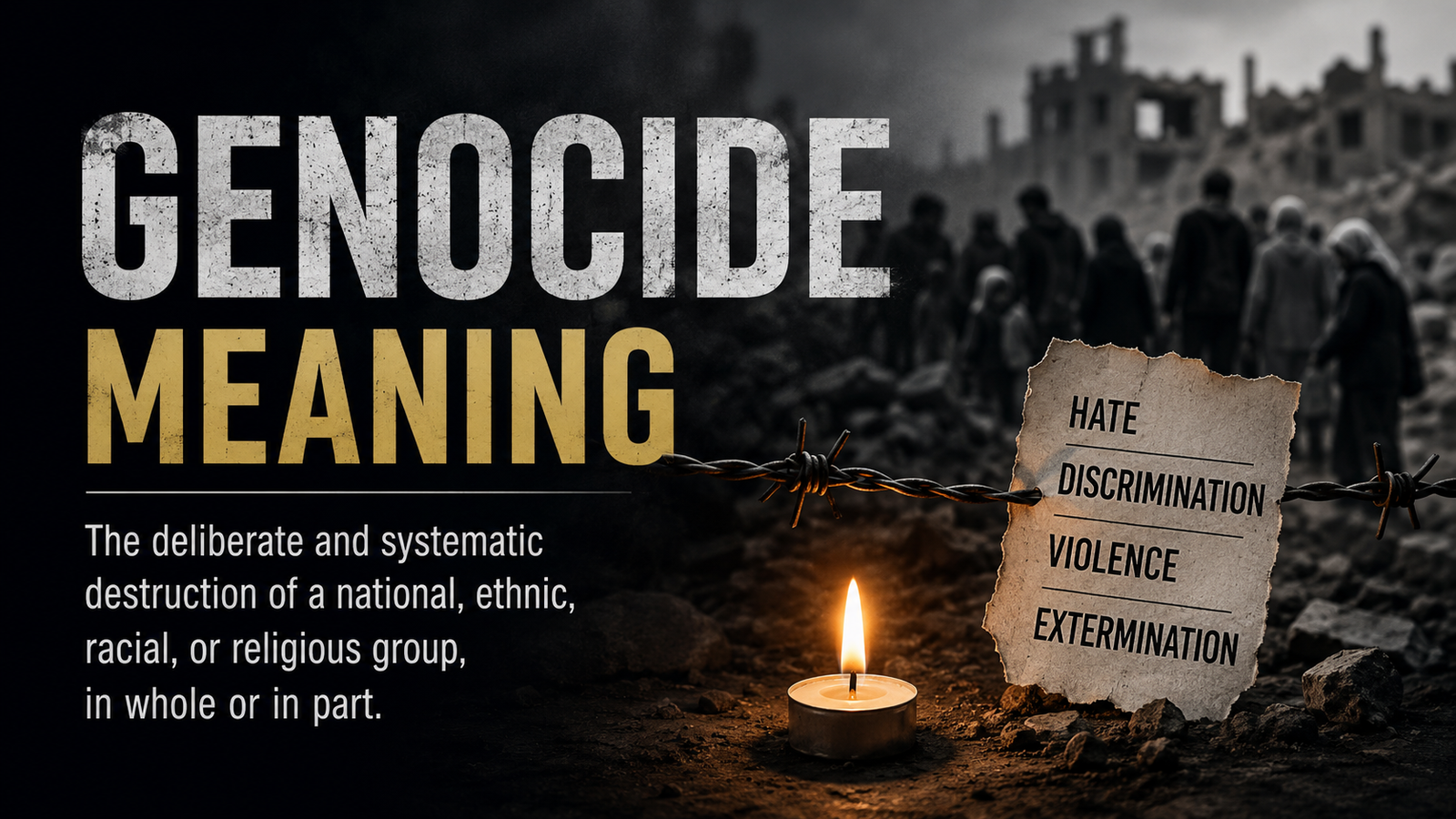
The word genocide describes one of the most serious crimes against humanity. It refers to deliberate actions intended to destroy, in whole or in part, a protected group of people because of their national, ethnic, racial, or religious identity.
Understanding the genocide meaning is important because the word is sometimes used casually to describe any large-scale killing. In international law, however, genocide has a much more specific meaning. It requires particular acts and, importantly, an intent to destroy the group as such. The United Nations Genocide Convention established this legal definition in 1948.
This guide explains what genocide means in simple English, how to pronounce it, where the word came from, how it is used, and how it differs from related terms such as massacre, ethnic cleansing, war crimes, and crimes against humanity.
What Does Genocide Mean?
Genocide means the deliberate attempt to destroy, completely or partially, a national, ethnic, racial, or religious group.
Under Article II of the 1948 Genocide Convention, genocide can involve five categories of acts:
- Killing members of the group
- Causing serious bodily or mental harm
- Creating living conditions intended to bring about the group’s physical destruction
- Taking measures intended to prevent births within the group
- Forcibly transferring children from the group to another group
The key point is that these acts must be committed with the specific intent to destroy the protected group, in whole or in part, as such.
In simple words, genocide is not simply “many people being killed.” It is the intentional destruction of a particular protected group.
Genocide Meaning in Simple English
In everyday English, you can understand genocide this way:
Genocide is the planned destruction of a group of people because of who they are.
For example, if authorities or an organized group deliberately target people because they belong to a particular ethnic or religious group and intend to destroy that group, the conduct may meet the legal definition of genocide if the required elements are proven.
The word therefore carries a much stronger and more precise meaning than words such as violence, murder, or mass killing.
How Do You Pronounce Genocide?
Genocide is pronounced with the stress on the first syllable.
The pronunciation is commonly represented in English dictionaries as approximately:
JEN-uh-side
The ending -cide is also found in words such as homicide and suicide, where it relates to killing.
Origin and Etymology of Genocide
The history of the word genocide is relatively modern.
The term was coined in 1944 by Raphael Lemkin, a Polish lawyer who developed the concept while examining the destruction of groups during the Second World War and earlier historical atrocities. The United Nations explains that Lemkin formed the word by combining genos, a Greek word associated with race or tribe, with the Latin-derived suffix -cide, meaning killing.
Lemkin introduced the term in his book Axis Rule in Occupied Europe.
His work helped give the international community a specific name for the deliberate destruction of groups. After the Second World War, he campaigned for genocide to become recognized as a distinct international crime.
The United Nations General Assembly recognized genocide as a crime under international law in 1946. Two years later, on December 9, 1948, the General Assembly adopted the Convention on the Prevention and Punishment of the Crime of Genocide. The convention entered into force on January 12, 1951.
As of July 2026, the UN Treaty Collection lists 154 parties to the Genocide Convention.
Why Did Raphael Lemkin Create the Word?
Before Lemkin coined the word, there was no single internationally recognized term specifically describing the intentional destruction of a group.
Lemkin believed that mass atrocities could not be properly confronted unless the world had a clear concept and legal framework for them.
His work was influenced heavily by the Holocaust, but his study of genocide was broader than one historical event. The United Nations notes that Lemkin also considered earlier cases in which nations, ethnic communities, and religious groups had been subjected to destructive policies.
His campaign ultimately contributed to the creation of the Genocide Convention.
What Makes an Act Genocide?
One of the most important parts of the genocide meaning is intent.
A person may be responsible for terrible violence without that conduct automatically becoming genocide under international law.
The legal definition requires an intention to destroy, in whole or in part, a protected national, ethnic, racial, or religious group as such. The specific intent requirement is sometimes described using the legal term dolus specialis.
This makes genocide legally different from many other serious international crimes.
For example, a large number of civilian deaths during a war can be horrific and unlawful, but the existence of many deaths alone does not automatically establish genocide.
Investigators and courts may need to examine evidence concerning the perpetrators’ statements, policies, patterns of conduct, targets, circumstances, and other evidence of intent.
Examples of Genocide
The word genocide is commonly associated with several historical situations that have been recognized by courts, governments, or international institutions as genocide.
The Holocaust
The Holocaust is one of the most widely known examples associated with genocide. Nazi Germany and its collaborators systematically murdered approximately six million Jews during the Second World War, while other groups were also persecuted and murdered.
The Holocaust played an important role in the historical context in which Lemkin developed and promoted the concept of genocide.
The Rwandan Genocide
The 1994 genocide against the Tutsi in Rwanda is another major example.
Over approximately 100 days, extremist forces and their supporters carried out mass killings targeting Tutsi people, as well as moderate Hutu and others who opposed the violence.
The International Criminal Tribunal for Rwanda later prosecuted individuals for genocide.
The Srebrenica Genocide
The 1995 Srebrenica genocide occurred during the Bosnian War.
Thousands of Bosniak Muslim men and boys were killed after the fall of Srebrenica. International courts, including the International Criminal Tribunal for the former Yugoslavia and the International Court of Justice, addressed the events under the law of genocide.
These examples show why legal classification matters. Historical events can involve multiple international crimes, and the exact legal findings depend on evidence and judicial determinations.
Genocide vs. Massacre
These words are related, but they are not identical.
A massacre generally means the killing of a large number of people, often civilians or people who are unable to defend themselves.
A massacre can occur for many reasons. The term itself does not necessarily establish that the perpetrators intended to destroy a protected group.
Genocide, by contrast, has a specific legal meaning that includes the intent to destroy a protected group, in whole or in part.
So, while genocide can involve massacres, not every massacre is genocide.
Genocide vs. Ethnic Cleansing
Ethnic cleansing generally refers to efforts to remove a particular ethnic or religious population from a territory through methods such as forced displacement, intimidation, or violence.
Genocide is different because the international legal definition focuses on intent to destroy the group, rather than simply removing it from a particular area.
The two concepts can overlap, and conduct associated with ethnic cleansing can sometimes involve acts that meet the legal definition of genocide. However, the terms should not automatically be treated as synonyms.
Genocide vs. War Crimes
War crimes are serious violations of international humanitarian law committed in connection with an armed conflict.
Examples can include intentionally attacking civilians, mistreating prisoners, or committing certain forms of unlawful destruction.
Genocide is a separate international crime. Importantly, the Genocide Convention states that genocide can occur during war or during peace.
Therefore, genocide does not require an armed conflict.
Genocide vs. Crimes Against Humanity
Crimes against humanity involve certain widespread or systematic attacks directed against a civilian population.
Genocide overlaps with crimes against humanity in some circumstances, but the crimes have different legal elements.
The defining feature of genocide is the specific intent to destroy a protected group, while crimes against humanity do not require that same genocidal intent.
Understanding this distinction is especially important when discussing historical conflicts because one situation may involve several different international crimes.
Synonyms for Genocide
Because genocide has a specific legal meaning, there are no perfect synonyms in every context.
Depending on the situation, related terms may include:
- Group destruction
- Extermination
- Mass destruction
- Systematic destruction
- Mass killing
- Annihilation
- Elimination of a group
However, these words should not automatically replace genocide in legal writing.
For example, mass killing describes the scale of deaths, while genocide describes a particular crime involving protected groups and specific intent.
Antonyms of Genocide
There is no single exact opposite of genocide, but several concepts represent the opposite idea:
- Protection
- Preservation
- Peace
- Tolerance
- Inclusion
- Coexistence
- Respect for human rights
- Protection of minority groups
These words describe conditions in which groups are protected rather than intentionally targeted for destruction.
Common Usage of the Word Genocide
The word genocide is most commonly used in discussions involving:
- International law
- Human rights
- History
- Armed conflicts
- Political science
- International relations
- Humanitarian crises
- War and peace studies
- Historical atrocities
Examples of natural sentences include:
“The court examined whether the evidence established genocidal intent.”
“The genocide left a lasting impact on survivors and their communities.”
“Historians continue to study the warning signs that can precede genocide.”
“The international community has a responsibility to work toward preventing genocide.”
Because the word has a precise legal meaning, it is best used carefully rather than as a general synonym for every instance of mass violence.
Why Understanding Genocide Matters
Learning the genocide meaning is not simply a vocabulary exercise.
The term exists because societies need language to identify and confront some of the most serious forms of organized violence.
The Genocide Convention does more than define the crime. It also establishes that countries have obligations to prevent and punish genocide. The convention states that genocide is prohibited whether it occurs during peace or war.
Recognizing warning signs, protecting vulnerable communities, documenting abuses, and supporting accountability are all important parts of preventing future atrocities.
The United Nations continues to emphasize prevention because discrimination and identity-based violence can create dangerous conditions in which mass atrocities become more likely.
Frequently Asked Questions About Genocide Meaning
What is the simple meaning of genocide?
Genocide means the deliberate attempt to destroy, completely or partially, a national, ethnic, racial, or religious group.
Who coined the word genocide?
The word genocide was coined by Raphael Lemkin in 1944. He combined Greek and Latin-derived elements to create the term.
What is the origin of the word genocide?
The word comes from genos, associated with race or tribe in Greek, and -cide, derived from Latin and meaning killing.
Is genocide the same as mass killing?
No. Mass killing does not automatically equal genocide. Genocide requires the specific intent to destroy, in whole or in part, a protected national, ethnic, racial, or religious group.
Is genocide illegal under international law?
Yes. Genocide is an international crime. The UN General Assembly recognized it as such in 1946, and the 1948 Genocide Convention codified it as a distinct crime.
Can genocide happen during peacetime?
Yes. The Genocide Convention explicitly states that genocide can occur in time of peace as well as in time of war.
What are the five acts associated with genocide?
They are killing members of a protected group, causing serious bodily or mental harm, deliberately creating destructive living conditions, preventing births within the group, and forcibly transferring children to another group.
Is ethnic cleansing another word for genocide?
No. Ethnic cleansing and genocide are distinct concepts. Ethnic cleansing generally concerns removing a population from a territory, while genocide requires an intent to destroy a protected group in whole or in part.
Conclusion
The genocide meaning is much more specific than simply “mass killing.” It refers to acts committed with the specific intent to destroy, in whole or in part, a national, ethnic, racial, or religious group.
The term was created by Raphael Lemkin in 1944 and later became part of international law through the 1948 Genocide Convention.
Understanding the word also means understanding why precision matters. Not every war crime, massacre, forced displacement, or mass killing legally qualifies as genocide. The specific circumstances and evidence of intent matter.
At the same time, the history behind the term carries an important human lesson: recognizing identity-based persecution and organized violence early can help societies respond before atrocities become even more devastating.
In simple terms, genocide means the intentional destruction of a protected group of people because of their group identity. Knowing this definition helps us use the word accurately and understand one of the most serious crimes recognized under international law.