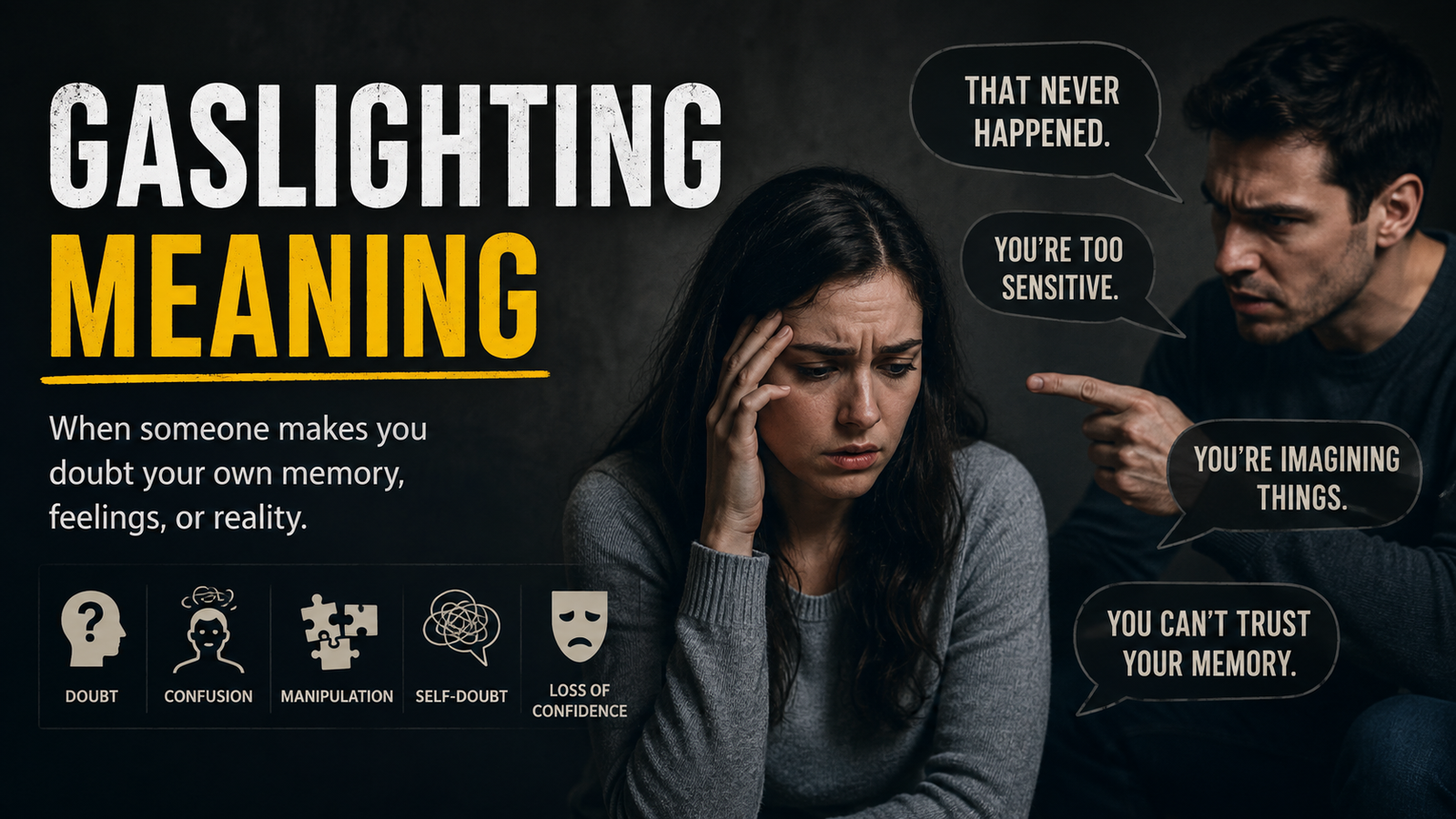
If you have ever heard someone say, “Stop gaslighting me,” you may have wondered what gaslighting actually means. The word is common in conversations about relationships, friendships, family problems, workplaces, social media, and even politics.
In simple English, gaslighting means manipulating someone so they begin to doubt their own memory, feelings, experiences, or understanding of what really happened. It is more than simply telling a lie. The key idea is that the person being manipulated is pushed to question their own sense of reality.
The term has a fascinating history. It comes from Gas Light, a 1938 play by British writer Patrick Hamilton and its film adaptations, especially the famous 1944 movie Gaslight. In the story, a husband deliberately makes his wife doubt what she sees and hears.
Today, the word is used much more broadly. This article explains the gaslighting meaning, pronunciation, origin, examples, synonyms, antonyms, common usage, and frequently asked questions in clear and simple English.
What Does Gaslighting Mean?
Gaslighting is a form of psychological manipulation in which one person repeatedly causes another person to question their own memory, perception, feelings, or understanding of events.
For example, imagine you clearly remember that a friend promised to help you on Saturday. When you remind them about the promise, they repeatedly say:
“I never said that. You must have imagined it.”
If this happens once because the person genuinely forgot, it is not necessarily gaslighting. People can forget conversations or remember events differently.
However, if someone repeatedly denies things they said or did, changes the story, dismisses your memories, and deliberately makes you doubt yourself, that can be gaslighting.
Merriam-Webster describes gaslighting as psychological manipulation that can make a person question their thoughts, perception of reality, memories, and emotional stability. The dictionary also notes a broader modern meaning involving deliberately misleading someone for personal advantage.
Gaslighting Meaning in Simple English
In very simple words:
Gaslighting = making someone doubt their own reality or memory through manipulation.
A gaslighter may say things such as:
- “That never happened.”
- “You’re remembering it completely wrong.”
- “You’re too sensitive.”
- “You’re imagining things.”
- “You’re making a big deal out of nothing.”
- “Everyone agrees with me, not you.”
- “You can’t trust your own memory.”
The purpose may be to avoid responsibility, control another person, win an argument, protect a secret, or gain power in a relationship.
Gaslighting Pronunciation
The word gaslighting is pronounced approximately like “GAS-light-ing.”
The related verb is gaslight, as in:
“He tried to gaslight her.”
The person who engages in this behavior can be called a gaslighter.
What Is the Origin of Gaslighting?
The origin of the word gaslighting can be traced to Patrick Hamilton’s 1938 play Gas Light. The story later inspired a 1940 British film and the better-known 1944 American film Gaslight.
The story explains the meaning of the word remarkably well.
In the plot, a husband secretly searches the attic of his home while looking for valuable objects. His activities cause the gas-powered lights in the house to change or dim.
When his wife notices the lights becoming dimmer, he tells her that she is imagining it.
He does not simply deny the physical change. He works to make her believe that her own perception cannot be trusted.
As this manipulation continues, she becomes increasingly uncertain about her memory and sanity.
That central idea eventually gave English speakers the verb “to gaslight.” The word later developed into the noun “gaslighting.” Merriam-Webster records the noun’s first known use in 1961.
The word became especially popular in modern English during the 2010s and 2020s. Merriam-Webster selected “gaslighting” as its 2022 Word of the Year, noting a major increase in interest in the term.
Gaslighting vs. Lying: What’s the Difference?
Gaslighting and lying are related, but they are not exactly the same.
A lie is generally a false statement made intentionally.
For example:
“I didn’t eat the last piece of cake.”
If the person did eat it, that is a lie.
Gaslighting usually goes further. The person may not only deny eating the cake but also try to make you question whether you actually saw them eating it.
For example:
“You didn’t see me eat it. You always think you see things that aren’t there. Your memory is terrible.”
The second example attempts to undermine the other person’s confidence in their own perception.
That distinction is important because not every disagreement, lie, mistake, or misunderstanding is gaslighting.
Examples of Gaslighting
Gaslighting can appear in many different situations. Here are some easy examples.
1. Gaslighting in a Romantic Relationship
Imagine one partner repeatedly makes hurtful comments about the other person’s appearance.
When confronted, they respond:
“I never said that. You’re making things up.”
Later, they might say:
“You’re always too emotional. Nobody else would take that comment seriously.”
If this becomes a repeated pattern designed to make the other person doubt what happened, it may be gaslighting.
2. Gaslighting Between Friends
Suppose a friend agrees to meet you at 5 p.m. They do not arrive and do not send a message.
When you later ask why they did not come, they say:
“We never agreed on 5 p.m. You just assumed that.”
If you clearly remember the conversation and this kind of denial happens repeatedly, it could be an example of gaslighting.
3. Gaslighting in a Family
A family member may repeatedly make hurtful comments and later deny saying them.
They might say:
“I was only joking. You are too sensitive.”
One awkward joke does not automatically mean gaslighting. The concern arises when there is a consistent pattern of denying behavior, rewriting events, and making someone distrust their own experience.
4. Gaslighting at Work
Gaslighting can also happen in professional settings.
Imagine a manager gives an employee verbal instructions and later denies giving those instructions.
The manager says:
“I never told you to do that. You must have misunderstood me.”
If this repeatedly happens and the employee is made to feel incapable or unreliable, it can become a form of workplace manipulation.
5. Gaslighting Online
The word is also commonly used on social media.
A person may deliberately misrepresent an easily verified event and then tell others:
“You are imagining it. That never happened.”
In modern public discussions, the term can also describe attempts to grossly mislead groups of people, not only individuals. Merriam-Webster recognizes this broader use.
Common Signs of Gaslighting
Gaslighting can be difficult to recognize because it often develops gradually.
Some common signs include:
Repeated Denial
Someone repeatedly denies statements or actions that you clearly remember.
Blaming You for Their Behavior
Instead of addressing what they did, they make the conversation about your supposed flaws.
Making You Question Your Memory
They repeatedly tell you that your memory is bad or that you misunderstand everything.
Dismissing Your Feelings
They may respond to legitimate concerns with statements such as:
“You’re too sensitive.”
Changing the Story
The explanation changes whenever you provide new information or evidence.
Making You Apologize
You may find yourself apologizing even when you originally raised a reasonable concern.
Creating Self-Doubt
Over time, you may begin thinking:
“Maybe I really am remembering everything incorrectly.”
That growing uncertainty is one of the most important features associated with gaslighting.
Is Every Argument Gaslighting?
No.
This is one of the most important points to understand.
People can disagree without gaslighting each other. Two people may genuinely remember an event differently. Someone may forget a conversation. A person may misunderstand what another person meant.
Those situations are not automatically gaslighting.
Gaslighting generally involves a pattern of manipulation, especially when someone intentionally undermines another person’s confidence in their own perceptions or memories.
Using the word for every disagreement can make the term less useful. Contemporary discussions about gaslighting have also highlighted concerns about the word being applied too broadly.
Gaslighting Synonyms
There is no single synonym that perfectly matches the full meaning of gaslighting, but several words describe related behaviors.
Common related terms include:
- Manipulation
- Deception
- Psychological manipulation
- Mind games
- Misleading
- Dishonesty
- Emotional manipulation
- Reality distortion
- Deceit
- Control
However, these words are not always interchangeable.
For example, manipulation is a much broader term. A person can manipulate someone without making them question their own reality.
Similarly, lying does not necessarily involve the sustained psychological manipulation associated with gaslighting.
Gaslighting Antonyms
There is no exact opposite of gaslighting in everyday English, but several concepts represent healthier communication.
Possible antonyms or contrasting ideas include:
- Honesty
- Truthfulness
- Validation
- Transparency
- Open communication
- Respect
- Accountability
- Trust
- Acknowledgment
- Mutual understanding
For example, instead of denying someone’s experience, a healthy response might be:
“I remember it differently, but I understand why you experienced it that way. Let’s talk about what happened.”
That approach leaves room for disagreement without deliberately attacking the other person’s sense of reality.
Common Usage of Gaslighting
The word gaslighting is now common in everyday English.
You may hear it in conversations about:
Relationships:
“She says he has been gaslighting her for years.”
Friendships:
“My friend kept denying what she had said, and I felt like I was being gaslit.”
Work:
“He felt that his manager was gaslighting him about previous instructions.”
Social media:
“People accused the company of gaslighting customers.”
Politics and public debate:
“Critics described the statement as political gaslighting.”
The broader public meaning has expanded beyond private relationships. Merriam-Webster notes that the word can now refer to grossly misleading people, particularly for personal advantage, in both personal and public contexts.
Gaslight, Gaslit, and Gaslighter: What Do They Mean?
These related forms can sometimes be confusing.
Gaslight
Gaslight is the verb.
Example:
“He tried to gaslight his partner.”
Gaslighting
Gaslighting is the noun or present participle.
Example:
“Gaslighting can damage a person’s confidence.”
Gaslit
Gaslit is a past-tense or past-participle form commonly used in modern English.
Example:
“She realized that she had been gaslit.”
Gaslighter
A gaslighter is a person who engages in gaslighting.
Example:
“The gaslighter repeatedly denied events that had clearly happened.”
Merriam-Webster lists gaslighter as a person who psychologically manipulates another person through gaslighting.
Why Does Gaslighting Feel So Confusing?
Gaslighting can be especially confusing because it attacks something people normally rely on every day: their own understanding of events.
If someone simply tells you a lie, you may eventually discover the truth.
But if someone repeatedly tells you that your memory is wrong, your feelings are irrational, and your interpretation of events cannot be trusted, you may begin doubting yourself before you even investigate what happened.
This is why gaslighting can be emotionally powerful.
A person may start checking their memory repeatedly, asking other people what happened, saving messages for proof, or avoiding difficult conversations altogether.
Recognizing the pattern can help a person separate healthy disagreement from deliberate manipulation.
How to Respond to Gaslighting
If you believe someone is repeatedly trying to make you doubt your own experiences, it can help to slow the conversation down.
Keep Records When Appropriate
For practical situations, keeping messages, emails, dates, or notes can help you remember what actually happened.
Avoid Endless Arguments
You do not have to prove every detail to someone who refuses to discuss events honestly.
Talk to Trusted People
A trusted friend, family member, counselor, or another appropriate support person can provide an outside perspective.
Pay Attention to Patterns
One disagreement is not necessarily gaslighting. Look at repeated behavior over time.
Set Clear Boundaries
You can say:
“I remember the situation differently, and I am not comfortable being told that my experience is imaginary.”
The goal is not always to win an argument. Sometimes the more important goal is protecting your ability to make decisions based on your own understanding.
Frequently Asked Questions About Gaslighting
What is the simple meaning of gaslighting?
Gaslighting means manipulating someone so they begin to doubt their own memory, perception, feelings, or understanding of reality.
What does gaslighting mean in a relationship?
In a relationship, gaslighting can involve repeatedly denying events, rewriting conversations, dismissing legitimate concerns, or making a partner believe that their memories and feelings cannot be trusted.
Is gaslighting the same as lying?
No. Lying involves intentionally giving false information. Gaslighting is broader and often involves manipulating someone into doubting their own perception or memory.
What is an example of gaslighting?
A simple example is someone doing something hurtful and then repeatedly saying, “I never did that. You imagined the whole thing,” while trying to make the other person doubt their memory.
What is the opposite of gaslighting?
There is no perfect one-word opposite, but honesty, transparency, validation, accountability, and respectful communication are useful contrasting concepts.
Where did the word gaslighting come from?
The term comes from Patrick Hamilton’s 1938 play Gas Light and its film adaptations. The famous 1944 movie Gaslight helped popularize the story in which a husband manipulates his wife into questioning her own perceptions.
Can friends gaslight each other?
Yes. Gaslighting is not limited to romantic relationships. It can occur between friends, family members, coworkers, and other people when one person repeatedly manipulates another’s perception or memory.
Can someone gaslight without realizing it?
The term is generally associated with manipulative behavior, so intent and pattern matter. However, people can also deny things, misremember events, or communicate poorly without deliberately gaslighting someone. That is why a single disagreement should not automatically be labeled gaslighting.
Final Thoughts on Gaslighting Meaning
The simplest way to understand gaslighting meaning is this: it is a pattern of manipulation that can make a person question their own memories, perceptions, feelings, or understanding of reality.
The word comes from a dramatic story written nearly a century ago, but its modern use has grown far beyond the original plot. Today, people use gaslighting when discussing relationships, friendships, family dynamics, workplaces, online conversations, and public communication.
At the same time, it is important not to use the word for every lie or disagreement. Genuine misunderstandings happen, memories can differ, and people sometimes make mistakes. Gaslighting is more specifically associated with repeated manipulation that undermines another person’s confidence in their own perception or reality.
Understanding the term can therefore be useful—not simply as a popular internet expression, but as a way to describe a particular kind of harmful communication pattern.
When you know what gaslighting means, you can better recognize the difference between an ordinary disagreement and behavior that repeatedly makes someone doubt themselves.