If you spend time on social media, Reddit, forums, blogs, or online chats, you have probably seen TL;DR, TLDR, or tl;dr. At first, the abbreviation can look confusing, but its meaning is actually very simple.
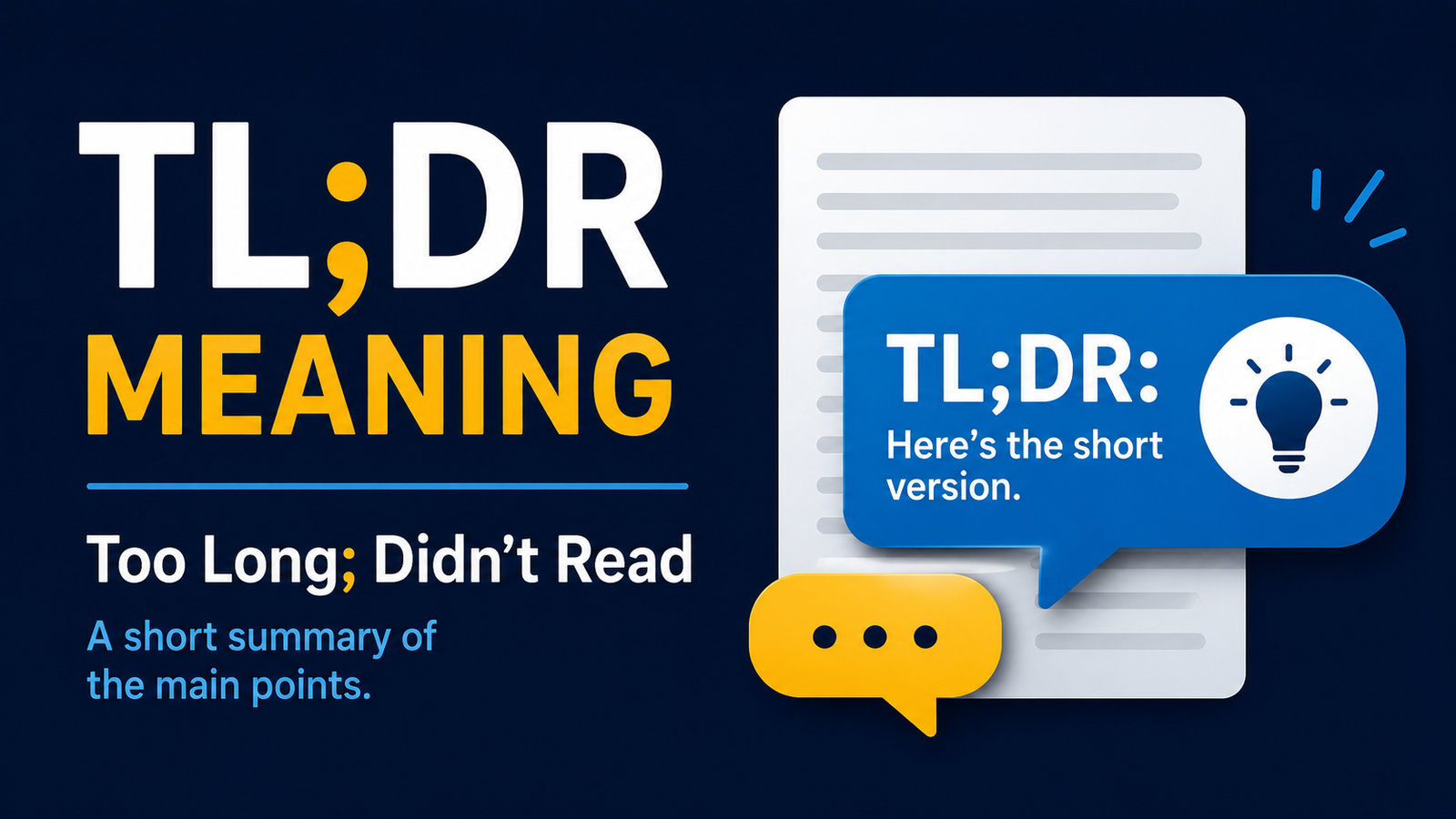
TL;DR means “Too Long; Didn’t Read.” It is an internet abbreviation used when a piece of writing is considered too long to read completely. Over time, however, the expression developed another common meaning: a short summary of the most important information in a longer text.
Today, you may see TL;DR at the beginning or end of an article, email, Reddit post, social media discussion, or long message. In that context, it usually introduces the main point so readers can understand the information quickly.
In this guide, we will explain the TLDR meaning, pronunciation, origin, examples, synonyms, antonyms, common usage, and the difference between its various meanings.
What Does TL;DR Mean?
TL;DR stands for “Too Long; Didn’t Read.”
It is an internet initialism that originally expressed the idea that a message, article, or post was so lengthy that the reader did not finish it. Cambridge Dictionary defines TLDR as an abbreviation for “too long; didn’t read” and also recognizes its use as a noun meaning a short summary of a written piece or discussion.
For example:
TL;DR: The meeting was canceled and moved to Friday.
Here, TL;DR introduces a quick version of the longer explanation.
There is an important difference in tone depending on how the term is used. If someone replies “TL;DR” to another person’s long post, it can sound dismissive or impatient. If a writer adds “TL;DR:” to their own article, it is usually meant as a helpful summary for readers.
Collins similarly defines TL;DR both as an expression that something is too long and as a summary of the essential facts in an online post, story, or article.
TL;DR Pronunciation
TL;DR is usually pronounced by saying each letter separately: “tee-el-dee-are.”
It is an initialism rather than a normal word, so most English speakers do not pronounce it as one single word.
You may see several written forms, including:
- TL;DR
- tl;dr
- TLDR
- tldr
- TL/DR
- tl dr
These forms generally refer to the same expression. Wiktionary lists several of these alternative forms and gives the pronunciation as the names of the individual letters.
What Is the Simple Meaning of TL;DR?
In simple English, TL;DR means “Here is the short version because the original is long.”
Imagine that a friend sends you a message containing ten paragraphs about what happened at work. You do not have time to read every detail, so you ask:
“TL;DR?”
You are essentially asking:
“Can you give me the main point?”
On the other hand, if your friend writes:
“TL;DR: The project deadline has been extended by two weeks.”
they are giving you the important information without requiring you to read the entire explanation.
That is why TL;DR has become useful beyond its original meaning. It can function as both a reaction to lengthy content and a label for a summary.
Origin of TL;DR
The exact person who coined TL;DR is not known, but documented evidence places the expression in the early 2000s.
According to sources discussing the term’s history, the earliest known use identified by the Oxford English Dictionary appeared in a 2002 message on the Usenet newsgroup rec.games.video.nintendo.
Usenet was an early form of online discussion in which people posted messages and responded to one another in topic-based groups. Long posts were common, making an abbreviation such as TL;DR particularly useful.
The expression subsequently spread through internet forums and online communities. By the middle and late 2000s, it was becoming increasingly familiar to internet users.
Its development is interesting because its meaning became more useful over time. At first, TL;DR was often a blunt response to someone else’s long message. Eventually, writers began using it themselves to offer readers a short summary.
That change turned TL;DR from a simple complaint into a practical communication tool.
How TL;DR Became Popular
The rise of blogs, forums, social networks, and online communities helped TL;DR become widely recognized.
Internet users increasingly had to process large amounts of information. A single discussion could contain dozens of comments, while articles and forum posts could stretch for thousands of words.
A quick summary gave readers a way to understand the central idea without reading everything.
The abbreviation also became part of online writing culture. Sources documenting its history note that it appeared in internet communities throughout the 2000s and eventually moved into more mainstream dictionaries and publications.
Today, TL;DR is no longer limited to old-school forums. It can appear in:
- Social media posts
- Reddit discussions
- Blog articles
- Newsletters
- Online communities
- Emails
- Workplace messages
- Technical documentation
- Group chats
- Long comments
- Discussion threads
Its continued popularity reflects a simple reality of online communication: people often want the important information quickly.
TL;DR Meaning in Texting
In texting, TL;DR usually means “Too Long; Didn’t Read” or “give me the short version.”
For example:
Person A: I wrote a really long explanation about what happened at school today.
Person B: TL;DR?
Person A: The teacher postponed the test.
Here, Person B is not necessarily criticizing the message. They simply want the main point.
Another example:
“TL;DR: I can’t come tonight because I have to work.”
The abbreviation makes the message feel casual and internet-friendly.
However, tone matters. A simple “TL;DR” sent after someone has spent a lot of time explaining something may sound rude.
TL;DR Meaning on Social Media
On social media, TL;DR is frequently used to make long posts easier to understand.
For example, someone might write a long post explaining a new policy and finish with:
TL;DR: The policy changes next month, and customers will need to update their accounts.
This lets people who are scrolling quickly understand the central message.
The term is particularly useful on platforms where users regularly encounter long threads, comments, or detailed explanations.
It can also appear at the beginning:
TL;DR: The company is launching three new products this year. Full explanation below.
This approach respects readers who want the main point while still giving interested people access to the complete details.
TL;DR Meaning in Articles and Blogs
Bloggers and writers often use TL;DR as a summary heading.
For example:
TL;DR
The article explains why electric vehicles are becoming more common, how charging infrastructure is developing, and what buyers should consider before purchasing one.
The rest of the article might contain detailed research, examples, statistics, and explanations.
This is not necessarily an admission that the article is poorly written. Instead, it gives readers a convenient overview.
For websites, a well-written summary can also improve readability because visitors can quickly determine whether the full article answers their question.
Examples of TL;DR in Everyday Communication
Here are some natural examples:
Example 1: Text Message
“I explained everything in the group chat. TL;DR: we’re meeting at 7 PM.”
Meaning: The important information is that the meeting is at 7 PM.
Example 2: Reddit
“TL;DR: The update fixed the main problem, but it created two smaller bugs.”
Meaning: This is the short version of a longer discussion.
Example 3: Social Media
“TL;DR: The event has been moved to Saturday because of bad weather.”
Meaning: Readers can skip the full explanation and still understand the key news.
Example 4: Workplace Communication
“TL;DR: The deadline is Friday, not Wednesday.”
Meaning: The writer wants busy colleagues to see the most important point immediately.
Example 5: Asking for a Summary
“That report is 50 pages long. Can I get the TL;DR?”
Meaning: The person wants a concise summary.
Is TL;DR Rude?
It can be, depending on how you use it.
When someone simply responds to another person’s long message with:
“TL;DR.”
the message can imply:
“Your message was too long, and I didn’t bother reading it.”
That can sound dismissive.
However, when a writer uses:
“TL;DR: Here are the three main points…”
the expression is usually helpful rather than rude.
The context and relationship between the people involved make a big difference.
For casual conversations with friends, TL;DR is usually harmless. In a professional environment, it is better to consider your audience before using it.
Is TL;DR Formal or Informal?
TL;DR is mainly informal.
It belongs to internet and digital communication, although dictionaries now recognize it as an established English abbreviation. Cambridge and Collins both include the term in their dictionaries.
It is perfectly natural in:
- Text messages
- Social media
- Online forums
- Casual emails
- Blogs
- Chat applications
For highly formal documents, however, words such as “summary,” “executive summary,” “in brief,” or “key points” may be more appropriate.
For example, instead of writing:
TL;DR: The company earned more money this year.
a formal business report might use:
Executive Summary: The company recorded increased revenue this year.
Synonyms for TL;DR
The best synonym depends on which meaning of TL;DR you intend.
When TL;DR means a short version, possible alternatives include:
- Summary
- Brief
- Overview
- Synopsis
- Gist
- Main point
- Key takeaway
- In brief
- Short version
- Bottom line
For example:
“Give me the TL;DR.”
can become:
“Give me the short version.”
or:
“What’s the main point?”
If TL;DR is being used as a label, summary is probably the closest standard-English equivalent.
Antonyms of TL;DR
There is no exact one-word antonym for TL;DR because it is an abbreviation rather than an ordinary descriptive word.
However, expressions with the opposite idea include:
- Detailed explanation
- Full version
- Complete account
- Long-form explanation
- In-depth discussion
- Full text
- Detailed report
For example:
TL;DR: The product is affordable and reliable.
Opposite idea:
Full explanation: The product’s price, specifications, performance, advantages, disadvantages, and long-term costs are discussed in detail.
In simple terms, TL;DR focuses on brevity, while its opposite focuses on completeness and detail.
TL;DR vs. Summary: What’s the Difference?
TL;DR and summary are similar, but they are not exactly the same.
A summary is a standard English word used in both formal and informal writing.
TL;DR is informal internet language that usually signals a concise version of something longer.
For example:
Formal:
“Please read the summary below.”
Casual:
“TL;DR: Here’s what happened.”
Both communicate a shortened version, but their tone is different.
TL;DR vs. BLUF
Another expression you may encounter is BLUF, which stands for “Bottom Line Up Front.”
BLUF is commonly associated with communication where the most important conclusion is placed at the beginning.
TL;DR and BLUF have a similar goal: helping readers get important information quickly.
The difference is mainly in context.
TL;DR is strongly associated with internet culture and informal communication.
BLUF is more associated with professional, military, business, and organizational communication.
When Should You Use TL;DR?
TL;DR is useful when:
- Your message is long.
- Readers may not have time to read everything.
- You want to highlight the key conclusion.
- You are writing for an online audience.
- The conversation is casual or semi-casual.
For example:
TL;DR: The event starts at 8 PM, tickets are sold out, and parking is available nearby.
The reader gets the essential information immediately.
When Should You Avoid TL;DR?
You may want to avoid TL;DR when communicating in a highly formal setting.
Examples include:
- Formal academic papers
- Legal documents
- Official government correspondence
- Highly formal business reports
- Professional applications
- Formal letters
In these situations, summary, overview, key findings, or executive summary may sound more appropriate.
The issue is not that TL;DR is incorrect. It is simply a matter of tone and audience.
Common Mistakes About TL;DR
Mistake 1: Thinking TL;DR Always Means “I Refuse to Read”
Not anymore.
While the original expression could be dismissive, modern usage often means “here is the summary.”
Mistake 2: Thinking It Only Appears on Social Media
TL;DR can appear in articles, blogs, emails, forums, technical discussions, and workplace chats as well.
Mistake 3: Assuming TLDR and TL;DR Have Different Meanings
They generally mean the same thing. The version without the semicolon, TLDR, has become common too.
Mistake 4: Using It Without Considering Tone
A writer-controlled TL;DR is often helpful. A blunt “TL;DR” directed at someone else’s lengthy explanation can sound dismissive.
Frequently Asked Questions About TLDR Meaning
What does TLDR mean?
TLDR means “Too Long; Didn’t Read.” It is an internet abbreviation used to describe overly long content or introduce a short summary.
What does TL;DR mean in texting?
In texting, TL;DR usually means “Too Long; Didn’t Read” or “give me the short version.” The exact meaning depends on context.
How do you pronounce TL;DR?
It is usually pronounced “tee-el-dee-are,” with each letter spoken separately.
Is TL;DR rude?
Sometimes. A direct “TL;DR” response can sound dismissive, while using “TL;DR” to introduce your own summary is generally helpful.
What is another word for TL;DR?
The closest standard-English alternatives are summary, overview, synopsis, gist, brief, and key takeaway.
Where did TL;DR originate?
The expression emerged from early internet culture. The earliest known documented use identified by the Oxford English Dictionary dates to 2002 on Usenet.
Can TL;DR be used in professional emails?
Yes, especially in informal workplace communication, but summary or key points may be better for highly formal emails and documents.
What is the difference between TL;DR and a summary?
A summary is a standard English term. TL;DR is an informal internet abbreviation that often introduces a quick summary of longer content.
Is TLDR the same as TL;DR?
Yes. TLDR, TL;DR, tldr, and tl;dr generally refer to the same expression.
What does TL;DR mean on Reddit?
On Reddit, TL;DR usually introduces a concise explanation of a longer post or comment. It can also be used as a response indicating that someone did not read the entire text.
Why TL;DR Still Matters
The popularity of TL;DR reflects a broader change in how people consume information.
People now encounter enormous amounts of text every day. News articles, social media discussions, newsletters, emails, reports, comments, and online guides can all compete for a reader’s limited attention.
A good TL;DR does not necessarily replace detailed information. Instead, it gives readers a choice.
Someone who only needs the conclusion can read the summary. Someone who wants context can continue to the full article.
That makes the abbreviation more than just internet slang. It has become a simple way of organizing information around the reader’s needs.
Final Thoughts on TLDR Meaning
The TLDR meaning is straightforward: “Too Long; Didn’t Read.”
The abbreviation began as a way for internet users to react to lengthy posts, but its role has expanded. Today, TL;DR is commonly used to introduce a short summary or the main takeaway from a longer piece of content.
You can find it in texting, social media, Reddit, blogs, emails, and online discussions. It is usually pronounced “tee-el-dee-are” and can be written as TL;DR, TLDR, tl;dr, or tldr.
The most important thing to remember is that context determines the tone. A TL;DR section written by the author can be a useful courtesy to readers, while replying “TL;DR” to someone’s long message may sound impatient.
So, if you see “TL;DR” at the top or bottom of an article, simply look for the short version. It is telling you: here are the main points without all the extra detail.