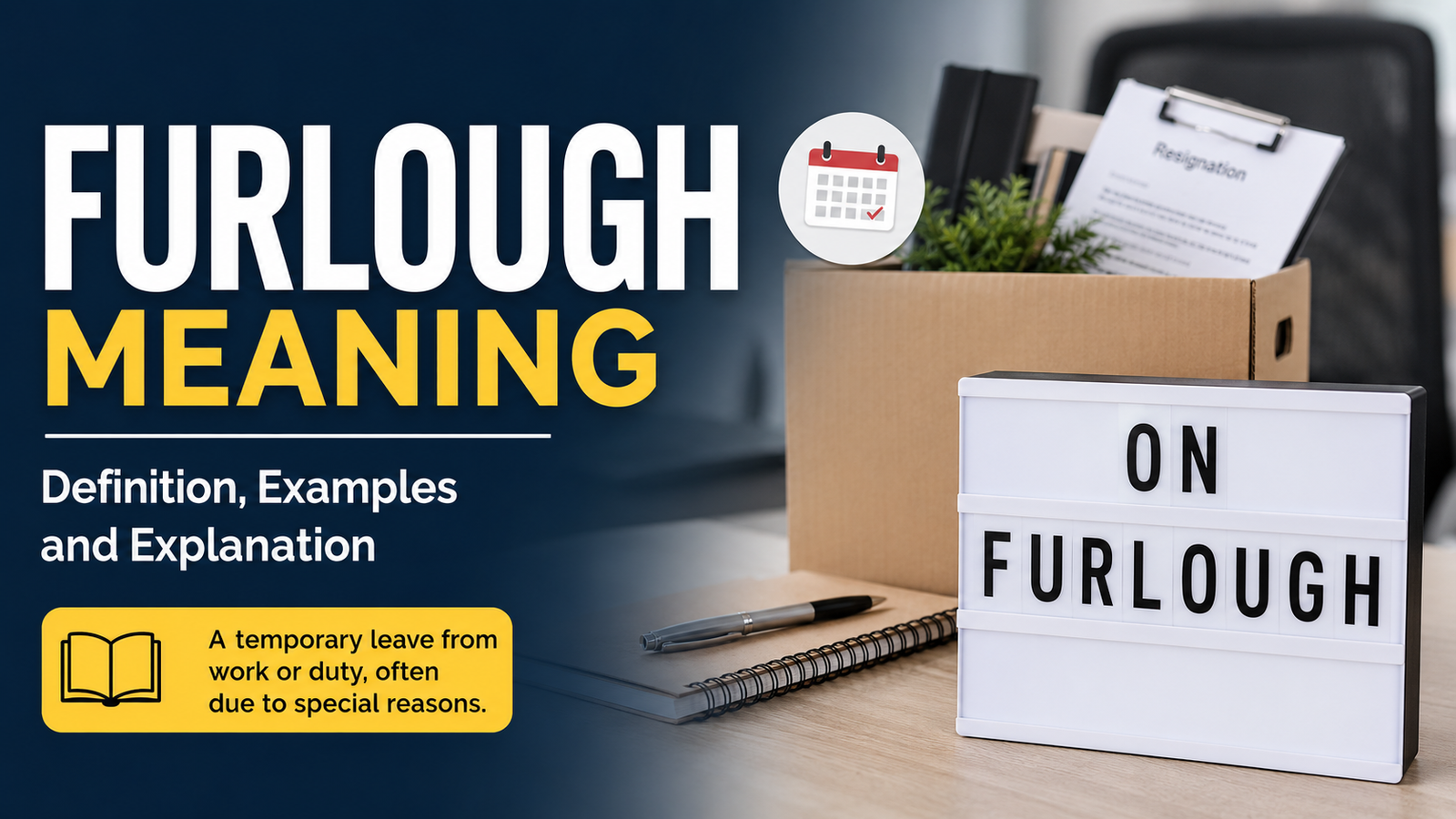
The word furlough can be confusing because its meaning changes slightly depending on the situation. In general, furlough means a temporary period away from work, military duty, or prison, usually with the expectation that the person will return.
In modern American English, the word is especially common in the workplace. When a company furloughs employees, it usually means those employees are temporarily told not to work, often because the company has financial difficulties or does not currently have enough work.
For example, if a company says, “Several employees were placed on furlough,” it generally means those employees are temporarily away from their jobs rather than permanently dismissed.
The word can also describe authorized leave for soldiers or prisoners. A soldier may be given a furlough to return home for a limited period, while a prisoner may receive permission to leave under specific conditions.
Furlough Meaning in Simple English
In simple English, furlough means a temporary break from work, military service, or imprisonment.
The exact meaning depends on context:
- At work: A temporary period when an employee does not work, often because the employer wants to reduce costs.
- In the military: Official permission for a service member to be away from duty temporarily.
- In prison: Permission for a prisoner to leave prison temporarily under certain conditions.
The important idea is temporary absence. A furlough does not automatically mean that a person has permanently lost their job or position.
Furlough Pronunciation
The American English pronunciation of furlough is represented as /ˈfɝː.loʊ/, while the British pronunciation is /ˈfɜː.ləʊ/.
The stress falls on the first syllable.
The pronunciation is straightforward once you remember that the ending sounds similar to the word “low.”
What Is the Definition of Furlough?
As a noun, furlough refers to a period when someone is officially allowed to be away from work, military service, or prison.
As a verb, furlough means to give someone this temporary absence or, in employment contexts, to temporarily stop an employee from working. Cambridge Dictionary identifies both noun and verb uses and notes that the employment sense is mainly associated with American English.
Furlough as a Noun
When used as a noun, furlough describes the period of absence itself.
Examples include:
- “The soldier was home on furlough.”
- “The company announced several furloughs.”
- “He was granted a short furlough from prison.”
Furlough as a Verb
As a verb, furlough means to temporarily place someone away from their normal duties.
For example:
- “The airline furloughed hundreds of employees.”
- “The government furloughed some workers.”
- “The soldier was furloughed for several weeks.”
The verb can therefore describe the action that creates the temporary absence.
Furlough Meaning in the Workplace
One of the most common modern uses of furlough relates to employment.
When an employer furloughs an employee, the employee usually stops working temporarily. This may happen because the company has reduced demand, financial pressure, seasonal changes, or another business problem.
A furlough is different from a permanent termination. The employee may still have an employment relationship with the company and may be expected to return when normal operations resume.
However, the exact rules surrounding pay, benefits, job protection, and return-to-work arrangements depend on the employer, contract, and applicable employment laws.
Example of a Workplace Furlough
Imagine an airline experiences a major drop in passenger demand.
Instead of permanently eliminating hundreds of jobs, it may temporarily furlough some employees. Those employees stop working for a period, with the expectation that they may return when business conditions improve.
This is why the word often appears in discussions about airlines, government agencies, schools, manufacturing companies, and other large organizations.
Furlough vs. Layoff
Furlough and layoff are sometimes used interchangeably, but they can carry different implications.
A furlough generally suggests a temporary interruption of work. A layoff can also be temporary, but it is often associated with a reduction in the workforce and may sometimes become permanent.
Cambridge lists layoff as a synonym in its employment-related definition of furlough.
For example:
Furlough:
“The company furloughed employees for two months.”
This suggests the workers may return.
Layoff:
“The company laid off 200 employees.”
This can suggest that the employment relationship has ended, although layoffs can also be temporary depending on the situation.
The distinction is not identical in every country or workplace, so the surrounding context matters.
Furlough vs. Vacation
A furlough is also different from an ordinary vacation.
A vacation is usually planned personal time away from work. The employee normally chooses or requests the time off and may continue receiving their regular benefits or pay depending on the employer’s policy.
A furlough, particularly in employment contexts, is generally initiated by the employer or organization because of operational or financial circumstances.
For example:
- “She took a vacation to visit her family.”
- “She was placed on furlough because the company reduced operations.”
The first is personal time off. The second is connected to the employer’s circumstances.
Furlough in the Military
The word furlough has a long association with military service.
A military furlough is an authorized period during which a service member is allowed to be away from their assigned duties, often to return home temporarily.
For example:
“The soldier went home on furlough.”
This does not mean the soldier permanently left the military. It means the person received official permission to be absent for a particular period.
This sense is still found in dictionaries and historical writing.
Furlough in the Prison System
Another established meaning involves prisoners.
A prisoner may receive a furlough, meaning official permission to leave prison temporarily under specific conditions.
This is a more specialized use than the workplace meaning.
For example:
“The prisoner was granted a furlough to attend a family event.”
Because prison furloughs can involve legal conditions, failing to return at the required time can have serious consequences. Cambridge specifically notes this aspect of the term.
Origin and History of the Word Furlough
The history of furlough is connected to the idea of authorized leave.
The word entered English through Dutch, from verlof, a word associated with leave or permission. Over time, its spelling and pronunciation developed into the English form furlough.
Its historical use was strongly connected with military service. Eventually, the word developed broader uses, including temporary absence from employment and other institutions.
This history helps explain why the word can refer to both permission to be absent and temporary removal from normal work.
Common Furlough Examples
Seeing the word in different sentences makes its meaning much easier to understand.
Example 1: Workplace
“Several employees were placed on furlough during the company’s financial difficulties.”
Here, furlough means a temporary period away from work.
Example 2: Military
“The soldier returned home on furlough.”
Here, furlough means authorized military leave.
Example 3: Government
“Some government workers were furloughed during the budget dispute.”
In this context, furlough refers to a temporary work interruption.
Example 4: Prison
“The prisoner was granted a furlough under strict conditions.”
Here, furlough means authorized temporary release.
Example 5: Verb
“The company furloughed hundreds of workers.”
Here, furloughed is the past tense of the verb furlough.
Example 6: Temporary Work Reduction
“Employees were asked to take several furlough days to reduce operating costs.”
This means employees were temporarily required to stay away from work, often without their normal wages for those days.
Common Phrases With Furlough
Several phrases commonly appear with this word.
“On furlough”
This means someone is currently away under an authorized furlough.
Example:
“He is currently on furlough from the military.”
“Furloughed employee”
This refers to an employee who has been temporarily removed from active work.
Example:
“The company contacted its furloughed employees when operations restarted.”
“Furlough days”
This usually means specific days when employees are required or permitted not to work.
Example:
“The teachers were given several furlough days.”
“Furlough program”
A furlough program is an organized arrangement that allows or requires people to take temporary leave.
Synonyms for Furlough
The best synonym depends on the context.
Workplace synonyms
- Temporary leave
- Temporary layoff
- Unpaid leave
- Work suspension
- Leave of absence
However, these terms are not always exact replacements because employment rules can give each term a different legal or practical meaning.
Military synonyms
- Leave
- Authorized leave
- Military leave
- Temporary absence
General synonyms
- Break
- Time off
- Temporary leave
- Absence
- Permission to leave
The phrase time off is more informal, while furlough is more specific and formal.
Antonyms of Furlough
There is no single perfect opposite of furlough, because its meaning changes with context.
Possible contextual opposites include:
- Active duty
- Employment
- Work
- Return to duty
- Permanent employment
- Continuous service
For example, if a soldier is on furlough, active duty can describe the contrasting state.
If an employee is furloughed, actively working is a natural opposite in everyday language.
Furloughed Meaning
Furloughed is the past tense and past participle of furlough.
If someone says:
“I was furloughed last month.”
they usually mean their employer temporarily stopped requiring them to work.
The word can also be used in military and prison contexts.
For example:
- “The workers were furloughed.”
- “The soldier was furloughed.”
- “The prisoner was furloughed.”
The context tells you which meaning applies.
Furloughing Meaning
Furloughing means the act of placing someone on furlough.
For example:
“The company is furloughing employees to reduce costs.”
The word is especially common in business and government discussions when an organization needs to reduce expenses without immediately ending everyone’s employment.
Is Furlough the Same as Unpaid Leave?
Not necessarily.
Both furlough and unpaid leave can involve an employee not receiving normal wages while away from work. However, they are not automatically identical.
Unpaid leave can be requested by an employee for personal, family, medical, educational, or other reasons, depending on workplace policies.
Furlough is often imposed or arranged by an employer because of business or operational circumstances.
The exact distinction can depend on local laws and the employer’s policies.
Is Furlough Temporary?
Usually, yes.
The central idea behind furlough is temporary absence. In employment situations, a furlough generally means the employee is expected or allowed to return to work rather than being permanently dismissed.
However, a furlough does not guarantee that employment will continue forever. If a company’s financial situation does not improve, furloughs can sometimes lead to layoffs or other workforce changes.
How to Use Furlough in a Sentence
Here are some natural sentence patterns:
As a noun:
- “He is on furlough.”
- “The company announced a furlough.”
- “She returned home during her furlough.”
As a verb:
- “The company furloughed 500 employees.”
- “Workers may be furloughed next month.”
- “The agency furloughed staff during the budget crisis.”
As an adjective-like past participle:
- “Furloughed workers are waiting to return.”
- “The furloughed employees received an update from management.”
Common Mistakes About Furlough
One common misunderstanding is assuming that furlough always means firing someone.
That is not necessarily true.
A furlough usually refers to a temporary interruption or authorized absence. A person may remain connected to an employer or organization during the furlough.
Another mistake is assuming that furlough always means paid leave. In workplace contexts, furloughs can involve unpaid time away from work, but the specific pay and benefits arrangements depend on the situation.
It is also incorrect to assume that furlough only applies to employees. Historically and currently, the word can describe military and prison leave as well.
Why Is the Word Furlough Common in the News?
You may encounter furlough frequently in news reports about companies, government agencies, airlines, schools, and economic problems.
The word is useful because it describes a situation where an organization wants to reduce labor costs or temporarily stop work without necessarily treating every affected worker as permanently dismissed.
For example, news coverage may discuss employees being furloughed because of a budget shortfall, a business slowdown, an emergency, or an interruption in operations.
The term therefore often appears in conversations about employment, government budgets, and economic uncertainty.
Furlough Meaning in Different Contexts
| Context | Meaning |
|---|---|
| Workplace | Temporary period when an employee is not working |
| Military | Authorized temporary absence from duty |
| Prison | Authorized temporary release |
| Government | Temporary work interruption, often linked to funding or operational issues |
| General use | Temporary authorized absence |
This table shows why context is important when interpreting the word.
FAQs About Furlough Meaning
What does furlough mean in simple words?
Furlough means a temporary period away from work, military duty, or prison. In workplace English, it often means an employee temporarily stops working because the employer has reduced work or needs to cut costs.
Does furlough mean you are fired?
No, not necessarily. A furlough is generally temporary, while being fired usually means the employment relationship has ended. However, the exact situation depends on the employer and applicable employment rules.
Is furlough paid or unpaid?
A furlough may be paid or unpaid depending on the specific situation, although workplace furloughs commonly involve unpaid time away from work. Always check the employer’s policy and applicable law.
What is the difference between furlough and layoff?
A furlough generally emphasizes temporary time away from work, while a layoff usually refers to an employer ending or suspending employment because of business conditions. The distinction varies by jurisdiction and organization.
How do you pronounce furlough?
In American English, furlough is pronounced with the stress on the first syllable and is represented in IPA as /ˈfɝː.loʊ/. The British pronunciation is /ˈfɜː.ləʊ/.
What does “on furlough” mean?
“On furlough” means temporarily absent from work, military duty, or another assigned responsibility under an authorized arrangement.
What does “furloughed employee” mean?
A furloughed employee is a worker who has been temporarily instructed or allowed not to work, often because the employer is facing financial or operational difficulties.
Conclusion
The furlough meaning is easier to understand when you focus on one central idea: temporary absence.
In the workplace, a furlough usually means an employee temporarily stops working, often because an organization needs to reduce costs or has less work available. In military settings, it means authorized leave from duty. In prison contexts, it can mean temporary authorized release.
Unlike words such as fired or dismissed, furlough does not automatically mean permanent job loss. The word usually points to a temporary arrangement, although what happens afterward depends on the circumstances.
Understanding this distinction makes it much easier to recognize furlough, furloughed, and furloughing when they appear in workplace conversations, news reports, books, or everyday English.
In short, when you see the word furlough, think temporary leave or temporary absence, and then use the surrounding context to determine exactly what kind of leave is being discussed.