Have you ever come across the word “ersatz” and wondered what it means? It is an unusual English word because it sounds foreign—and that is because it actually comes from German.
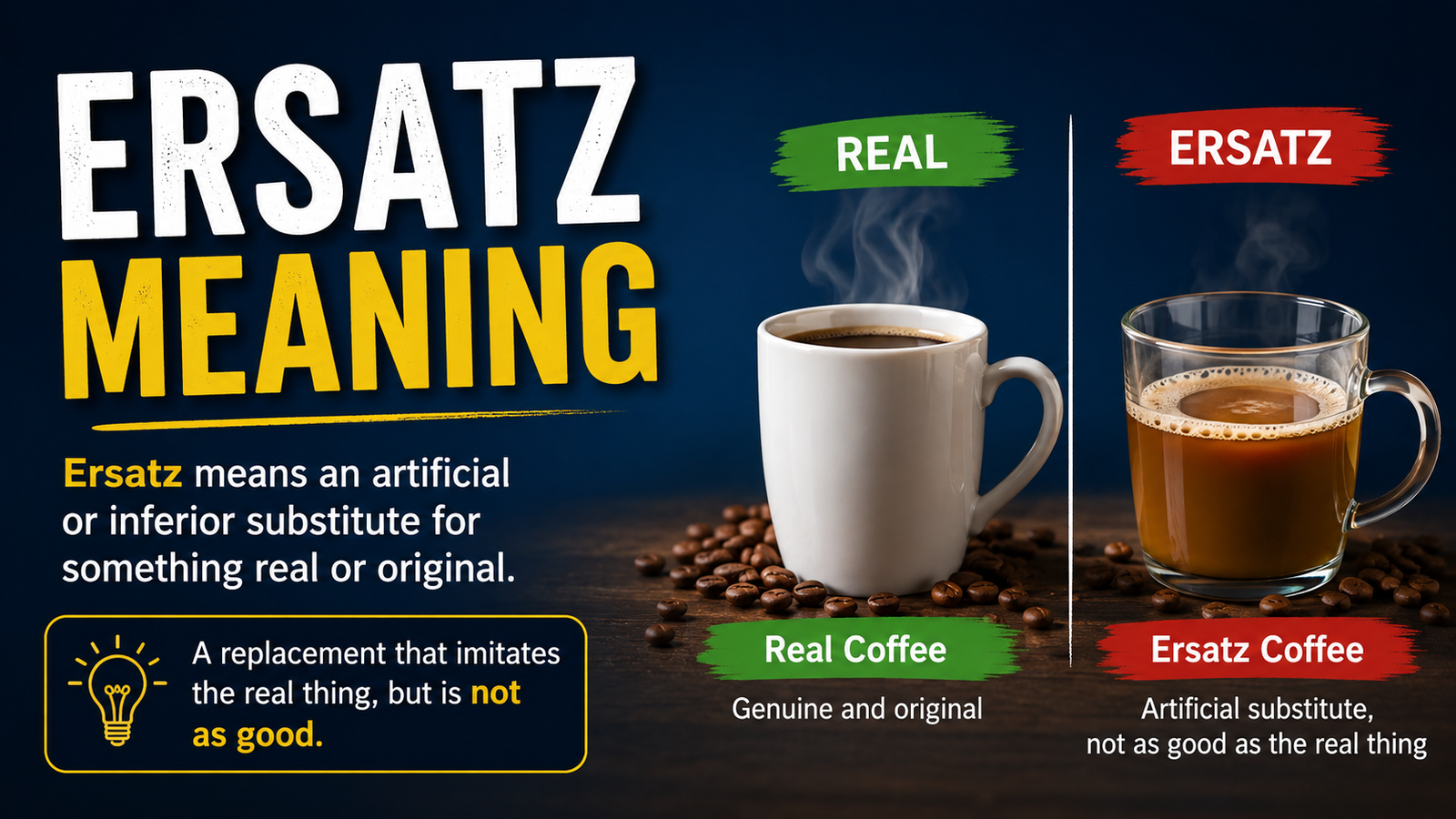
In simple English, ersatz means a substitute or imitation, especially one that is artificial or considered lower in quality than the real thing. For example, if a product is designed to look or work like the original but is not quite as good, you can describe it as ersatz.
The word can describe food, materials, products, experiences, ideas, or even something that feels emotionally or culturally inauthentic. It is usually used with a slightly negative or disapproving tone.
This guide explains the ersatz meaning, pronunciation, origin, examples, synonyms, antonyms, common usage, and frequently asked questions in simple English.
What Does Ersatz Mean?
The simplest definition of ersatz is:
Ersatz means an artificial or inferior substitute for something real or original.
For example:
- Ersatz coffee = a substitute for real coffee.
- Ersatz leather = artificial material used instead of genuine leather.
- An ersatz luxury hotel = a place designed to look luxurious but lacking the quality of a genuine luxury hotel.
- An ersatz smile = a smile that appears genuine but feels artificial or forced.
Cambridge Dictionary describes ersatz as something used instead of something else, particularly when the original is expensive or difficult to obtain. It also marks the word as disapproving, which is important because English speakers often use it to suggest that the substitute is not as good as the original.
Oxford gives a similar explanation, defining ersatz as something artificial and not as good as the real thing or product.
So, if someone says, “This is an ersatz version of the original,” they are usually suggesting that it resembles the original but does not fully match it.
Ersatz Meaning in Simple English
In very simple words, ersatz means “fake substitute” or “artificial replacement.”
Imagine that your favorite coffee is unavailable. Someone gives you a drink made from another ingredient that looks and tastes somewhat like coffee. You might call it ersatz coffee.
Or imagine a handbag made from synthetic material that looks like leather. It could be described as ersatz leather.
The important point is that ersatz is more than simply “another option.” The word often carries the idea that the replacement is artificial, makeshift, or inferior.
A normal substitute may be perfectly acceptable. An ersatz substitute often suggests that something has been copied, simulated, or replaced without fully matching the original.
Ersatz Pronunciation
The pronunciation of ersatz varies slightly between British and American English.
According to Cambridge Dictionary, the common pronunciations are:
- UK: /ˈeə.zæts/
- US: /ˈer.zɑːts/
The main stress falls on the first syllable.
The ending may sound unusual to English speakers because the word comes from German. In American English, the final sound is commonly pronounced with an “s” sound after the “t.”
You may hear more than one accepted English pronunciation. Merriam-Webster also lists several pronunciations, including forms represented as “air-sahts” and “er-zahts.”
Is Ersatz a German Word?
Yes. Ersatz is originally a German word.
In German, Ersatz is a noun meaning replacement, substitute, or compensation, depending on the context. The German word does not necessarily carry the negative meaning that the English adjective often has.
For example, German uses Ersatz in ordinary expressions referring to a replacement or substitute. In English, however, the borrowed word developed a stronger association with artificial or inferior substitutes.
This difference is useful to remember: German “Ersatz” can be neutral, while English “ersatz” is often critical or disapproving.
Origin and History of Ersatz
The history of ersatz is particularly interesting.
The English word was borrowed from German Ersatz, meaning “substitute” or “replacement.” Merriam-Webster records the first known English use of ersatz in 1871, while other historical sources place its emergence in English during the 1870s.
The German noun Ersatz comes from the verb ersetzen, meaning “to replace.” Etymological sources connect the German form further back to older Germanic roots associated with setting or placing.
Ersatz and World War I
The word became especially prominent during World War I.
During the war, shortages made it difficult to obtain many ordinary products. People and industries had to find alternatives for ingredients and materials that were unavailable or expensive.
Merriam-Webster notes that English speakers began using ersatz for substitute products such as coffee made from alternative ingredients and flour made from potatoes.
These replacements were sometimes necessary because of shortages, but many were viewed as inferior to the original products.
As a result, the English word gradually developed its modern sense: an artificial or inferior substitute.
The term continued to appear during World War II and eventually became an established part of English vocabulary.
How Is Ersatz Used in a Sentence?
The word ersatz is most commonly used as an adjective.
Here are some examples:
- The soldiers had to survive on ersatz coffee during the shortage.
- The restaurant used ersatz cream instead of real dairy cream.
- The building was an ersatz version of a traditional European palace.
- She rejected the ersatz jewelry because she wanted genuine gold.
- The movie offered an ersatz version of the classic story.
- He created an ersatz office at home to imitate his workplace.
- The synthetic material looked like leather, but it was clearly ersatz.
- The tourist attraction felt like an ersatz version of the historic city.
- The cheap drink was marketed as an ersatz alternative to premium coffee.
- His friendliness seemed ersatz rather than genuine.
Notice that the word can apply to physical products as well as abstract experiences.
Ersatz as an Adjective
Today, ersatz is most commonly encountered as an adjective.
It usually comes before a noun:
- ersatz coffee
- ersatz leather
- ersatz luxury
- ersatz culture
- ersatz identity
- ersatz solution
- ersatz tradition
- ersatz version
- ersatz experience
When used this way, it tells the reader that something is being presented or used as a replacement for something else.
For example:
“The shop sells ersatz leather bags.”
This means the bags imitate leather rather than being made from genuine leather.
Ersatz as a Noun
Although it is primarily used as an adjective in modern English, ersatz can also function as a noun.
As a noun, it can refer to an artificial substitute or replacement.
For example:
“The product was little more than ersatz.”
Here, the word means something like an imitation or substitute rather than the genuine article.
Dictionary sources recognize both adjective and noun uses.
However, the adjective form is much more familiar to many English speakers.
Common Usage of Ersatz
You are most likely to see ersatz in writing rather than everyday casual conversation.
It appears particularly often in:
- Journalism
- Books and essays
- Cultural criticism
- History
- Food writing
- Product reviews
- Politics and social commentary
- Literature
- Academic writing
For example, a reviewer might describe a restaurant as offering an ersatz version of traditional cuisine.
A journalist might call a replica of a famous landmark an ersatz monument.
A writer discussing artificial materials might refer to ersatz wood or ersatz leather.
The word can make writing more precise because it does not merely mean “different.” It communicates the idea of substitution combined with artificiality or lack of authenticity.
What Is the Difference Between Ersatz and Substitute?
The words ersatz and substitute are closely related, but they do not always have the same tone.
Substitute is generally neutral.
For example:
“We used honey as a substitute for sugar.”
This does not necessarily mean honey is worse than sugar. It simply means honey was used instead.
Ersatz, on the other hand, often implies that the replacement is artificial or inferior.
For example:
“The drink was an ersatz substitute for coffee.”
This suggests that the drink was trying to imitate coffee but did not provide the same quality or experience.
Therefore:
Substitute = replacement
Ersatz = artificial or inferior replacement
That distinction is one of the most important things to understand about the word.
Ersatz Synonyms
Several English words can be used as synonyms for ersatz, depending on the context.
1. Artificial
Something made to imitate something natural or genuine.
Example: The flowers were artificial rather than real.
2. Fake
Something that is not genuine.
Example: He discovered that the watch was fake.
3. Imitation
Something designed to resemble another thing.
Example: She bought imitation leather shoes.
4. Synthetic
Something manufactured rather than naturally produced.
Example: The jacket was made from synthetic fibers.
5. Substitute
Something used instead of another thing.
Example: Yogurt can sometimes be used as a substitute for cream.
6. Faux
A stylish term often used for artificial versions of materials or styles.
Example: The store sells faux leather jackets.
7. Simulated
Something designed to reproduce the appearance or behavior of another thing.
Example: The training used a simulated emergency.
8. Counterfeit
An unauthorized imitation, especially one intended to pass as genuine.
Example: Authorities seized counterfeit designer goods.
Not every synonym has exactly the same meaning. Ersatz is distinctive because it often combines the ideas of replacement, imitation, and inferior quality.
Ersatz Antonyms
The opposite of ersatz is something genuine, authentic, original, or real.
Common antonyms include:
- Genuine
- Authentic
- Real
- Original
- Natural
- Legitimate
- True
- Actual
For example:
Ersatz leather vs. genuine leather
Ersatz product vs. original product
Ersatz experience vs. authentic experience
The best antonym depends on what you are describing.
Ersatz vs. Fake
Although ersatz and fake can sometimes describe the same thing, they have different shades of meaning.
Fake usually suggests something is deliberately presented as genuine when it is not.
Ersatz emphasizes the idea of a substitute or imitation.
For instance, an artificial flower is not necessarily being sold as a real flower. It can simply be an ersatz flower.
A counterfeit designer handbag, however, may be deliberately sold as an authentic designer handbag. Calling it fake or counterfeit would be more precise.
Ersatz vs. Faux
Faux is another useful comparison.
Both words can describe artificial versions of something, but faux often sounds more neutral or fashionable.
You might see:
faux leather
faux fur
faux wood
The word ersatz is more likely to suggest that the imitation is inferior, disappointing, or lacking authenticity.
Therefore, saying something is ersatz can sound more critical than simply calling it faux.
Ersatz vs. Replica
A replica is a copy made to resemble an original object.
A replica is not necessarily inferior. Some replicas are carefully produced and can be extremely accurate.
Ersatz, by contrast, usually carries a negative implication.
For example:
“The museum displayed a replica of the ancient statue.”
This is neutral.
“The shop sold an ersatz version of the famous statue.”
This suggests the version was artificial or inferior.
Why Does Ersatz Have a Negative Meaning in English?
The negative sense largely developed because of the historical circumstances surrounding substitute goods.
During wartime shortages, people had to rely on alternative ingredients and materials. These products were often created because the genuine versions were unavailable.
English speakers associated the German term Ersatz with these wartime substitutes, many of which were viewed as poor replacements. Over time, the word came to mean more than simply “replacement.” It became associated with something artificial and inferior.
This is why the historical story behind the word helps explain its modern tone.
Examples of Ersatz in Everyday Life
You may encounter the concept of ersatz without actually hearing the word.
Consider these examples:
Artificial vanilla: A manufactured flavor used instead of natural vanilla can be described as an ersatz version of the natural flavor.
Synthetic leather: Material designed to resemble real leather can be called ersatz leather.
Replica luxury: A cheap imitation of an expensive luxury experience might be described as ersatz luxury.
Artificial food: A product designed to imitate a traditional food may be described as ersatz if the writer wants to emphasize its lack of authenticity.
Forced emotion: A performance of emotion that does not feel sincere can be described metaphorically as ersatz.
This shows how flexible the word has become.
Is Ersatz a Negative Word?
Usually, yes.
In modern English, ersatz generally has a negative or disapproving tone. Cambridge explicitly labels the adjective as disapproving, while Oxford defines it in terms of something artificial and not as good as the real thing.
However, context matters.
If a substitute is useful and perfectly acceptable, substitute, alternative, or replacement may be better choices.
If the writer wants to emphasize that the substitute feels cheap, artificial, copied, or inferior, ersatz is particularly effective.
How to Remember the Meaning of Ersatz
A simple way to remember ersatz is:
Ersatz = an imitation used instead of the real thing.
Think about a product that says, “I look like the original, but I am not the original.”
That is the basic idea behind ersatz.
You can also remember its German origin. The German word Ersatz means “replacement” or “substitute,” while English developed the additional sense of something artificial or inferior.
Frequently Asked Questions About Ersatz
What does ersatz mean in simple English?
Ersatz means an artificial or inferior substitute for something genuine or original.
Is ersatz a negative word?
Usually, yes. In English, ersatz often suggests that something is artificial, imitation-based, or not as good as the real thing.
How do you pronounce ersatz?
In British English, Cambridge gives /ˈeə.zæts/, while the common American pronunciation is /ˈer.zɑːts/.
Is ersatz a German word?
Yes. English borrowed ersatz from German, where Ersatz means a replacement or substitute.
What is a synonym for ersatz?
Depending on the context, synonyms include artificial, fake, imitation, synthetic, faux, simulated, and substitute.
What is the opposite of ersatz?
Common antonyms include genuine, authentic, real, original, natural, and legitimate.
Can ersatz be used as a noun?
Yes. Although it is more commonly used as an adjective, dictionaries also recognize ersatz as a noun meaning an artificial substitute or replacement.
Is ersatz the same as fake?
Not exactly. Fake usually emphasizes that something is not genuine, while ersatz emphasizes that something is being used as a substitute or imitation and often suggests inferior quality.
What is an example of ersatz?
“The company produced an ersatz version of the famous luxury watch.”
This means the product imitates the luxury watch but is not the genuine original.
Why did ersatz become popular in English?
The word became particularly prominent during World War I, when shortages led to the use of many substitute products. Its association with those often-inferior substitutes helped establish its modern English meaning.
Conclusion: Ersatz Meaning Explained
The word ersatz has a fascinating history and a very useful modern meaning.
In simple English, ersatz describes an artificial, imitation, or inferior substitute for something genuine. The word comes from German, where Ersatz simply means replacement or substitute. English adopted the term in the 19th century, and its use expanded significantly during the world wars because of shortages and substitute products.
Today, you can use ersatz to describe everything from artificial materials and substitute foods to imitation experiences and ideas that feel inauthentic.
The key distinction is tone: a substitute can be neutral, but ersatz often suggests that the replacement falls short of the original.
If you remember one definition, remember this:
Ersatz means an artificial or inferior substitute that imitates or replaces the real thing.
That simple idea will help you understand the word whenever you encounter it in books, journalism, reviews, or everyday English writing.