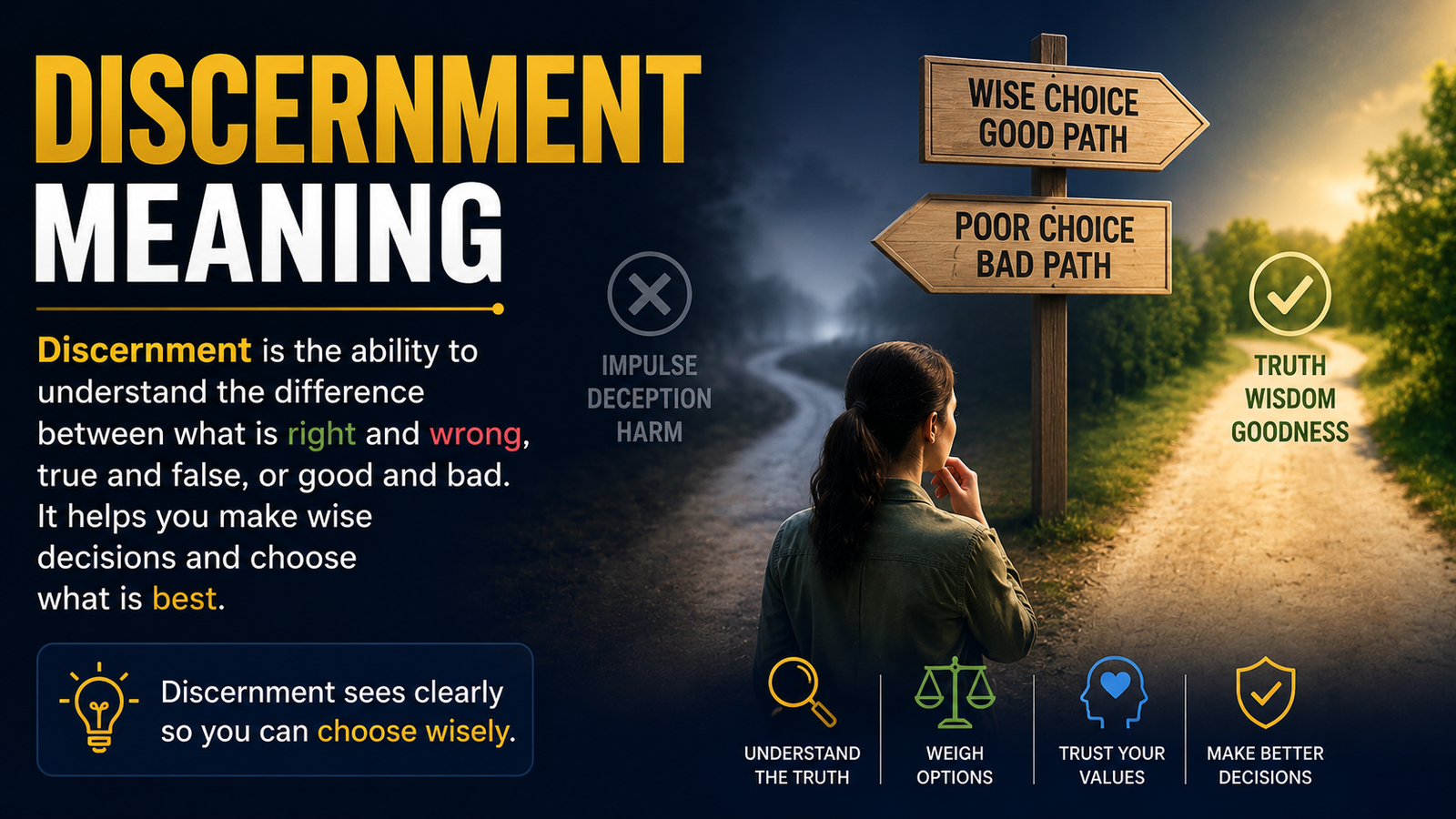
The word discernment describes an important ability: knowing how to look beyond the obvious, understand differences, and make a sensible judgment. It is often used when someone can recognize quality, truth, character, or value when those things are not immediately clear.
In everyday life, discernment helps people make better choices. You might use discernment when deciding whether to trust someone, choosing between two products, evaluating advice, selecting a job opportunity, or deciding whether information online is reliable.
In simple English, discernment means the ability to notice important differences and make a good judgment.
The word is usually used in a positive sense. Dictionaries describe it as keen perception, insight, or the ability to judge people and things well.
What Does Discernment Mean?
Discernment means the ability to understand something clearly and recognize the difference between similar choices, ideas, people, or situations.
For example, imagine that two watches look almost identical. One is made with high-quality materials while the other is poorly made. A person with good discernment can notice the difference and choose the better watch.
Discernment is not simply about seeing something. It involves understanding what you see and judging it accurately.
The Cambridge English Dictionary defines discernment as the ability to judge people and things well. Oxford similarly describes it as the ability to show good judgment about the quality of someone or something.
Simple Definition
Discernment = the ability to recognize differences, understand what matters, and make wise judgments.
Discernment in One Sentence
She showed great discernment when she realized that the attractive offer was not actually a good deal.
Discernment Pronunciation
The pronunciation of discernment can vary slightly between British and American English.
American English: /dɪˈsɝːn.mənt/
British English: /dɪˈsɜːn.mənt/
The main stress falls on the second syllable. Oxford and Cambridge list the pronunciation with this stress pattern.
What Is the Origin of Discernment?
The history of discernment is connected to the verb discern, meaning to distinguish, perceive, or understand.
Merriam-Webster traces discernment to discern + -ment and records its first known English use in the 16th century, around 1570.
The older verb discern has deeper roots. It came through Middle English and Anglo-French from the Latin discernere, meaning to separate, distinguish, or sift apart. The Latin word is associated with the idea of separating one thing from another.
This history helps explain the modern meaning. When you use discernment, you are essentially separating what is valuable or true from what is less valuable or misleading.
Collins traces the noun to Middle French discernement, while Dictionary.com records the word in English from around 1580–90.
Discernment in Simple English
Sometimes dictionary definitions can make the word seem more complicated than it really is.
Think of discernment as good judgment combined with careful observation.
Suppose a friend recommends two restaurants. Both have excellent-looking menus, but you notice that one has consistently poor reviews while the other has a strong reputation. Instead of choosing based only on appearance, you consider the evidence and make a thoughtful decision.
That is discernment.
It can involve:
- Observation — noticing details others may miss.
- Understanding — knowing what those details mean.
- Comparison — recognizing meaningful differences.
- Judgment — deciding what is better, safer, wiser, or more appropriate.
- Experience — using knowledge gained from previous situations.
Discernment does not necessarily mean being suspicious or negative. A discerning person can identify both good qualities and problems.
Why Is Discernment Important?
Discernment matters because modern life constantly requires choices.
People encounter advertisements, social media posts, news stories, financial offers, career opportunities, relationships, and opinions every day. Not everything that looks attractive is valuable, and not everything that sounds convincing is true.
Discernment gives people a way to slow down and evaluate what they encounter.
For example, a person may use discernment to ask:
- Is this information trustworthy?
- Is this person being sincere?
- Is this opportunity really beneficial?
- What details am I missing?
- Are there risks behind this attractive offer?
- Which choice matches my goals and values?
This is particularly relevant in an online environment where information can spread quickly. Good judgment can be more useful than simply having access to more information.
Recent dictionary examples also show discernment being discussed in areas such as career decisions, technology, writing, and human judgment.
Examples of Discernment
Here are several examples showing how the word works in everyday English.
Example 1: Choosing Friends
She used discernment when deciding which people she could trust.
This means she carefully judged people’s behavior and character rather than trusting everyone immediately.
Example 2: Shopping
His discernment helped him recognize that the expensive product was not necessarily the best one.
He looked beyond the price and considered quality.
Example 3: Career Decisions
Good discernment is important when choosing between two job offers.
The person needs to consider salary, workplace culture, responsibilities, growth opportunities, and long-term goals.
Example 4: Art
The collector has excellent discernment when choosing paintings.
This suggests that the collector has a strong ability to recognize quality and artistic value.
Example 5: Online Information
Readers need discernment when evaluating claims on social media.
The sentence suggests that readers should carefully judge whether information is accurate or misleading.
Example 6: Relationships
She showed discernment by recognizing the difference between genuine kindness and manipulation.
Here, discernment means understanding someone’s behavior beneath the surface.
Example 7: Leadership
A successful leader needs discernment to make difficult decisions.
A leader often has to consider incomplete information, competing interests, and possible consequences.
Discernment vs. Judgment
Discernment and judgment are closely related, but they are not always identical.
Judgment generally refers to the ability to make a decision or form an opinion.
Discernment emphasizes the ability to notice distinctions and understand what is important before making that judgment.
For example:
She used good judgment by rejecting the offer.
This focuses on the decision.
She showed discernment by noticing hidden problems in the offer.
This focuses more on the ability to recognize those problems.
In many situations, the two words can be used almost interchangeably.
Discernment vs. Discrimination
This distinction is important because discrimination can have different meanings.
In the context of language and judgment, discrimination can mean the ability to distinguish between things. This sense is closely related to discernment.
However, in everyday modern English, discrimination often refers to unfair treatment based on characteristics such as race, sex, age, or other protected traits.
Because of this, discernment is often the clearer word when you mean careful and intelligent judgment.
Merriam-Webster notes that discernment emphasizes accuracy in recognizing character, motives, quality, or other distinctions.
Synonyms of Discernment
There are many words that share part of the meaning of discernment.
Common synonyms include:
- Insight
- Judgment
- Perception
- Understanding
- Wisdom
- Acumen
- Awareness
- Discrimination
- Penetration
- Shrewdness
- Acuity
- Good sense
- Practical wisdom
- Sound judgment
However, these words are not perfect replacements in every sentence.
For example, insight often focuses on deep understanding, while acumen commonly suggests sharp practical judgment. Perception can emphasize noticing or understanding something quickly.
Merriam-Webster explains that discernment particularly stresses accuracy when reading character, motives, or appreciating quality.
Antonyms of Discernment
An antonym is a word with an opposite or contrasting meaning.
Depending on the context, possible antonyms of discernment include:
- Ignorance
- Confusion
- Foolishness
- Carelessness
- Poor judgment
- Indiscrimination
- Naivety
- Unawareness
- Stupidity
Not all of these are exact opposites. The best opposite depends on what aspect of discernment you mean.
For example, if discernment means careful judgment, poor judgment is a natural contrast. If it means recognizing differences, indiscrimination may be more appropriate.
Common Uses of Discernment
The word discernment is relatively formal and is more common in writing, professional discussions, and thoughtful conversation than in very casual speech.
Common phrases include:
“Use discernment”
Use discernment when deciding whether to trust the information.
This means to think carefully and make a sensible judgment.
“Good discernment”
She has good discernment when choosing business partners.
This means she usually makes accurate judgments.
“Lack of discernment”
His lack of discernment caused him to make several poor decisions.
This means he failed to recognize important differences or warning signs.
“Great discernment”
The editor showed great discernment in selecting the articles.
This suggests excellent judgment and a strong ability to recognize quality.
“Discernment in decision-making”
This phrase describes the ability to evaluate choices carefully before acting.
What Does It Mean to Have Discernment?
Having discernment means being able to look carefully, think critically, and recognize what really matters.
A discerning person does not necessarily know everything. Instead, they know how to evaluate what they see and hear.
For example, imagine someone receives an unusually generous business proposal. A person without much discernment might immediately accept it because it looks profitable.
A discerning person may ask questions first:
Why is the offer so generous?
What are the conditions?
What risks are involved?
What information is missing?
That careful approach is discernment.
How to Develop Better Discernment
Discernment can improve with knowledge, experience, and deliberate thinking.
Slow Down Before Important Decisions
Many poor choices happen because people react too quickly.
Taking time to consider the situation can reveal details that were initially overlooked.
Ask Better Questions
Instead of accepting a claim immediately, ask why it is true.
Questions such as “What evidence supports this?”, “What could I be missing?”, and “What are the possible consequences?” can encourage better judgment.
Learn From Experience
Past mistakes can become useful lessons.
If a particular warning sign caused problems before, recognizing that same sign in the future can improve your decision-making.
Consider Multiple Perspectives
Discernment does not mean automatically believing your first impression.
Listening to different viewpoints can help you identify assumptions and understand a situation more completely.
Separate Facts From Feelings
Emotions can provide useful information, but they can also influence judgment.
When making an important decision, try to distinguish between what you feel and what you can verify.
Pay Attention to Details
Small details can sometimes reveal important differences.
A discerning person learns to notice what others may overlook without becoming unnecessarily suspicious of everything.
Discernment in Relationships
Discernment can be especially valuable in relationships.
People often judge others based on first impressions, charm, popularity, or appearance. These things can be misleading.
Discernment encourages you to look at consistent behavior.
For example, someone may say they are reliable. A discerning person also observes whether that person actually keeps promises.
Someone may appear friendly. Discernment involves noticing whether their actions consistently show respect and honesty.
This does not mean assuming the worst about people. Instead, it means giving actions and patterns appropriate weight.
Discernment in the Workplace
Professional life also requires discernment.
Managers use it when hiring employees. Employees use it when evaluating offers, workplace relationships, and career opportunities.
A person with strong professional discernment can often recognize:
- Which feedback is useful
- Which opportunities are realistic
- Which risks deserve attention
- Which colleagues are dependable
- Which priorities matter most
- Which promises are supported by evidence
In this context, discernment can contribute to better communication and decision-making.
Is Discernment a Positive Word?
Yes. Discernment is generally a positive and approving word.
Calling someone discerning usually suggests that the person has good taste, strong judgment, intelligence, or an ability to understand people and situations.
Oxford labels the word as formal and approving, particularly when referring to good judgment about the quality of someone or something.
For example:
She chose the artwork with remarkable discernment.
This is a compliment.
What Is a Discerning Person?
A discerning person is someone who notices meaningful differences and makes thoughtful judgments.
The adjective discerning comes from the same word family.
For example:
He is a discerning customer who carefully compares products before buying.
This does not mean that he is difficult to please. It means he has standards and knows how to evaluate quality.
Discernment vs. Intelligence
Discernment and intelligence are related, but they are not the same thing.
A highly intelligent person may have excellent knowledge or reasoning skills. However, intelligence alone does not guarantee good judgment.
Discernment involves applying observation, knowledge, experience, and judgment to a particular situation.
In simple terms:
Intelligence can help you understand information. Discernment helps you decide what that information means and what you should do with it.
Discernment vs. Intuition
Discernment can sometimes feel like intuition, but the concepts are different.
Intuition is often a quick feeling or instinct about something.
Discernment usually suggests more deliberate recognition and judgment.
A person might have an initial feeling that something is wrong. Discernment can then help them examine the situation and determine whether that feeling is supported by evidence.
The two can work together, but they should not be treated as exact synonyms.
Frequently Asked Questions About Discernment
What is the simple meaning of discernment?
Discernment means the ability to recognize differences, understand situations clearly, and make good judgments.
What is an example of discernment?
An example is recognizing that a seemingly attractive job offer has hidden disadvantages after carefully examining its salary, responsibilities, conditions, and long-term prospects.
Is discernment a positive word?
Yes. Discernment is generally positive. It suggests good judgment, insight, perception, and the ability to recognize quality or important differences.
What is the synonym of discernment?
Common synonyms include insight, judgment, perception, wisdom, acumen, understanding, awareness, and good sense.
What is the opposite of discernment?
Depending on the context, possible opposites include poor judgment, confusion, ignorance, carelessness, naivety, and indiscrimination.
How do you use discernment in a sentence?
You could say: “She used discernment when choosing which advice to follow.”
Is discernment the same as wisdom?
They are closely related but not identical. Wisdom often involves broad knowledge and life experience, while discernment focuses more specifically on recognizing distinctions and making accurate judgments.
What does lack of discernment mean?
A lack of discernment means having difficulty recognizing important differences or making sound judgments. It can lead to poor choices because a person may overlook warning signs or fail to recognize quality.
Final Thoughts on Discernment Meaning
Discernment is the ability to see beyond the surface and make a thoughtful, accurate judgment. It combines observation, understanding, comparison, and good sense.
The word has a long history connected to the idea of separating or distinguishing one thing from another. Its modern meaning still carries that central idea: recognizing what is important and telling one thing apart from another.
Whether you are choosing friends, evaluating information, making career decisions, shopping for a product, or handling an important relationship, discernment can help you make better choices.
In a world filled with information and competing opinions, the ability to notice carefully, think clearly, and judge wisely remains one of the most useful skills a person can develop.
In short, discernment means seeing the difference, understanding its importance, and choosing wisely.