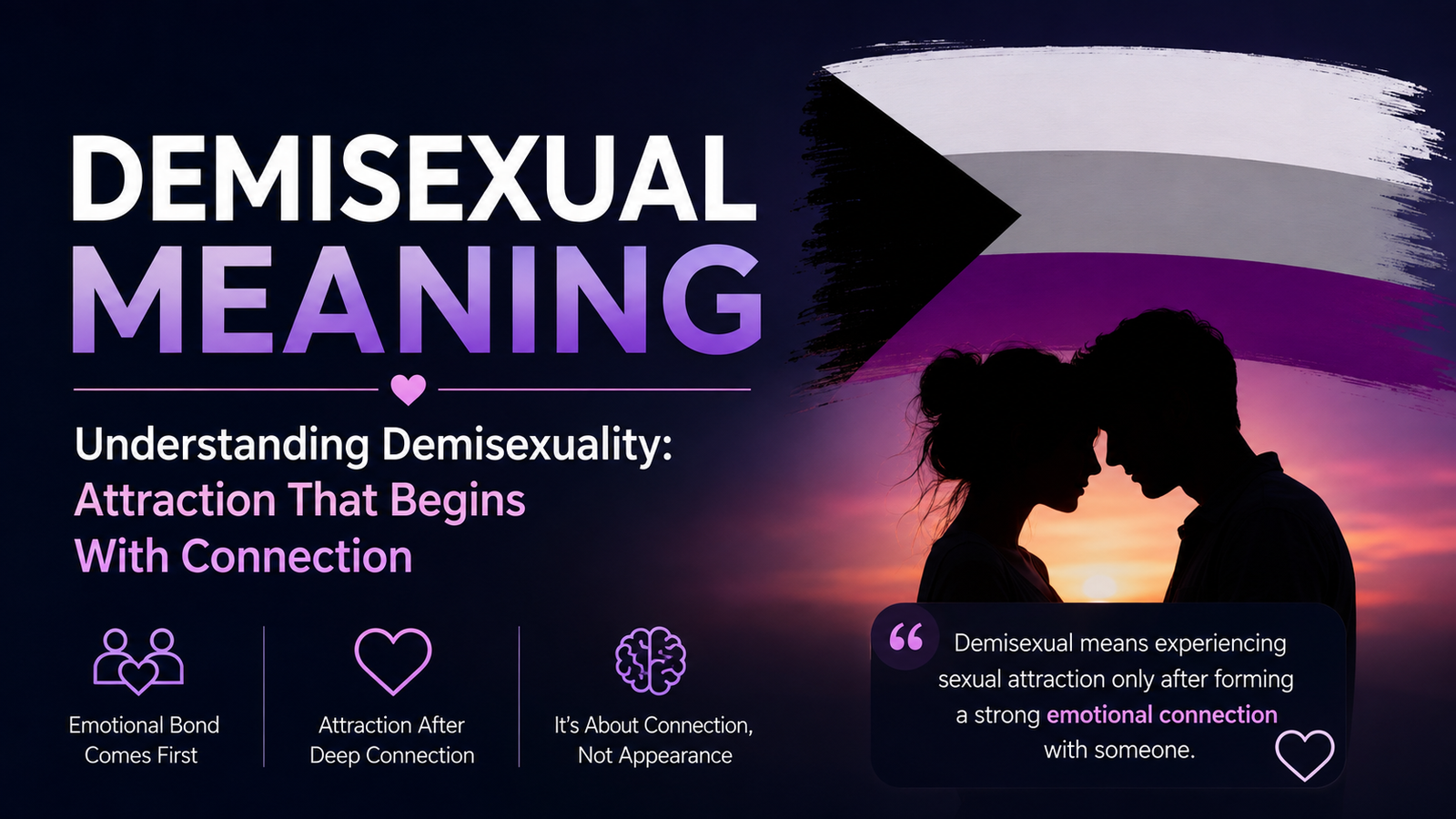
The term demisexual meaning can be confusing if you have only recently seen it online, in dating conversations, or on social media. In simple terms, demisexual describes a person who experiences sexual attraction only after developing a strong emotional connection with someone.
That does not simply mean someone prefers to take things slowly, avoids casual dating, or wants to know a person before having sex. The important difference is sexual attraction itself. A demisexual person may not feel sexual attraction toward someone at all until a meaningful emotional bond has developed.
Demisexuality is generally considered part of the asexual spectrum. However, demisexual people can experience sexual attraction; it simply tends to appear under particular circumstances.
What Does Demisexual Mean?
Demisexual means experiencing sexual attraction only after forming a close or strong emotional bond with another person.
For example, imagine someone meets a new person at a party. They may think that person is attractive, interesting, funny, or stylish, but they do not experience sexual attraction toward them.
After months of friendship, trust, emotional intimacy, and getting to know each other deeply, something may change. The person may eventually develop sexual attraction.
That pattern of attraction can be described as demisexuality.
The emotional connection does not guarantee attraction. A demisexual person can become very close to someone and still never feel sexually attracted to them. The bond is a condition that makes sexual attraction possible, not a guarantee that attraction will happen.
Demisexual Pronunciation
The word demisexual is commonly pronounced:
dem-ee-SEK-shoo-uhl
Merriam-Webster lists pronunciations beginning with demi- and places the primary stress around the “sexual” portion of the word.
The related noun demisexuality refers to the orientation or experience itself.
Demisexuality Definition in Simple English
A simple definition is:
A demisexual person usually needs a meaningful emotional connection before they can experience sexual attraction.
This is different from simply deciding to wait before having sex.
For example, someone might find a stranger sexually attractive but choose not to have sex because they want a serious relationship. A demisexual person may not experience that initial sexual attraction toward the stranger in the first place.
This distinction between sexual attraction and sexual behavior is important. A person’s decision to have or not have sex does not automatically tell you their sexual orientation.
Where Did the Word Demisexual Come From?
The word demisexual is relatively modern.
Merriam-Webster records the first known use of demisexual in 2006 as a noun and 2007 as an adjective. The word is formed from demi-, meaning “half” or “partly,” combined with sexual.
The term emerged within online asexuality communities in the mid-2000s. Dictionary.com reports that the term was coined in 2006 on forums associated with the Asexual Visibility and Education Network (AVEN).
The label gave people a way to describe an experience that did not feel completely asexual but also did not resemble the way many allosexual people experience sexual attraction.
Over time, demisexual became more widely used in conversations about sexuality and identity.
Is Demisexuality an Asexual Orientation?
Yes. Demisexuality is generally considered part of the asexual spectrum.
Asexuality is a broad term describing people who experience little or no sexual attraction. The asexual spectrum also includes identities such as gray-asexuality and demisexuality.
A demisexual person differs from someone who is completely asexual in one important respect: a demisexual person can experience sexual attraction after developing a strong emotional bond.
However, experiences vary considerably. Some demisexual people experience sexual attraction only a few times in their lives, while others may experience it more frequently.
There is no single way to be demisexual.
Demisexual vs. Asexual
The terms demisexual and asexual are related, but they are not identical.
| Term | Basic meaning |
|---|---|
| Asexual | Experiences little or no sexual attraction |
| Demisexual | Experiences sexual attraction only after a strong emotional bond |
| Gray-asexual | Experiences sexual attraction rarely, weakly, or under limited circumstances |
These categories can overlap in people’s lived experiences.
For example, a demisexual person might go for a long period without feeling sexual attraction to anyone. Another person might identify as asexual because they do not experience sexual attraction at all.
The important point is that sexual attraction is not the same thing as sexual behavior or libido.
Demisexual vs. “I Like to Take Things Slowly”
This is one of the biggest misunderstandings about demisexuality.
Many people prefer emotional intimacy before becoming sexually involved with someone. That preference alone does not necessarily mean they are demisexual.
Consider two people:
Person A:
They immediately feel sexual attraction toward someone but prefer to wait until they trust that person before having sex.
Person B:
They do not experience sexual attraction toward that person until a strong emotional connection develops.
Person B’s experience is closer to demisexuality.
The distinction is about when sexual attraction appears, rather than simply when someone chooses to act on attraction.
Signs Someone May Relate to Demisexuality
There is no official checklist that can determine whether someone is demisexual. Sexual orientation is personal, and only the individual can decide whether a label fits.
Still, some people who identify as demisexual describe experiences such as:
Sexual attraction is rare
You may rarely experience sexual attraction toward other people, even when friends frequently talk about celebrity crushes or physical attraction.
Emotional intimacy comes first
You may notice that sexual attraction only becomes possible after building significant trust, familiarity, and emotional closeness.
Appearance alone does not create sexual attraction
You might recognize that someone is conventionally attractive without actually feeling sexually attracted to them.
Attraction develops unexpectedly
You might spend months or years seeing someone as a friend before realizing that your feelings have changed.
You feel different from your friends
Some people discover the term after noticing that their experience of attraction seems different from what their friends describe.
The Demisexuality Resource Center emphasizes that these experiences are not universal. Someone can identify as demisexual without matching every commonly described sign.
Examples of Demisexuality
Understanding real-life examples can make the meaning easier to grasp.
Example 1: Friends First
Alex meets Jordan at university. Alex thinks Jordan is funny and attractive but does not feel sexually attracted to them.
Over several months, they become close friends. They share personal experiences and develop deep trust.
Eventually, Alex begins experiencing sexual attraction toward Jordan.
That could be consistent with a demisexual experience.
Example 2: Dating Apps
Someone using a dating app may see photographs of many attractive people but feel no sexual attraction toward the profiles.
After talking regularly with one person for several weeks and developing a strong emotional connection, sexual attraction may emerge.
Again, this can fit the experience of demisexuality.
Example 3: A Long-Term Friendship
Two people have been close friends for years. One eventually realizes that their feelings have changed and that they now experience sexual attraction toward their friend.
The fact that attraction appeared after a deep emotional bond is consistent with the basic definition of demisexuality.
Example 4: No Attraction After Bonding
A common misconception is that every demisexual person will become sexually attracted to close friends.
That is not true.
A strong emotional bond may make sexual attraction possible, but it does not make attraction inevitable.
Is Demisexuality the Same as Being Romantic?
No.
Sexual attraction and romantic attraction are different forms of attraction.
A demisexual person can also be heterosexual, bisexual, gay, lesbian, pansexual, or use another label to describe their romantic orientation.
For example, someone could be demisexual and biromantic, meaning their sexual attraction requires an emotional bond while their romantic attraction may involve more than one gender.
The word demisexual describes a pattern of sexual attraction. It does not, by itself, specify which gender or genders someone may be romantically or sexually attracted to.
Demisexual vs. Sapiosexual
These two terms are sometimes confused.
Demisexuality focuses on the development of an emotional bond as a condition for sexual attraction.
Sapiosexuality is commonly used to describe attraction connected to intelligence.
Someone could identify with one term, both, or neither.
Having a preference for intelligent people does not automatically make someone demisexual. Likewise, needing an emotional bond before sexual attraction does not automatically mean intelligence is the main source of attraction.
Demisexual vs. Celibacy
Demisexuality is also different from celibacy.
Celibacy generally refers to a choice or lifestyle involving abstinence from sexual activity.
Demisexuality describes a pattern of sexual attraction.
A demisexual person may choose to have sex, avoid sex, enjoy sex, or have complicated feelings about sex. Their sexual behavior does not determine whether they are demisexual.
Common Usage of “Demisexual”
The word demisexual is most often used when people discuss:
- Sexual orientation
- Dating and relationships
- Asexual-spectrum identities
- LGBTQIA+ terminology
- Emotional intimacy
- Online dating profiles
- Personal identity and self-discovery
It can be used as both an adjective and a noun.
For example:
Adjective: “She identifies as demisexual.”
Noun: “He is demisexual.”
The related noun demisexuality refers to the orientation or experience.
Synonyms and Related Terms for Demisexual
There is no perfect synonym for demisexual, because it describes a specific pattern of sexual attraction.
However, several related terms may appear in discussions of sexuality:
- Demisexuality
- Asexual-spectrum identity
- Ace-spectrum identity
- Gray-asexuality — related but not identical
- Asexuality — broader category
- Allosexuality — generally refers to experiencing sexual attraction and is not a synonym
It is better to use demisexual when the specific experience being described is sexual attraction that requires an emotional bond.
Antonyms of Demisexual
There is no single exact antonym for demisexual.
In discussions of sexual orientation, allosexual is often used as a contrasting term for people who experience sexual attraction and are not on the asexual spectrum.
However, allosexuality is not the direct opposite of demisexuality. A person can be allosexual while having many different patterns of attraction.
The key distinction is that demisexuality describes a particular condition under which sexual attraction occurs.
Common Misconceptions About Demisexuality
“Demisexual just means having high standards.”
Not necessarily.
Having high standards is a preference. Demisexuality describes a person’s pattern of sexual attraction.
“Every demisexual person hates sex.”
False.
Demisexual people have different feelings about sex. Some enjoy sexual activity, while others may have little interest in it.
“Demisexual people cannot be attracted to anyone.”
Not exactly.
They can experience sexual attraction, but the attraction generally occurs only after the required emotional connection has developed.
“You cannot be demisexual if you have had sex.”
False.
Sexual behavior and sexual attraction are different. Some demisexual people have sex and enjoy it.
“Everyone who waits for a relationship is demisexual.”
Not necessarily.
Someone can experience sexual attraction immediately and still choose to wait before becoming sexually involved.
Why the Term Demisexual Can Be Helpful
Labels are not mandatory, but they can help some people understand themselves.
Someone who has always wondered why physical appearance alone does not create sexual attraction may find that demisexual gives them a useful way to describe their experience.
The Demisexuality Resource Center notes that having a label can help people find community, understand their experiences, and feel less isolated.
At the same time, nobody has to use the label. Identity is personal, and people can choose the terminology that feels most accurate to them.
Frequently Asked Questions About Demisexual Meaning
What does demisexual mean?
Demisexual means experiencing sexual attraction only after developing a strong emotional bond with someone. It is generally considered part of the asexual spectrum.
Is demisexual the same as asexual?
No. Asexual people generally experience little or no sexual attraction, while demisexual people can experience sexual attraction after forming a strong emotional connection.
Can a demisexual person fall in love?
Yes. Demisexuality describes sexual attraction, not romantic attraction. A demisexual person can experience romantic feelings, although the way they experience romance varies from person to person.
Can demisexual people have sex?
Yes. Some demisexual people have sex and enjoy it, while others have little or no interest in sexual activity. Sexual behavior does not determine whether someone is demisexual.
How do you know if you are demisexual?
There is no test that can officially determine this. You may relate to the term if you consistently experience sexual attraction only after forming a close emotional bond. Ultimately, you decide whether the label accurately describes your experience.
Is demisexual part of LGBTQIA+?
Demisexuality is generally discussed within the asexual spectrum and is represented in broader LGBTQIA+ conversations. Whether an individual personally identifies with the LGBTQIA+ label is their own choice.
Does demisexual mean you need to date someone before finding them attractive?
Not necessarily. A person can recognize someone’s physical attractiveness without experiencing sexual attraction. Demisexuality specifically concerns the development of sexual attraction, not the ability to notice beauty or appreciate someone’s appearance.
Is demisexual a real sexual orientation?
Yes. Major dictionaries and sexuality resources recognize the term. Merriam-Webster defines demisexual in relation to sexual attraction that develops after an emotional bond.
Final Thoughts on Demisexual Meaning
The simplest way to understand demisexual meaning is this: a demisexual person experiences sexual attraction only after forming a meaningful emotional connection with someone.
It is not simply about being shy, having high standards, preferring serious relationships, or choosing to wait before sex. The defining feature is the person’s experience of sexual attraction itself.
Demisexuality sits on the asexual spectrum, but every demisexual person’s experience can look different. Some may experience attraction rarely, while others may experience it after developing a strong bond with particular people. Some enjoy sex, while others do not.
Understanding the term can make conversations about relationships and sexuality more precise. More importantly, it can help people who have always felt different recognize that there are established words for many different ways of experiencing attraction.
If the label demisexual feels useful and accurate to someone, they can use it. If it does not, there is no requirement to adopt it. The purpose of a label is to help describe an experience—not to put someone into a box.