If you have spent time on social media, cryptocurrency websites, gaming platforms, or digital marketplaces, you have probably seen the term NFT. But what does NFT meaning actually refer to?
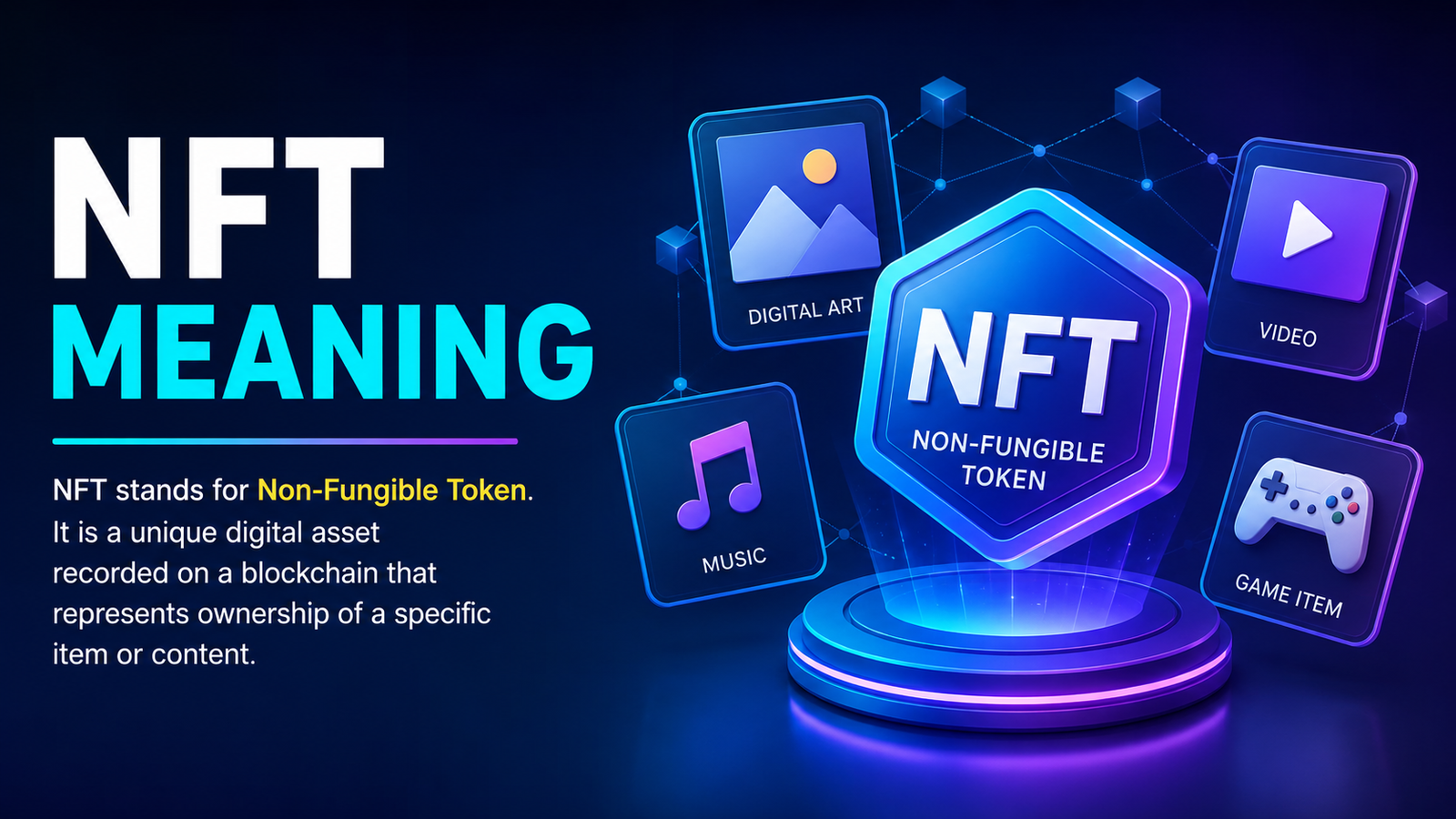
NFT stands for “non-fungible token.” In simple English, an NFT is a unique digital token recorded on a blockchain that can be used to represent ownership or another verifiable connection to a particular digital or physical asset. Unlike ordinary cryptocurrencies, NFTs are designed to be distinguishable from one another rather than interchangeable on a one-for-one basis.
The concept can sound complicated at first. However, the basic idea is easier to understand when you break the phrase into three parts: non-fungible, token, and blockchain.
This guide explains NFT meaning, pronunciation, origin, examples, synonyms, antonyms, common usage, how NFTs work, and frequently asked questions in simple English. 🧭
What Does NFT Mean?
NFT means “non-fungible token.”
An NFT is a unique digital record that exists on a blockchain. It can represent something such as digital artwork, a collectible, music, a video, an in-game item, a membership, an event ticket, or even a connection to a real-world asset.
The important word is non-fungible.
Something fungible can be replaced by another identical item without making a meaningful difference. For example, one $10 bill can generally be exchanged for another $10 bill. One unit of a cryptocurrency can also be interchangeable with another unit of the same cryptocurrency.
Something non-fungible, however, has individual characteristics that make it different from another item. A specific painting, signed baseball card, house, or original manuscript is a good example.
NFTs bring this idea into the digital world. Ethereum describes NFTs as individually unique tokens with properties that distinguish them from other tokens.
NFT Meaning in Simple English
The easiest way to understand NFT meaning is:
An NFT is like a unique digital certificate recorded on a blockchain that identifies a particular digital or physical asset and can record ownership or related rights.
Imagine buying an original signed poster.
Many people might have photographs or copies of the poster, but one particular signed copy belongs to you. An NFT can provide a similar concept for digital assets by creating a unique blockchain record associated with a particular item.
However, an important distinction is that owning an NFT does not automatically mean you own the copyright to the image, music, video, or other content connected to it. The rights depend on the terms associated with that particular NFT.
How Do You Pronounce NFT?
NFT is normally pronounced by saying each letter separately:
N-F-T
Cambridge gives the pronunciation as /ˌen.efˈtiː/. Oxford also lists NFT as the abbreviation for non-fungible token.
The full phrase non-fungible token is pronounced differently depending on the speaker’s accent, but the abbreviation NFT is almost always spoken as three letters.
What Does “Non-Fungible” Mean?
The word fungible is important for understanding NFT meaning.
If something is fungible, individual units are interchangeable.
For example:
- One $1 bill can normally replace another $1 bill.
- One bitcoin can generally be exchanged for another bitcoin.
- One unit of a particular cryptocurrency is intended to have the same basic value as another identical unit.
These are examples of fungible assets.
A non-fungible item is different.
Consider a family photograph. You could print another copy, but the original physical photograph may have sentimental or historical value that makes it different from the copy.
The same basic idea applies to digital ownership records.
An NFT has a unique identity and characteristics recorded through blockchain technology. Ethereum’s NFT documentation explains that NFTs can have individual properties and identifiable ownership records.
What Is the “Token” in NFT?
A token is a digital record created and managed through blockchain technology.
In the case of an NFT, the token can contain information that identifies a particular item and its ownership history.
The U.S. National Institute of Standards and Technology describes an NFT as an owned, transferable, indivisible data record representing a linked physical or virtual asset and managed by a smart contract on a blockchain.
This is why an NFT should not simply be thought of as “a picture on the internet.”
The image, video, song, or other media may be connected to the NFT, but the NFT itself is the blockchain-based record.
How Do NFTs Work?
NFTs generally depend on blockchain technology and smart contracts.
A blockchain is a distributed digital record that can store transaction information. A smart contract is software deployed on a blockchain that follows programmed rules.
For example, an NFT smart contract can:
- Create or mint an NFT.
- Give the NFT a unique identifier.
- Associate the NFT with a blockchain address.
- Store or point to metadata describing the NFT.
- Record transfers between owners.
- Apply programmed rules where supported.
Ethereum explains that NFT ownership is tracked through blockchain addresses and that NFT smart contracts can create tokens, assign ownership, and give each NFT an individual ID.
What Does “Minting an NFT” Mean?
Minting means creating an NFT on a blockchain.
When someone mints an NFT, information about the token is recorded according to the rules of its smart contract.
For example, a digital artist might create a piece of artwork and mint an NFT connected to it.
The artist could then offer that NFT for sale through a compatible marketplace.
NFT vs Cryptocurrency
NFTs and cryptocurrencies are both blockchain-based, but they are not the same thing.
A cryptocurrency such as Bitcoin is generally fungible. One bitcoin is interchangeable with another bitcoin in terms of the underlying currency unit.
NFTs are non-fungible. Each token can have a distinct identifier and properties.
A simple comparison looks like this:
| Feature | Cryptocurrency | NFT |
|---|---|---|
| Interchangeable | Usually yes | No, each can be unique |
| Main concept | Digital currency or token | Unique digital token |
| Individual identity | Units are generally equivalent | Each NFT can have a distinct ID |
| Common examples | Bitcoin, Ether | Digital art, collectibles, tickets |
| Blockchain-based | Yes | Yes |
Ethereum’s ERC-721 standard was specifically developed for tracking distinguishable assets because standard fungible-token systems are not designed to treat each individual asset as unique.
Examples of NFTs
NFTs can represent many different kinds of things.
1. Digital Art
Digital artwork was one of the most visible uses of NFTs.
An artist can create digital artwork and connect it to an NFT. The blockchain record can then provide a verifiable ownership history for the token.
2. Digital Collectibles
NFTs can function as digital collectibles.
For example, a collection may contain thousands of tokens with different traits, designs, or rarity levels.
The fact that each token has an identifiable blockchain record makes it possible to distinguish one collectible from another.
3. Gaming Items
NFTs can represent items used in games, such as characters, equipment, virtual land, or collectibles.
Ethereum’s documentation lists ownable game items among possible NFT applications.
4. Event Tickets
An event organizer could issue tickets as NFTs.
The token can potentially contain information about the ticket and provide a blockchain-verifiable record. Ethereum notes that NFT-based tickets can be created in different quantities and can contain distinguishing characteristics such as assigned seats.
5. Music
Musicians can use NFTs to represent digital music-related assets, collectibles, memberships, or special experiences.
The NFT itself does not automatically transfer copyright. Any rights granted to the buyer depend on the specific agreement.
6. Digital Memberships
An NFT can also act as a membership credential.
For example, a community could give NFT holders access to a private digital space, event, or service.
7. Real-World Assets
NFT technology can potentially be used to represent connections to physical assets.
Ethereum’s ERC-721 proposal specifically discusses possible applications involving physical property and other distinguishable assets.
What Is the Origin of NFTs?
The idea behind unique digital tokens developed over several years alongside blockchain technology.
NFT history is often associated with early blockchain experiments involving unique digital assets and collectibles. Ethereum later provided a major technical foundation for NFTs through standards designed to track individually distinguishable tokens.
The ERC-721 proposal became an important milestone because it defined a standard interface for non-fungible tokens on Ethereum. The proposal explains that ERC-20-style fungible tokens were not suitable for assets where every individual item needed to be tracked separately.
The term itself also became increasingly common as NFT technology spread into digital art, collectibles, gaming, and online communities.
Merriam-Webster lists 2017 as the first known use of “non-fungible token” in the meaning it defines today.
Dictionary.com places the first recorded period for the abbreviation NFT in the 2015–2020 range.
So, while the technology developed through earlier blockchain experiments, NFTs became widely recognized as a mainstream digital concept during the late 2010s and early 2020s.
NFT Synonyms
There is no perfect synonym for NFT because it is a specific technical term.
However, depending on the context, related expressions include:
- Non-fungible token
- Unique digital token
- Blockchain-based collectible
- Digital collectible
- Digital ownership token
- Blockchain asset
- Unique digital asset
These terms are not always exact replacements.
For example, “digital collectible” describes one common type of NFT but does not describe every possible NFT application.
NFT Antonyms
NFT also does not have one exact opposite in everyday English.
However, the closest conceptual opposite is a fungible token.
A fungible token is interchangeable with another unit of the same type.
Examples include many cryptocurrencies and blockchain-based tokens designed to function as interchangeable units.
The key difference is:
Fungible = interchangeable
Non-fungible = individually distinguishable
That distinction is the foundation of the term NFT.
Common Usage of NFT
The word NFT is commonly used as a noun and abbreviation.
Here are some natural examples:
- “She bought an NFT from a digital artist.”
- “The company released NFT tickets for the event.”
- “He created an NFT collection.”
- “The game includes NFT-based collectibles.”
- “The artwork was sold as an NFT.”
- “NFT ownership is recorded on a blockchain.”
You may also see related terms such as NFT marketplace, NFT collection, NFT creator, NFT holder, NFT minting, and NFT wallet.
Cambridge gives examples involving digital art, trading history, creators monetizing digital artifacts, and sports trading cards.
Why Are NFTs Valuable?
An NFT does not automatically have value simply because it is an NFT.
Its value can depend on many factors, including:
- Scarcity
- Demand
- Creator reputation
- Utility
- Community interest
- Historical significance
- Artistic appeal
- Ownership rights
- Brand recognition
- Market conditions
This is similar to physical collectibles. A printed baseball card is not valuable merely because it is a card. Its value can depend on rarity, condition, demand, and historical importance.
The same principle applies to NFTs.
Are NFTs the Same as Owning a Digital Picture?
No.
This is one of the most important points about NFT meaning.
Anyone may be able to view, copy, or download a digital image associated with an NFT, depending on how the content is distributed.
The NFT provides a blockchain-based ownership record for the token. It does not necessarily prevent other people from viewing or copying the associated media.
Ethereum explains that NFTs are designed to provide verifiable ownership records and digital uniqueness, while other platforms can still display or interact with the underlying content.
Therefore, buying an NFT should not automatically be interpreted as buying exclusive copyright ownership of the associated artwork.
Why Do People Buy NFTs?
People buy NFTs for different reasons.
Some collectors enjoy owning unique digital items. Artists may use NFTs as another way to distribute their work. Gamers may be interested in digital items or experiences. Communities may use NFTs as membership credentials.
Some buyers also purchase NFTs because they believe an asset may become more valuable in the future.
That last reason carries substantial risk. NFT prices can fluctuate significantly, and owning an NFT does not guarantee that it will increase in value.
Are NFTs Still Relevant?
NFTs are no longer simply a term associated with digital artwork.
The technology can be applied to collectibles, tickets, gaming assets, credentials, memberships, digital identity-related systems, and other use cases.
Ethereum’s current documentation continues to describe NFTs as a way of representing unique assets and lists applications including art, collectibles, gaming items, event attendance, educational credentials, and domain names.
At the same time, the NFT market has evolved. Not every NFT project succeeds, and the technology has practical limitations and risks. Buyers should understand what they are actually purchasing rather than assuming that every NFT represents an investment opportunity.
NFT Meaning in Texting and Social Media
Unlike abbreviations such as “LOL” or “BRB,” NFT is not normally slang for a casual phrase in everyday texting.
Online, NFT almost always refers to non-fungible token when the conversation involves cryptocurrency, blockchain, digital art, gaming, collectibles, or online ownership.
For example:
“Did you see that NFT collection?”
Here, NFT clearly means non-fungible token.
Similarly:
“He sold his NFT.”
This usually refers to a specific blockchain-based token.
Frequently Asked Questions About NFT Meaning
What does NFT stand for?
NFT stands for non-fungible token. It refers to a unique blockchain-based token that can represent or be associated with a digital or physical asset.
What is the simple meaning of NFT?
In simple terms, an NFT is a unique digital token with a blockchain-based record that can identify ownership or another connection to a particular asset.
How do you pronounce NFT?
NFT is pronounced “N-F-T,” with each letter spoken separately. Cambridge lists its pronunciation as /ˌen.efˈtiː/.
What is an example of an NFT?
A digital artwork represented by a unique blockchain token is a common example. Other examples include digital collectibles, game items, event tickets, and membership-related tokens.
What is the opposite of NFT?
The closest conceptual opposite is a fungible token, because fungible tokens are designed to be interchangeable while NFTs are individually distinguishable.
Is an NFT a cryptocurrency?
No. NFTs and cryptocurrencies both use blockchain technology, but an NFT is designed to be unique rather than interchangeable like a typical cryptocurrency unit.
Does buying an NFT mean I own the copyright?
Not necessarily. NFT ownership and copyright ownership are separate concepts. The rights granted to a buyer depend on the specific NFT and its legal terms.
Why are NFTs called non-fungible?
They are called non-fungible because each NFT can have a distinct identity and properties, meaning it is not simply interchangeable with another NFT.
Can an NFT represent a physical item?
Yes. NFT standards can support representations or links to physical assets, although the exact legal and practical relationship between the token and physical property depends on the particular project.
What does minting an NFT mean?
Minting an NFT means creating a token on a blockchain according to the rules of its smart contract.
Final Thoughts on NFT Meaning
The simplest answer to “What does NFT mean?” is non-fungible token.
But the concept goes beyond the three words. An NFT is a blockchain-based digital record designed to distinguish one token from another. It can be associated with artwork, music, collectibles, gaming items, tickets, memberships, credentials, and other assets.
The easiest way to remember the term is:
Fungible means interchangeable.
Non-fungible means unique or individually distinguishable.
Token means a digital record represented on a blockchain.
Put those ideas together, and NFT means a unique blockchain-based token.
As NFTs continue to develop, their most useful applications may extend beyond the speculative hype that originally made the term famous. Understanding what an NFT actually represents—and what rights it does or does not provide—is far more important than simply knowing the abbreviation. 🧭
For readers researching NFT meaning, that distinction is the key to understanding the technology clearly and avoiding common misconceptions.