If you have ever seen someone write “They were showing PDA” or “I’m not comfortable with PDA,” you may have wondered what PDA actually means. The abbreviation is common in texting, social media, dating conversations, entertainment news, and everyday English.
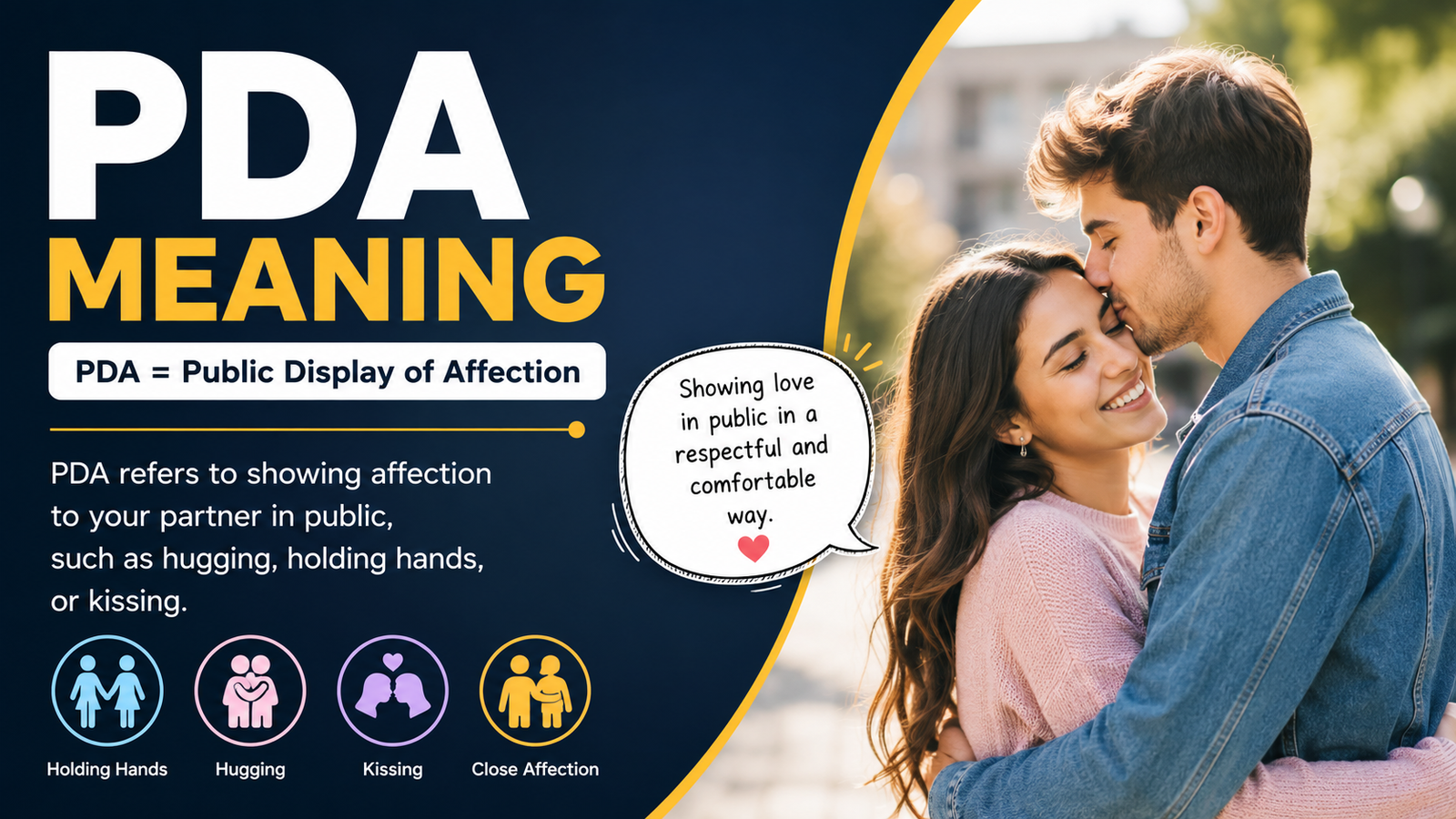
The most common meaning of PDA today is “public display of affection.” It describes affectionate behavior between people when that behavior happens in front of others. Holding hands, hugging, kissing, cuddling, or showing other romantic affection in public can all be described as PDA. Cambridge Dictionary and Oxford Learner’s Dictionaries both list this as an established informal meaning of the abbreviation.
However, PDA has another important meaning: “personal digital assistant.” This refers to a small handheld computer that was widely used for organizing personal information before smartphones became dominant. Merriam-Webster records the technology meaning and gives 1992 as its first known use in that sense.
In this guide, we will explain PDA meaning, pronunciation, origin, examples, synonyms, antonyms, texting usage, relationship context, and other meanings in simple English.
What Does PDA Mean?
In modern everyday conversations, PDA usually means “public display of affection.”
A public display of affection is an affectionate action that other people can see. For example, a couple holding hands while walking through a park is showing PDA. A quick kiss in public can also be called PDA.
The abbreviation is especially common when people talk about dating and relationships.
For example:
- “They were showing a lot of PDA at the party.”
- “I don’t mind a little PDA.”
- “Their PDA made everyone smile.”
- “He doesn’t like public displays of affection.”
The exact behavior considered PDA can vary from one person or culture to another. What feels completely normal to one couple may seem too personal to someone else.
PDA Meaning in Simple English
The easiest definition is:
PDA means showing affection to someone in a public place where other people can see it.
The word public means other people are present or can see what is happening.
Display means showing something openly.
Affection means feelings of love, care, or fondness.
Put these words together and public display of affection means openly showing loving or romantic feelings in front of other people.
Common examples include:
- Holding hands
- Hugging
- Giving a quick kiss
- Putting an arm around a partner
- Cuddling
- Showing affectionate gestures toward a partner
The meaning is not limited to one specific action. The context matters.
PDA Pronunciation
PDA is pronounced by saying each letter separately:
The pronunciation is “pee-dee-ay.” Cambridge Dictionary gives the pronunciation as /ˌpiː.diːˈeɪ/.
You do not normally pronounce PDA as a single word. It is an initialism, so the three letters are spoken individually.
What Does PDA Mean in Texting?
In texting and online conversations, PDA usually means public display of affection.
Someone might text:
“They were doing PDA at the restaurant 😂.”
This means the person saw a couple behaving affectionately in a public place.
Another example is:
“Are you okay with PDA?”
Here, the person is asking whether you are comfortable showing or seeing romantic affection in public.
You may also see:
“Too much PDA!”
This usually means someone thinks a couple is being excessively affectionate in front of other people.
Because texting often uses abbreviations to save time, PDA is much shorter than writing public display of affection every time.
What Does PDA Mean in a Relationship?
In relationships, PDA refers to visible expressions of affection between romantic partners.
For some couples, PDA is simply holding hands or giving each other a hug. For others, it may include kissing or cuddling.
There is no universal amount of PDA that every couple should have. Personal comfort, social setting, family expectations, and cultural norms can all influence how people feel about public affection.
A couple may enjoy holding hands while walking but avoid kissing in public. Another couple may be comfortable with more visible affection.
Neither preference automatically means a relationship is stronger or weaker.
What matters most is that both people are comfortable with the behavior and respect the environment around them.
Common Examples of PDA
PDA can appear in many ordinary situations.
Holding Hands
A couple walking while holding hands is one of the simplest examples of PDA.
It is generally a subtle way to show closeness without attracting much attention.
Hugging
A hug between romantic partners can also be considered PDA when it happens in a public setting.
A brief hug is usually viewed differently from prolonged physical affection.
Kissing
A kiss in public is another common example.
A quick kiss may be viewed as mild PDA, while more intimate behavior may attract greater attention or make people nearby uncomfortable.
Cuddling
Sitting closely together, resting against each other, or cuddling in a public place can also fall under the term PDA.
Putting an Arm Around Someone
A person placing an arm around their partner while sitting at a restaurant, watching a movie, or attending an event can be described as PDA.
PDA Examples in Sentences
Understanding PDA becomes easier when you see it used naturally.
Example 1:
“Those two were holding hands and showing PDA at the mall.”
Example 2:
“She doesn’t like PDA, so she prefers to keep romantic moments private.”
Example 3:
“The celebrity couple was photographed showing PDA during their vacation.”
Example 4:
“A little PDA can be sweet, but some people prefer private affection.”
Example 5:
“My friends are very affectionate, but they don’t usually show PDA.”
Example 6:
“Are you comfortable with PDA when we’re around other people?”
These examples show that PDA can be used both neutrally and humorously.
PDA and Social Media
The word PDA frequently appears on social media.
People may use it when commenting on photos or videos of couples. Entertainment websites also commonly use the abbreviation when describing celebrities being affectionate in public. Recent 2026 entertainment coverage, for example, has used “PDA” to describe celebrity couples showing affection in public.
Typical social-media phrases include:
- “Cute PDA!”
- “They are always showing PDA.”
- “That is way too much PDA.”
- “Their PDA is adorable.”
- “No more PDA, please!”
The tone can be positive, negative, playful, or sarcastic depending on the situation.
Is PDA Always Romantic?
Not necessarily.
The phrase public display of affection is most commonly associated with romantic relationships, but affection can also exist between family members or close friends.
For example, hugging a family member in public is technically an affectionate public gesture. However, in everyday English, when people say “PDA,” they usually have romantic affection in mind.
That is why context is important.
PDA Meaning in Technology
PDA has an older technology-related meaning: personal digital assistant.
A personal digital assistant was a small handheld computer designed to help people organize information such as appointments, addresses, schedules, notes, and other personal data. NIST describes a PDA as a handheld computer used for personal information organization and electronic communication.
PDAs became particularly associated with personal technology during the 1990s and 2000s.
Before smartphones became the standard, people could use devices such as PDAs to manage calendars, contacts, notes, and other information.
Merriam-Webster lists personal digital assistant as the noun meaning of PDA and gives its first known use as 1992.
Today, this meaning is much less common in everyday conversation because smartphones have replaced most of the functions that traditional PDAs provided.
PDA Origin and History
The abbreviation PDA has more than one history because it represents different phrases.
The technology meaning, personal digital assistant, became established in the early 1990s. Merriam-Webster records 1992 as the first known use of PDA for this device.
The relationship meaning comes from shortening public display of affection into its initial letters.
As texting, social media, celebrity coverage, and online dating conversations became more common, PDA became an easy shorthand for public romantic affection.
Today, the relationship meaning is particularly familiar in informal English.
PDA Synonyms
There is no single perfect synonym for PDA because PDA is an abbreviation rather than a normal descriptive word.
Depending on the sentence, possible alternatives include:
- Public affection
- Public display of affection
- Showing affection
- Open affection
- Public romantic affection
- Affectionate behavior in public
- Visible affection
The most direct alternative is simply public display of affection, because that is what PDA stands for.
PDA Antonyms
PDA does not have a strict dictionary antonym, but several expressions communicate the opposite idea.
These include:
- Private affection
- Keeping affection private
- Emotional restraint
- Discreet behavior
- Private intimacy
- Keeping romance behind closed doors
For example:
PDA: “They were holding hands and kissing in public.”
Opposite idea: “They prefer to keep their romantic affection private.”
PDA vs. Public Affection
These expressions are closely related, but PDA is more commonly used as an abbreviation.
Public affection is a broad phrase describing affection shown openly.
PDA, especially in casual English, often refers specifically to romantic or intimate affection that other people can see.
For everyday writing, public display of affection is the clearest full phrase.
Is PDA a Good Thing or a Bad Thing?
There is no universal answer.
Some people see PDA as a normal and healthy way to express affection. Others feel uncomfortable when couples show too much affection in public.
The difference often comes down to personal boundaries and social expectations.
A brief hug or holding hands may be considered completely normal in one environment. The same level of affection could feel inappropriate in another setting.
Cultural norms also matter. What is considered acceptable public behavior varies between societies and communities.
The safest approach is to consider consent, comfort, context, and respect for other people.
Why Do Couples Show PDA?
People show PDA for many different reasons.
Some simply enjoy expressing affection naturally. Holding hands can communicate closeness, while a hug can provide comfort and reassurance.
For some couples, public affection can also make them feel connected. Research discussed in relationship literature has associated physical affection with attachment and relationship intimacy, although the experience differs from couple to couple.
PDA does not automatically prove that a relationship is happy or healthy, however. A couple’s private relationship cannot be judged simply by how affectionate they appear in public.
When Can PDA Become Uncomfortable?
PDA can become uncomfortable when it ignores the boundaries of the people involved or the expectations of the setting.
For example, a workplace, school, religious setting, formal event, or crowded public space may have different expectations from a private gathering.
It is also important to remember that both partners should be comfortable with the behavior.
If one person enjoys PDA and the other dislikes it, the solution is communication rather than pressure.
Other Meanings of PDA
Although public display of affection is common in everyday relationship conversations, PDA can represent several different terms.
Depending on the context, PDA may refer to:
Public Display of Affection — romantic or affectionate behavior visible to others.
Personal Digital Assistant — an older type of handheld computer used for organizing personal information.
Patent Ductus Arteriosus — a medical term referring to a blood-vessel connection in the heart that normally closes after birth.
Pathological Demand Avoidance — a term used in some discussions concerning an autism-related profile, although terminology and professional views around this concept vary.
This is why context matters whenever you encounter the abbreviation PDA.
If the conversation is about dating, celebrities, romance, or texting, public display of affection is usually the intended meaning.
If the conversation is about older computers or technology history, personal digital assistant is more likely.
How to Use PDA Correctly
Use PDA when your audience is likely to understand the abbreviation.
For example:
“The couple was showing PDA.”
This sounds natural in casual conversation and online writing.
In formal writing, it may be better to write the full phrase first:
“The couple showed a public display of affection (PDA).”
After introducing the abbreviation, you can use PDA throughout the rest of the text.
Remember that PDA is normally written in capital letters when it is used as an abbreviation.
Frequently Asked Questions About PDA Meaning
What does PDA stand for?
PDA most commonly stands for public display of affection. It describes affectionate behavior, such as holding hands, hugging, or kissing, when other people can see it.
What does PDA mean in texting?
In texting, PDA usually means public display of affection. Someone may use it when talking about a couple showing romantic affection in public.
How do you pronounce PDA?
PDA is pronounced “pee-dee-ay.” Each letter is spoken separately.
Is kissing PDA?
Yes. Kissing in a public place can be considered PDA. The amount of affection people consider appropriate varies by person, culture, and situation.
Is holding hands PDA?
Yes. Holding hands in public can be considered a mild or subtle form of PDA.
What is the opposite of PDA?
There is no exact antonym, but keeping affection private or private affection expresses the opposite idea.
What did PDA mean before smartphones?
PDA could mean personal digital assistant, a handheld computer used for organizing information such as contacts, schedules, and appointments.
Is PDA only used for couples?
Usually, PDA refers to romantic affection in everyday conversation. However, the broader phrase public display of affection can technically include other forms of visible affection.
Why do people dislike PDA?
Some people dislike PDA because of personal boundaries, cultural expectations, religious or family values, or simply because they prefer romantic affection to remain private.
Is PDA normal in relationships?
Yes. Public affection is common in many relationships, but the amount considered comfortable or appropriate differs from couple to couple and from one setting to another.
Final Thoughts on PDA Meaning
So, what does PDA mean?
In modern texting, dating, social media, and everyday conversation, PDA most commonly means “public display of affection.” It describes visible expressions of affection such as holding hands, hugging, kissing, cuddling, or putting an arm around a romantic partner.
The pronunciation is “pee-dee-ay,” and the abbreviation is especially common in informal English.
PDA also has an older technology meaning: personal digital assistant, a handheld computer that helped users manage personal information before smartphones took over many of those functions.
If you see PDA in a relationship, celebrity, or texting context, public display of affection is almost certainly the meaning. If you see it in a discussion about older computers or technology, personal digital assistant may be intended instead.
Ultimately, PDA is less about a specific action and more about where affection is shown and how visible it is to other people. Whether it feels sweet, normal, embarrassing, or inappropriate depends on the people involved and the setting.