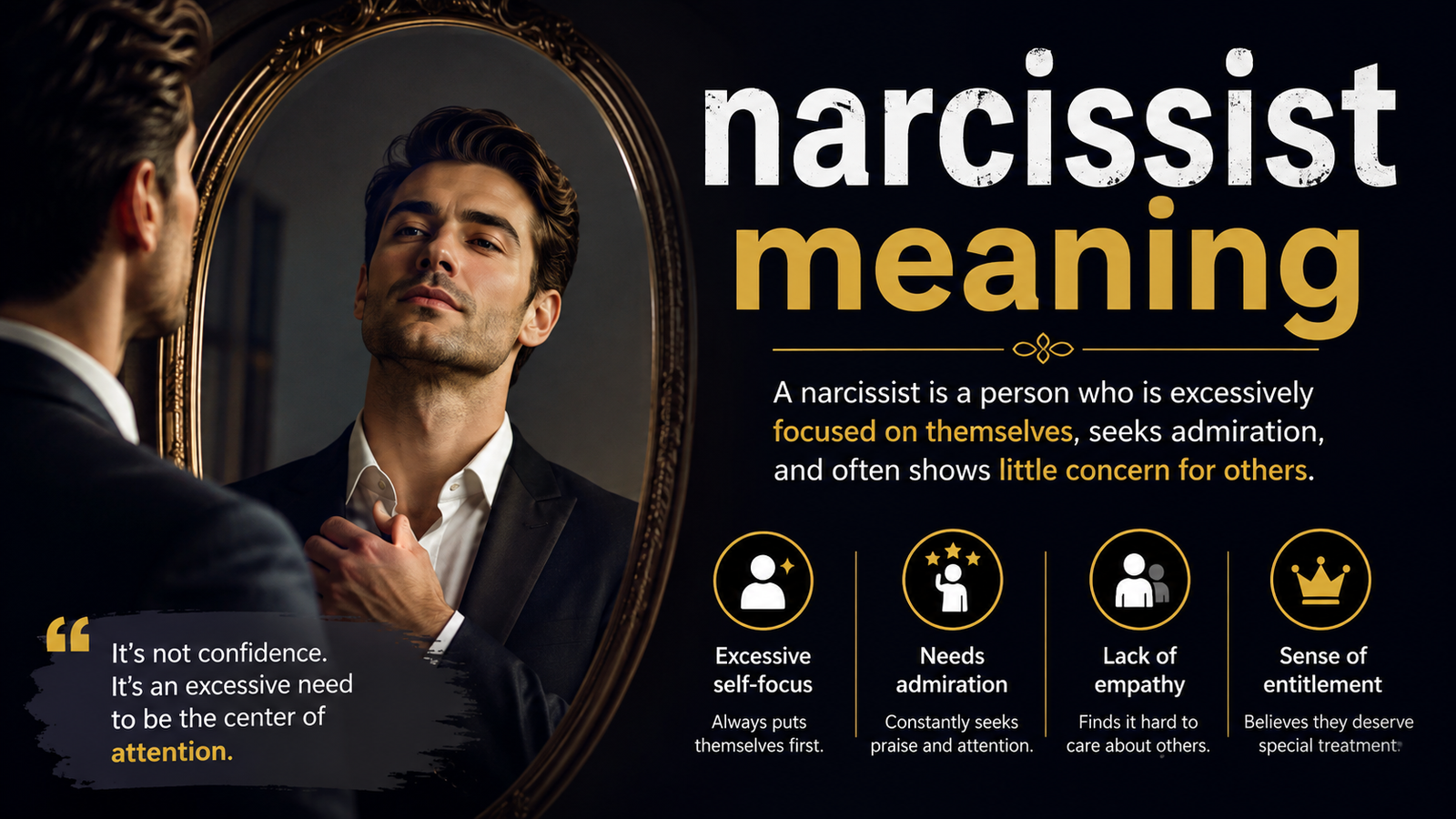
If you have searched for “narcissist meaning,” you may already know that the word is often used to describe someone who seems overly focused on themselves. In everyday English, a narcissist is generally described as a person who admires themselves excessively, wants attention or praise, and may show little concern for other people’s feelings.
However, the word has a deeper meaning in psychology. Being confident, enjoying compliments, or caring about your appearance does not automatically make someone a narcissist. The term can describe ordinary self-centered behavior in casual conversation, while Narcissistic Personality Disorder (NPD) is a specific mental health diagnosis with more persistent and impairing patterns. The American Psychiatric Association explains that NPD involves a pervasive pattern of grandiosity, a need for admiration, and a lack of empathy.
This guide explains narcissist meaning in simple English, including its pronunciation, origin, examples, synonyms, antonyms, common usage, and the important difference between everyday narcissism and a clinical disorder.
Narcissist Meaning in Simple English
A narcissist is a person who is excessively focused on themselves and their own importance. They may strongly want admiration, attention, praise, or special treatment.
In simple terms, you can think of a narcissist as someone who often puts “me” before “we.”
For example, imagine someone who constantly talks about their achievements but rarely asks about other people’s experiences. If a friend shares good news, they immediately change the conversation back to themselves. In everyday speech, people might call that person a narcissist.
The word can also describe someone who appears highly concerned with their appearance, status, talents, success, or social image. Oxford defines the everyday use as someone who admires themselves too much, while its psychological use refers to a person who is strongly focused on themselves, needs admiration, and has difficulty understanding other people’s feelings.
Still, it is important not to use narcissist as a medical diagnosis based on one annoying or selfish action.
Narcissist Pronunciation
The word narcissist is commonly pronounced:
NAR-suh-sist
Oxford lists pronunciations including /ˈnɑːsɪsɪst/ and /ˈnɑːrsɪsɪst/, depending on the variety of English.
How to Say Narcissist
Break the word into three simple parts:
nar + cis + sist
The first syllable sounds like “nar,” followed by a soft “sis” sound, and then “ist.”
The plural is narcissists, pronounced approximately NAR-suh-sists.
The related adjective is narcissistic, meaning excessively self-focused or showing characteristics associated with narcissism.
What Is the Origin of the Word Narcissist?
The word narcissist comes from Narcissus, a character from Greek mythology who became famous for falling in love with his own reflection.
The story was famously recorded by the Roman poet Ovid in Metamorphoses. Narcissus was portrayed as a beautiful young man who became fascinated with his reflection in a pool. The myth eventually became a powerful symbol of excessive self-love and vanity.
The psychological concept developed much later. According to etymological records, narcissism entered psychological language in the late 19th and early 20th centuries. Havelock Ellis connected the myth of Narcissus with psychological behavior in 1898, while German psychiatrist Paul Näcke coined the term Narzissismus in 1899. The English word narcissist is recorded from around 1919.
So, the modern word has an interesting journey:
Greek mythology → Narcissus → narcissism → narcissist
The basic idea remained connected to excessive self-focus, but psychology later gave the concept a much more specific meaning.
What Is Narcissism?
Narcissism refers to excessive self-love, self-focus, or an exaggerated sense of one’s own importance. The APA Dictionary of Psychology describes narcissism as excessive self-love or egocentrism.
Narcissism exists on a spectrum.
A person may occasionally behave selfishly without having a narcissistic personality. People can also enjoy compliments, feel proud of their accomplishments, or want recognition without being narcissistic in a problematic sense.
The concern becomes greater when self-focus is persistent and creates serious difficulties in relationships, work, or other parts of life.
This distinction matters because calling every selfish or arrogant person a “narcissist” can make the word less accurate.
Narcissist vs. Narcissistic Personality Disorder
One of the biggest misunderstandings surrounding the word is the assumption that every narcissist has Narcissistic Personality Disorder.
That is not correct.
A person can display narcissistic traits without meeting the criteria for NPD. The American Psychiatric Association specifically notes that having narcissistic traits is not the same as having narcissistic personality disorder. For NPD, the pattern must be persistent, inflexible, maladaptive, and associated with significant impairment or distress.
NPD is characterized by a broad pattern involving features such as:
- An exaggerated sense of self-importance
- A strong need for admiration
- Feelings of entitlement
- Preoccupation with success, power, beauty, or status
- Exploiting other people for personal advantage
- Difficulty recognizing or responding to other people’s feelings
- Envy or the belief that others are envious
- Arrogant attitudes or behavior
A diagnosis should be made by a qualified mental health professional rather than by friends, family members, social media users, or online quizzes.
Common Characteristics Associated With a Narcissist
In everyday conversation, people often use narcissist for someone who repeatedly displays several self-centered behaviors.
1. Constant Need for Attention
A narcissistic person may strongly seek attention and recognition. They may become uncomfortable when someone else receives praise.
2. Excessive Need for Admiration
Compliments can be especially important to someone with strong narcissistic traits. They may want others to repeatedly confirm that they are talented, attractive, successful, or important.
3. Sense of Entitlement
They may believe they deserve special treatment even when there is no reasonable basis for it.
For example, someone might expect everyone to accommodate their schedule while refusing to make similar compromises for others.
4. Lack of Empathy
A major concern is difficulty recognizing or responding appropriately to another person’s emotions.
This does not necessarily mean that the person never experiences emotions or can never care about anyone. Rather, persistent problems with empathy can be an important feature in narcissistic behavior and NPD.
5. Grandiose Self-Image
Some people with strong narcissistic characteristics may exaggerate their abilities, achievements, status, or importance.
They might believe they are unusually talented or deserve recognition far beyond what their accomplishments support.
6. Sensitivity to Criticism
Narcissism is not always as simple as looking confident or arrogant.
The APA notes that people with NPD may also experience vulnerability, shame, emptiness, or intense sensitivity to criticism or defeat.
This means a person can appear extremely confident on the outside while being highly sensitive to rejection or criticism internally.
Examples of Narcissist in a Sentence
Understanding examples can make the meaning easier to remember.
Example 1
“Everyone noticed that he kept turning every conversation back to himself, so they jokingly called him a narcissist.”
Here, the word is being used casually to describe self-centered behavior.
Example 2
“She accused her former partner of being a narcissist because he always demanded attention.”
This is common in everyday speech, but an accusation does not establish a clinical diagnosis.
Example 3
“The actor’s character is portrayed as a wealthy narcissist who believes he is better than everyone else.”
Here, narcissist describes a fictional character.
Example 4
“Being proud of your achievements does not automatically make you a narcissist.”
This example highlights the important distinction between healthy confidence and problematic narcissism.
Example 5
“The manager’s narcissistic behavior made teamwork difficult.”
Here, narcissistic is the adjective form of narcissist.
Narcissist Examples in Everyday Situations
The word frequently appears in conversations about relationships, workplaces, friendships, and social media.
A person may casually be called a narcissist when they:
- Constantly make conversations about themselves
- Take credit for other people’s work
- Become angry when they are not praised
- Expect special treatment
- Ignore other people’s boundaries
- Brag excessively about their achievements
- Dismiss other people’s feelings
- Need to be the center of attention
However, none of these behaviors alone proves that someone has NPD.
People can behave selfishly for many different reasons. Personality, stress, insecurity, poor communication, relationship problems, or other psychological factors can influence behavior.
Narcissist Synonyms
The best synonym depends on the context.
Common everyday alternatives include:
- Self-centered
- Self-absorbed
- Egotistical
- Conceited
- Vain
- Arrogant
- Self-important
- Boastful
- Egocentric
- Big-headed
These words are not perfect substitutes in every situation.
For example, vain usually emphasizes excessive concern about appearance, while arrogant emphasizes an exaggerated belief in one’s superiority. Self-centered is broader and may simply mean that someone focuses too much on themselves.
Narcissist Antonyms
Words with meanings opposite or contrasting to narcissist include:
- Humble
- Selfless
- Considerate
- Empathetic
- Altruistic
- Modest
- Generous
- Compassionate
- Thoughtful
- Unassuming
Again, these are contextual opposites rather than strict dictionary antonyms.
For example, an empathetic person tries to understand other people’s feelings, while an excessively self-focused person may have difficulty giving those feelings enough attention.
Narcissist vs. Egotist
These words are similar, but they are not identical.
An egotist is generally someone who talks excessively about themselves and has an exaggerated sense of their own importance.
A narcissist can also be egotistical, but the concept is broader. It can involve a strong need for admiration, entitlement, exploitation, interpersonal difficulties, and problems with empathy.
In everyday conversation, the two words are often used interchangeably. In psychology, however, narcissism has a more specific meaning.
Narcissist vs. Self-Confident Person
Confidence and narcissism are not the same thing.
A confident person can feel proud of their abilities while still respecting other people. They can accept criticism, celebrate someone else’s success, and admit when they make a mistake.
A person with strong narcissistic characteristics may instead need constant validation, expect special treatment, or react poorly when their desired image is challenged.
In simple terms:
Confidence says: “I know I have value.”
Narcissism may say: “I need you to prove that I am more important than everyone else.”
This is a simplified comparison, not a diagnostic test.
How Is the Word Narcissist Commonly Used?
The word narcissist has become extremely common online.
It appears frequently in discussions about dating, marriage, friendship, family conflict, workplace behavior, celebrity culture, and social media.
People may use phrases such as:
- “My ex was a narcissist.”
- “He is acting like a narcissist.”
- “She has narcissistic behavior.”
- “That was a narcissistic response.”
- “I think I am dealing with a narcissist.”
Social media has made the term more visible, but popularity can also create confusion.
Not every difficult person is a narcissist. Not every selfish partner has NPD. And one unpleasant interaction cannot tell you whether someone has a personality disorder.
Is Being Selfish the Same as Being a Narcissist?
No.
Most people behave selfishly from time to time. Someone might be tired, stressed, distracted, jealous, or simply having a bad day.
Narcissism involves a broader pattern of behavior and personality characteristics.
The distinction becomes especially important when discussing NPD. According to the APA, the disorder involves a persistent pattern that affects functioning and relationships rather than occasional self-centered behavior.
Can a Narcissist Change?
Change is possible, but it can be difficult and gradual when someone has deeply established narcissistic patterns.
The American Psychiatric Association notes that people with NPD can improve and that treatment may focus on areas such as relationships, self-esteem, realistic goals, and the therapeutic relationship.
Treatment decisions depend on the individual and should be handled by qualified professionals.
It is also worth remembering that a person does not need a diagnosis for their behavior to affect someone else negatively. Healthy boundaries can be important in any difficult relationship.
Why Do People Call Others Narcissists So Often?
The word is powerful because it gives people a quick way to describe behavior that feels selfish, manipulative, arrogant, or emotionally exhausting.
But popular use has become broader than the clinical meaning.
Someone who interrupts you, posts too many selfies, loves compliments, or talks about their career is not automatically a narcissist.
Using the word carefully helps preserve its meaning and avoids turning a psychological diagnosis into an insult.
Frequently Asked Questions About Narcissist Meaning
What does narcissist mean?
A narcissist is generally a person who shows excessive self-focus, self-admiration, or concern with their own importance. In psychology, narcissism can refer to a broader set of personality traits, while NPD is a specific clinical disorder.
What is the simple meaning of narcissist?
In simple English, a narcissist is someone who is too focused on themselves and often wants admiration or special attention.
How do you pronounce narcissist?
Narcissist is commonly pronounced NAR-suh-sist. Oxford lists slightly different pronunciations across varieties of English.
Where does the word narcissist come from?
The word comes from Narcissus, a figure in Greek mythology associated with falling in love with his own reflection. The psychological term developed centuries later.
What is the difference between a narcissist and someone with NPD?
Narcissist is commonly used as a general or informal description of someone displaying narcissistic traits. Narcissistic Personality Disorder is a recognized mental health disorder involving a persistent and impairing pattern of grandiosity, need for admiration, and lack of empathy.
Is narcissist a bad word?
It depends on how it is used. In everyday conversation, it can be a critical or insulting label. In psychology, narcissism is a legitimate concept, but NPD should not be diagnosed casually.
What is the opposite of a narcissist?
There is no single perfect antonym, but words such as selfless, humble, empathetic, considerate, modest, and compassionate express contrasting qualities.
Can a confident person be a narcissist?
Confidence alone does not make someone a narcissist. Healthy confidence can exist alongside empathy, humility, respect for others, and the ability to accept criticism.
Conclusion: Narcissist Meaning Explained
The simplest definition of narcissist is a person who is excessively focused on themselves and often seeks admiration, attention, or special treatment.
The word has roots in the ancient story of Narcissus, whose obsession with his own reflection became a lasting symbol of excessive self-love. Centuries later, psychologists developed the concept of narcissism to describe patterns of self-focus and related behavior.
Today, narcissist is used in both everyday language and psychological discussions. That is why context matters.
Someone can be vain, boastful, selfish, or occasionally self-centered without having Narcissistic Personality Disorder. NPD is a specific clinical condition involving a persistent pattern of grandiosity, need for admiration, lack of empathy, and related interpersonal difficulties.
Understanding this difference makes the word more useful and accurate. Instead of labeling everyone who behaves badly a narcissist, it is better to focus on the actual behavior, its pattern, and its impact on other people.
In short, when you see the phrase “narcissist meaning,” remember:
Narcissist = a person who shows excessive self-focus or self-admiration, especially when it comes with a strong need for attention or admiration and reduced concern for others.
The word is simple to understand, but its psychological meaning is much more nuanced than the popular label often suggests.