
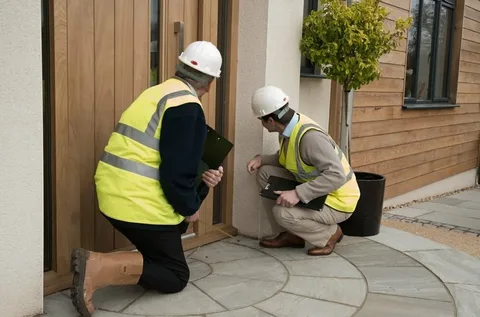
The builder pours the foundations on a Tuesday. By Friday the homeowner gets a call: Building Control never saw the trenches, and the concrete has to come out. A few thousand pounds and three weeks gone, over a single missed inspection. It is one of the most common and most avoidable disasters on an extension, and it happens because people assume one person signs the whole job off. Nobody does. Hiring a structural engineer near me is only the first link in a chain of approvals, and knowing the whole chain is what keeps a project out of trouble.
Here is who checks what, and in what order.
The Short Version: Three Players, One Certificate
An extension passes through three sets of hands before it is legally complete.
- The structural engineer calculates the beams, foundations and connections, and produces the calculation pack
- The architect or designer draws the building regulations package that pulls it together
- Building Control inspects the build at each stage and issues the completion certificate
Only the last of these is the actual sign off. The engineer’s calculations feed into it. They are not the approval themselves.
What Does a Structural Engineer Do?
The engineer proves the building will stand up. Their output is a calculation pack, and Building Control will not approve structural work without it.
You need one whenever the work touches anything load bearing, which on an extension is almost always. Specifically:
- Removing a load bearing wall, including the rear wall you open up to extend
- Installing any steel beam or RSJ
- Altering the roof structure
- Designing foundations, especially on clay or near trees
Fees run roughly £500 to £1,500 for a typical extension. The pack covers beam sizing, foundation design and the connections where new structure meets old, and the builder works directly from it on site.
What Does Building Control Actually Sign Off?
This is the legal approval, and it is separate from planning permission. Planning decides whether you can build. Building Control decides whether you built it correctly, covering structure, fire safety, insulation and drainage.
Crucially, Building Control applies even when your extension is permitted development and needs no planning application at all. The regulations do not care about planning status.
Building Control checks the work in stages and, at the end, issues the completion certificate. That certificate is the document that signs your extension off.
The Inspection Stages You Cannot Skip
Building Control inspects at roughly seven points, and each one has to be seen before the next stage covers it up. Miss one and you may have to expose the work again.
- Commencement, before work starts
- Foundations, before any concrete is poured
- Damp proof course
- Drainage, before it is backfilled
- Structure and steel, checked against the engineer’s calculations
- Insulation and pre plaster
- Final completion, which issues the certificate
The foundation stage is the one that catches people, exactly as in the opening. Pour before the inspector sees the trenches and you risk breaking it all out. Give 24 hours notice at each stage and the process is smooth.
The structure stage is where the engineer’s calculations earn their place, because the inspector is checking the as built steel against the design.
Local Authority or Private Building Control?
You choose who carries out Building Control, and there are two routes. Since 6 April 2024, under the Building Safety Act, private approvers are formally called Registered Building Control Approvers, the role previously known as the approved inspector.
| Local authority | Private approver | |
| Typical cost | £800 to £1,500 | £900 to £1,800 |
| Speed | Standard | Often faster, competitive turnaround |
| VAT | No VAT on fees | VAT applies |
| Records | Direct access to council records | Independent |
Both routes are equally valid and both issue a legally recognised completion certificate. Local authority is usually a little cheaper; private is usually quicker on plan turnaround. The trade offs between private building control and the council route are worth weighing before you commit, because the choice affects both your budget and your timeline.
One thing only the local authority can do: issue a regularisation certificate for work that was built without approval in the first place.
Why the Completion Certificate Matters So Much
People treat the certificate as paperwork. It is the single most valuable document the whole process produces.
When you sell or remortgage, the buyer’s solicitor asks for it. No certificate, and the consequences are real:
- Buyers may withdraw or renegotiate the price down
- Lenders may refuse to lend
- You may be forced into a retrospective regularisation certificate, which can mean opening up finished work
So the sign off is not the end of the admin. It is the thing that protects the value of what you built.
How the Chain Works on a Real Project
On a Bromley new build, Extension Architecture designed a four bedroom house with a void connecting the kitchen through to the basement level. An opening like that removes a chunk of structural floor plate, so the surrounding structure had to be designed to carry the load around it.
That is the chain in action. The structural engineer calculated how the floor worked without the removed section, the design incorporated it, and Building Control inspected the as built structure against those calculations before signing off. Three roles, one sequence, one certificate at the end.
Your First Three Moves
Before anyone breaks ground, get the chain in place.
- Appoint a structural engineer early, during design, not after, because beam spans affect the layout and catching that late is expensive
- Choose your Building Control route, local authority or private, and register the application before work starts
- Book every inspection with 24 hours notice, especially foundations, and never let the builder cover up work the inspector has not seen
Get those three right and the completion certificate arrives on schedule, the sale goes smoothly years later, and the Tuesday foundation pour never becomes a Friday phone call.
