Have you ever formed an opinion about someone before actually getting to know them? Maybe you assumed a person would behave a certain way because of their appearance, background, age, accent, religion, gender, or social group. That kind of judgment can be an example of prejudice.
Have you ever formed an opinion about someone before actually getting to know them? Maybe you assumed a person would behave a certain way because of their appearance, background, age, accent, religion, gender, or social group. That kind of judgment can be an example of prejudice.
Have you ever formed an opinion about someone before actually getting to know them? Maybe you assumed a person would behave a certain way because of their appearance, background, age, accent, religion, gender, or social group. That kind of judgment can be an example of prejudice.
The prejudice meaning is generally a preconceived or unfair opinion about a person, group, or thing, especially when that opinion is formed without enough knowledge or reasonable evidence. It can influence how people think, speak, and behave toward others.
Prejudice is an important word in everyday English because it appears in conversations about society, education, workplaces, relationships, discrimination, culture, and human behavior.
What Does Prejudice Mean?
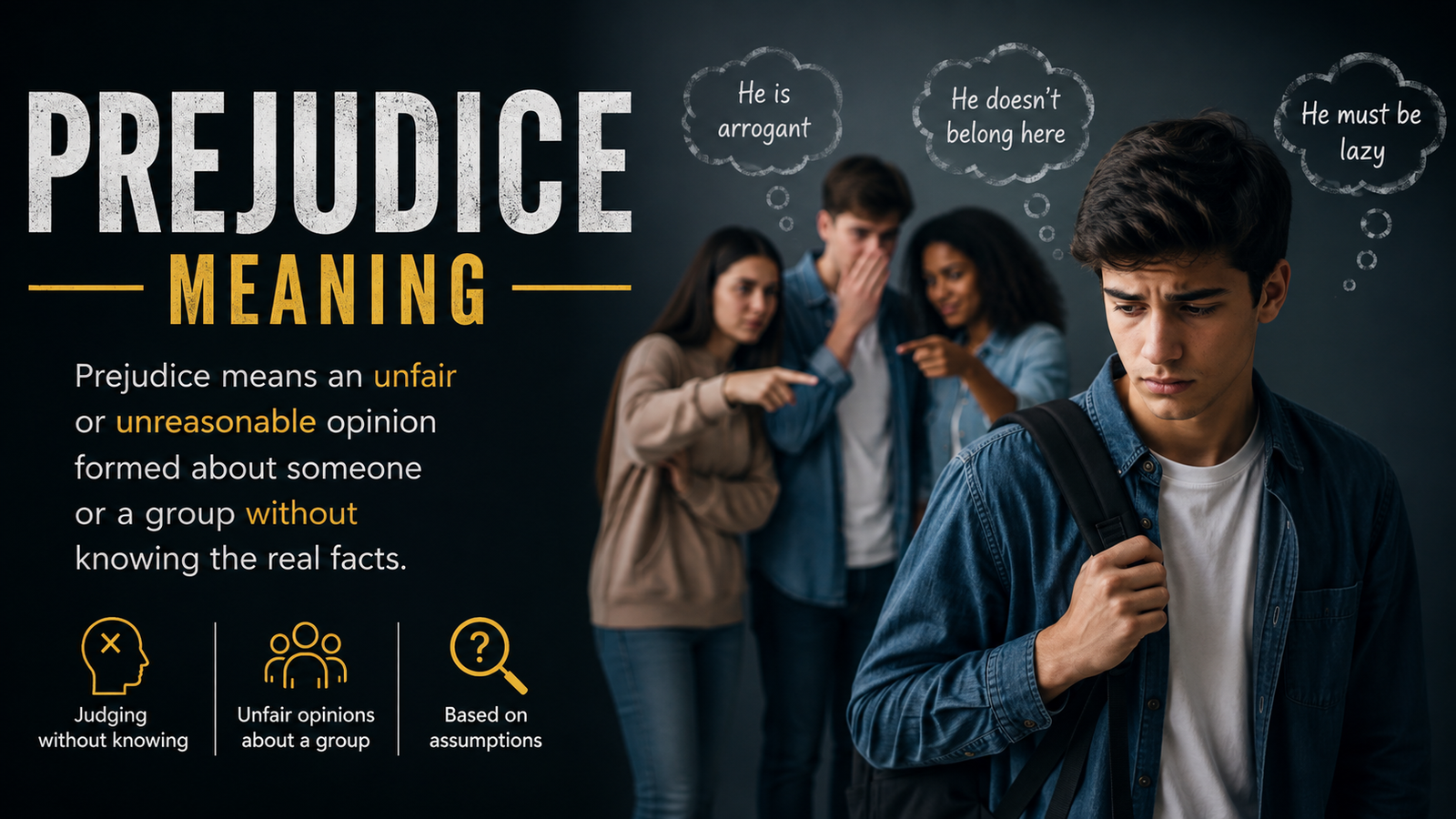
Prejudice means an unfair or unreasonable opinion formed about someone or something before having enough information or experience.
It often involves a negative feeling or attitude toward a particular person or group. Merriam-Webster defines prejudice as an adverse opinion formed without sufficient grounds or knowledge and also uses the word for hostile attitudes toward individuals or groups.
For example:
- She faced prejudice because of her accent.
- We should not judge people based on prejudice.
- His prejudice against the new system disappeared after he learned more about it.
- Racial prejudice can affect how people are treated.
In simple terms, prejudice is judging before knowing.
Prejudice Pronunciation
The word prejudice is pronounced:
PREJ-uh-dis
Its dictionary pronunciation is commonly represented as /ˈpre-jə-dəs/.
The stress falls on the first syllable.
The adjective prejudiced is pronounced differently at the end and means having or showing prejudice or bias.
Simple Definition of Prejudice
A simple way to understand prejudice is:
Prejudice = an opinion or feeling about someone formed before you know the facts.
Imagine a new student joins a class. Someone hears that the student comes from a particular country and immediately assumes they will be unfriendly. That assumption is not based on actually knowing the student.
That is prejudice.
Prejudice does not always involve an openly hostile attitude. Sometimes it appears as an automatic assumption, unfair expectation, or fixed belief.
Prejudice Meaning in Different Contexts
The word can be used in several situations.
1. Social Prejudice
Social prejudice occurs when someone develops unfair attitudes toward people because they belong to a particular social group.
For example, assuming someone is less capable because of their social background can be prejudiced.
2. Racial Prejudice
Racial prejudice involves negative or unfair attitudes toward people based on perceived race or racial background.
For example:
Racial prejudice can create unfair treatment in schools and workplaces.
3. Religious Prejudice
Religious prejudice involves judging or disliking people because of their religion or perceived religious identity.
A person may hold assumptions about someone’s personality or values without actually knowing them.
4. Gender Prejudice
Gender prejudice occurs when people make unfair assumptions based on gender.
For example:
It is prejudiced to assume that someone cannot perform a certain job simply because of their gender.
5. Cultural Prejudice
Cultural prejudice involves negative assumptions about people because of their culture, traditions, language, or customs.
Learning about different cultures can help people question assumptions they may have accepted without evidence.
Origin and Etymology of Prejudice
The history of prejudice goes back many centuries.
Merriam-Webster traces the English word through Middle English and Anglo-French to the Latin praeiudicium, meaning a previous judgment or damage. The Latin elements are connected with prae-, meaning “before,” and judicium, meaning “judgment.”
The basic idea is therefore closely connected to making a judgment beforehand.
The word has been used in English since at least the 14th century in the relevant sense.
This history helps explain why the modern meaning focuses on forming an opinion before having enough information.
How Prejudice Works
Prejudice often begins with a quick judgment.
Humans naturally categorize information to make sense of the world. However, problems arise when people turn limited information into broad assumptions about entire groups.
For example, one unpleasant experience with a person does not logically prove that everyone from that person’s background behaves the same way.
Prejudice takes an individual experience, stereotype, rumor, or assumption and treats it as if it were a reliable rule.
This can make people overlook individual differences.
Prejudice vs. Bias
Prejudice and bias are closely related, but they are not always identical.
Bias generally means a tendency or inclination toward or against something. Merriam-Webster describes bias as a personal and sometimes unreasoned judgment and lists prejudice as one of its related meanings.
Prejudice usually carries a stronger sense of an unfair or unfavorable preconception, particularly toward people or groups.
For example:
Bias:
A manager consistently prefers one particular style of work.
Prejudice:
A manager assumes a particular group of employees is unreliable without considering their individual performance.
The two words overlap, but prejudice usually emphasizes an unfair preconceived attitude.
Prejudice vs. Discrimination
These words are often confused, but they describe different things.
Prejudice is mainly an attitude, belief, or feeling.
Discrimination generally refers to unfair treatment or behavior based on a category such as race, religion, gender, or age.
Merriam-Webster defines discrimination in one major sense as unfairly treating people or groups differently on a categorical basis.
A simple distinction is:
Prejudice = what someone thinks or feels.
Discrimination = how someone may act because of that belief.
For example, a person may have a prejudiced opinion about a particular group. If that person then refuses someone a job because of membership in that group, the behavior may constitute discrimination.
The two can therefore be connected, but they are not synonyms.
Examples of Prejudice in Everyday Life
Here are some easy examples of how the word can be used.
Example 1: Workplace
The employee believed that prejudice was affecting her chances of promotion.
This suggests she thought an unfair attitude toward her group or background might be influencing decisions.
Example 2: School
The teacher warned students not to let prejudice influence their opinions of new classmates.
Here, prejudice means making unfair assumptions before knowing someone.
Example 3: Social Life
He realized that his prejudice against the restaurant came from an old rumor rather than personal experience.
This shows that prejudice can also be directed toward things, organizations, or ideas.
Example 4: Media
People should question whether a news report presents a subject without prejudice.
In this context, prejudice can refer to an unfair leaning that affects judgment.
Example 5: Personal Opinion
I had a prejudice against online learning until I tried it myself.
This example shows that the word can sometimes describe a preconceived negative opinion about something rather than a social group.
Common Types of Prejudice
Prejudice can take many forms depending on what the judgment is based on.
Common examples include:
- Racial prejudice
- Religious prejudice
- Gender prejudice
- Age prejudice
- Cultural prejudice
- Class-based prejudice
- National or ethnic prejudice
- Prejudice based on appearance
- Prejudice based on disability
- Prejudice based on language or accent
The central idea remains the same: a person is judged through a preconceived belief rather than fairly considered as an individual.
Synonyms of Prejudice
Depending on the context, useful synonyms include:
- Bias
- Preconception
- Preconceived opinion
- Partiality
- Prepossession
- Stereotyping
- Intolerance
- Unfair judgment
- Hostility
- Partisanship
However, these words are not interchangeable in every sentence.
For example, bias can sometimes describe a relatively mild tendency, while prejudice often suggests a more unfair or negative preconception. Merriam-Webster specifically notes that prejudice commonly implies an unfavorable prepossession associated with suspicion, fear, or intolerance.
Antonyms of Prejudice
There is no single perfect opposite for prejudice in every context, but useful antonyms include:
- Fairness
- Impartiality
- Objectivity
- Open-mindedness
- Tolerance
- Acceptance
- Understanding
- Neutrality
- Unbiased judgment
For example:
Prejudice prevents fair judgment, while open-mindedness encourages people to consider evidence before reaching a conclusion.
Common Phrases With Prejudice
The word appears in several common expressions.
Prejudice Against
This is one of the most common constructions.
Example:
She experienced prejudice against people from her community.
Racial Prejudice
This refers to unfair racial attitudes.
Example:
Education can help people recognize and challenge racial prejudice.
Religious Prejudice
This refers to unfair judgments based on religion.
Example:
Religious prejudice can create tension between communities.
Without Prejudice
This phrase has a special legal and formal meaning.
In legal contexts, without prejudice can indicate that a statement, action, or decision does not harm certain legal rights or claims. Merriam-Webster lists this as a distinct legal sense of prejudice.
Therefore, without prejudice should not automatically be interpreted as simply meaning “without discrimination.”
Prejudiced: Meaning and Usage
Prejudiced is the adjective form commonly used to describe someone or something that has or shows prejudice.
For example:
- He is prejudiced against people from other cultures.
- The decision was criticized as prejudiced.
- She admitted that she had been prejudiced against the idea before trying it.
Merriam-Webster defines prejudiced as resulting from or having a prejudice or bias for or especially against something or someone.
Why Is Understanding Prejudice Important?
Understanding prejudice matters because unfair assumptions can influence decisions before people have a chance to be understood as individuals.
A prejudiced assumption can affect friendships, education, employment, communication, and social relationships.
Recognizing prejudice does not require assuming that every disagreement is prejudice. Instead, it means being willing to ask an important question:
“Am I judging this person or situation based on evidence, or am I relying on an assumption?”
That small pause can lead to better decisions.
How to Avoid Prejudice
Nobody has perfect knowledge or completely automatic-free thinking. A useful approach is to examine assumptions rather than immediately accepting them.
Learn Before Judging
Try to gather information before forming a strong opinion.
Meet People as Individuals
Avoid assuming that one person’s behavior represents an entire group.
Question Stereotypes
Ask whether a belief is based on evidence or repeated social assumptions.
Listen to Different Perspectives
Listening to people with different experiences can reveal information you might otherwise miss.
Separate Facts From Assumptions
A fact can be checked. An assumption may feel true without being supported by evidence.
Stay Open-Minded
Being open-minded does not mean accepting every claim as true. It means being willing to reconsider an opinion when better information becomes available.
Prejudice Meaning in a Sentence
Here are several natural sentences using prejudice:
- Prejudice can prevent people from seeing others as individuals.
- She spoke openly about the prejudice she experienced at work.
- We should not allow prejudice to influence important decisions.
- His prejudice against the city disappeared after he visited it.
- The organization works to reduce racial prejudice.
- She realized that her opinion was based on prejudice rather than evidence.
- Education can challenge harmful prejudice and stereotypes.
- The judge must make decisions without personal prejudice.
Frequently Asked Questions About Prejudice Meaning
What is the simple meaning of prejudice?
Prejudice means having an unfair or preconceived opinion about someone or something before having enough information to judge fairly.
Is prejudice the same as bias?
Not exactly. Bias is a tendency or leaning that can influence judgment, while prejudice usually refers to an unfair preconceived attitude, often involving negative feelings toward someone or a group.
What is an example of prejudice?
Assuming someone is dishonest simply because they belong to a particular group is an example of prejudice because the judgment is made without considering the individual or sufficient evidence.
What is the opposite of prejudice?
Common opposites include fairness, impartiality, objectivity, tolerance, acceptance, and open-mindedness.
What is the difference between prejudice and discrimination?
Prejudice generally describes an attitude, belief, or feeling, while discrimination describes unfair treatment or behavior toward a person or group.
What does “without prejudice” mean?
In ordinary language, it can mean without an unfair bias. In legal contexts, however, without prejudice has a more specific meaning concerning the preservation of legal rights or claims.
Is prejudice always negative?
The modern social meaning of prejudice is usually negative, but the word can also describe a preconceived leaning toward something. Dictionaries note that it can occasionally appear in constructions expressing a favorable preference.
Conclusion: Prejudice Meaning Explained
The prejudice meaning is simple at its core: forming a judgment about someone or something before having enough knowledge or evidence to judge fairly.
Prejudice can appear in everyday opinions as well as serious social issues. It may involve race, religion, gender, culture, age, appearance, social background, or many other characteristics.
The word comes from an old idea of making a “previous judgment,” which remains central to its modern meaning.
Understanding the difference between prejudice, bias, and discrimination is also important. Prejudice is generally an attitude or preconceived judgment, bias is a broader leaning that can affect judgment, and discrimination refers to unfair treatment or conduct.
The best way to challenge prejudice is not simply to label people. It is to slow down, question assumptions, seek reliable information, listen to different experiences, and judge people as individuals.
In a world where first impressions can spread quickly, thinking before judging is one of the simplest ways to replace prejudice with understanding.