If you have heard someone say “habibi” in an Arabic song, movie, text message, or everyday conversation, you may wonder what the word actually means. Is it romantic? Does it mean “friend”? Can you say it to anyone?
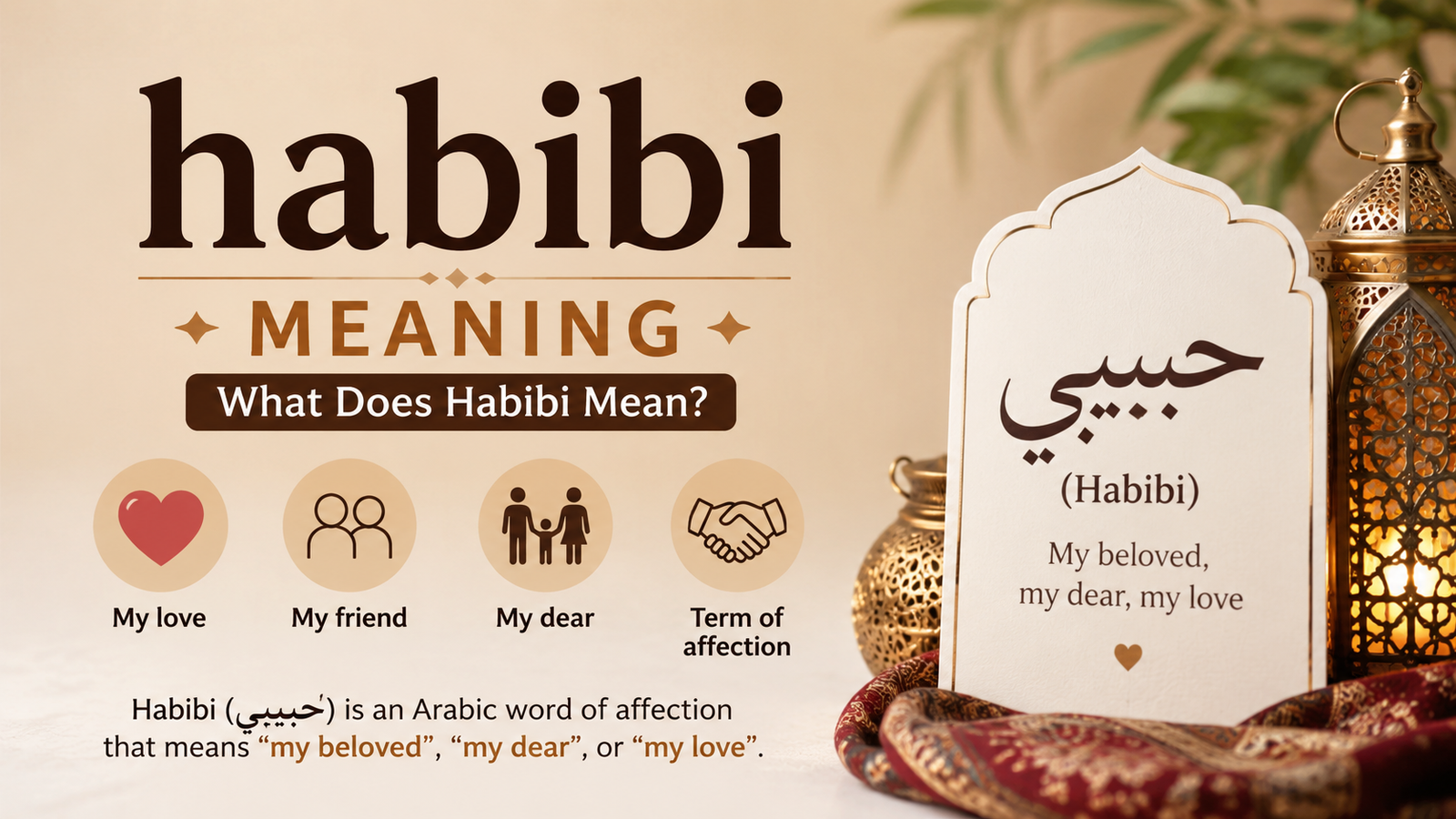
The simple answer is that habibi is an Arabic term of affection that literally means “my beloved,” “my dear,” or “my love.” However, its real meaning depends heavily on the relationship between the people speaking and the tone of the conversation. It can be romantic, friendly, familial, playful, or simply warm and familiar.
In Arabic, habibi (حبيبي) is generally the masculine form, while habibti (حبيبتي) is the feminine form. The word comes from the Arabic root associated with love and affection, making it much more emotionally expressive than a simple English word such as “friend.”
This guide explains the habibi meaning, pronunciation, Arabic origin, examples, synonyms, antonyms, texting usage, romantic meaning, and common mistakes in simple English.
What Does Habibi Mean?
Habibi means “my beloved,” “my love,” “my dear,” or “my darling” in Arabic.
It is written in Arabic as:
حبيبي
The word is normally used when addressing a male. Its feminine counterpart is habibti (حبيبتي), meaning “my beloved” or “my dear” when addressing a woman.
However, translating habibi into just one English word can be misleading. In an English-speaking context, “my beloved” sounds strongly romantic. In Arabic conversation, habibi can be much more flexible.
For example, a father may call his son habibi. Two male friends may use it casually with each other. A romantic partner may also say habibi to express love. In some situations, people use the word warmly with acquaintances or strangers.
So, habibi does not automatically mean “boyfriend,” “husband,” or romantic partner.
Habibi Meaning in Simple English
In simple English, you can understand habibi as:
- My love
- My dear
- My darling
- My beloved
- My dear friend
- Buddy or friend, in some casual contexts
The exact translation depends on the situation.
If a romantic partner says, “Habibi, I miss you,” it probably means “My love, I miss you.”
If a close friend says, “Habibi, where have you been?” it may simply mean “My friend, where have you been?”
If a parent says it to a child, it expresses love and affection, not romance.
That flexibility is one of the most important things to understand about the word.
How Do You Pronounce Habibi?
Habibi is commonly pronounced with three syllables, with the middle syllable receiving noticeable emphasis.
The Arabic pronunciation is represented in linguistic sources as /ħa.biː.biː/.
The ḥ sound at the beginning is a deeper Arabic “h” sound than the ordinary English “h.” For everyday English speakers, a normal “h” is often used as an approximation.
The two long ee sounds are also important. Avoid making the word sound like a short, rushed three-syllable English word.
When learning Arabic vocabulary, listening to native speakers is the best way to develop the correct pronunciation because Arabic dialects can produce small differences in sounds and rhythm.
What Is the Origin of Habibi?
The word habibi comes from Arabic and is connected to the Arabic root ح-ب-ب (ḥ-b-b), which is associated with love, affection, and being beloved.
The word habib (حبيب) means “beloved,” “dear,” or “sweetheart.” Adding the first-person possessive ending -i gives the sense of “my beloved” or “my dear.”
This explains why habibi feels so personal.
Rather than simply describing someone as lovable, the speaker is expressing a relationship with that person: my beloved, my dear one, or someone dear to me.
The feminine form comes from habiba (حبيبة), meaning a beloved woman, combined with the same possessive ending. This produces habibti (حبيبتي).
Habibi vs. Habibti
One of the most common questions about the word is the difference between habibi and habibti.
Habibi
Habibi (حبيبي) is traditionally the masculine form.
It is generally used when addressing a man or boy.
Examples include:
- A wife speaking to her husband
- A mother speaking to her son
- A man speaking warmly to his male friend
- Someone addressing a male acquaintance affectionately
Habibti
Habibti (حبيبتي) is the feminine form.
It is generally used when addressing a woman or girl.
Examples include:
- A husband speaking to his wife
- A mother speaking to her daughter
- A woman speaking warmly to her female friend
- Someone addressing a woman affectionately
Dictionary sources describe the distinction as masculine habibi and feminine habibti.
There can be dialect-specific exceptions and informal usage, so real-life Arabic speech does not always follow the simplified rules learners see in English-language explanations.
Is Habibi a Romantic Word?
Sometimes, but not always.
This is probably the biggest misunderstanding surrounding habibi.
In romantic relationships, habibi can mean:
“My love.”
A boyfriend might say:
“Good morning, habibi.”
A wife might say:
“I miss you, habibi.”
In these examples, the word carries romantic affection.
But romance is only one possible meaning.
Parents, siblings, friends, and other people can use affectionate language without any romantic intention. Arabic-speaking communities commonly use terms of endearment more broadly than English speakers might expect.
Therefore, hearing someone call another person habibi does not by itself prove that they are romantically involved.
You need to consider the relationship, tone, surrounding words, and cultural setting.
Habibi Meaning in Texting
The word habibi is extremely easy to use in text messages because it can make a message sound warmer and more personal.
For example:
“Where are you, habibi?”
Depending on the relationship, this could mean:
“Where are you, my love?”
or simply:
“Where are you, my friend?”
Another example is:
“Thank you, habibi!”
Here, it may simply be a warm way of saying:
“Thank you, dear!”
People may also use the word in social media comments, captions, private messages, memes, and online conversations.
The growing international popularity of Arabic music, entertainment, social media, and online culture has helped make habibi familiar to people who do not speak Arabic.
Habibi Meaning in Love
When used between romantic partners, habibi can express closeness, affection, and emotional attachment.
In this context, possible English translations include:
- My love
- My darling
- My beloved
- My sweetheart
- My dear
For example:
“I love you, habibi.”
This would naturally be understood as an affectionate romantic expression.
Another example:
“Goodnight, habibi.”
Between romantic partners, this can sound similar to “Goodnight, my love.”
However, context remains essential. The same word can be used outside romance.
Habibi Meaning Between Friends
Among friends, habibi can have a much more relaxed meaning.
Two close male friends might call each other habibi while joking, greeting each other, or discussing everyday life.
For example:
“Habibi, come here!”
could mean something like:
“Buddy, come here!”
or
“My friend, come here!”
This does not necessarily carry romantic meaning.
In some Arabic-speaking communities, affectionate terms are a normal part of friendly communication. Their use depends on familiarity, age, social relationship, and local customs.
Habibi Meaning in Family Conversations
Family members also use habibi naturally.
A mother might call her son habibi.
A father may use it when speaking affectionately to his child.
A sibling might use it in a warm or joking way.
For example:
“Come eat, habibi.”
In a family setting, this is likely to mean something like:
“Come eat, my dear.”
There is no romantic meaning in this situation.
This family usage is one reason it is inaccurate to translate habibi as “boyfriend” or “lover.”
Habibi Meaning When Talking to Strangers
In some Arabic-speaking environments, habibi can even be used with people who are not close friends or relatives.
For example, a person may use an affectionate term when speaking casually with a customer, shopkeeper, driver, or acquaintance.
The National has noted that terms such as habibi and habibti can occur in UAE social and professional settings, although familiarity and the relationship between speakers still matter.
This does not mean that everyone should automatically call every stranger habibi.
If you are learning Arabic, it is better to listen to how native speakers around you use the term before making it part of your everyday vocabulary.
Common Examples of Habibi
Here are some simple examples that show how the meaning changes with context.
Example 1: Romantic
“I miss you, habibi.”
Meaning: “I miss you, my love.”
Example 2: Friendship
“Habibi, let’s go!”
Meaning: “My friend, let’s go!”
Example 3: Family
“Are you okay, habibi?”
Meaning: “Are you okay, my dear?”
Example 4: Gratitude
“Thank you, habibi.”
Meaning: “Thank you, dear.”
Example 5: Casual greeting
“How are you, habibi?”
Meaning could be “How are you, my friend?” or “How are you, my dear?”
Example 6: Romantic message
“Good night, habibi. Sleep well.”
Meaning: “Good night, my love. Sleep well.”
The surrounding conversation tells you which interpretation makes the most sense.
Habibi Synonyms
There is no perfect English synonym because habibi combines affection, familiarity, and personal connection.
Depending on context, possible English equivalents include:
- My love
- My dear
- My darling
- My beloved
- Sweetheart
- Dear
- Honey
- My friend
- Buddy
- Mate
The closest choice depends on who is speaking and why.
For a romantic relationship, “my love” or “my darling” may work best.
For a friendship, “my friend” or “buddy” may be more natural.
For a family relationship, “my dear” or “darling” may better capture the emotional meaning.
Habibi Antonyms
There is no single direct antonym of habibi.
Because the word expresses affection or closeness, its opposite would depend on the context.
Possible contrasting ideas include:
- Enemy
- Stranger
- Unloved person
- Opponent
- Someone disliked
But these are not exact dictionary opposites.
For example, if habibi is being used to mean “my dear,” an opposite idea might be someone who is disliked or emotionally distant.
If it is being used casually to mean “friend,” an opposite might be “enemy.”
So it is more accurate to say that habibi has no single fixed antonym in English.
Common Mistakes When Using Habibi
Mistake 1: Assuming it is always romantic
This is the most common mistake.
Habibi can be romantic, but it can also be friendly or familial.
Mistake 2: Using habibi and habibti interchangeably
Traditionally, habibi is masculine, while habibti is feminine.
Mistake 3: Translating it only as “lover”
“Lover” is too narrow.
The word can describe affection without romantic involvement.
Mistake 4: Using it without considering culture
Although the word is widely understood, the way people use terms of endearment differs between communities.
A phrase that sounds natural among close friends may sound inappropriate in a formal workplace.
Mistake 5: Thinking every use has exactly the same emotional intensity
Tone matters.
A playful “habibi” between friends can feel very different from a quiet “habibi” between romantic partners.
Why Is Habibi So Popular?
Part of the word’s popularity comes from its emotional flexibility.
It is short, memorable, expressive, and easy for non-Arabic speakers to recognize. It also appears frequently in Arabic music, films, television, social media, and international pop culture.
But its popularity should not hide its linguistic meaning.
At its heart, habibi is a word connected to love and affection. The literal construction means “my beloved,” while everyday usage allows the word to move naturally between romance, family, friendship, and casual warmth.
Frequently Asked Questions About Habibi
What does habibi mean in English?
Habibi means “my beloved,” “my love,” “my dear,” or “my darling.” It is an Arabic term of affection and is traditionally used when addressing a male.
Is habibi Arabic?
Yes. Habibi is an Arabic word written حبيبي. It comes from habib, meaning beloved or dear, combined with the possessive ending meaning “my.”
Is habibi only used for lovers?
No. Habibi is not exclusively romantic. Friends and family members can use it affectionately, and in some communities it can also be used casually with acquaintances or strangers.
What is the female version of habibi?
The feminine form is habibti (حبيبتي). It generally means “my beloved,” “my love,” or “my dear” when addressing a woman or girl.
Can friends call each other habibi?
Yes. Friends can call each other habibi, especially in informal and affectionate conversations. The exact feeling depends on the speakers and the surrounding context.
Does habibi mean “I love you”?
Not exactly. Habibi means something closer to “my love,” “my beloved,” or “my dear.” It expresses affection, but it is not the same grammatical construction as saying “I love you.”
What does habibi mean in texting?
In texting, habibi can mean “my love,” “my dear,” “darling,” or “my friend.” The intended meaning depends on the relationship and tone of the conversation.
Is habibi a slang word?
Habibi is better described as a common Arabic term of endearment rather than simply slang. It is used in everyday speech across Arabic-speaking communities and also appears in formal and cultural contexts with appropriate variation.
Can a woman say habibi?
Yes. A woman can use habibi when addressing a male. If she is addressing a woman, the traditional form is habibti.
Why do people say habibi so often?
The word is versatile and can communicate warmth, affection, friendliness, or closeness without necessarily being romantic. Its flexibility makes it useful in many everyday situations.
Final Thoughts on Habibi Meaning
The simplest definition of habibi is “my beloved,” “my love,” or “my dear.” But the word has more depth than any single English translation can capture.
It comes from the Arabic language and is built around a root connected with love and affection. The masculine form is habibi, while the feminine form is habibti.
Most importantly, habibi does not automatically mean romance. A romantic partner can use it, but so can parents, children, siblings, friends, and—depending on the social setting—acquaintances.
If you encounter the word in a message, song, movie, or conversation, look at the context, relationship, and tone before deciding exactly what it means.
That is what makes habibi such an interesting Arabic expression: one short word can communicate love, friendship, familiarity, kindness, or simple warmth depending on who says it and how it is said.