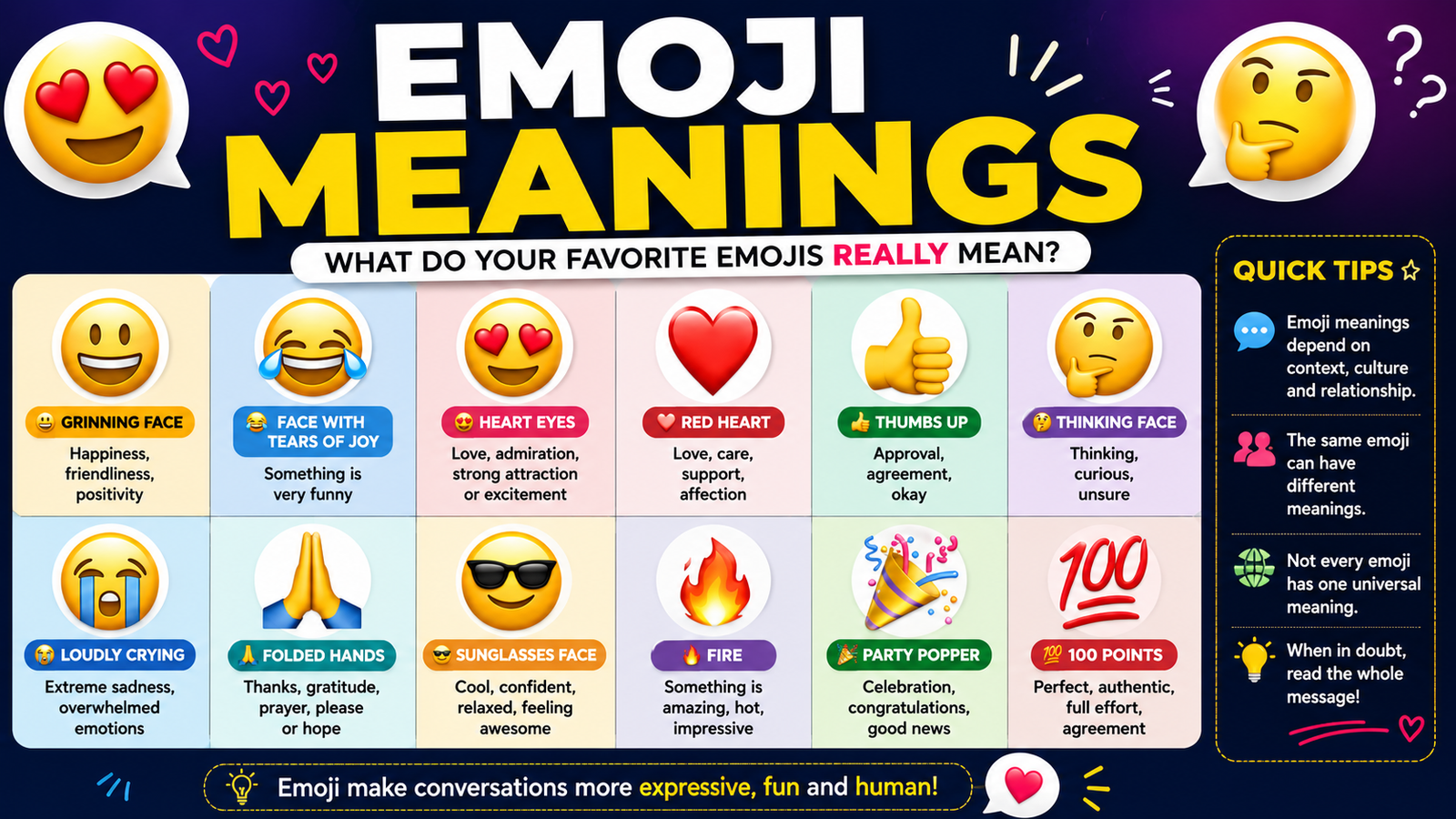
Emoji have become one of the easiest ways to add emotion, humor, personality, and context to digital conversations. A simple ❤️ can make a message feel warmer, while 😂 can show that something is genuinely funny. But emoji meanings are not always as obvious as they look.
The same emoji can have a different meaning depending on the conversation, relationship, age group, culture. Unicode, the organization responsible for standardizing emoji characters, specifically notes that emoji do not have one universal meaning. Their interpretation can change according to language, culture, and context.
This guide explains emoji meanings in simple English, including their pronunciation, origin, common uses, examples, synonyms, antonyms, and frequently asked questions.
What Does “Emoji” Mean?
An emoji is a small pictorial symbol used in digital communication to represent an emotion, object, person, activity, idea, or reaction.
For example:
- 😀 means happiness or friendliness.
- ❤️ commonly expresses love or affection.
- 👍 can mean approval or agreement.
- 😂 usually indicates strong laughter.
- 😢 can express sadness.
- 🎉 represents celebration.
Unicode describes emoji as picture characters that can represent faces, weather, vehicles, buildings, food, animals, plants, emotions, activities, and much more.
Unicode describes emoji as picture characters that can represent faces, weather, vehicles, buildings, food, animals, plants, emotions, activities, and much more.
Emoji Pronunciation
The word emoji is pronounced approximately as ih-MOH-jee in English.
The word comes from Japanese 絵文字, combining e, meaning “picture,” and moji, meaning “character.” Despite the similarity in spelling, the word is not derived from the English word “emotion.”
What Is the Origin of Emojis?
Emoji originated in Japan and became associated with mobile-phone communication before spreading around the world.
Early Japanese mobile-phone systems included pictorial symbols that allowed users to communicate ideas quickly. Some of these symbols were later incorporated into Unicode so that digital devices could represent them consistently.
Today, emoji are part of everyday communication across messaging apps, social media, websites, email, and other digital platforms.
Unicode explains that emoji were originally connected to Japanese mobile-phone use but are now widely used worldwide.
The modern emoji system is standardized through Unicode. This helps different computers and phones recognize the same underlying character, although the visual design can vary between Apple, Google, Microsoft, Samsung, and other platforms.
Why Are Emoji So Popular?
Emoji help people communicate feelings that can be difficult to express through plain text.
Consider the message:
“Okay.”
It could sound neutral, annoyed, cold, or dismissive depending on the situation.
Now compare:
“Okay 😊”
The smile can make the message feel friendlier.
Emoji can also provide tone. They may show whether someone is joking, celebrating, expressing affection, reacting with surprise, or trying to soften a statement.
Unicode notes that emoji can add gestures, facial expressions, tone of voice, playfulness, and intentional ambiguity to written communication.
Common Emoji Meanings
Below are some of the most commonly recognized emoji and their everyday meanings.
😀 Grinning Face
Meaning: Happiness, friendliness, excitement, or general positivity.
Example:
“Great news! 😀”
It can be used when someone wants to make a message appear cheerful.
😃 Grinning Face With Big Eyes
Meaning: Happiness, enthusiasm, or excitement.
Example:
“I finally finished my project! 😃”
This emoji is often slightly more energetic than a simple smile.
😂 Face With Tears of Joy
Meaning: Something is extremely funny.
Example:
“That video was hilarious 😂”
It is one of the most recognizable laughter-related emoji.
🤣 Rolling on the Floor Laughing
Meaning: Extreme laughter.
Example:
“You actually said that? 🤣”
It usually suggests that something is even funnier or more ridiculous than a normal laughing reaction.
😊 Smiling Face With Smiling Eyes
Meaning: Warmth, happiness, kindness, appreciation, or gentle affection.
Example:
“Thank you for helping me 😊”
Depending on the conversation, it can also communicate a soft or slightly shy emotional tone.
😍 Smiling Face With Heart-Eyes
Meaning: Love, admiration, attraction, or strong enthusiasm.
Example:
“This dress is beautiful 😍”
It does not always mean romantic love. Someone can use it to show excitement about food, fashion, travel, celebrities, or something they really enjoy.
🥰 Smiling Face With Hearts
Meaning: Affection, love, warmth, gratitude, or feeling emotionally touched.
Example:
“You’re so sweet 🥰”
It is commonly used in affectionate conversations.
😘 Face Blowing a Kiss
Meaning: Affection, love, flirting, or sending a playful kiss.
Example:
“Goodnight 😘”
Its meaning depends heavily on the relationship between the people communicating.
❤️ Red Heart
Meaning: Love, affection, care, support, or strong appreciation.
Example:
“Thank you so much ❤️”
A red heart can be romantic, but it is also widely used between friends and family members.
💔 Broken Heart
Meaning: Heartbreak, emotional pain, disappointment, or sadness.
Example:
“I can’t believe they canceled the concert 💔”
It can refer to serious emotional disappointment or something much lighter.
👍 Thumbs Up
Meaning: Approval, agreement, confirmation, or “okay.”
Example:
“Meet me at 7?”
“👍”
However, the tone can change depending on the conversation. In some situations, a standalone thumbs-up can feel short or dismissive.
👎 Thumbs Down
Meaning: Disapproval, disagreement, rejection, or dislike.
Example:
“I didn’t enjoy that movie. 👎”
🙏 Folded Hands
Meaning: Prayer, thanks, gratitude, hope, pleading, or appreciation.
Example:
“Thank you for your help 🙏”
The exact interpretation depends on context. Some people use it as a prayer symbol, while others use it simply to express thanks.
😭 Loudly Crying Face
Meaning: Intense sadness, emotional overwhelm, or sometimes extreme laughter.
Example:
“I can’t believe this happened 😭”
On social media, it is sometimes used humorously to show that something is overwhelmingly funny or adorable.
😢 Crying Face
Meaning: Sadness, disappointment, hurt, or emotional pain.
Example:
“I miss my friends 😢”
😎 Smiling Face With Sunglasses
Meaning: Confidence, coolness, relaxation, or playful self-assurance.
Example:
“Vacation starts tomorrow 😎”
It can also be used humorously when someone feels proud of themselves.
🤔 Thinking Face
Meaning: Thinking, uncertainty, doubt, curiosity, or questioning.
Example:
“Are you sure about that? 🤔”
😮 Face With Open Mouth
Meaning: Surprise, shock, amazement, or disbelief.
Example:
“You won the competition? 😮”
😡 Angry Face
Meaning: Anger, frustration, irritation, or strong displeasure.
Example:
“I’ve been waiting for two hours 😡”
😱 Face Screaming in Fear
Meaning: Shock, fear, horror, or extreme surprise.
Example:
“I just saw the final score 😱”
🙄 Face With Rolling Eyes
Meaning: Annoyance, disbelief, sarcasm, boredom, or frustration.
Example:
“He forgot his keys again 🙄”
🤗 Smiling Face With Open Hands
Meaning: Warmth, friendliness, welcome, affection, or an emotional hug.
Example:
“Welcome home! 🤗”
🔥 Fire
Meaning: Something is excellent, exciting, attractive, impressive, or trending.
Example:
“Your new song is 🔥”
The literal meaning is fire, but online it often means “amazing” or “very impressive.”
✨ Sparkles
Meaning: Beauty, excitement, magic, emphasis, cleanliness, or something special.
Example:
“New year, new goals ✨”
🎉 Party Popper
Meaning: Celebration, congratulations, parties, achievements, or good news.
Example:
“Congratulations on your graduation! 🎉”
💯 Hundred Points
Meaning: Complete agreement, perfection, confidence, authenticity, or giving maximum effort.
Example:
“That advice is 💯”
💀 Skull
The skull emoji has developed a particularly interesting internet meaning.
Literal meaning: Death or a skull.
Modern slang meaning: “I am laughing so hard I am dead.”
Example:
“That joke took me out 💀”
This is an excellent example of why emoji meanings cannot always be understood from their literal appearance.
Emoji Meanings in Texting
Emoji are especially common in texting because they make short messages easier to interpret emotionally.
For example:
“Fine.”
This can sound cold.
“Fine 😊”
The emoji can make it seem more friendly.
Similarly:
“You did it!”
sounds enthusiastic, while:
“You did it! 🎉❤️”
adds celebration and affection.
People also combine emoji to create meanings that are not represented by one symbol.
For example:
- ❤️✨ = love, beauty, or something special
- 😂💀 = extremely funny
- 🎂🎉 = birthday celebration
- 🔥👏 = impressive performance
- 😭❤️ = emotionally touched or overwhelmed with affection
Do Emoji Have Synonyms?
Emoji do not have synonyms in exactly the same way ordinary words do, but many emoji can communicate similar ideas.
For example, emoji associated with happiness may include:
- 😀
- 😃
- 😄
- 😊
- 😁
Emoji associated with love or affection may include:
- ❤️
- 🥰
- 😍
- 💕
- 💖
The exact feeling can differ between them.
For instance, ❤️ can communicate straightforward love or care, while 😍 often suggests admiration or strong excitement.
Do Emoji Have Antonyms?
Emoji do not technically have antonyms because they are pictorial symbols rather than ordinary vocabulary words.
However, some emoji can communicate contrasting ideas.
For example:
- ❤️ and 💔 can represent love and heartbreak.
- 👍 and 👎 can represent approval and disapproval.
- 😀 and 😢 can represent happiness and sadness.
- 🔥 and 🧊 can suggest heat and cold.
- ☀️ and 🌙 can represent day and night.
These are better described as contrasting emoji meanings rather than true antonyms.
Emoji Meaning Depends on Context
One of the most important things to remember is that there is no universal dictionary meaning for every emoji.
Unicode explicitly states that emoji are encoded primarily according to their general appearance, not a single fixed intended meaning. Meanings can change according to culture, language, and context.
For example, 🙏 may mean prayer to one person and thank you to another.
Likewise, 💀 can represent a literal skull in one conversation and laughter in another.
Even the 👍 emoji can be interpreted differently depending on the relationship between the people communicating.
That is why you should always read the surrounding message before deciding what an emoji means.
Emoji vs. Emoticons: What Is the Difference?
Emoji and emoticons are related but different.
An emoji is generally a pictographic character or sequence, such as 😀 or ❤️.
An emoticon is created from ordinary text characters to represent an expression. A classic example is:
🙂
Unicode explains that emoticons originated from character combinations such as punctuation marks, while emoji developed as pictorial symbols used in digital communication.
Today, many people use both terms casually, but technically they describe different things.
Are Emoji a Language?
Emoji are sometimes called a “universal language,” but technically they are not a complete language.
Unicode explains that emoji do not have the grammar and vocabulary required to constitute a human language. Instead, they work alongside written language to add emotion, gestures, tone, and context.
Someone can send:
“See you tomorrow 😊”
The words carry the basic message, while the emoji adds a friendly emotional layer.
Why Does the Same Emoji Look Different on Different Phones?
The same Unicode emoji can look slightly different on different platforms.
Apple, Google, Microsoft, Samsung, and other companies design their own visual versions of emoji. Unicode standardizes the underlying characters, but it does not control the artwork used by individual vendors.
This means an emoji can look slightly different on an iPhone compared with an Android phone while still representing the same Unicode character.
Emoji in 2026
Emoji continue to evolve as digital communication changes.
Unicode maintains the technical standards and data that define emoji characters and sequences. The Unicode Emoji standard is regularly updated, and new emoji proposals are evaluated according to established criteria.
Unicode’s 2026 materials also show that emoji selection considers factors such as potential meanings, symbolism, and real-world usage.
New emoji do not simply appear because someone requests them. Proposals go through a formal review process, and only a small percentage advance toward encoding.
This continuing development reflects how quickly digital communication changes.
How to Use Emoji Correctly
There is no single rulebook for everyday emoji use, but a few practical guidelines can help.
Match the Emoji to the Message
Use an emoji that supports your intended tone.
For example:
“Congratulations! 🎉”
is immediately understandable.
Consider Your Relationship
A heart or kissing emoji may have a different meaning when sent to a partner than when sent to a close friend.
Don’t Overuse Emoji
A message filled with dozens of unrelated emoji can become difficult to understand.
A few well-chosen symbols are often more effective.
Think About Cultural Differences
An emoji that seems harmless in one culture may carry another association somewhere else.
Unicode specifically warns that emoji meanings are not universally understood and can vary by culture and audience.
Frequently Asked Questions About Emoji Meanings
What is the meaning of emoji?
Emoji are pictorial symbols used to communicate emotions, objects, activities, ideas, reactions, and other concepts in digital communication.
What does the word emoji mean?
The word emoji comes from Japanese. E means picture and moji means character.
How do you pronounce emoji?
In English, emoji is commonly pronounced approximately ih-MOH-jee, with the main stress on the middle syllable.
What is the most popular emoji?
Popularity changes over time and depends on the dataset, platform, and region. Unicode directs readers to its emoji-frequency resources and other statistical resources for current usage information.
Can one emoji have multiple meanings?
Yes. This is extremely common. The meaning of an emoji can change according to context, culture, language, and internet slang.
Is emoji a language?
No. Emoji can communicate ideas and emotions, but Unicode explains that they do not have the grammar and vocabulary required to form a complete human language.
Why does the same emoji look different on different devices?
Different technology companies create their own emoji artwork. Unicode standardizes the characters but does not control the visual design used by each platform.
What is the difference between emoji and emoticons?
Emoji are pictorial symbols such as 😀 and ❤️, while emoticons are expressions created from text characters, such as :-).
Can emoji meanings change over time?
Yes. Internet communities can develop new meanings for existing emoji. Unicode itself notes that emoji can be repurposed and that meanings may change over time.
Conclusion
Emoji meanings are much more interesting than simple pictures on a keyboard. They can express happiness, sadness, love, humor, sarcasm, approval, excitement, disappointment, and countless other emotions.
The most important lesson is that an emoji rarely has just one fixed meaning. Context matters. A 💀 may represent a skull literally or mean that someone is laughing uncontrollably. A 🙏 may express prayer, gratitude, or a request. A ❤️ can communicate romantic love, friendship, family affection, or general appreciation.
Emoji began with Japanese mobile communication and have grown into a major part of modern digital conversation. Unicode now provides the technical framework that allows emoji to work across platforms, while individual communities continue to give familiar symbols new meanings.
So, when you are trying to understand an emoji, don’t look only at the picture. Look at the message, relationship, culture, and situation surrounding it. That context is often the real key to understanding what the emoji means.