Have you ever met someone whose thoughts, personality, or actions were difficult to understand? Or encountered a question that seemed to have no obvious answer? In situations like these, the word enigma is often the perfect description.
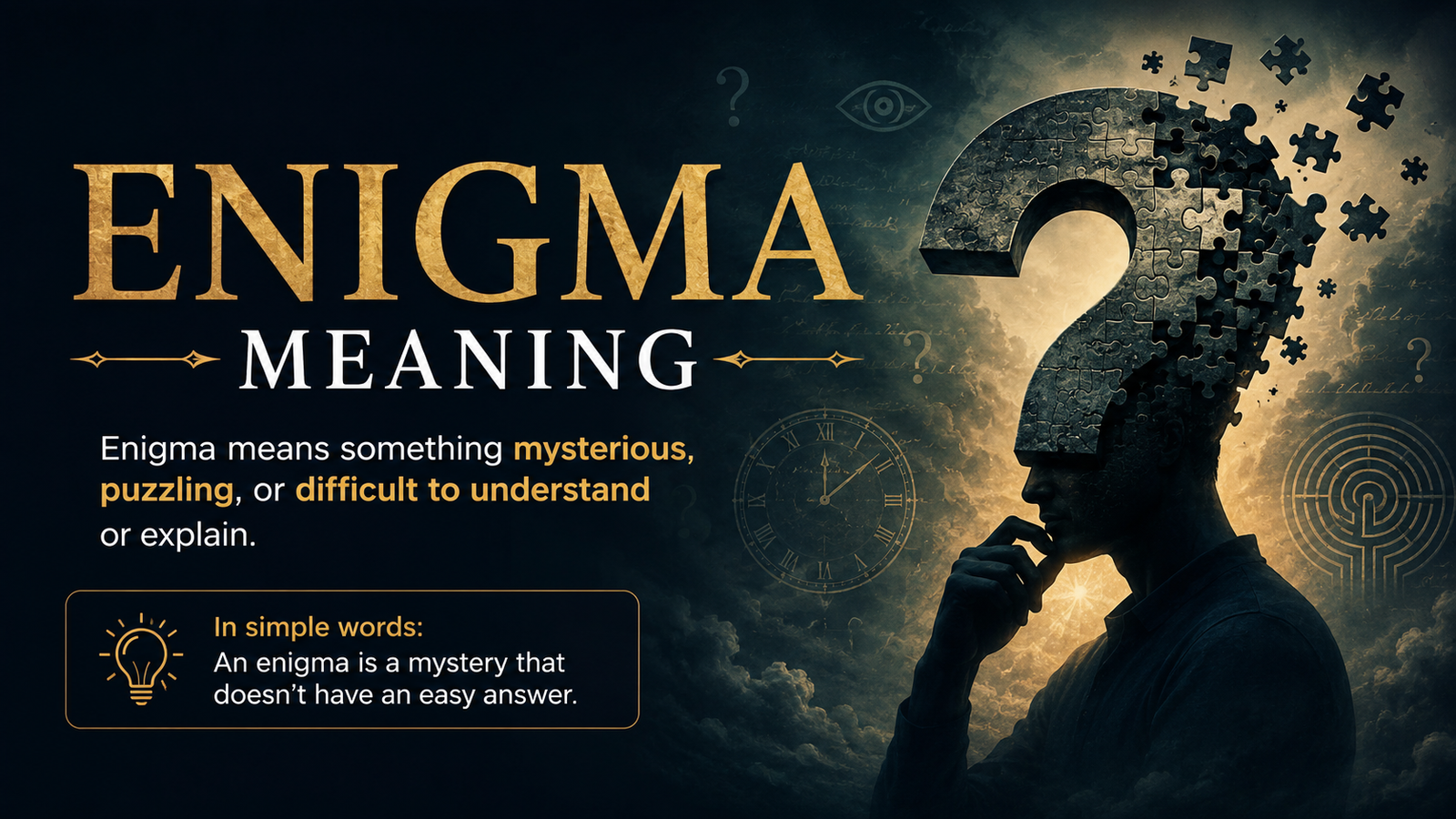
The word enigma means a person, thing, or situation that is mysterious, puzzling, or difficult to understand completely. It can describe anything from a mysterious person to an unexplained event, a confusing problem, or a hidden meaning.
For example, if someone says, “He is an enigma,” they mean that the person is difficult to figure out. Similarly, “The disappearance remains an enigma” means that the disappearance is still unexplained.
Cambridge Dictionary defines an enigma as something mysterious that seems impossible to understand completely. Oxford also uses the word for a person, thing, or situation that is mysterious and difficult to understand.
In this guide, we will explore the enigma meaning, pronunciation, origin, synonyms, antonyms, common uses, examples, and frequently asked questions in simple English.
Enigma Meaning in Simple English
In simple English, enigma means a mystery that is difficult to solve or understand.
It can refer to:
- A mysterious person
- A difficult question
- An unexplained event
- A confusing situation
- Something with a hidden meaning
- A person whose behavior is hard to understand
For example:
“Sarah is an enigma.”
This means Sarah is mysterious, and other people find it difficult to understand her personality, thoughts, or behavior.
Another example is:
“The ancient structure remains an enigma.”
Here, enigma means that people still do not fully understand how, why, or when the structure was created.
The important idea behind the word is mystery and difficulty in understanding.
What Is the Definition of Enigma?
An enigma is a noun used for something or someone that is mysterious, puzzling, or difficult to explain.
Oxford defines it as a person, thing, or situation that is mysterious and difficult to understand.
Cambridge similarly explains that an enigma is something mysterious that seems impossible to understand completely.
The word can therefore describe both people and things.
Enigma as a Person
When you call someone an enigma, you are saying that you cannot easily understand that person.
For example:
“Despite knowing him for years, he remains an enigma to me.”
This suggests that the person’s personality, motives, or feelings remain unclear.
Enigma as a Thing
An enigma can also be an object, event, question, or problem.
For example:
“The origin of the strange signal remains an enigma.”
The signal is an enigma because researchers have not discovered a clear explanation.
How Do You Pronounce Enigma?
The word enigma has three syllables.
The standard British pronunciation is /ɪˈnɪɡ.mə/, while American dictionaries commonly give /əˈnɪɡ.mə/.
The main stress falls on the middle syllable.
The pronunciation may feel unfamiliar at first, but it becomes easier when you hear it and use it in a sentence.
Enigma Pronunciation in Everyday Speech
You might hear the word in sentences such as:
“Her personality is an enigma.”
“The case remains an enigma.”
“Scientists are trying to solve this enigma.”
The adjective related to enigma is enigmatic, which means mysterious or difficult to understand. Merriam-Webster describes “enigmatic” as something that is mysterious or resembles an enigma.
Origin and History of the Word Enigma
The history of enigma goes back to ancient Greek.
The English word came through Latin aenigma, meaning “riddle,” from the Greek ainigma. The Greek word is connected with ainissesthai, meaning to speak obscurely or in riddles.
This origin explains why the modern word still has a strong connection with mystery and hidden meaning.
In English, enigma appeared around the 16th century. Etymonline records its use in the 1530s for a statement that concealed a hidden meaning through obscure words or forms. The broader sense of something inexplicable developed around the beginning of the 17th century.
Over time, the word moved beyond literal riddles. Today, an enigma can be almost anything that people cannot fully explain.
Enigma vs. Mystery: What Is the Difference?
Enigma and mystery are very similar, but they are not always interchangeable in tone.
A mystery is something unknown or unexplained.
An enigma usually suggests something that is particularly puzzling, difficult to interpret, or resistant to explanation.
Consider these examples:
“The police are investigating a mystery.”
This simply means there is something unknown that needs to be discovered.
“The suspect’s behavior is an enigma.”
This suggests that the behavior is unusually difficult to understand or interpret.
Merriam-Webster notes that enigma can apply particularly to behavior or an utterance that is very difficult to interpret.
So, while every enigma can be described as a mystery, the word enigma often gives the idea a more puzzling or intellectually challenging quality.
Examples of Enigma in Sentences
Understanding the word becomes much easier when you see it in context.
Example 1: A Mysterious Person
“My new neighbor is an enigma.”
Meaning: The neighbor is difficult to understand or figure out.
Example 2: An Unexplained Event
“The sudden disappearance remains an enigma.”
Meaning: Nobody has found a satisfactory explanation for the disappearance.
Example 3: A Difficult Problem
“The scientists faced an enigma that took years to solve.”
Meaning: They encountered a difficult mystery or problem.
Example 4: A Person’s Personality
“Her quiet personality makes her something of an enigma.”
Meaning: Her personality is difficult for others to understand.
Example 5: History
“The purpose of the ancient monument remains an enigma.”
Meaning: Historians still do not know exactly why the monument was created.
Example 6: Science
“The unusual behavior of the particles remains an enigma.”
Meaning: Scientists have not completely explained the behavior.
Example 7: Art
“The painting’s meaning has remained an enigma for generations.”
Meaning: People have never reached a complete agreement about what the painting means.
Example 8: Everyday Conversation
“Why he suddenly left is an enigma.”
Meaning: Nobody understands why he left.
Common Uses of Enigma
The word enigma is common in formal, literary, academic, journalistic, and everyday English.
Here are some common patterns.
“An enigma”
This is the most basic form.
“The case is an enigma.”
“An enigma to someone”
This means something is difficult for a particular person to understand.
“He is an enigma to his friends.”
“Remain an enigma”
This phrase is often used when something stays unexplained over time.
“The origin of the artifact remains an enigma.”
“Solve the enigma”
This means to discover the answer to something mysterious.
“Researchers hope to solve the enigma.”
“The enigma of…”
This construction is common in writing.
“The enigma of human consciousness has fascinated scientists and philosophers for centuries.”
Enigma Synonyms
There are several words that can have a similar meaning to enigma. The best choice depends on the context.
Mystery
Mystery is probably the closest everyday synonym.
Example:
“The disappearance is a mystery.”
Riddle
A riddle is usually a question or statement designed to be solved.
Example:
“The old poem contains a difficult riddle.”
Puzzle
A puzzle can be a problem that requires thought or ingenuity.
Example:
“The strange evidence was a puzzle for investigators.”
Conundrum
A conundrum is a difficult problem or question, especially one that seems complicated or confusing.
Example:
“Choosing between the two options was a conundrum.”
Mystery or Puzzlement
Depending on the context, words such as mystery, puzzle, riddle, and conundrum can communicate some of the same ideas.
Cambridge lists mystery and riddle among related synonyms for enigma.
Enigma Antonyms
An antonym is a word with an opposite or contrasting meaning.
Because enigma refers to something mysterious or difficult to understand, possible opposites include:
- Explanation
- Answer
- Clarity
- Certainty
- Understanding
- Solution
- Obviousness
- Transparency
For example:
Enigma: “The cause of the problem is an enigma.”
Opposite idea: “The cause of the problem is clear.”
There is not always one perfect direct antonym for enigma, because the opposite depends on the sentence.
Enigma vs. Enigmatic
These two words are closely related but have different grammatical roles.
Enigma is a noun.
Example:
“The man’s identity is an enigma.”
Enigmatic is an adjective.
Example:
“The man has an enigmatic personality.”
In simple terms:
Enigma = the mystery
Enigmatic = mysterious
Merriam-Webster identifies enigmatic as an adjective meaning mysterious or resembling an enigma.
Is Enigma a Positive or Negative Word?
The word enigma is generally neutral.
It does not automatically mean something is good or bad.
Calling someone an enigma could be positive if you mean that they are fascinating, intriguing, or complex.
For example:
“The artist remains an enigma, which makes her work even more fascinating.”
Here, the word has a positive or admiring tone.
But it can also have a negative or frustrating meaning.
“His constant changes of mind are an enigma to everyone.”
In this case, people are struggling to understand his behavior.
Therefore, the meaning depends heavily on context.
How to Use Enigma in Everyday English
Although enigma is a relatively formal word, it can still be used in everyday conversation.
Instead of saying:
“I don’t understand him.”
You could say:
“He’s an enigma to me.”
Instead of:
“Nobody knows why this happened.”
You could say:
“Why it happened remains an enigma.”
However, in very casual conversations, words such as mystery, puzzle, or confusing may sound more natural.
Enigma works particularly well when you want your language to sound thoughtful, descriptive, or literary.
Why Do Writers Use the Word Enigma?
Writers often choose enigma because it communicates more than simple confusion.
If a character is called an enigma, the reader understands that there is something hidden about that character.
The word can create curiosity.
For example:
“Nobody knew where she came from. Her past remained an enigma.”
This immediately makes the reader wonder about her history.
The word is also useful in journalism, history, science, and literature because many subjects involve unanswered questions.
Common Mistakes When Using Enigma
One common mistake is treating enigma as a verb.
In standard modern English, enigma is primarily a noun.
You should say:
“The problem is an enigma.”
Not:
“They enigma the problem.”
Another mistake is using enigma when you simply mean “difficult.”
An enigma is not merely something hard. It specifically carries the idea of mystery, puzzlement, or difficulty in understanding.
For example:
“This math homework is difficult.”
is not necessarily the same as:
“This mathematical problem is an enigma.”
The second sentence suggests that the problem is mysterious or particularly difficult to explain.
Enigma Meaning in Literature and Culture
The idea of an enigma has played an important role in literature and culture because people naturally enjoy unanswered questions.
Mystery novels often revolve around enigmas. A missing person, unexplained crime, secret identity, or mysterious message can all become an enigma that drives the story.
The word can also describe famous people whose personalities or private lives are difficult for the public to understand.
Similarly, works of art can become enigmas when their meaning remains open to interpretation.
In this sense, an enigma is not always something that must eventually be solved. Sometimes the uncertainty is what makes it interesting.
Quick Meaning of Enigma
| Word | Enigma |
|---|---|
| Part of speech | Noun |
| Simple meaning | A mystery or something difficult to understand |
| Pronunciation | /ɪˈnɪɡ.mə/ (UK); /əˈnɪɡ.mə/ (US) |
| Plural | Enigmas |
| Related adjective | Enigmatic |
| Main synonyms | Mystery, riddle, puzzle, conundrum |
| Common antonym ideas | Answer, explanation, clarity, certainty |
| Origin | Greek, through Latin |
| Modern use | A mysterious person, thing, event, or problem |
The pronunciation and core dictionary definitions are supported by Cambridge and Oxford.
Frequently Asked Questions About Enigma Meaning
What does enigma mean in simple words?
Enigma means a mystery or something that is very difficult to understand or explain. It can describe a person, event, question, object, or situation.
Is enigma a synonym for mystery?
Yes. Mystery is one of the closest synonyms for enigma. However, enigma can suggest something especially puzzling or difficult to interpret.
What is an example of an enigma?
An example is an unexplained historical event. You could say, “The purpose of the ancient structure remains an enigma.”
What is the opposite of enigma?
There is no single perfect antonym in every situation, but answer, explanation, clarity, certainty, and understanding can express the opposite idea.
What is the adjective form of enigma?
The adjective is enigmatic. It means mysterious or difficult to understand.
Is enigma a noun or adjective?
Enigma is a noun. For example, “The case is an enigma.” The related adjective is “enigmatic.”
Where does the word enigma come from?
The word comes through Latin aenigma from Greek ainigma, meaning a riddle. Its history is connected to a Greek verb meaning to speak obscurely or in riddles.
Can enigma describe a person?
Yes. Calling someone an enigma means that the person’s personality, motives, thoughts, or behavior are difficult to understand.
Is enigma a positive word?
It can be positive, negative, or neutral depending on context. A mysterious person may be described as an enigma in an admiring way, while an unexplained problem may be called an enigma with frustration.
What is the difference between enigma and enigmatic?
Enigma is a noun meaning a mystery. Enigmatic is an adjective meaning mysterious.
Conclusion: Enigma Meaning Explained
The word enigma describes something or someone that is mysterious, puzzling, and difficult to understand completely. It can refer to an unexplained event, a complicated question, a hidden meaning, or a person whose personality remains difficult to figure out.
Its roots go back to the Greek idea of speaking in riddles, which explains its strong connection with mystery and hidden meanings.
The easiest way to remember the meaning is:
Enigma = a mystery that is difficult to understand or explain.
If you understand that basic idea, you can use the word naturally in many situations—from everyday conversations to literature, journalism, history, and science.
For example, when something has no clear explanation, you can simply say:
“It remains an enigma.”
That short sentence captures the central meaning of the word: there is a mystery, and the answer is still out of reach.