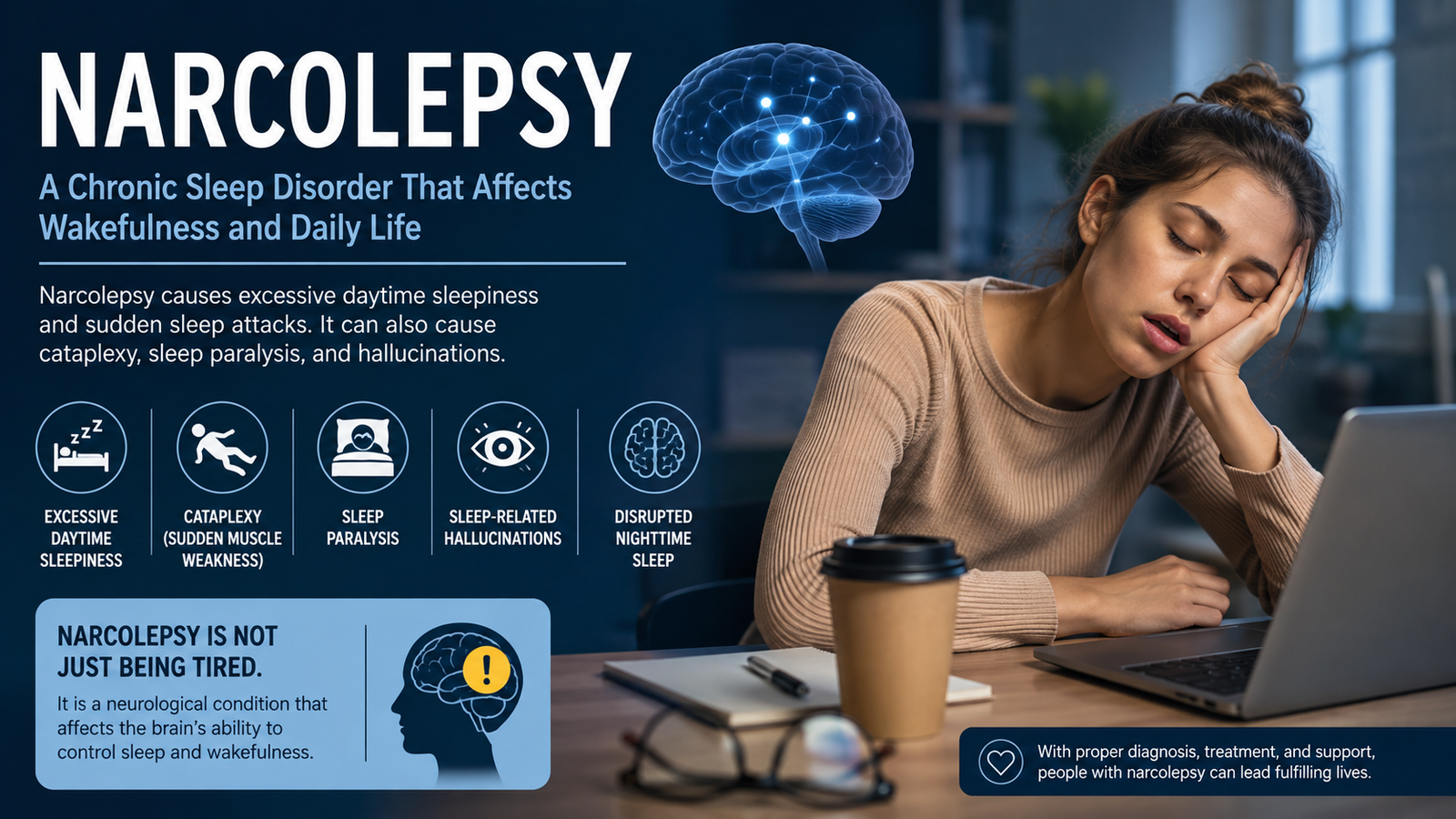
Narcolepsy is a chronic neurological sleep disorder that affects the brain’s ability to control the normal sleep-wake cycle. In simple terms, a person with narcolepsy may feel extremely sleepy during the day and can sometimes fall asleep suddenly, even when they are trying to stay awake.
Narcolepsy is more than simply being tired or not getting enough sleep. Some people experience sudden muscle weakness called cataplexy, sleep paralysis, or vivid hallucinations while falling asleep or waking up. The condition can affect school, work, driving, relationships, and everyday activities.
This guide explains the narcolepsy meaning, pronunciation, origin, symptoms, causes, types, examples, synonyms, antonyms, diagnosis, treatment, and common usage in simple English.
What Does Narcolepsy Mean?
Narcolepsy means a long-term sleep disorder that causes excessive daytime sleepiness and an abnormal tendency to fall asleep during the day.
Someone with narcolepsy may feel an overwhelming need to sleep even after getting what seems like enough nighttime sleep. In some cases, a person may experience sudden “sleep attacks,” in which they fall asleep for a short period without intending to.
These episodes can happen while reading, watching television, eating, talking, studying, or doing other ordinary activities. They can last from seconds to several minutes.
Narcolepsy can also disturb nighttime sleep. So, a person can be very sleepy during the day while still having difficulty getting continuous, restful sleep at night.
Narcolepsy in Simple English
In very simple English:
Narcolepsy is a condition that makes it difficult for the brain to control when a person is awake and when they are asleep.
It is not the same as ordinary tiredness. A person with narcolepsy may have an uncontrollable urge to sleep during the daytime.
How Do You Pronounce Narcolepsy?
The word narcolepsy is pronounced with the main stress toward the first part of the word.
The word has four syllables and is commonly heard in medical and everyday discussions about sleep disorders.
Origin of the Word Narcolepsy
The word narcolepsy comes from Greek roots. It is associated with the Greek words narkē, meaning “numbness” or “stiffness,” and lēpsis, meaning “a seizure” or “an attack.”
The name reflects the sudden sleep-related episodes associated with the disorder. Over time, the term became established in medical language for a neurological condition involving abnormal regulation of sleep and wakefulness.
Today, narcolepsy is recognized as a chronic neurological sleep disorder rather than simply a problem of being excessively sleepy.
What Are the Main Symptoms of Narcolepsy?
Narcolepsy does not look exactly the same in everyone. Some people have several symptoms, while others experience only a few.
1. Excessive Daytime Sleepiness
The most common feature is excessive daytime sleepiness.
A person may feel unusually sleepy during the day and struggle to remain awake during activities that normally require attention. The urge to sleep can be difficult or impossible to control.
This sleepiness can interfere with studying, working, driving, conversations, and social activities.
2. Sleep Attacks
A sleep attack is a sudden period when someone falls asleep or becomes extremely sleepy without planning to do so.
For example, someone might fall asleep while:
- Reading a book
- Sitting in class
- Watching television
- Eating
- Talking with another person
- Working at a desk
These episodes may be brief, and some people wake up feeling refreshed afterward.
3. Cataplexy
Cataplexy is a sudden loss of muscle control triggered by strong emotions.
Laughter, excitement, surprise, anger, or other powerful emotions can sometimes cause a person’s muscles to become weak. The person’s head may drop, their knees may buckle, or they may slump or fall.
Importantly, a person generally remains conscious during cataplexy.
Cataplexy is strongly associated with narcolepsy type 1.
4. Sleep Paralysis
Sleep paralysis happens when a person temporarily cannot move or speak while falling asleep or waking up.
It can be frightening because the person may be conscious but unable to move normally. Episodes are generally temporary.
5. Sleep-Related Hallucinations
Some people with narcolepsy experience vivid hallucinations as they fall asleep or wake up.
These experiences can seem extremely real. A person might see, hear, or sense something that is not actually happening.
Because these experiences occur around the transition between sleep and wakefulness, they can sometimes be confused with other conditions.
6. Disrupted Nighttime Sleep
Narcolepsy does not necessarily mean sleeping peacefully for long periods at night.
Many people with narcolepsy have disrupted nighttime sleep even though they are extremely sleepy during the day.
This is one reason why simply telling someone with narcolepsy to “sleep more” does not address the underlying disorder.
What Causes Narcolepsy?
The exact cause of narcolepsy is not completely understood.
Research indicates that hypocretin, also called orexin, plays an important role in regulating wakefulness and the sleep-wake cycle. Many people with narcolepsy type 1 have unusually low levels of hypocretin because the brain cells that produce it have been lost.
Researchers believe that several factors may contribute to narcolepsy, including genetics and environmental influences.
Some genetic variations, particularly those involving the immune system, are associated with a higher risk. However, having a related genetic variation does not automatically mean that someone will develop narcolepsy.
Researchers have also investigated whether certain infections or immune responses can contribute to the development of narcolepsy in genetically susceptible people.
Types of Narcolepsy
There are two main types.
Narcolepsy Type 1
Narcolepsy type 1 is generally characterized by excessive daytime sleepiness along with cataplexy. It is also commonly associated with low levels of hypocretin.
Cataplexy is an important feature that helps distinguish type 1 from type 2.
Narcolepsy Type 2
Narcolepsy type 2 involves excessive daytime sleepiness without cataplexy.
People with type 2 generally do not have the same evidence of low hypocretin levels seen in typical type 1 cases.
The symptoms and diagnosis can be complex, so a sleep specialist may need to evaluate the person’s complete sleep history.
Is Narcolepsy a Disease or a Sleep Disorder?
Narcolepsy is considered a neurological sleep disorder.
It affects the brain mechanisms responsible for regulating sleep and wakefulness. Although sleep is the most obvious part of the condition, narcolepsy is not simply a habit or lifestyle problem.
It is a chronic condition that can continue throughout a person’s life, although symptoms can often be managed with appropriate treatment and daily strategies.
How Is Narcolepsy Diagnosed?
Doctors usually begin by asking about daytime sleepiness, nighttime sleep, sudden sleep episodes, cataplexy, and other symptoms.
Because several conditions can cause excessive daytime sleepiness, doctors may need to rule out other possibilities, including sleep apnea, insomnia, restless legs syndrome, certain neurological conditions, and other causes of sleepiness.
A sleep specialist may recommend tests such as:
- Polysomnography, commonly called an overnight sleep study
- Multiple Sleep Latency Test (MSLT)
- Other medical or laboratory tests when appropriate
The MSLT measures how quickly someone falls asleep during scheduled daytime nap opportunities and can provide important information when evaluating suspected narcolepsy.
How Is Narcolepsy Treated?
There is currently no cure that completely eliminates narcolepsy, but treatment can help manage symptoms and improve daily functioning.
Treatment depends on the person’s symptoms and may include a combination of medication, planned naps, regular sleep habits, and safety measures.
Doctors may prescribe medicines that promote wakefulness for excessive daytime sleepiness. Some medicines can also help reduce cataplexy and other symptoms.
For example, modafinil is a wakefulness-promoting medicine used to treat excessive sleepiness associated with narcolepsy.
Other medications may be considered depending on the individual’s symptoms and medical history.
Because these medicines can have side effects and may not be appropriate for everyone, they should be used only under guidance from a qualified healthcare professional.
Lifestyle Tips for People With Narcolepsy
Daily habits can complement medical treatment.
A consistent sleep and wake schedule can help support a more stable routine. Planned daytime naps may also help some people manage periods when sleepiness is strongest.
Other practical strategies include:
- Going to bed and waking up at consistent times
- Planning short naps when appropriate
- Maintaining a comfortable sleep environment
- Exercising regularly
- Discussing safety concerns with a healthcare professional
- Informing trusted people at school or work about the condition
Driving deserves particular attention.ccan Excessive sleepiness make driving or operating machinery dangerous, so people experiencing uncontrolled sleep attacks should discuss driving safety with their healthcare provider.
Narcolepsy vs. Normal Sleepiness
It is normal to feel sleepy after a poor night’s sleep, a long day, or an exhausting activity.
Narcolepsy is different.
With narcolepsy, daytime sleepiness can be persistent and unusually strong. Some people experience sudden sleep episodes even when they have attempted to maintain a normal sleep schedule.
Another important difference is that narcolepsy can include symptoms such as cataplexy, sleep paralysis, and sleep-related hallucinations.
However, not everyone with excessive sleepiness has narcolepsy. Other sleep disorders and medical conditions can cause similar symptoms.
Synonyms and Related Words for Narcolepsy
There is no perfect everyday synonym for narcolepsy, because it is the specific medical name of a condition.
However, related terms include:
- Sleep disorder
- Neurological sleep disorder
- Excessive daytime sleepiness
- Sleep-wake disorder
- Hypersomnia — a broader term associated with excessive sleepiness, but not an exact synonym
It is important not to use “hypersomnia” and “narcolepsy” as if they always mean exactly the same thing. Narcolepsy is a specific disorder with characteristic sleep-wake abnormalities.
Antonyms of Narcolepsy
Narcolepsy does not have a true antonym because it is a medical condition rather than a simple descriptive word.
If you need conceptual opposites, terms such as these may be used depending on context:
- Normal alertness
- Normal wakefulness
- Healthy sleep-wake regulation
- Stable sleep pattern
These are conceptual opposites, not medical antonyms.
Examples of Narcolepsy in a Sentence
Here are some natural examples:
- The doctor suspected narcolepsy because of her severe daytime sleepiness.
- Narcolepsy can affect a person’s ability to stay awake during normal daytime activities.
- His cataplexy was triggered by intense laughter, which led his doctor to investigate narcolepsy.
- People with narcolepsy may experience sleep paralysis when falling asleep or waking up.
- Treatment helped her manage the daytime symptoms of narcolepsy.
- Narcolepsy is more than ordinary tiredness because it involves abnormal regulation of sleep and wakefulness.
Common Usage of the Word Narcolepsy
The word narcolepsy is most commonly used in medical, educational, health, and sleep-related discussions.
For example:
- “What are the symptoms of narcolepsy?”
- “Can narcolepsy be treated?”
- “Does narcolepsy cause sudden sleep attacks?”
- “What is the difference between narcolepsy type 1 and type 2?”
- “Can narcolepsy affect nighttime sleep?”
The term should be used carefully because casually describing someone as “narcoleptic” simply because they are tired can minimize a real neurological condition.
Is Narcolepsy Common?
Narcolepsy is considered relatively uncommon, and it may be underdiagnosed, particularly when symptoms are mild or mistaken for other problems.
MedlinePlus Genetics reports an estimated prevalence of around 1 in 2,000 people in the United States and Western Europe, while prevalence varies significantly among populations.
The condition can begin at different ages, but it often starts during adolescence or young adulthood.
Frequently Asked Questions About Narcolepsy
What is narcolepsy in simple words?
Narcolepsy is a chronic neurological sleep disorder that causes excessive daytime sleepiness and problems controlling the transition between sleep and wakefulness.
Is narcolepsy the same as being very tired?
No. Ordinary tiredness usually has an understandable cause, such as insufficient sleep. Narcolepsy involves abnormal sleep-wake regulation and may cause uncontrollable sleep episodes and other symptoms.
Can people with narcolepsy fall asleep suddenly?
Yes. Some people experience sudden episodes of overwhelming sleepiness or unintended sleep during daytime activities.
What is cataplexy in narcolepsy?
Cataplexy is a sudden temporary loss of muscle control, often triggered by strong emotions such as laughter, excitement, surprise, or anger. It is particularly associated with narcolepsy type 1.
Can narcolepsy be cured?
There is currently no complete cure, but treatments and lifestyle strategies can help control symptoms and improve quality of life.
Can narcolepsy affect nighttime sleep?
Yes. People with narcolepsy can have disrupted nighttime sleep even though they experience significant sleepiness during the day.
Is narcolepsy dangerous?
The condition itself can be managed, but uncontrolled daytime sleepiness can create safety risks, especially while driving or operating machinery. Anyone experiencing these symptoms should discuss appropriate safety measures with a healthcare professional.
When should someone see a doctor about excessive sleepiness?
Persistent or unexplained daytime sleepiness, unintended sleep episodes, cataplexy, sleep paralysis, or other unusual sleep symptoms deserve medical evaluation. Excessive sleepiness can have many causes, so a professional assessment is important.
Final Thoughts on Narcolepsy Meaning
Narcolepsy is a chronic neurological sleep disorder that affects the body’s ability to regulate sleep and wakefulness. Its most recognizable feature is excessive daytime sleepiness, but symptoms can also include sleep attacks, cataplexy, sleep paralysis, vivid sleep-related hallucinations, and disrupted nighttime sleep.
Understanding the difference between ordinary tiredness and narcolepsy is important. A person with narcolepsy is not simply “lazy” or unwilling to stay awake. The condition involves genuine changes in the brain’s sleep-wake regulation and can have a significant effect on everyday life.
Fortunately, diagnosis and treatment can help many people manage their symptoms. If someone repeatedly experiences uncontrollable daytime sleepiness or other symptoms associated with narcolepsy, speaking with a qualified healthcare professional or sleep specialist is an important next step.
Medical note: This article is for general educational purposes and does not diagnose or treat narcolepsy. Persistent excessive sleepiness or sudden sleep episodes should be evaluated by a qualified healthcare professional.