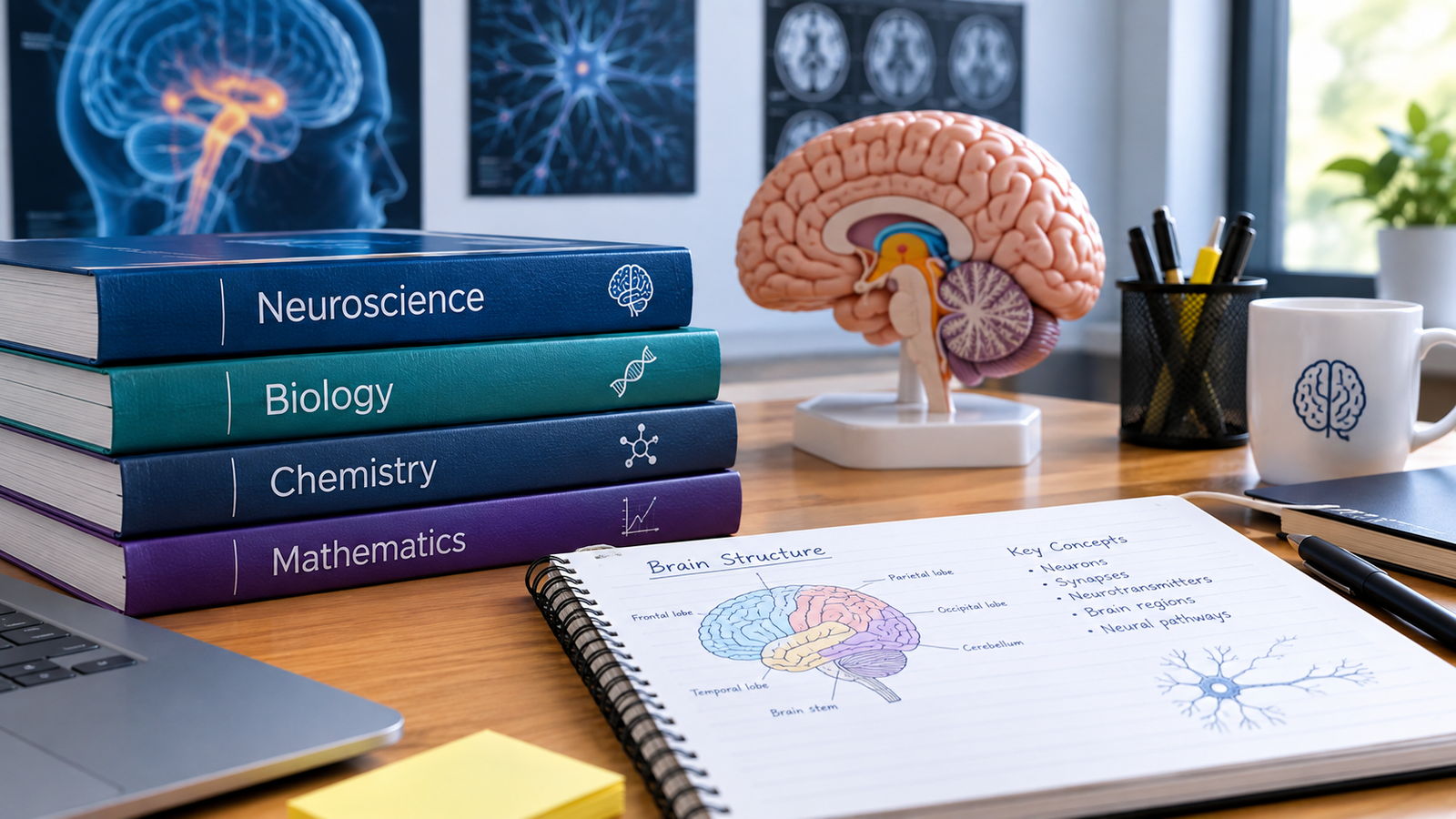
Strong preparation makes the difference between passively watching a lecture and actively engaging with complex ideas in brain science. If you are aiming for a high school medical neuroscience program, you can build practical skills now that will pay off in labs, simulations, and discussions. Rather than memorizing long lists, focus on core mechanisms, how to read biomedical figures, and the habits that help researchers and clinicians make sound decisions. The suggestions below do not require a campus lab, expensive equipment, or prior coursework, yet they mirror the kinds of tasks students often encounter in academic and clinical settings.
- Refresh the Neurobiology You Will Actually Apply
Center your review on mechanisms you can use at the bench or bedside. Revisit action potentials by sketching how voltage-gated sodium and potassium channels drive spike shape and refractory periods, then connect that to synaptic transmission via glutamate and GABA. Tie systems to function by mapping how the hippocampus supports memory consolidation, the prefrontal cortex guides executive control, and the basal ganglia influence movement initiation. Program overviews on pages like https://lichangesummer.org/medical-neuroscience/ can help you see common themes; your goal is to relate those themes to mechanisms. Two realistic practice prompts: explain why a dopamine agonist might transiently ease bradykinesia in Parkinson’s disease by altering basal ganglia circuitry, and predict how a brainstem lesion could disrupt cranial nerve reflexes. Avoid the common mistake of rote lobe memorization without linking structure to signal and behavior.
- Learn to Read Biomedical Figures, Not Just Text
In neuroscience, pictures carry the argument. Practice interpreting raster plots and peri-stimulus time histograms by describing firing-rate changes relative to a stimulus marker. Study MRI slice orientation so you can tell axial from coronal views and avoid flipping left and right during a case review. Compare T1-weighted to T2-weighted images: on T1, cerebrospinal fluid appears dark; on T2, it appears bright, reflecting differences in relaxation times. If you encounter diffusion tensor imaging, note that brighter, more coherent tracts suggest higher fractional anisotropy in white matter. For EEG, learn what a topographic map shows about spatial patterns across electrodes and how an eye-blink artifact dominates frontal channels with large, slow deflections. Treat every figure like a mini experiment: identify the variables, read the axes and units, and summarize the main takeaway in one sentence before diving into the caption.
- Practice With Open Neuroscience Data and Simple Tools
You can develop real data skills using open resources. Download a short EEG recording from a public repository and import it into a spreadsheet or a beginner-friendly Python notebook. Try a 1 to 40 Hz band-pass filter to reveal alpha rhythms near 10 Hz, then apply a 60 Hz notch filter to reduce mains interference, noting the tradeoff that aggressive filtering can distort nearby oscillations. Observe how sampling rate governs time resolution: rapid transients become visible at higher sampling rates, but this increases file size and processing demands. Contrast this with fMRI’s strength in spatial resolution but slower temporal dynamics due to the delayed blood-oxygen-level-dependent signal. A practical scenario: detect an eye blink by its slow, high-amplitude signature in Fp1 and Fp2, mark it as an artifact, and see how even a few such events can skew an averaged event-related potential. Always document each preprocessing step so results remain interpretable.
- Know the Ethics, Privacy, and Safety Basics
Neuroscience often involves people, protected health information, and powerful equipment, so baseline literacy in ethics and safety matters. Review informed consent and assent, the purpose of institutional review boards, and the principles of beneficence and nonmaleficence. Practice de-identifying a mock case by removing direct identifiers and any free text clues that could identify a participant again. Learn why correlation in imaging data cannot establish causation without careful experimental controls. On the safety side, review standard PPE use (nitrile gloves, lab coat, eye protection), sharps-container protocols, and signage indicating biohazard or chemical risks. Understand MRI safety zones and why ferromagnetic objects, including certain tools and oxygen tanks, must never enter the scanner room. A single oversight can compromise a study or cause real harm; treating ethics and safety as integral to science, not an afterthought, prepares you for professional environments.
Communicate Like a Clinician Scientist
Clear communication is a technical skill. Practice a brief oral case presentation using the HPI (history of present illness), relevant neuro exam findings (pupillary light reflex, extraocular movements, motor strength, sensation), and a focused assessment that ties signs to likely neuroanatomy. Draft a one-page structured abstract for a hypothetical study with Background, Methods, Results, and Conclusion, defining primary outcomes and potential confounders. When you create figures, write captions that name the dataset, preprocessing steps, and the statistical test used so that someone else can understand what they are looking at. Expect tradeoffs: too much jargon obscures meaning, but oversimplification can erase crucial assumptions. Build a durable habit by keeping a bound notebook with dated entries, procedures, and reflections, and by presenting one figure or paper summary per week to a friend or mentor to strengthen your scientific voice.
The throughline in all of these steps is practical fluency. You do not need to master advanced calculus or run a wet lab to arrive ready for a medical neuroscience program. Instead, connect neurobiology to measurable signals, practice reading complex visuals, handle open datasets with care, internalize ethics and safety, and share your thinking clearly. This preparation helps you contribute meaningfully during lectures, labs, and case discussions, and it carries forward into future coursework, research opportunities, or clinical volunteering where careful reasoning and clear communication are the currency of progress.