If you have ever received a text that says “SMH” and wondered what it means, you are not alone. This short internet abbreviation appears frequently in text messages, comments, memes, TikTok posts, Instagram captions, and other forms of online communication.
So, what does SMH mean?
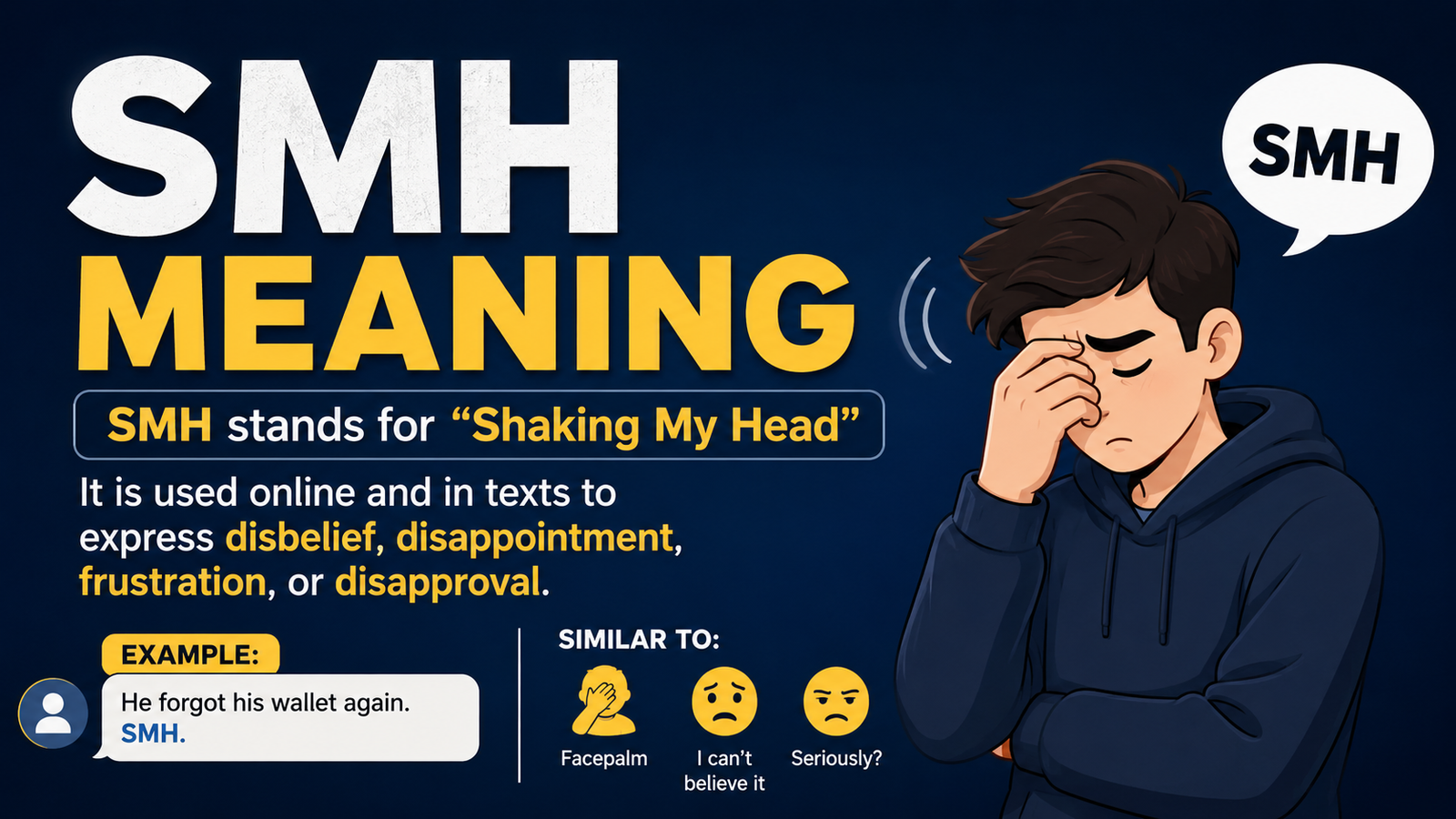
SMH stands for “shaking my head” or, in some contexts, “shake my head.” People use it to express disappointment, disbelief, frustration, annoyance, or disapproval. It is usually a reaction to something that seems foolish, surprising, frustrating, or difficult to believe.
For example, if someone says, “I forgot my keys inside the house again,” a friend might reply, “SMH.” The message basically means, “I can’t believe you did that” or “I’m shaking my head at this.”
This guide explains the SMH meaning, pronunciation, origin, examples, synonyms, antonyms, common usage, and the difference between SMH and similar expressions.
What Does SMH Mean?
The most common meaning of SMH is “shaking my head.”
It represents the physical gesture people make when they slowly move their head from side to side to show disagreement, disappointment, disbelief, or frustration.
In online conversations, people obviously cannot see the other person’s facial expressions or body language. Abbreviations such as SMH help communicate that emotional reaction quickly.
For example:
- “You seriously forgot your own birthday? SMH.”
- “He missed an open goal. SMH.”
- “SMH, why did I do that?”
- “She bought another pair of shoes even though she has dozens already. SMH.”
The exact feeling depends on the context. SMH can sound playful between friends or genuinely critical when someone is expressing serious disappointment.
Dictionary.com defines SMH as an abbreviation for “shaking my head” or “shake my head,” used to express feelings such as disbelief, disgust, or shock.
SMH Pronunciation
Although SMH is mainly written, people sometimes say the abbreviation aloud.
The letters are usually pronounced individually:
You can say “S-M-H”, rather than trying to pronounce it as one word.
In everyday conversation, however, many people simply type SMH instead of saying it.
What Does SMH Stand For?
SMH = Shaking My Head
Each letter represents a word:
- S = Shaking
- M = My
- H = Head
The phrase describes the familiar head-shaking gesture associated with disagreement, frustration, disbelief, or disappointment.
Sometimes people interpret SMH as “shake my head,” particularly when describing what they are doing rather than the reaction itself. Both forms communicate essentially the same idea.
The Origin and History of SMH
The exact person who invented SMH is not known.
Like many internet abbreviations, its precise origin is difficult to trace. Dictionary.com notes that SMH emerged in online communication during the 2000s, when people increasingly used short expressions to communicate tone in text messages and online conversations.
The abbreviation was recorded on Urban Dictionary in 2004 and became more visible on Twitter by 2007. It later became increasingly familiar across social media and online culture.
The idea behind the abbreviation is much older than the internet itself. People have used head-shaking as a nonverbal way to communicate “no,” “I can’t believe this,” or “that’s disappointing” for generations.
The internet simply turned that physical reaction into three letters.
Why Did SMH Become Popular?
One major reason for SMH’s popularity is convenience.
Typing “I can’t believe you’re doing this” takes much longer than writing “SMH.” Internet users often want to communicate an emotional reaction quickly, especially in fast-moving conversations.
SMH also works because the meaning is easy to understand once someone knows the abbreviation.
It can communicate a mixture of emotions without requiring a long explanation. Depending on the situation, it may suggest:
- Disappointment
- Frustration
- Disbelief
- Annoyance
- Disapproval
- Exasperation
- Mild embarrassment
- Amusement at someone’s mistake
The surrounding message usually tells you which emotion the writer intends.
SMH Meaning in Text Messages
In texting, SMH usually means that the sender is disappointed, frustrated, or unable to believe what happened.
Consider this conversation:
Alex: “I left my phone at home again.”
Sam: “SMH 😂”
Here, SMH is probably playful. Sam is teasing Alex rather than seriously criticizing them.
Now consider a different example:
Alex: “He lied to everyone about the project.”
Sam: “SMH. That’s really disappointing.”
Here, SMH communicates stronger disapproval.
This flexibility is one reason the abbreviation works so well in casual digital conversations.
SMH Meaning on Social Media
SMH is also widely used on social media.
People may place SMH at the beginning or end of a post, comment, caption, or reply.
For example:
“SMH, people really believe everything they read online.”
Or:
“He had one job and still managed to mess it up. SMH.”
Social-media users may also combine SMH with emojis, especially the facepalm, laughing, or disappointed-face emojis.
For example:
“You forgot the tickets again? SMH 🤦”
The emoji makes the emotional meaning even clearer.
Dictionary.com describes SMH as common in digital communication and notes that it can appear in social-media hashtags, reactions, and GIF-based responses.
SMH Meaning on TikTok
On TikTok, SMH has essentially the same meaning.
It can be used in comments, captions, text overlays, and replies when someone wants to show frustration, disbelief, or exasperation.
For example:
“People actually believe this? SMH.”
“He really said that on camera. SMH.”
Dictionary.com specifically lists SMH among common TikTok expressions and explains that it is used to express frustration, exasperation, or disbelief.
The important thing to remember is that SMH is not a special TikTok-only term. It existed online before TikTok and is used across many digital platforms.
Common Examples of SMH
Here are some natural examples of how people use SMH:
Example 1: Forgetting Something
“I left my wallet at home. SMH.”
Meaning: I can’t believe I forgot my wallet.
Example 2: Someone Making a Mistake
“He sent the email to the wrong person. SMH.”
Meaning: That was such an avoidable mistake.
Example 3: Disbelief
“She really paid $500 for that? SMH.”
Meaning: I can’t believe she did that.
Example 4: Sports
“They were winning by 20 points and still lost. SMH.”
Meaning: That result is frustrating and hard to believe.
Example 5: Playful Use
“You ate the last slice without asking? SMH 😂”
Meaning: I’m pretending to be annoyed because you ate my food.
Example 6: Self-Criticism
“I forgot my password again. SMH.”
Meaning: I’m disappointed or amused with myself for making the same mistake.
SMH Synonyms
There is no perfect one-word synonym for SMH because it combines an action with an emotional reaction. However, several expressions can communicate a similar idea.
Common alternatives include:
- I can’t believe it
- Seriously?
- Unbelievable
- That’s disappointing
- What were you thinking?
- Come on
- Oh, please
- That’s frustrating
- I can’t even
- Facepalm
- What a shame
The best alternative depends on the tone.
For example, “Seriously?” may sound more direct, while “I can’t believe it” emphasizes disbelief.
SMH Antonyms
SMH does not have a strict dictionary antonym because it is an internet initialism rather than a conventional word.
Still, expressions showing approval, agreement, excitement, or admiration can function as contextual opposites.
Examples include:
- Well done
- Great job
- Nice!
- Amazing
- Exactly
- I agree
- That’s awesome
- Good for you
- Respect
- W
For example:
“He finally finished the project. Nice!”
This expresses approval rather than the disappointment often associated with SMH.
SMH vs. SMDH
You may also see SMDH, which is a stronger version of SMH.
SMDH commonly stands for “shaking my damn head.”
The added word makes the expression more emphatic and can indicate stronger frustration or disbelief.
For example:
SMH: “You forgot the appointment again.”
SMDH: “You forgot the appointment again? SMDH.”
The second version generally carries more emotional force.
Because SMDH contains profanity, it is better suited to casual conversations and informal online spaces.
Is SMH Rude?
SMH is not automatically rude.
Its tone depends heavily on the situation and relationship between the people communicating.
Among close friends, SMH can be humorous:
“You ordered pizza and didn’t ask me? SMH 😂”
In a serious conversation, however, it may sound dismissive:
“You ignored the warning again. SMH.”
If you are communicating professionally, it is usually better to write the full thought rather than rely on internet slang.
For example, instead of sending “SMH” to a manager or customer, you could say:
“I’m disappointed that this happened, but let’s work out a solution.”
That communicates the emotion more clearly and professionally.
When Should You Use SMH?
SMH is best for informal digital communication.
Good places to use it include:
- Text messages
- Group chats
- Social-media comments
- Memes
- TikTok comments
- Instagram posts
- Casual online conversations
- Messages between friends
It is generally less appropriate in:
- Formal emails
- Business reports
- Academic papers
- Job applications
- Official documents
- Professional presentations
The abbreviation is informal slang, so the setting matters.
Is SMH Still Used in 2026?
Yes. SMH remains a recognizable piece of internet slang in 2026.
Although online language constantly changes, SMH has lasted far longer than many short-lived internet expressions. Its meaning is straightforward, and the head-shaking gesture it represents is universally familiar.
It also remains easy to use across different platforms because it requires only three letters.
That simplicity gives SMH staying power.
Other Meanings of SMH
While “shaking my head” is the dominant internet-slang meaning, SMH can have other meanings in different contexts.
For example, SMH can refer to The Sydney Morning Herald, an Australian newspaper. It can also appear as an abbreviation or acronym in unrelated technical, organizational, or business contexts.
This is why context matters.
If someone writes:
“SMH, I can’t believe he did that.”
they almost certainly mean “shaking my head.”
But if SMH appears in a news, business, scientific, or organizational document, it may mean something completely different.
Common Mistakes When Using SMH
One common mistake is assuming that SMH always means anger.
It does not.
The expression can range from mild amusement to serious frustration. A laughing emoji can even make the phrase playful.
Another mistake is using SMH in every situation.
Because it is informal slang, it may look out of place in professional or academic writing.
A third mistake is confusing SMH with other abbreviations. SMDH, for example, adds emphasis, while LOL generally expresses amusement rather than disappointment.
Understanding the context is more important than simply memorizing the letters.
Frequently Asked Questions About SMH
What does SMH mean in texting?
SMH means “shaking my head” or “shake my head.” It usually expresses disbelief, frustration, disappointment, annoyance, or disapproval.
What does SMH mean on Snapchat?
On Snapchat, SMH generally means “shaking my head.” Someone may use it when reacting to something surprising, frustrating, silly, or disappointing.
What does SMH mean on TikTok?
On TikTok, SMH is used to express frustration, disbelief, exasperation, or disapproval. It is not exclusive to TikTok and is common across internet communication.
Is SMH a bad word?
No. SMH itself is not a swear word. It is an informal abbreviation for “shaking my head.” However, it can communicate criticism or annoyance depending on the context.
How do you pronounce SMH?
SMH is normally pronounced by saying the letters individually: “S-M-H,” or “ess-em-aitch.”
What does SMDH mean?
SMDH usually means “shaking my damn head.” It is a stronger version of SMH and expresses greater frustration or disbelief.
Can I use SMH in a formal email?
It is better to avoid SMH in formal emails. Use a clear sentence such as “I’m disappointed by what happened” or “I find this difficult to understand.”
What is the opposite of SMH?
There is no exact opposite, but expressions such as “well done,” “great job,” “nice,” and “amazing” can communicate approval rather than disappointment or disbelief.
Final Thoughts on SMH Meaning
The SMH meaning is simple: “shaking my head.”
It is an informal internet abbreviation used when someone wants to show disbelief, disappointment, frustration, annoyance, or disapproval without writing a long sentence.
Its popularity comes from its simplicity. Three letters can communicate an entire reaction: “I can’t believe this,” “What were you thinking?” or “That’s frustrating.”
SMH became established in online communication during the 2000s and eventually spread across social media, texting, memes, and everyday internet culture.
The next time you see someone write “SMH”, you will know exactly what they mean. And if something unbelievable happens in your own group chat, you now have a three-letter response ready: SMH.