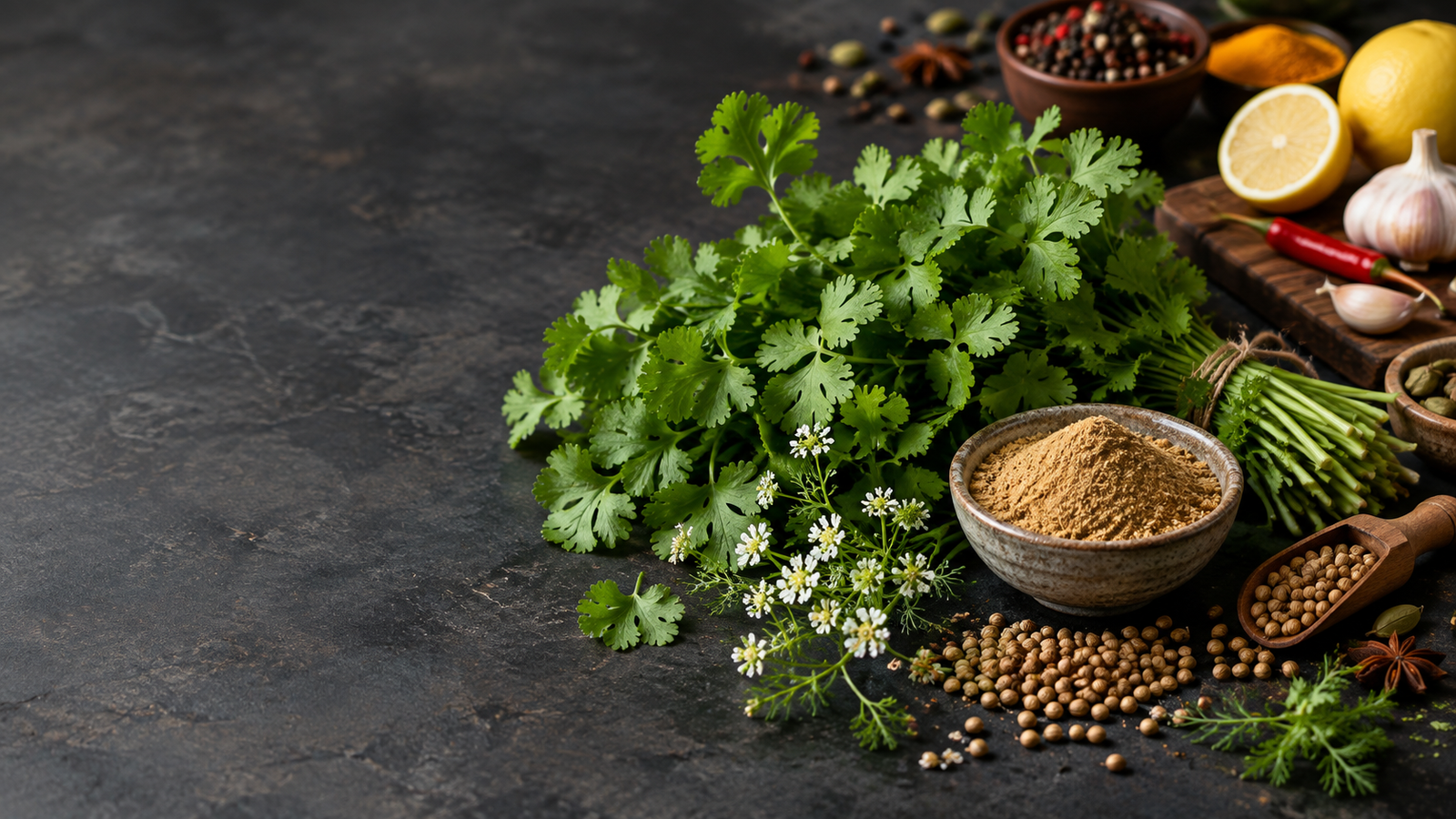
Koriandri Biography Table
| Category | Details |
|---|---|
| Term | koriandri |
| Botanical connection | Coriandrum sativum |
| Common English name | Coriander |
| Fresh-leaf name in North America | Cilantro |
| Plant family | Apiaceae |
| Plant type | Annual herb |
| Genus | Coriandrum |
| Species | Coriandrum sativum L. |
| Native range | Eastern Mediterranean to western Pakistan |
| Main edible parts | Leaves, stems, roots, and fruits commonly called seeds |
| Fresh flavor | Bright, herbal, citrus-like, sometimes pungent |
| Seed flavor | Warm, aromatic, citrusy, nutty, and mildly sweet |
| Major culinary role | Herb, spice, garnish, seasoning, and ingredient |
| Common uses | Curries, chutneys, soups, salads, sauces, spice blends, rice dishes, marinades |
| Related common names | Coriander, cilantro, coriander herb, coriander seed |
| Family relatives | Parsley, carrot, celery, fennel and other Apiaceae plants |
| Life cycle | Annual |
| Flowers | Usually white to pale pink |
| Fruit | Small, rounded, ribbed fruit commonly used as coriander seed |
| Global importance | Culinary, agricultural, cultural, and botanical |
| Key naming issue | “koriandri” may represent a language form rather than a separate species |
What Is Koriandri?
Koriandri is a term closely associated with coriander, the familiar aromatic herb and spice scientifically known as Coriandrum sativum L.
At first glance, the unusual spelling can make koriandri appear to be the name of a rare plant, an emerging food ingredient, or even a distinct botanical species. In most food and plant-related contexts, however, the word points toward coriander and its different culinary forms.
The linguistic story is particularly interesting. Estonia’s official language database lists koriander as the word for coriander and records koriandri among its inflected forms. This means that in Estonian, koriandri can naturally appear within a sentence because the noun changes form according to grammatical function.
That distinction matters because online articles sometimes treat koriandri as though it were an independent botanical name. There is no need to create a separate plant identity where the evidence points to the well-established species Coriandrum sativum.
Kew’s Plants of the World Online recognizes Coriandrum sativum L. as an accepted species in the Apiaceae family. Kew describes it as an annual plant whose native range extends from the eastern Mediterranean region to western Pakistan, with cultivation and introduction across many other parts of the world.
So, in practical terms, when a reader encounters koriandri in a food-related context, the most useful starting point is coriander.
Why the Word Koriandri Creates Confusion
The confusion surrounding koriandri comes largely from the way plant names travel between languages.
Plants rarely have one universal everyday name. A botanical species may have different names in different countries, regions, languages, cuisines, and historical periods.
Coriander is an excellent example.
English speakers may use coriander to describe the plant generally. In North American English, cilantro usually refers specifically to the fresh leaves, while coriander commonly refers to the dried fruits used as a spice.
Other English-speaking regions use coriander for both the fresh herb and the dried spice.
In South Asian kitchens, people may use terms such as dhania or hara dhania for fresh coriander leaves and related terms for the seeds. In Spanish-speaking regions, cilantro is widely used for the fresh herb.
The botanical plant does not change simply because the name changes.
That is why koriandri should be approached as a linguistic and culinary term connected with coriander rather than automatically being interpreted as a separate plant.
The Scientific Identity Behind Koriandri
The scientific name associated with koriandri is Coriandrum sativum L.
The genus is Coriandrum, while sativum identifies the species.
The plant belongs to Apiaceae, a large botanical family that includes parsley, carrot, celery, fennel and numerous other aromatic or edible plants. Kew lists Coriandrum sativum as an accepted species.
Scientific classification provides an important point of clarity.
Common names can be inconsistent. Scientific names are designed to provide a more stable reference for researchers, botanists, horticulturists, farmers, food producers, and educators.
For someone researching koriandri, identifying Coriandrum sativum is therefore much more useful than relying solely on spelling.
Once the botanical identity is established, the rest of the subject becomes easier to understand: its leaves, seeds, flowers, roots, cultivation, culinary uses, history, and cultural significance all belong to the same plant.
The Origin of Coriander
The precise historical origin of coriander is more complicated than a single modern country name suggests.
Kew gives the accepted native range of Coriandrum sativum as extending from the eastern Mediterranean to western Pakistan. Its records also show the plant as introduced or cultivated across a remarkably broad geographic area.
This broad distribution reflects how useful the plant has been to human societies.
Coriander can serve two culinary roles from one crop. Its fresh leaves provide an aromatic herb, while its dried fruits provide a spice. This versatility likely contributed to its movement through agricultural communities and trade networks.
Over centuries, coriander became integrated into regional food traditions across Europe, Asia, Africa, the Middle East, and eventually the Americas.
The plant’s long relationship with human cuisine is therefore central to understanding why words associated with it appear in so many languages.
The Linguistic Journey of the Name
The name associated with coriander has an unusually long linguistic history.
The Estonian language database traces koriander through German Koriander and ultimately to the Latin coriandrum, with Greek koriandron also recorded in the etymological chain.
This is a useful reminder that plant names often travel alongside trade, scholarship, agriculture, medicine, and cuisine.
A word can cross several languages while retaining enough of its original sound to remain recognizable centuries later.
The spelling koriandri, therefore, should not automatically be interpreted as evidence of a new plant.
Instead, it can reflect grammatical inflection or language-specific usage.
This is one of the most important points for readers searching the term online.
What Does Koriandri Look Like?
A koriandri plant, meaning the coriander plant, changes considerably as it grows.
Young plants have soft green leaves that can look relatively broad and rounded near the lower portion. As the plant develops, the leaves become increasingly divided and delicate.
Kew’s botanical descriptions record lower leaves with broader lobes and upper leaves that become much more finely divided. The plant can develop an erect, branching stem and typically reaches several tens of centimeters in height.
Eventually, the plant produces small flowers.
These flowers are generally white to pinkish and arranged in umbrella-like clusters characteristic of the Apiaceae family. Following flowering, the plant develops small rounded fruits.
Those dried fruits are what cooks commonly call coriander seeds.
This life cycle is one of the plant’s most fascinating characteristics because a single annual herb provides several culinary ingredients at different stages.
Koriandri Leaves
Fresh koriandri leaves are perhaps the part most immediately recognized by home cooks.
They are delicate, green, and strongly aromatic.
In North America, these fresh leaves are generally called cilantro. Elsewhere, coriander may be used for the same fresh herb.
The flavor is difficult to describe with a single adjective.
Many people experience fresh coriander as bright, green, citrus-like, herbal, and refreshing. Others perceive a sharper or more pungent quality.
There is also a well-known group of people who experience fresh cilantro as having a distinctly soapy or detergent-like taste. This difference is partly associated with genetic variation affecting odor perception.
The result is an interesting example of how the same food can produce dramatically different sensory experiences in different people.
Koriandri Seeds
The seeds associated with koriandri are technically dried fruits rather than botanical seeds in the strictest sense.
In everyday cooking, however, calling them coriander seeds is completely standard.
They have a very different sensory character from fresh coriander leaves.
Whole coriander seeds can have warm, citrusy, slightly sweet, woody, nutty, and aromatic notes.
Toasting them gently can deepen their fragrance.
Ground coriander is frequently used in spice blends because it contributes warmth without dominating a dish in the same way that some hotter spices can.
The transformation from fresh leaf to dried fruit demonstrates why coriander has remained valuable across so many cuisines.
One plant offers multiple flavor profiles.
Koriandri Roots
The roots of the coriander plant are less familiar in many Western kitchens, but they have culinary importance in parts of Southeast Asia.
They possess a deeper, earthier aroma than the leaves and can be incorporated into pastes, marinades, sauces, and other preparations.
Because roots are physically tougher than leaves, they are usually processed rather than eaten as a raw garnish.
Their concentrated aromatic character makes them particularly useful in recipes where coriander is intended to form part of the underlying flavor rather than simply provide freshness at the end.
This broader use of the plant illustrates an important principle: koriandri is not limited to a handful of green leaves.
Different culinary cultures have learned to use different parts of Coriandrum sativum.
How Koriandri Is Used in Cooking
The culinary possibilities associated with koriandri are extensive.
Fresh leaves are commonly added near the end of cooking or immediately before serving. This preserves their delicate aroma and vibrant appearance.
They can be chopped and sprinkled over curries, soups, rice dishes, noodles, vegetables, beans, salads, sauces, and grilled foods.
They can also be blended into chutneys, herb sauces, dips, marinades, and dressings.
Coriander seeds behave differently.
They can be used whole, lightly toasted, crushed, or ground.
Whole seeds can provide occasional bursts of fragrance, while ground coriander distributes its flavor more evenly throughout a dish.
This makes coriander useful at several stages of cooking.
Koriandri in South Asian Cuisine
South Asian cooking provides one of the clearest examples of coriander’s versatility.
Fresh coriander leaves appear frequently as garnish and as a component of chutneys and herb-based preparations.
Coriander seeds are equally important.
They are used in spice mixtures, curry bases, vegetable dishes, lentil preparations, meat marinades, pickles, and numerous regional recipes.
The seeds may be combined with cumin, chili, turmeric, black pepper, cardamom, cloves, or other spices.
In this context, coriander is not simply a decorative herb.
It can contribute foundational flavor to the dish.
For many South Asian cooks, the difference between fresh coriander and coriander seed is obvious from both aroma and function.
Fresh leaves provide brightness.
Seeds provide depth.
Koriandri in Middle Eastern Food
Coriander has also played an important role in Middle Eastern food traditions.
Fresh leaves can be used with salads, sauces, soups, grilled foods, and vegetable dishes.
Ground coriander seed can add a warm aromatic layer to meat, legumes, vegetables, and spice blends.
Its citrus-like notes can work particularly well with garlic, lemon, cumin, chili, and other aromatic ingredients.
Because coriander is relatively adaptable, it does not belong to a single culinary tradition.
Instead, it becomes part of different flavor systems depending on the surrounding ingredients.
That flexibility helps explain its international popularity.
Koriandri in Mexican and Latin American Cooking
Fresh cilantro has a particularly visible role in Mexican and other Latin American cuisines.
It can appear in salsas, tacos, soups, rice dishes, bean preparations, marinades, and fresh toppings.
Its sharp green aroma can provide contrast against richer ingredients.
Tomatoes, onions, chili peppers, citrus, avocado, and cilantro frequently appear together because their flavors create a lively combination.
Again, terminology can vary.
Someone accustomed to the word cilantro may not immediately associate it with coriander.
Botanically, however, the fresh leaves and coriander seeds come from the same species.
Koriandri in Southeast Asian Cooking
Coriander is also significant in Southeast Asian cuisines.
Fresh leaves can be used as garnish, while stems and roots may contribute to sauces, pastes, soups, and marinades.
The roots are particularly valued in some Thai preparations.
This is an excellent demonstration of how culinary traditions can reveal possibilities that are not obvious from supermarket use in another country.
A person who thinks of coriander only as a garnish may be surprised to learn that the same plant can contribute foundational flavor through its roots and seeds.
Why Some People Think Koriandri Tastes Like Soap
The unusual taste experience associated with fresh coriander has attracted considerable scientific and public interest.
Some people describe cilantro leaves as fresh and citrusy.
Others describe the same leaves as tasting like soap.
This is not simply a matter of someone being unwilling to try a food.
Differences in smell perception can influence how the flavor is experienced.
Certain genetic variants involving olfactory receptors have been studied in relation to the perception of aldehydes found in cilantro.
That does not mean every person who dislikes coriander has a specific genetic variant, nor does it mean genetics completely determines food preference.
Taste is influenced by genetics, learned experience, smell, culture, expectation, and individual sensitivity.
Still, the soap-like perception is a genuine and well-known sensory phenomenon.
Koriandri Nutrition
Fresh coriander leaves contain relatively small amounts of energy because they are normally eaten in modest quantities.
Their nutritional contribution is therefore best understood as part of an overall diet rather than as a standalone source of large amounts of nutrients.
Like other leafy herbs, coriander provides micronutrients and plant compounds.
Coriander seeds are nutritionally different because they are more concentrated and are typically used as a spice rather than eaten in large quantities.
This distinction is important when discussing health claims.
A recipe containing a tablespoon of fresh leaves should not be compared directly with a serving of ground coriander seed.
The form, quantity, preparation method, and overall diet all influence nutritional significance.
Antioxidant Compounds and Plant Chemistry
Coriander contains naturally occurring plant compounds that contribute to its aroma, taste, and biological characteristics.
Essential oils and other phytochemicals are responsible for much of the plant’s distinctive sensory profile.
Some laboratory and experimental research has investigated coriander’s antioxidant, antimicrobial, digestive, metabolic, and other biological properties.
However, laboratory activity should not automatically be interpreted as a proven therapeutic effect in humans.
This distinction is especially important when reading online articles that describe herbs as cures for medical conditions.
Coriander can be a nutritious culinary ingredient, but culinary use is not the same thing as medical treatment.
Traditional Uses of Koriandri
Coriander has a long history of use beyond ordinary seasoning.
Traditional medical systems in different regions have incorporated coriander preparations into various practices.
Historical use is valuable from a cultural and ethnobotanical perspective because it shows how communities understood and interacted with the plant.
Modern readers should nevertheless distinguish traditional practice from clinical evidence.
A traditional remedy may be historically significant without having sufficient modern clinical evidence to establish a medical claim.
This balanced approach allows the cultural history of koriandri to be appreciated without overstating what science has demonstrated.
Koriandri and Digestion
Coriander has traditionally been associated with digestive preparations.
Its aromatic qualities and use in food have made it a familiar ingredient in meals designed around herbs and spices.
Some experimental studies have investigated compounds found in coriander for possible digestive or gastrointestinal effects.
But claims that coriander can treat digestive disorders should be made carefully.
A culinary herb may support enjoyable eating and contribute useful plant compounds without functioning as a substitute for medical diagnosis or treatment.
For persistent digestive symptoms, professional medical advice remains more appropriate than relying on an herb alone.
Koriandri and Everyday Wellness
The strongest everyday role of koriandri is arguably culinary rather than medicinal.
Fresh herbs can make ordinary meals more appealing without requiring large amounts of salt, sugar, or heavy sauces.
Coriander’s strong aroma means that a small amount can noticeably change the character of a dish.
This makes it useful for people who enjoy flavorful food and varied plant ingredients.
The value of an herb does not need to depend on exaggerated health claims.
Flavor, cultural heritage, agricultural importance, and culinary versatility are already substantial reasons for its continued use.
Growing Koriandri at Home
Coriander is commonly grown as an annual herb.
Gardeners generally prefer a location with adequate sunlight and well-drained soil.
Because the plant has a relatively short life cycle, gardeners often sow seeds at intervals rather than planting everything at once.
This can provide a more continuous supply of young leaves.
One challenge is premature flowering, often called bolting.
When the plant moves rapidly into its flowering stage, it produces fewer of the tender leaves that many cooks want.
Growing conditions, temperature, day length, cultivar, and timing can all influence this behavior.
Soil and Water Requirements
Koriandri does not require an elaborate growing system.
Well-drained soil is important because consistently waterlogged conditions can create problems for roots.
At the same time, newly germinated plants need adequate moisture.
A sensible approach is to maintain relatively even moisture while avoiding excessive saturation.
Container growing can work well because the gardener has greater control over soil composition and drainage.
The container should have drainage holes, and the growing medium should not remain permanently wet.
Harvesting Koriandri Leaves
Young leaves can be harvested once the plant has established enough growth to tolerate cutting.
Regular harvesting encourages gardeners to use the herb while it is at its most tender.
It is generally better to avoid stripping a small plant completely.
Leaving enough foliage allows the plant to continue growing.
For kitchen use, freshly harvested coriander leaves are usually most aromatic when used promptly.
If a large quantity has been harvested, proper storage becomes important.
Harvesting Coriander Seeds
Gardeners interested in seeds need to allow the plant to flower and develop fruit.
The small fruits gradually mature and change appearance as they dry.
Timing is important because waiting too long can result in seeds falling from the plant.
Once properly dried, the fruits can be collected and stored in an airtight container.
Whole coriander seeds generally retain their aroma longer than ground coriander because grinding increases the exposed surface area and allows volatile compounds to dissipate more quickly.
How to Store Fresh Koriandri
Fresh coriander leaves are delicate.
They lose quality much faster than dried spices because they contain significant moisture and have tender tissues.
Refrigeration can help extend their usable life.
Before storage, damaged or excessively wet leaves should be removed.
Different households use different methods, including wrapping the herb loosely or placing stems in water under suitable refrigeration conditions.
The goal is to balance moisture retention with airflow and avoid prolonged exposure to excess water that can accelerate decay.
How to Store Coriander Seeds
Coriander seeds are easier to preserve.
They should be kept away from moisture, heat, and excessive light.
An airtight container in a cool, dry cupboard is generally suitable for household storage.
Whole seeds tend to maintain their aromatic qualities better than ground coriander.
For the strongest flavor, cooks can grind small amounts shortly before use.
This is particularly useful in recipes where coriander is one of the major spices.
How to Store Ground Koriandri
Ground coriander gradually loses aroma because its volatile compounds are exposed to air.
For that reason, purchasing or grinding smaller quantities can sometimes provide better flavor than keeping a large container for a long time.
The spice should be protected from humidity.
A tightly closed container helps reduce exposure to air and moisture.
If the aroma becomes noticeably weak, the spice may still be safe to consume if properly stored, but its culinary value will be reduced.
Koriandri and Food Safety
Fresh herbs should be handled like other fresh produce.
They should be purchased from clean sources and handled with clean hands and utensils.
Washing practices should follow appropriate food-safety guidance.
Fresh herbs can carry microorganisms from soil, water, handling, or transportation, so cleanliness matters.
People with weakened immune systems, pregnant individuals, older adults, and young children may need to follow especially careful food-safety practices depending on the circumstances.
Food safety is separate from the plant’s nutritional or culinary qualities.
A healthy ingredient still needs appropriate handling.
Can Everyone Eat Koriandri?
For most people, coriander is a familiar food ingredient.
However, food allergies can occur with many foods, including herbs and spices.
Anyone who experiences symptoms such as swelling, difficulty breathing, widespread hives, or other signs of a serious allergic reaction after eating a food should seek appropriate medical attention.
Food intolerance and strong dislike are different from allergy.
The soap-like flavor sometimes experienced with cilantro is also not automatically an allergy.
It is primarily a sensory phenomenon.
Koriandri in Agriculture
Coriander has value beyond home cooking.
It is commercially cultivated as both a fresh herb and a spice crop.
Farmers may grow varieties or select seeds according to the desired end product.
A crop intended for abundant fresh foliage has different priorities from one grown primarily for seed production.
Plant density, irrigation, temperature, soil conditions, harvesting schedule, and cultivar selection can all influence the final crop.
Its adaptability has helped coriander become established in agricultural systems far beyond its original range.
Kew’s distribution data illustrates just how widely the species is cultivated or introduced.
Why Koriandri Is Botanically Interesting
Coriander is interesting because its morphology changes as the plant matures.
The lower leaves can look relatively broad, while upper leaves become increasingly divided and delicate.
The plant then shifts from vegetative growth into flowering and fruit production.
This transformation is common in annual plants but particularly useful in coriander because each stage has culinary relevance.
Young leaves are harvested for fresh use.
Mature plants provide flowers that lead to fruits.
The dried fruits become the spice commonly known as coriander seed.
Few everyday kitchen ingredients offer such a clear connection between plant development and culinary use.
Koriandri and Biodiversity
Although coriander is widely cultivated, its botanical identity remains connected to a single accepted species: Coriandrum sativum.
Kew records the species within Apiaceae and documents numerous historical synonyms and varieties associated with the plant.
Different cultivated populations can display variation in growth, leaf form, seed size, aroma, and other characteristics.
Such diversity matters to agriculture because farmers and breeders may select plants according to particular production goals.
Maintaining plant diversity can also be important for resilience and future breeding work.
The Difference Between Koriandri and Cilantro
The simplest explanation is this:
Koriandri is a term connected with coriander.
Cilantro usually means the fresh leaves in North American English.
Coriander may refer to the plant generally or, particularly in North American usage, the dried fruits used as a spice.
The terminology varies internationally.
Therefore, the safest way to understand a recipe is to look at the ingredient itself and the context.
If a recipe asks for chopped green leaves, it almost certainly means the fresh herb.
If it calls for ground coriander or toasted coriander seeds, it means the dried spice.
The names may overlap, but the culinary applications are distinct.
Koriandri vs Parsley
Coriander and parsley are related because both belong to Apiaceae.
They are nevertheless different plants.
Their leaves can look superficially similar, especially to inexperienced cooks, but their flavors are substantially different.
Parsley tends to have a clean, green, slightly peppery or grassy character.
Fresh coriander is usually more aromatic and citrus-like, with a distinctive flavor that some people perceive as soapy.
The difference becomes especially obvious when the herbs are used raw.
Koriandri vs Cumin
Coriander and cumin are frequently used together, particularly in South Asian, Middle Eastern, and other spice traditions.
They are not the same plant.
Coriander comes from Coriandrum sativum.
Cumin comes from a different species, Cuminum cyminum.
Coriander tends to bring citrusy, warm, slightly sweet notes.
Cumin is generally more earthy, nutty, savory, and intensely aromatic.
Combining them creates a layered flavor that is common in many spice blends.
Koriandri in Modern Food Culture
The popularity of global cooking has made coriander increasingly familiar to people who may not have grown up eating it.
Recipes travel rapidly through restaurants, television, cookbooks, social media, food blogs, and international grocery stores.
A single ingredient can therefore move between culinary traditions with remarkable speed.
This is another reason terms like koriandri attract online searches.
A reader may encounter the word in a translated recipe or foreign-language context without immediately recognizing that it refers to a familiar ingredient.
Understanding the language behind the word can make international recipes considerably easier to interpret.
Why the Exact Term Matters for Searchers
Search engines frequently bring together different spellings and language forms.
Someone searching for koriandri may encounter pages describing coriander, cilantro, coriander seeds, recipes, plant cultivation, nutrition, or etymology.
That variety can make the search experience confusing.
The most reliable approach is to establish the botanical identity first.
Once Coriandrum sativum has been identified, individual questions become easier to answer.
Is the page talking about leaves?
Then it is discussing fresh coriander or cilantro.
Is it discussing dried fruits?
Then it is discussing coriander seed.
Is it discussing the word itself?
Then linguistic context matters.
This distinction turns an ambiguous search term into a much clearer subject.
Common Misunderstandings About Koriandri
Koriandri is a completely new plant
There is no good botanical basis for treating koriandri as a newly discovered plant species.
The term is closely connected to coriander, while Coriandrum sativum is the established species involved in the food-related meaning. Kew recognizes that species as accepted.
Koriandri and cilantro are unrelated
They are not unrelated.
Cilantro generally refers to the fresh leaves of the same coriander plant.
The naming difference is largely regional and contextual.
Coriander seeds are true botanical seeds
In everyday language they are called coriander seeds.
Botanically, the structures are dried fruits containing the plant’s seeds.
This distinction is common in culinary language and does not make the ingredient any less useful.
Fresh coriander and coriander seed taste the same
They do not.
Fresh leaves have a bright, green, highly distinctive flavor.
The dried fruits have warmer, nuttier, citrus-like and spice-oriented notes.
They come from the same plant but are chemically and culinarily experienced very differently.
How to Use Koriandri in Everyday Meals
Fresh leaves can be added to meals in several simple ways.
Chop them into a tomato-and-onion salsa.
Scatter them over rice.
Mix them into a yogurt-based sauce.
Add them to soup immediately before serving.
Blend them with green chili and other ingredients for a chutney.
Use them as a finishing herb over grilled meat or vegetables.
Coriander seeds can be toasted lightly and added whole or ground.
They work particularly well with cumin, garlic, chili, ginger, turmeric, and other aromatic spices.
The most effective use depends on whether the goal is freshness or depth.
A Practical Guide to Buying Koriandri
When buying fresh coriander, look for leaves that appear vibrant and relatively firm.
Avoid bunches with extensive yellowing, sliminess, or widespread wilting.
For coriander seeds, aroma is an important quality indicator.
Fresh seeds should smell distinctly fragrant.
Ground coriander should have a recognizable warm aroma rather than smelling flat or stale.
Whole seeds are often preferable when long storage is expected.
They can be ground when needed.
Koriandri as a Bridge Between Language and Food
One of the most interesting things about koriandri is that its story is not purely botanical.
It is linguistic.
A person searching for the term may actually be encountering a grammatical form of the Estonian word koriander rather than the name of an independent plant. Estonia’s official language resource records the word forms directly, providing useful evidence for understanding this unusual spelling.
At the same time, the plant behind the terminology has a genuinely global history.
Coriandrum sativum has been cultivated and used across many regions.
That combination of language and agriculture explains why a seemingly unfamiliar word can lead back to one of the world’s most recognizable culinary herbs.
Frequently Asked Questions About Koriandri
What does koriandri mean?
Koriandri is closely connected with coriander. In Estonian, koriander is the standard noun for coriander and koriandri is one of its grammatical forms. In broader online usage, the spelling may be used to refer to coriander or the coriander plant.
Is koriandri the same as coriander?
In food-related contexts, koriandri generally points to coriander and the species Coriandrum sativum. The important difference is usually linguistic rather than botanical.
Is koriandri the same as cilantro?
Cilantro normally refers to the fresh leaves of Coriandrum sativum, particularly in North American English. Koriandri is a term associated with coriander and may refer more generally to the plant or appear as a language-specific form.
What is the scientific name of koriandri?
The botanical species associated with koriandri is Coriandrum sativum L. Kew lists it as an accepted species in the Apiaceae family.
What family does koriandri belong to?
Coriandrum sativum belongs to the Apiaceae family, the same broad family that includes parsley, carrots, celery, and fennel.
What parts of koriandri can be eaten?
Fresh leaves and stems are widely used. The dried fruits are commonly called coriander seeds, while roots are also used in some culinary traditions.
Why does koriandri sometimes taste like soap?
Some people perceive fresh cilantro leaves as soapy or detergent-like. Differences in smell perception, including genetic variation involving olfactory receptors, are thought to contribute to this experience. Personal preference and previous exposure can also influence how people perceive the flavor.
Can koriandri be grown at home?
Yes. Coriander is a commonly cultivated annual herb and can be grown in suitable garden beds or containers. Good drainage, appropriate moisture, adequate light, and suitable growing temperatures help support healthy plants.
Does koriandri have medicinal benefits?
Coriander has a history of traditional use and has been investigated in laboratory and experimental research for various biological properties. However, traditional use and laboratory findings should not be treated as proof that coriander can diagnose, prevent, or cure a medical condition.
What is the difference between coriander leaves and coriander seeds?
They come from the same plant but have very different flavors and uses. Fresh leaves are bright, green, and aromatic, while dried coriander fruits have warmer, spicier, citrusy, and nutty characteristics.
Where did koriandri originally come from?
The associated species, Coriandrum sativum, has a native range described by Kew as extending from the eastern Mediterranean to western Pakistan. It is now widely cultivated and introduced in many parts of the world.
Is koriandri a spice or an herb?
It can be both, depending on which part of the plant is being discussed. Fresh leaves are used as an herb, while dried coriander fruits are used as a spice.
Can koriandri be used in tea?
Coriander seeds are sometimes used in traditional and culinary infusions. However, an infusion should not be assumed to have medicinal effects simply because coriander has a history of traditional use.
How should fresh koriandri be stored?
Fresh coriander should generally be kept refrigerated and protected from excessive moisture and decay. Its delicate leaves lose quality much faster than dried coriander seeds.
How should coriander seeds be stored?
Whole coriander seeds are best protected from moisture, heat, and excessive light. An airtight container in a cool, dry location helps preserve their aroma.
Why is koriandri popular worldwide?
Its popularity comes from exceptional versatility. The plant provides fresh leaves, aromatic seeds, and useful roots, allowing different cultures to incorporate different parts into their own cuisines.
The Enduring Identity of Koriandri
The most useful way to understand koriandri is to look beyond the unfamiliar spelling.
Behind the word is a plant with a long botanical, agricultural, culinary, and linguistic history.
Coriandrum sativum connects fresh green leaves with fragrant dried fruits, garden cultivation with international cuisine, and everyday cooking with centuries of language development.
The term also demonstrates why context matters when researching unfamiliar words online. A strange-looking spelling does not necessarily represent a new species, a new food trend, or a mysterious ingredient. Sometimes it is simply another linguistic form connected to something already familiar.
For readers encountering koriandri for the first time, the key is therefore straightforward: identify the language, consider the culinary context, and then connect the term to the established botanical identity of Coriandrum sativum.
That approach turns an unusual search term into a much richer story—one involving plants, language, food, agriculture, culture, and the remarkable ability of a single herb to occupy so many different places in human life.




One thought on “Koriandri: Meaning, Origins, Uses, Nutrition, Culture, and the Story Behind the Name”