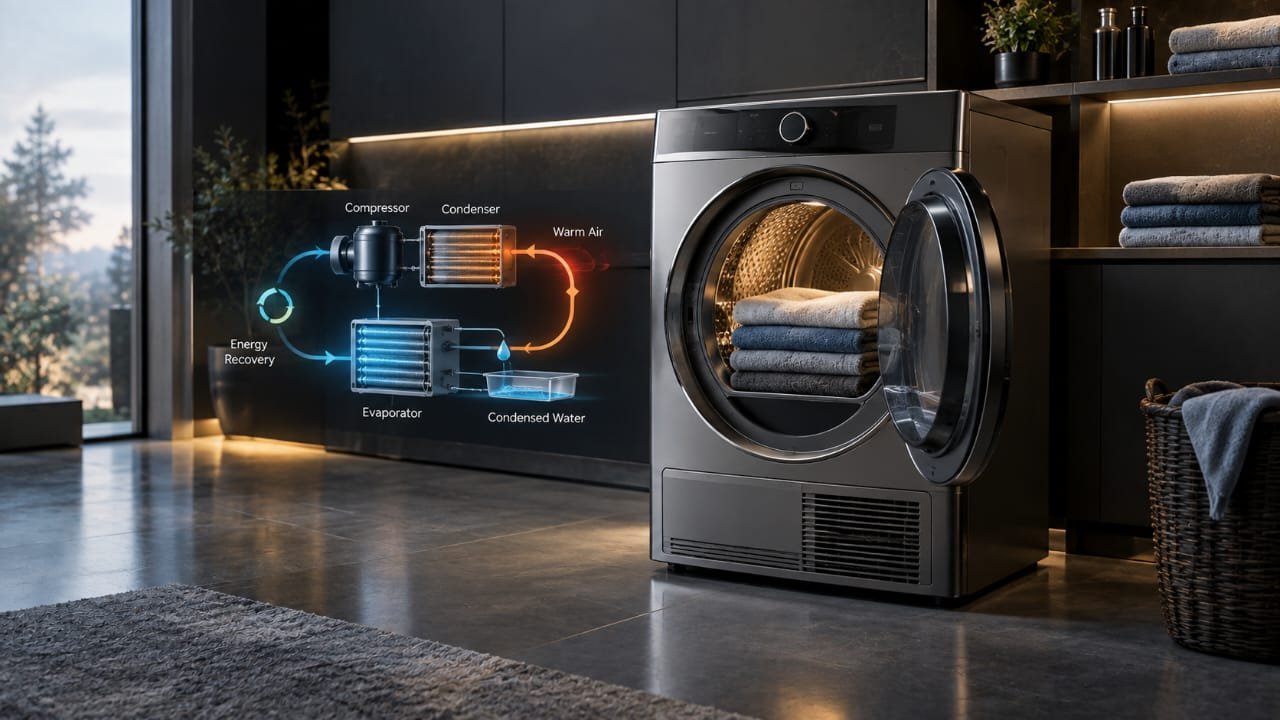
A heat pump dryer is a modern type of tumble dryer designed to dry clothes efficiently while using considerably less energy than many conventional vented or condenser dryers. Instead of continuously creating heat and exhausting warm, humid air, it recycles heat through a closed-loop system. This approach makes the appliance particularly interesting for households seeking lower energy consumption, gentler fabric care, and flexible installation without an external exhaust duct.
The technology can appear complicated at first because a heat pump dryer combines principles associated with refrigeration, air conditioning, condensation, and conventional clothes drying. In practice, however, its basic purpose is straightforward: warm air absorbs moisture from clothing, the moisture is condensed and collected, and much of the heat is recovered and reused.
As household energy efficiency has become increasingly important, heat pump dryers have moved from being a specialist appliance into a mainstream option. They are now available in numerous capacities, designs, and price categories, ranging from compact models for apartments to large-capacity machines intended for busy family households.
This article explores the technology in depth, including its history, operating principles, components, energy efficiency, installation requirements, maintenance, drying performance, advantages, limitations, buying considerations, and common questions.
Heat Pump Dryer Biography Table
| Attribute | Details |
|---|---|
| Name | Heat Pump Dryer |
| Appliance Type | Electric clothes dryer |
| Primary Function | Drying laundry |
| Core Technology | Heat pump and closed-loop air circulation |
| Heat Source | Refrigerant-based heat pump system |
| Moisture Removal | Condensation |
| External Vent Required | Usually no |
| Typical Installation | Indoor or enclosed laundry area |
| Energy Characteristic | Generally more energy-efficient than conventional electric dryers |
| Fabric Care | Generally lower-temperature drying |
| Condensate | Collected in a water tank or directed to a drain, depending on model |
| Main Components | Compressor, evaporator, condenser, expansion device, drum, fan, filters |
| Common Capacities | Approximately 7–10 kg, with larger and smaller models also available |
| Maintenance | Filters and moisture-condensation areas require regular cleaning |
| Best Known For | Energy efficiency and heat recovery |
| Main Trade-Off | Longer drying cycles and higher purchase prices on many models |
| Suitable Users | Households seeking efficient, ventless laundry drying |
| Installation Flexibility | High because an external exhaust duct is generally unnecessary |
What Is a Heat Pump Dryer?
A heat pump dryer is an electric clothes dryer that uses a refrigeration-style heat pump to circulate and reuse thermal energy during the drying process.
Traditional dryers often heat air and pass that air through wet clothes. The warm air collects moisture and is then discharged or condensed. Much of the energy contained in that warm air can therefore be lost.
A heat pump dryer approaches the process differently. The warm, humid air leaving the drum is cooled so that its moisture condenses. Rather than simply discarding the recovered heat, the machine uses the heat pump to transfer thermal energy back into the drying system.
This creates a largely closed air circuit.
The result is an appliance capable of repeatedly using the same thermal energy instead of continuously generating new heat from an electrical heating element.
The relatively low drying temperatures are another defining characteristic. Clothes can be exposed to gentler conditions than they might experience inside some traditional high-temperature dryers, potentially reducing unnecessary thermal stress on fabrics.
How a Heat Pump Dryer Works
The operating principle can be understood as a continuous cycle.
First, the machine circulates air through the drum containing wet clothes. The air becomes warm and absorbs moisture from the fabric.
The humid air then travels toward the evaporator section of the heat pump. Here, the air is cooled sufficiently for water vapor to condense into liquid water.
The condensed water is collected in a reservoir or, on some installations, transferred directly to a drainage system.
The heat extracted from the moist air is not simply discarded. Instead, the heat pump system raises and transfers thermal energy so it can be used again to warm the drying air.
The reheated air is then sent back through the drum.
This cycle repeats until sensors determine that the laundry has reached the selected level of dryness.
The Closed-Loop Principle
The closed-loop design is one of the most important characteristics of a heat pump dryer.
Instead of treating heated air as disposable, the appliance treats it as a reusable working medium.
A simplified representation is:
Drum → Moist Air → Cooling/Condensation → Heat Recovery → Reheating → Drum
The process does not mean that every unit of energy remains perfectly conserved. Electrical energy is still required to operate the compressor, fan, controls, sensors, and other components. Nevertheless, recovering and reusing heat can substantially reduce the amount of electricity required for drying.
The Heat Pump Inside the Dryer
The heat pump is the technological heart of the appliance.
It operates using a refrigeration cycle involving a refrigerant and several major components. Although the exact architecture differs between manufacturers, the fundamental process commonly involves an evaporator, compressor, condenser, and expansion device.
Evaporator
The evaporator is responsible for absorbing heat from the humid air circulating through the dryer.
As the air cools, moisture reaches its condensation point and turns into liquid water.
This stage simultaneously contributes to moisture removal and heat recovery.
Compressor
The compressor raises the pressure and temperature of the refrigerant.
It requires electrical energy, but it enables the system to move thermal energy from one location to another rather than relying solely on electrical resistance heating.
Condenser
The condenser transfers heat from the refrigerant back into the circulating dryer air.
This warms the air so it can return to the drum and absorb additional moisture.
Expansion Device
The expansion device lowers the pressure of the refrigerant, allowing it to cool before returning to the evaporator.
Together, these components create the refrigeration cycle that distinguishes a heat pump dryer from simpler forms of electric clothes drying.
Why Heat Pump Dryers Use Less Energy
The main efficiency advantage comes from heat recovery and heat transfer.
An ordinary electrical heating element converts electricity directly into heat. While that process is straightforward, the warm air carrying moisture away from the laundry can eventually leave the drying system or lose much of its useful thermal energy.
A heat pump instead uses electricity to move heat.
This distinction is important.
The compressor does not have to create every joule of useful heat from electrical resistance. It helps transfer existing thermal energy through the refrigeration cycle, allowing the appliance to recover heat that would otherwise be wasted.
Actual energy consumption varies considerably according to the machine, load size, fabric type, selected programme, moisture level, room temperature, and sensor strategy. Nevertheless, energy efficiency is one of the central reasons consumers choose this type of dryer.
Heat Pump Dryer vs Conventional Dryer
The differences become clearer when the technologies are placed side by side.
| Feature | Heat Pump Dryer | Conventional Vented/Electric Dryer |
|---|---|---|
| Heating Method | Heat pump | Often electrical heating element |
| Air System | Usually closed-loop | Often exhaust-based |
| External Vent | Generally unnecessary | Required for vented models |
| Drying Temperature | Generally lower | Often higher |
| Energy Efficiency | Generally higher | Generally lower |
| Drying Time | Often longer | Often shorter |
| Purchase Price | Often higher | Often lower |
| Fabric Treatment | Gentler in many programmes | Potentially more thermal stress |
| Heat Recovery | Yes | Limited or absent |
| Installation Flexibility | High | Depends on design |
This comparison does not mean that every conventional dryer performs identically or that every heat pump dryer has the same efficiency. Product design varies significantly between models.
Heat Pump Dryer vs Condenser Dryer
The terms “heat pump dryer” and “condenser dryer” are sometimes used interchangeably, but they describe different things.
A condenser dryer removes moisture by cooling humid air until water condenses. However, a conventional condenser dryer may still use an electrical heating element to generate the heat needed for drying.
A heat pump dryer also uses condensation to remove moisture, but it incorporates a heat pump to recover and reuse thermal energy.
Therefore, a useful distinction is:
All heat pump dryers are condensation-based systems, but not all condenser dryers are heat pump dryers.
This distinction is important when comparing appliances.
Energy Efficiency and Household Electricity Use
Drying laundry can consume substantial electricity because removing water from fabric requires considerable thermal energy.
The energy demand depends on the quantity of water remaining in the clothing when it enters the dryer. A washing machine’s final spin speed therefore has an indirect effect on dryer consumption.
A higher-speed spin cycle can remove more water mechanically before drying begins. The dryer then has less moisture to remove thermally.
This is one reason a well-integrated laundry routine can improve overall efficiency.
A household can potentially reduce drying energy demand by:
- Using an appropriate washing-machine spin speed.
- Avoiding unnecessarily small loads.
- Cleaning lint and air filters regularly.
- Choosing sensor-controlled programmes.
- Selecting a suitable dryness level rather than excessive drying.
- Keeping the appliance in an appropriate environment.
- Maintaining the heat-exchange surfaces according to manufacturer instructions.
Drying Time
One of the most frequently discussed disadvantages of a heat pump dryer is its drying speed.
Because these machines commonly operate at lower temperatures, a full load may take longer to dry than it would in a conventional high-temperature dryer.
For consumers accustomed to very rapid drying, this can initially feel inconvenient.
However, drying time should not be evaluated independently from energy consumption.
A shorter programme is not automatically more economical if it requires substantially more energy.
Modern machines increasingly compensate through moisture sensors, improved airflow, optimized drum patterns, and more sophisticated heat-pump control.
Why Lower Temperatures Matter for Clothes
High temperatures can accelerate wear in certain fabrics.
Repeated exposure to intense heat may contribute to:
- Shrinkage
- Fiber weakening
- Elastic deterioration
- Color changes
- Surface damage
- Increased wear in delicate textiles
Because a heat pump dryer can operate at relatively low temperatures, it may provide a gentler environment for many garments.
That does not mean every item should automatically be tumble dried. Clothing-care labels remain important.
Wool, silk, technical fabrics, rubber-backed materials, and garments containing delicate decorative elements may have specific requirements.
Heat Pump Dryer and Fabric Care
The relationship between temperature and fabric longevity makes heat pump technology particularly appealing to people who dry clothing frequently.
Many models offer specialized programmes for cotton, synthetics, mixed fabrics, towels, bedding, delicate items, sportswear, and other categories.
The drum itself can also influence fabric treatment.
Some modern designs use patterned drum surfaces or carefully controlled reversing movements to prevent clothes from remaining compressed in one position for too long.
Sensor systems can further reduce unnecessary drying.
Rather than operating for a predetermined period regardless of actual moisture content, a sensor-controlled programme can adjust the cycle according to conditions inside the drum.
Moisture Sensors
Moisture sensors are an important part of modern dryer technology.
They monitor the condition of the load and help determine when the clothing has reached the selected dryness level.
Depending on the appliance, sensors may detect electrical conductivity, humidity, temperature, or related characteristics.
Sensor-controlled drying can prevent unnecessary operation after the laundry is already dry.
This has two potential benefits:
- It can reduce wasted energy.
- It can reduce unnecessary exposure of fabrics to heat and mechanical movement.
Water Collection
Because moisture is removed through condensation, the resulting water needs somewhere to go.
Many heat pump dryers contain a removable water reservoir.
After drying, the user empties the tank.
Some models can instead be connected to a drain, allowing condensed water to flow away automatically.
A drain connection can be especially convenient for households that run several drying cycles per week.
Before installation, it is worth checking exactly what drainage options the appliance supports.
Installation Requirements
One of the biggest practical advantages of a heat pump dryer is installation flexibility.
Because it generally does not need a large external exhaust duct, it can be installed in locations where a vented dryer would be difficult to accommodate.
Potential locations include:
- Laundry rooms
- Utility rooms
- Apartments
- Enclosed laundry cupboards
- Garages where environmental conditions are suitable
- Dedicated appliance spaces
However, “ventless” does not mean “install anywhere.”
The appliance still requires appropriate electrical power, ventilation around the cabinet where specified, stable flooring, and suitable ambient conditions.
Manufacturer installation instructions should always take priority.
Room Temperature and Performance
Environmental temperature can affect the performance of a heat pump dryer.
Because the appliance relies on a refrigeration cycle, extremely cold or excessively hot surroundings can influence operating efficiency and drying performance.
A well-designed laundry area with reasonable ambient conditions is generally preferable.
The appliance should also have sufficient clearance for airflow and heat dissipation according to its installation requirements.
Maintenance of a Heat Pump Dryer
Regular maintenance is essential.
Even an advanced heat pump dryer cannot perform efficiently if airflow is restricted by accumulated lint or if heat-transfer surfaces become heavily contaminated.
Important maintenance areas commonly include:
Lint Filter
The lint filter catches fibers released from clothing during tumbling.
It should generally be cleaned after each cycle or according to the manufacturer’s instructions.
A blocked filter can reduce airflow and impair drying performance.
Heat Exchanger
The heat exchanger or related heat-pump surfaces can accumulate lint and dust.
Some appliances use self-cleaning or automated systems, while others require periodic manual attention.
The manufacturer’s cleaning procedure should be followed carefully.
Condensate System
Water reservoirs, drains, pumps, and associated channels should remain clean.
A blocked drainage system can cause warnings, leaks, or interrupted cycles.
Moisture Sensors
Sensor surfaces can become coated with residue from fabric softeners or detergent.
Keeping them clean can help preserve accurate moisture detection.
Common Heat Pump Dryer Problems
Like every household appliance, heat pump dryers can develop problems.
Some apparent faults are actually caused by simple maintenance issues.
Clothes Remain Damp
Possible causes include:
- Overloading
- Incorrect programme
- Blocked filters
- Restricted airflow
- Excessively wet laundry entering the machine
- Dirty moisture sensors
- Environmental conditions
- Technical faults
Before assuming that the heat pump itself has failed, basic maintenance should be checked.
Dryer Takes Too Long
Extended drying can result from poor airflow, an overloaded drum, clogged filters, or a heat-exchange system requiring cleaning.
A washing machine that leaves excessive water in clothing can also increase drying time.
Water Tank Fills Too Quickly
This can simply indicate that the laundry contained substantial moisture.
If the tank fills unusually quickly or water appears elsewhere, however, the drainage system may require inspection.
Unusual Noise
Some sound is normal.
The compressor, fan, drum, pump, and refrigerant system can produce sounds that differ from those of traditional dryers.
A sudden new noise, scraping sound, repeated clicking, or abnormal vibration should be investigated.
Advantages of Heat Pump Dryers
The technology offers several notable benefits.
Lower Energy Consumption
Energy efficiency is the primary attraction.
Heat recovery allows the dryer to reuse thermal energy rather than repeatedly producing and discarding heat.
No External Exhaust in Most Models
The absence of a traditional exhaust duct makes installation easier in many homes.
Lower Drying Temperatures
Reduced temperatures can be advantageous for fabric care.
Flexible Installation
Because they generally operate without external exhaust ventilation, these machines are suitable for more indoor environments.
Condensed Water Collection
Moisture is captured as liquid water, eliminating the need to release humid exhaust air into the room.
Modern Automatic Controls
Many contemporary machines offer moisture sensing, specialized programmes, delayed starts, and other automated functions.
Disadvantages of Heat Pump Dryers
The technology also has trade-offs.
Higher Initial Cost
Heat pump systems are more technically complex than basic electric dryers, and this can increase the purchase price.
Longer Cycles
Lower-temperature operation commonly means drying takes longer.
Maintenance Requirements
Filters, sensors, heat-transfer surfaces, and drainage components need attention.
More Complex Technology
A heat pump dryer contains refrigeration components and electronics that are more sophisticated than those found in basic dryers.
Environmental Conditions Matter
Performance can be affected by unsuitable ambient temperatures or poor installation conditions.
Is a Heat Pump Dryer Worth It?
Whether a heat pump dryer represents good value depends on how the appliance will be used.
A household that dries clothes several times each week may place greater importance on energy consumption than someone who uses a dryer only occasionally.
The purchase decision can therefore be considered across several dimensions:
- Frequency of use
- Electricity prices
- Available installation space
- Desired drying speed
- Fabric-care priorities
- Initial budget
- Expected ownership period
- Maintenance willingness
The purchase price is only one part of the ownership equation.
For a frequently used appliance, operating costs over several years can become significant.
Choosing the Right Capacity
Capacity should match household laundry habits.
Smaller households may find a compact drum sufficient, while families with frequent bedding and towel loads may benefit from a larger capacity.
A dryer that is consistently overloaded may produce poor airflow and extended drying times.
A dryer that is consistently underfilled may also represent inefficient use of equipment.
Capacity should therefore be selected according to realistic laundry patterns rather than simply choosing the largest available machine.
Drum Size and Load Type
Capacity alone does not tell the whole story.
Two dryers with similar stated capacities may differ in drum dimensions, programme design, and internal airflow.
Large items such as duvets, blankets, towels, and bedding benefit from adequate drum space because they need room to move.
A crowded drum can prevent warm air from circulating effectively around every item.
Programme Selection
Modern heat pump dryers typically provide multiple programmes.
Common categories include:
- Cotton
- Synthetics
- Mixed fabrics
- Delicates
- Towels
- Bedding
- Sportswear
- Shirts
- Quick drying
- Wool
- Eco programmes
The best programme depends on fabric type and desired dryness.
Using a high-intensity programme for every load is rarely necessary.
Eco Programmes
Eco programmes are designed around energy efficiency rather than simply achieving the shortest possible cycle.
They may take longer while consuming less electricity.
This illustrates an important principle in appliance efficiency:
Time and energy are not the same measurement.
A longer cycle can sometimes use less energy because the appliance operates more conservatively.
Heat Pump Dryer Buying Checklist
Before purchasing a heat pump dryer, consumers can evaluate the following characteristics.
1. Capacity
Choose a capacity appropriate for household laundry volume.
2. Energy Performance
Compare official energy information rather than relying solely on marketing language.
3. Drying Time
Check programme durations if rapid drying is important.
4. Noise
For apartments or open-plan homes, operating noise can matter significantly.
5. Drainage Options
Determine whether the appliance can connect directly to a drain.
6. Filter Design
A simple, accessible filter can make routine maintenance easier.
7. Heat Exchanger Maintenance
Check how the manufacturer expects the heat-transfer surfaces to be cleaned.
8. Sensor Technology
Moisture sensing can improve automatic drying control.
9. Drum Capacity
Consider bulky items as well as ordinary clothing.
10. Warranty and Service
A technically sophisticated appliance benefits from accessible after-sales support.
Heat Pump Dryer and Household Sustainability
The growing interest in heat pump dryers reflects a broader transition toward efficient household technology.
Instead of treating energy consumption as an unavoidable consequence of convenience, modern appliances increasingly attempt to recover, reuse, and intelligently manage energy.
Heat pump dryers fit this philosophy particularly well.
Their closed-loop design demonstrates how refrigeration technology can be adapted for an entirely different domestic purpose.
The same broad principle appears in heat pumps used for space heating, refrigeration systems, and air-conditioning equipment: rather than simply generating heat through resistance, the system transfers thermal energy.
The Science of Moisture Removal
Drying clothing is fundamentally a moisture-removal problem.
Water contained within textile fibers must move toward the surface and then evaporate into the surrounding air.
The rate of evaporation depends on factors such as:
- Temperature
- Humidity
- Airflow
- Fabric structure
- Surface area
- Water content
- Drum movement
A dryer therefore needs both thermal energy and effective air circulation.
Simply increasing temperature is not the only way to accelerate drying.
Air movement, moisture sensing, drum design, and heat recovery all influence performance.
This is why the engineering of a heat pump dryer involves much more than the heat pump itself.
Airflow and Drum Movement
Effective drying depends on exposing as much wet fabric as possible to moving air.
The drum rotates and periodically changes direction in many machines.
This helps separate garments and prevents them from remaining in a tightly compressed mass.
Airflow then carries moisture away from the fabric.
A well-maintained lint filter is essential because restricted airflow can interfere with this process.
Why Overloading Is a Problem
Putting too many clothes into a dryer can reduce performance.
When the drum is packed too tightly:
- Clothing has less room to tumble.
- Airflow through the load decreases.
- Wet areas may remain trapped against other garments.
- Drying time increases.
- Sensors may have greater difficulty assessing the load.
The stated maximum capacity should therefore not be interpreted as permission to fill the drum until there is no room for movement.
Washing Machine Spin Speed Matters
The dryer does not work independently of the washing machine.
A higher spin speed can remove a significant amount of water mechanically before drying.
Removing water mechanically is generally less energy-intensive than evaporating it thermally.
Therefore, the complete laundry system matters:
Wash → Spin → Dry
Improving the spin stage can reduce the work required during the drying stage.
Fabric Sorting
Sorting clothes before drying can improve both results and fabric care.
Heavy towels can behave very differently from lightweight shirts.
Similarly, synthetic fabrics may dry more rapidly than thick cotton garments.
Combining drastically different materials can therefore result in some items becoming dry while others remain damp.
Sorting does not need to be complicated. Even separating heavy and lightweight loads can make a noticeable difference in practical use.
Safety Considerations
Heat pump dryers are designed for household use, but safe operation remains important.
Users should:
- Follow the manufacturer’s installation instructions.
- Keep filters clean.
- Avoid placing unsuitable materials inside the appliance.
- Observe garment-care labels.
- Avoid blocking ventilation openings where applicable.
- Keep the appliance level and stable.
- Maintain appropriate electrical connections.
- Never ignore repeated overheating, burning smells, unusual electrical behavior, or serious mechanical noises.
Items contaminated with flammable substances such as certain oils or solvents require particular caution and should not be placed into a dryer unless explicitly considered safe by the manufacturer and relevant safety guidance.
Heat Pump Dryers in Apartments
The technology is particularly useful in apartments because conventional external venting can be difficult.
A ventless design eliminates the need to route a large hot-air exhaust duct through an exterior wall.
This can simplify installation in buildings where structural modifications are restricted.
However, apartment residents should still verify electrical requirements, drainage options, appliance clearances, and building rules.
Heat Pump Dryers and Small Laundry Rooms
A compact laundry area can also benefit from a ventless appliance.
Because the dryer does not normally expel humid air through an exterior vent, installation can be more flexible.
Nevertheless, the room should not be treated as a completely sealed box.
Manufacturers specify clearance requirements and operating conditions for good performance and safe operation.
Technological Developments
Heat pump dryer technology continues to evolve.
Newer generations increasingly incorporate:
- More precise moisture sensors
- Improved compressors
- Variable-speed components
- Smarter programme control
- Better airflow management
- Automated filter systems
- Remote monitoring
- Load-recognition technologies
- Improved drum designs
Some premium appliances can integrate with broader smart-home systems.
Connectivity itself does not make a dryer more efficient, but software can help users monitor cycles, receive maintenance alerts, or choose programmes more conveniently.
Common Myths About Heat Pump Dryers
Myth 1: They Do Not Produce Heat
They absolutely do produce heat.
The difference is how that heat is generated, transferred, recovered, and reused.
Myth 2: They Never Need Maintenance
They still require maintenance.
Filters, sensors, drainage systems, and heat-transfer surfaces must be maintained according to the manufacturer’s instructions.
Myth 3: They Are Always Extremely Slow
Many heat pump dryers have longer standard cycles than high-temperature conventional dryers, but programme times vary considerably.
Myth 4: Every Condenser Dryer Is a Heat Pump Dryer
This is incorrect.
A condenser dryer can use an electrical heating element rather than a heat pump.
Myth 5: A Bigger Dryer Is Always Better
Capacity should match actual laundry habits.
An oversized appliance may not be the most practical choice for a small household.
Frequently Asked Questions About Heat Pump Dryer
What is a heat pump dryer?
A heat pump dryer is an electric clothes dryer that uses a refrigeration-style heat pump to recover and reuse heat while removing moisture from laundry through condensation.
Does a heat pump dryer need a vent?
Most heat pump dryers do not require a conventional external exhaust vent. They operate using a closed-loop air system and condense moisture inside the appliance.
Is a heat pump dryer energy efficient?
Generally, yes. Heat recovery and lower-temperature operation allow these dryers to use less electricity than many traditional electric dryers, although exact consumption depends on the appliance and operating conditions.
Why does a heat pump dryer take longer?
Many models operate at lower temperatures than conventional dryers. Lower temperatures can reduce energy consumption and provide gentler fabric treatment, but they may increase cycle duration.
Does a heat pump dryer collect water?
Yes. Moisture removed from clothing normally condenses into liquid water. Depending on the model, this water may collect in a removable tank or flow directly into a drain.
Can a heat pump dryer be installed indoors?
Generally, yes, provided the installation environment meets the manufacturer’s requirements. One of the major advantages of the technology is that it normally does not require an external exhaust duct.
Does a heat pump dryer shrink clothes?
Any tumble drying can potentially affect certain fabrics. However, the relatively lower temperatures commonly used by heat pump systems can reduce thermal stress compared with hotter drying methods. Garment-care labels should always be followed.
Is a heat pump dryer better than a condenser dryer?
They are different technologies. A heat pump dryer is a type of condensation-based dryer that uses a heat pump to recover and reuse thermal energy. Whether its higher purchase price is worthwhile depends on individual usage and priorities.
How often should the lint filter be cleaned?
For many dryers, cleaning the lint filter after each cycle is appropriate. The exact maintenance schedule should follow the manufacturer’s instructions.
Can a heat pump dryer connect to a drain?
Many models support direct drainage, although the exact configuration varies. Some instead rely on a removable condensate tank.
Does a heat pump dryer work with towels?
Yes. Many models include dedicated towel programmes or settings suitable for heavy cotton fabrics. Large towel loads may require longer cycles than lightweight garments.
Can you dry bedding in a heat pump dryer?
Many larger-capacity machines can dry bedding, but the drum must have sufficient room for the items to move freely. Always check the manufacturer’s capacity recommendations.
Does a heat pump dryer need cleaning?
Yes. Regular maintenance is important for efficient operation. Lint filters, condensate components, moisture sensors, and heat-transfer areas may all require cleaning.
Why is my heat pump dryer taking too long?
Possible causes include an overloaded drum, blocked filters, dirty heat-transfer surfaces, excessive residual moisture in the laundry, unsuitable programme selection, poor airflow, or a technical fault.
Are heat pump dryers noisy?
They produce sounds from the drum, fan, compressor, and water-handling components. Noise levels differ between models, so checking the manufacturer’s stated noise rating can be useful.
Do heat pump dryers work without electricity?
No. They require electricity to operate the compressor, fan, controls, drum motor, and other components.
Can a heat pump dryer reduce clothing damage?
Its lower operating temperatures can provide gentler treatment for many fabrics, although drying suitability ultimately depends on the individual garment and its care instructions.
The Future of Heat Pump Drying
The development of the heat pump dryer reflects a broader transformation in domestic appliance engineering. Efficiency is increasingly being achieved not simply by reducing functionality but by redesigning the underlying energy cycle.
The most important concept is recovery.
Instead of allowing useful thermal energy to disappear with exhaust air, the system captures and transfers that energy back into the drying process. The result is a sophisticated appliance that combines refrigeration engineering with everyday laundry care.
Future systems are likely to place even greater emphasis on precise sensors, variable-speed components, automated maintenance, and software-assisted control. The objective is not merely to make clothes dry, but to determine how much heat, airflow, time, and mechanical movement the particular load actually requires.
For consumers, this means that the modern dryer is becoming less of a simple timed heating appliance and more of an adaptive energy-management system.
A Practical Way to Evaluate a Heat Pump Dryer
A sensible evaluation should begin with actual household needs rather than specifications alone.
Consider how frequently laundry is dried, which fabrics dominate the laundry basket, whether bulky items such as towels and bedding are common, how much installation space is available, and whether direct drainage is desirable.
Then compare capacity, programme duration, energy information, noise, maintenance requirements, warranty coverage, and service availability.
Most importantly, consider the appliance as a long-term household system.
The purchase price represents only the beginning of ownership. Electricity consumption, maintenance, drying performance, fabric care, installation convenience, and expected service life can all influence the overall value of the machine.
Why Heat Pump Dryer Technology Matters
The significance of the heat pump dryer extends beyond one appliance category.
It represents a practical application of thermal recycling: use energy, recover useful heat, and circulate it again rather than continuously discarding it.
For households that rely heavily on mechanical clothes drying, that principle can have meaningful implications for electricity consumption and long-term operating costs.
At the same time, lower-temperature drying, sensor-based control, and ventless installation address several everyday concerns that have traditionally been associated with tumble dryers.
The technology is therefore not simply about making clothes dry. It is about making the drying process more controlled, efficient, and adaptable.
For anyone researching modern laundry appliances, understanding how a heat pump dryer works provides a useful foundation for comparing models, interpreting energy information, choosing appropriate programmes, and maintaining the machine properly over its working life.