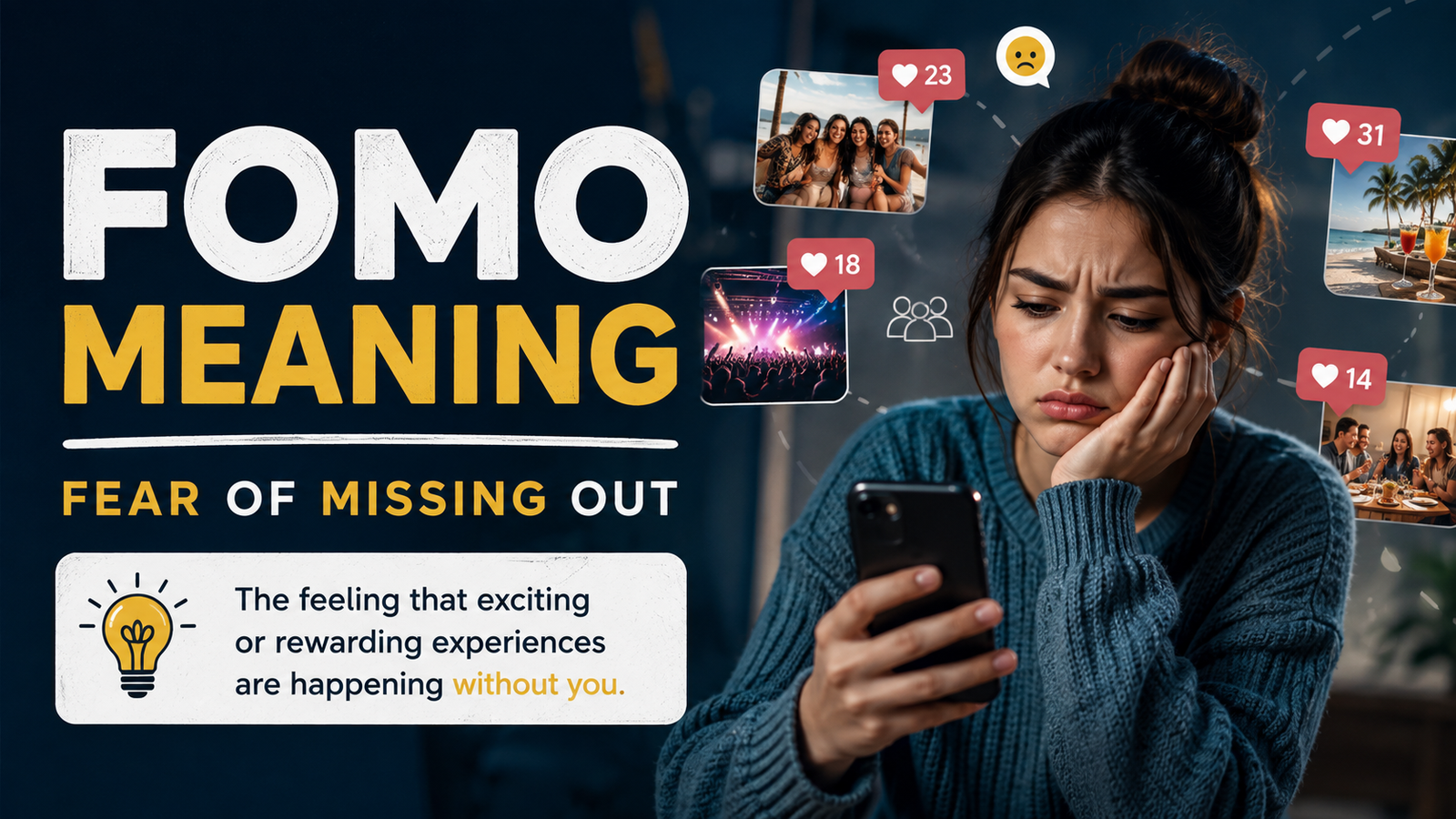
If you have ever seen your friends going out without you, noticed people attending an exciting event on Instagram, or worried that everyone else is enjoying something you are missing, you have probably experienced FOMO.
So, what does FOMO meaning actually refer to?
FOMO stands for “Fear of Missing Out.” It describes the uneasy or anxious feeling that you might be missing an enjoyable, exciting, important, or rewarding experience while other people are taking part in it.
The expression is especially common on social media, where people constantly see photos, videos, stories, and posts about what others are doing. Cambridge Dictionary defines FOMO as a worried feeling about missing exciting events that other people are attending, particularly when social media makes you aware of them.
Today, FOMO is used far beyond parties and social events. People may feel FOMO about travel, relationships, shopping, careers, investments, entertainment, friendships, or even simple everyday decisions.
This guide explains the FOMO meaning, pronunciation, origin, examples, synonyms, antonyms, common usage, and answers to frequently asked questions in simple English.
What Does FOMO Mean?
FOMO means “Fear of Missing Out.”
It is the feeling that something exciting, valuable, or enjoyable is happening somewhere else and that you are not part of it.
For example, imagine that you stay home on Saturday night. Later, you see pictures of your friends at a party. They appear to be having an amazing time.
You might suddenly think:
“I should have gone.”
Or:
“Everyone is having fun except me.”
That uncomfortable feeling is FOMO.
FOMO does not necessarily mean that you genuinely wanted to attend the event. Sometimes, you only start wanting something after seeing other people enjoy it.
That is one reason FOMO can influence decisions. It can make people say yes to plans, purchases, opportunities, or experiences simply because they are afraid of being left out.
FOMO Meaning in Simple English
In very simple English:
FOMO = worrying that you are missing something good while other people are enjoying it.
It can happen when you:
- Miss a party
- See friends traveling without you
- Notice people buying a popular product
- See colleagues receiving promotions
- Watch people attending a concert
- See couples enjoying romantic experiences
- Notice a trend becoming popular
- Hear about an opportunity after it has passed
How Do You Pronounce FOMO?
FOMO is usually pronounced as a word rather than saying each letter separately.
The common American pronunciation is approximately “FOH-moh.” Cambridge gives the American pronunciation as /ˈfoʊ.moʊ/ and the British pronunciation as /ˈfəʊ.məʊ/.
The word comes from the first letters of:
Fear
Of
Missing
Out
So, FOMO is an acronym.
FOMO Origin: Where Did the Word Come From?
The idea behind FOMO is much older than social media. People have always worried about being excluded or missing rewarding experiences.
However, the modern acronym FOMO has a more specific history.
Patrick J. McGinnis is widely credited with coining the term while he was a student at Harvard Business School. In 2004, he used FOMO in a humorous article published in the school’s student newspaper, The Harbus.
McGinnis used the term to describe a pattern he noticed in student life. People sometimes made social decisions because they were afraid of missing an experience rather than because the experience was necessarily the best choice for them.
He also introduced another expression at the same time: FOBO, meaning “Fear of a Better Option.”
The word gradually spread beyond Harvard. The growth of the internet, smartphones, and social media helped FOMO become a widely recognized part of everyday language.
Research has also examined FOMO as a psychological and social phenomenon. Academic literature describes it as involving the perception that other people are having rewarding experiences and a desire to remain connected to what others are doing.
Why Is FOMO So Common Today?
Modern technology makes FOMO easier to experience.
Before social media, you might not know what your friends were doing every evening. If you stayed home, you could simply enjoy your night without seeing dozens of updates from other people.
Today, a few taps can show you:
- Who went to a restaurant
- Who attended a concert
- Who traveled abroad
- Who got engaged
- Who bought a new car
- Who received a promotion
- Who attended an exclusive event
This constant stream of information can create the impression that other people’s lives are always exciting.
But social media usually shows selected moments rather than complete lives.
Someone may post a picture from an amazing vacation while leaving out the stressful flight, expensive hotel bill, exhaustion, or difficult moments that happened during the trip.
That difference is important.
FOMO often grows when we compare our ordinary moments with other people’s carefully selected highlights.
Research reviews have linked FOMO with problematic social-media use and negative emotional experiences, although FOMO itself should not automatically be treated as a mental-health diagnosis.
FOMO Meaning in Texting
In texting and online conversations, FOMO usually has a casual meaning.
Someone might text:
“I have serious FOMO right now.”
This means:
“I feel like I’m missing something fun or important.”
Another person might say:
“Don’t give me FOMO!”
That usually means:
“Stop showing me what I’m missing because now I want to be there too.”
Examples of FOMO in Texting
Friend: “We’re all going to the beach tomorrow.”
You: “Wait, what? Now I have FOMO!”
Here, FOMO means that you suddenly feel bad about not joining them.
Another example:
“I wasn’t planning to buy the tickets, but everyone’s going. Major FOMO.”
The person is saying that their decision is being influenced by the fear of missing the experience.
FOMO Meaning on Social Media
On social media, FOMO often describes the emotional reaction people have after seeing other people’s activities.
For example, you open Instagram and see:
“Everyone I know is at this concert.”
You were perfectly comfortable at home five minutes earlier.
Now you feel as if you made the wrong decision.
That is a classic example of social-media FOMO.
Social platforms can make FOMO stronger because information about other people’s activities is available almost instantly. Academic research has specifically examined the relationship between FOMO, social networking, and the desire to stay connected.
FOMO Meaning in Love and Relationships
FOMO can also appear in romantic relationships.
For example, someone who is single may constantly see engagement announcements, wedding photographs, romantic vacations, or couples posting about their relationships.
They may start thinking:
“Everyone is in a relationship except me.”
That can create relationship FOMO.
A person in a relationship can experience FOMO too.
They might wonder whether they could be happier with someone else after seeing attractive couples or romantic content online.
However, social media does not provide a complete picture of another person’s relationship.
A happy photograph does not necessarily mean a perfect relationship.
Relationship FOMO Example
“I wasn’t worried about dating until I saw all my friends getting engaged. Now I feel like I’m behind.”
This is an example of FOMO because the person’s feelings are being influenced by what other people appear to be experiencing.
FOMO Meaning in Everyday Life
FOMO is not limited to social situations.
It can influence everyday decisions.
Shopping FOMO
A store announces:
“Only 10 left!”
You did not need the product, but suddenly you feel pressured to buy it.
That can be shopping-related FOMO.
Travel FOMO
You see friends traveling to another country and think:
“Why am I not doing that?”
You may suddenly feel dissatisfied with your own routine.
Career FOMO
You hear that someone your age has started a successful company.
You begin wondering whether you are falling behind professionally.
Investment FOMO
An asset or market becomes popular, and everyone seems to be talking about it.
You decide to invest because you are afraid the opportunity will disappear.
This type of FOMO can be particularly risky because emotional pressure may replace careful decision-making.
Common FOMO Examples
Here are some simple examples of how the word is used.
Example 1:
“I stayed home last night, and now I have FOMO after seeing everyone’s pictures.”
Example 2:
“Don’t post any more vacation photos. You’re giving me FOMO!”
Example 3:
“I bought the concert ticket because I didn’t want to experience FOMO.”
Example 4:
“She gets FOMO whenever her friends make plans without her.”
Example 5:
“Social media gives me FOMO when I see people traveling all the time.”
Example 6:
“I wasn’t interested in the new phone until everyone started talking about it. Now I have FOMO.”
Example 7:
“He joined the group because he was afraid of missing out.”
These examples show that FOMO can be used as both a noun and part of casual expressions.
Is FOMO a Bad Thing?
Not necessarily.
FOMO is a normal human feeling. Wanting to belong, stay connected, and participate in meaningful experiences is natural.
A small amount of FOMO can even encourage someone to try something new.
For example, you might hear about a community event and decide to attend because you do not want to miss an opportunity to meet people.
The problem begins when FOMO repeatedly controls your decisions.
If you constantly check your phone, compare yourself with others, spend money unnecessarily, lose sleep, or agree to plans you genuinely do not want, FOMO may be affecting your quality of life.
The key is not to eliminate every feeling of FOMO. Instead, learn to recognize it before allowing it to make decisions for you.
How to Deal With FOMO
If FOMO is becoming frustrating, several simple habits can help.
1. Ask Yourself What You Actually Want
Before joining an event or buying something, ask:
“Would I want this if I had never seen someone else doing it?”
That question can separate genuine interest from social pressure.
2. Remember That Social Media Is Selective
People usually post moments worth sharing.
They do not document every boring afternoon, argument, disappointment, or ordinary meal.
What you see online is often only a small part of someone’s life.
3. Limit Constant Checking
If you repeatedly check social media because you are afraid of missing an update, try creating periods when you put your phone away.
You may discover that you are not actually missing anything important.
4. Focus on Your Own Priorities
Ask yourself what matters to you.
Maybe you would rather spend Friday night resting than attending a crowded party.
That is not missing out. It is making a choice.
5. Practice JOMO
One popular response to FOMO is JOMO, or “Joy of Missing Out.”
JOMO means being comfortable with staying away from something and enjoying your own choice.
Instead of thinking:
“Everyone is there except me.”
JOMO encourages:
“I chose not to go, and I’m happy with that choice.”
FOMO Synonyms
There is no perfect one-word synonym for FOMO because the acronym describes a specific combination of fear, anxiety, comparison, and social pressure.
However, related words and phrases include:
- Fear of exclusion
- Anxiety about missing out
- Social anxiety
- Feeling left out
- Fear of being left behind
- Envy
- Social pressure
- Fear of missing an opportunity
- Desire to fit in
- Need to stay connected
The best synonym depends on the situation.
For example, “feeling left out” may describe the emotion, while “social pressure” may describe what causes someone to act.
FOMO Antonyms
The opposite of FOMO is not always one specific word.
However, several concepts can represent the opposite feeling:
JOMO — Joy of Missing Out
JOMO describes the satisfaction of choosing not to participate.
Contentment
Contentment means feeling satisfied with what you already have rather than constantly comparing yourself with others.
Self-confidence
A confident person may feel comfortable making choices without needing approval from everyone else.
Mindfulness
Mindfulness can help people focus on their current experience rather than worrying about what they might be missing elsewhere.
FOMO vs. FOBO
FOMO and FOBO sound similar, but they describe different fears.
FOMO means:
Fear of Missing Out
You are afraid that you will miss an experience or opportunity.
FOBO means:
Fear of a Better Option
You are afraid that you will choose something now and later discover that a better option was available.
For example:
FOMO: “I should go to this party because I don’t want to miss anything.”
FOBO: “I don’t know which restaurant to choose because another one might be better.”
Both terms were introduced by Patrick McGinnis in connection with his observations of decision-making and social behavior.
Common Ways to Use FOMO in a Sentence
Here are natural examples:
- “I have FOMO because everyone is going to the festival.”
- “Her Instagram posts gave me serious FOMO.”
- “Don’t let FOMO make you spend money you don’t have.”
- “I joined the trip because I didn’t want to miss out.”
- “He gets FOMO whenever his friends make plans.”
- “Social media can create a lot of FOMO.”
- “I stayed home and surprisingly didn’t feel any FOMO.”
- “That concert gave people major FOMO.”
Frequently Asked Questions About FOMO
What does FOMO stand for?
FOMO stands for “Fear of Missing Out.” It describes the worry that you are missing an enjoyable, exciting, or important experience that other people are having.
What does FOMO mean in texting?
In texting, FOMO usually means that someone feels bad, anxious, or left out because they are not participating in something other people are doing.
How do you pronounce FOMO?
FOMO is commonly pronounced “FOH-moh.” The American pronunciation is /ˈfoʊ.moʊ/.
Who invented the word FOMO?
Patrick J. McGinnis is widely credited with coining the modern acronym FOMO in a 2004 article while he was a student at Harvard Business School.
Is FOMO a real psychological feeling?
Yes. FOMO has been studied in psychology and behavioral research. Researchers describe it as involving concern that others are having rewarding experiences and a desire to remain connected with those experiences.
Is FOMO only caused by social media?
No. Social media can make FOMO more noticeable and frequent, but people can experience it without social media. Missing a party, opportunity, trip, or social gathering can also produce FOMO.
What is the opposite of FOMO?
One popular opposite concept is JOMO, meaning “Joy of Missing Out.” It describes feeling comfortable and even happy about choosing not to participate.
Can FOMO affect decision-making?
Yes. FOMO can encourage people to make quick choices because they fear losing an opportunity or being excluded. Taking a moment to consider what you genuinely want can help reduce this pressure.
Final Thoughts on FOMO Meaning
The FOMO meaning is simple: Fear of Missing Out.
It describes the uncomfortable feeling that something exciting, valuable, or rewarding is happening without you. Although people experienced this kind of feeling long before smartphones existed, the modern word FOMO was coined by Patrick McGinnis in 2004 and later became part of everyday digital language.
Today, you can see FOMO in texting, social media, dating, shopping, travel, careers, entertainment, and many other parts of life.
The most important thing to remember is that missing something does not automatically mean you are missing out on something better.
Other people’s highlights are not a complete picture of their lives. A good decision is not necessarily the decision that everyone else is making.
Sometimes, the healthiest response to FOMO is simply to pause and ask yourself:
“Do I really want this, or am I only afraid of missing it?”
That small question can turn FOMO from something that controls your choices into something you can recognize, understand, and manage.