
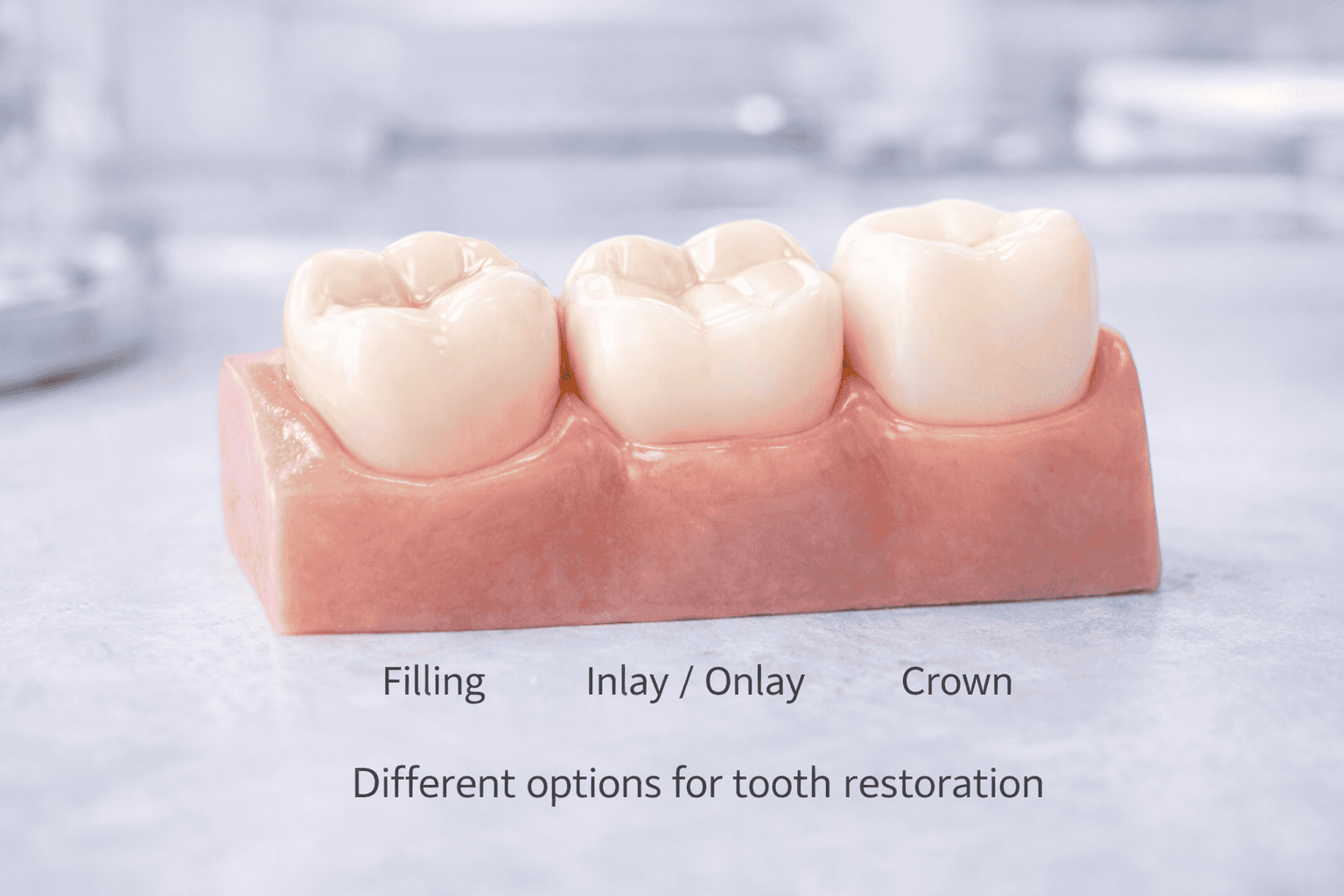
When a tooth needs work, your dentist’s recommended repair is rarely arbitrary. The amount of remaining enamel, how deep the decay reaches into the dentin, whether a cusp is weakened, and how your teeth contact during chewing all shape the plan. Understanding why a clinician chooses a direct filling, an inlay or onlay, or a full crown can make consent conversations clearer and help you care for the final restoration. This article explains the clinical checkpoints dentists use, the trade-offs between options, and realistic scenarios that show how a small lesion differs from a heavily restored, crack-prone molar.
- How Tooth Structure and Decay Depth Drive the Plan
Before recommending any restoration, a Dentist evaluates how much healthy enamel remains and how close the decay or fracture is to the pulp. Bitewing X-rays reveal interproximal lesions between teeth and the size of existing fillings, while a clinical exam checks for craze lines, defective margins, and pain on a bite test (useful for cracked tooth syndrome). Location matters: a small occlusal pit on a premolar behaves differently than a wide MOD lesion on a first molar that undermines the buccal and lingual cusps. Heavier occlusal forces in the back of the mouth also raise the strength bar.
Isolation and access influence durability too. Resin bonding is strongest in clean, dry enamel; saliva contamination at the gingival margin can weaken adhesion. That is why clinicians favor rubber dam isolation or careful retraction with cotton rolls and high-volume suction when placing adhesive restorations. If a cavity margin dips below the gumline, bonding to cementum is less predictable, which can push the decision toward an indirect restoration that relocates margins or a full coverage approach that protects vulnerable cusps.
- When a Direct Filling Is the Right Choice
Direct composite resin works well for small to moderate cavities, especially when most of the enamel shell is intact. After removing softened dentin, the tooth is etched, primed, and bonded; a matrix band and wooden wedge help shape a tight contact for class II (between teeth) fillings. Composite is placed in increments and cured with a light to reduce shrinkage stress, then polished to refine the occlusion. For shallow cervical lesions near the gumline or high-caries-risk spots, glass ionomer or a resin-modified variant may be chosen for its fluoride release and better performance on root surfaces.
There are limits. A very large composite spanning multiple surfaces on a load-bearing molar can flex under chewing and eventually fracture or leak at the margin. Patients with bruxism (clenching and grinding) add even more stress. In those cases, a direct repair might be a short-term patch. After a filling, brief cold sensitivity is normal; biting tenderness that persists beyond a couple of weeks warrants a recheck. Once numbness wears off, resume flossing around the new margin to prevent recurrent decay and let your dentist adjust any high spots to protect the restoration.
- Why an Inlay or Onlay Preserves Strength
Inlays and onlays are lab-made or CAD/CAM-milled restorations that fit into (inlay) or onto (onlay) the tooth, often covering one or more weakened cusps. They are designed when a direct filling would be too wide or deep, but a full crown would remove more healthy enamel than necessary. After conservative preparation, the dentist takes a digital scan or impression, places a provisional if a lab is used, and later bonds the final ceramic, hybrid, or metal restoration with resin cement. Because the dentist refines the occlusion outside the mouth, the fit can be precise, with smooth contacts and strong cuspal coverage.
The tradeoff is complexity and additional appointments when a lab is involved. Onlays cannot solve every problem; if a crack runs below the gumline or an entire wall is missing, full coverage may be required. Material selection depends on bite forces and esthetics. A lithium disilicate ceramic onlay blends beautifully and wears well against opposing teeth, while high-strength zirconia resists chipping under heavy load but is less translucent. For a grinder who fractured a cusp on a second molar, a bonded onlay plus a night guard distributes forces better than a large filling and preserves more tooth than a crown.
- When a Full Crown Becomes the Safer Plan
A crown is indicated when a tooth has lost so much structure that multiple cusps are undermined, when an existing restoration cracks through, or after root canal therapy, when a protective ferrule and full coverage help prevent vertical fracture. The preparation encircles the tooth, providing a defined margin (chamfer or shoulder) for seating. Materials include monolithic zirconia for high strength, porcelain-fused-to-metal for long service in high-stress areas, and lithium disilicate for anterior strength with improved translucency. Large core buildups or a post may be needed if little coronal dentin remains.
There are practical considerations. A temporary crown protects the prepared tooth while the final crown is made; avoid sticky foods that could dislodge it, and gently slide floss out to keep the provisional in place. Once the definitive crown is cemented, mild thermal sensitivity can occur initially as the tooth acclimates and occlusion settles. Daily flossing at the crown margin and fluoride toothpaste help prevent recurrent decay where the crown meets the tooth. For patients with bruxism, a custom night guard reduces the risk of porcelain chipping and crown loosening. Periodic bitewing X-rays allow your dentist to monitor the margins over time.
Two Real World Scenarios and Questions to Bring to Your Exam
Scenario 1: A college student’s bitewing X-ray shows a small interproximal lesion limited to enamel on an upper premolar. The contact is tight, but the cusps are strong. A bonded composite, placed with a sectional matrix and wedge,e restores the contour and requires only a localized occlusal adjustment. Scenario 2: A parent reports sharp bite pain on a lower molar with an old MOD amalgam. Transillumination reveals a crack line crossing a cusp; the buccal wall flexes under a bite stick. Here, a full coverage crown (possibly after a bonded core) is safer than adding more filling material that could propagate the crack.
To participate in the decision at your next visit, ask: How much enamel and dentin remain after decay removal, and will any cusps be covered? Can the tooth be isolated well for strong bonding, or is an indirect approach more predictable? What material fits my bite forces and esthetic goals, and should I use a night guard? How will you evaluate the occlusion to prevent high contacts? What is the plan if sensitivity lingers? Finally, what follow-up schedule will check margins with bitewing X-rays and confirm the restoration is performing as expected?
Early, well-matched treatment protects tooth structure you cannot get back. Small cavities repaired with conservative composites can last when isolation is excellent, and home care is steady. Larger fractures and heavily restored molars fare better with bonded onlays or full crowns that control flex and distribute load. Bring your bite history, clenching habits, and any past sensitivity to the conversation, and ask your clinician to show you the X-rays and photographs that inform the choice. Understanding the reasoning behind the restoration helps you maintain it with daily flossing, fluoride, and consistent checkups.
