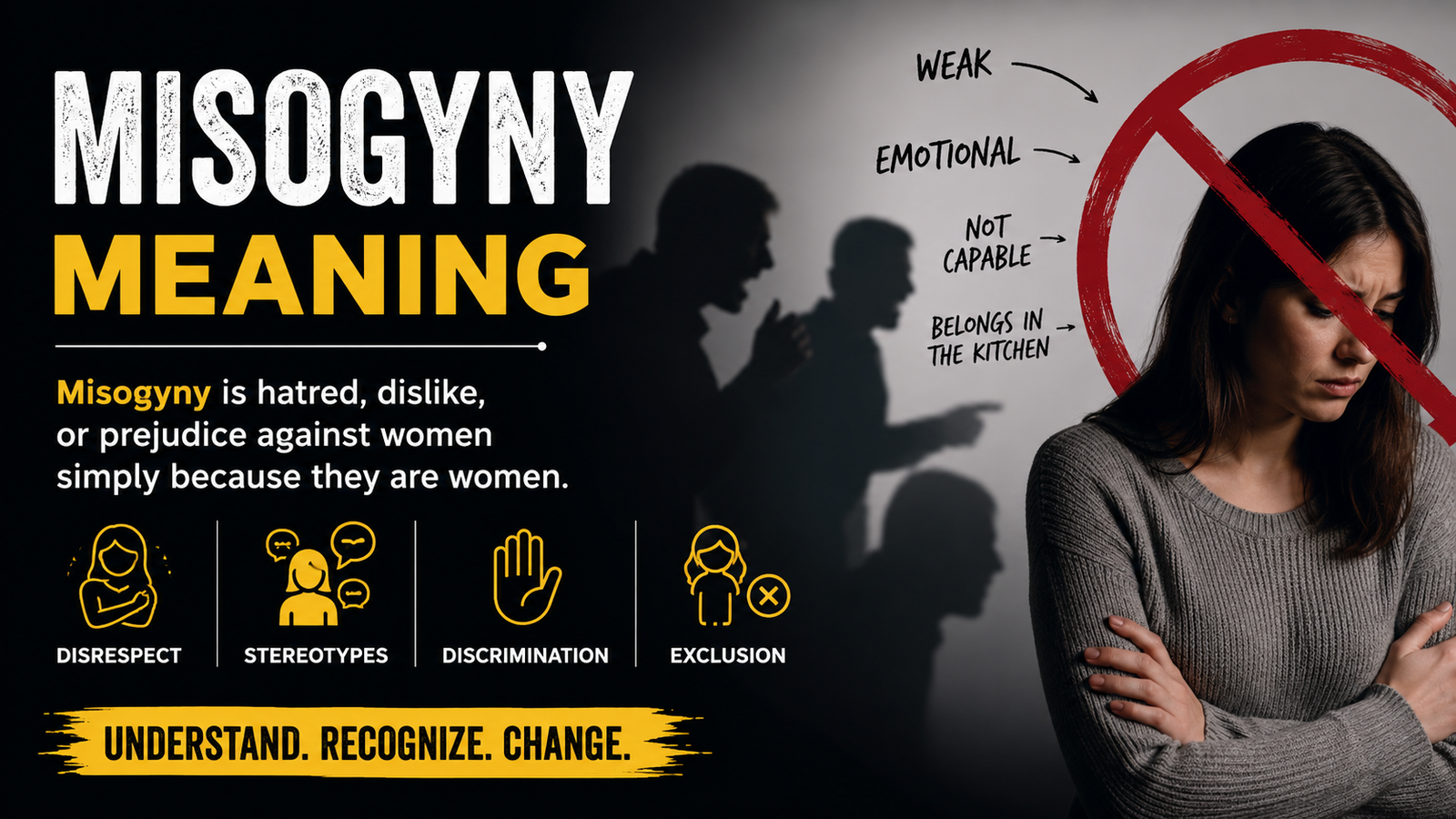
The word misogyny is commonly used when talking about prejudice, hostility, discrimination, or hatred directed toward women and girls. You may see it in news reports, social media discussions, books, workplaces, and conversations about gender equality.
But what does misogyny really mean? Is it simply hatred of women, or can it include more subtle attitudes and behavior?
In simple English, misogyny means a strong dislike, contempt for, or prejudice against women because they are women. Oxford defines it as a feeling of hatred or dislike toward women, or a belief that women are not as good as men.
Misogyny does not always appear as openly hateful language. It can also show up through unfair treatment, degrading stereotypes, double standards, harassment, exclusion, or assumptions that women are naturally less capable than men.
This guide explains the misogyny meaning, pronunciation, origin, examples, synonyms, antonyms, related words, common usage, and frequently asked questions in clear and simple English.
What Is the Meaning of Misogyny?
Misogyny means hatred, dislike, contempt, mistrust, or deeply rooted prejudice against women or girls.
In everyday language, you can think of it as treating women negatively simply because they are women.
For example, imagine a qualified woman applies for a management position. If someone rejects her only because they believe women should not be leaders, that attitude can be described as misogynistic.
Similarly, if someone repeatedly makes insulting comments about women as a group, those comments may be described as misogynistic.
Misogyny can be obvious, such as openly hateful statements. It can also be subtle, such as repeatedly dismissing women’s opinions while giving men’s opinions more respect.
The exact meaning can vary slightly depending on context. Modern discussions often use the term more broadly than simply “hatred of women,” including entrenched prejudice and behavior that demeans or disadvantages women.
Misogyny Pronunciation
The word misogyny can look difficult when you first see it.
A common American-English pronunciation is approximately mih-SOJ-uh-nee.
Oxford lists British pronunciation as /mɪˈsɒdʒɪni/ and American pronunciation as /mɪˈsɑːdʒɪni/.
How to Remember the Pronunciation
Break the word into three simple parts:
mi + soj + uh-nee
The middle sound is similar to the “j” sound in the word “judge.”
Misogyny Origin and Etymology
The history of misogyny goes back to Ancient Greek.
The word comes from Greek misogynia, connected to misogynēs, meaning a woman-hater. It combines Greek elements associated with hatred and woman.
The English noun misogyny dates to the 1650s, according to etymological sources.
Interestingly, the underlying Greek term is much older than its English form. Ancient Greek writers used related terminology for hostility toward women. One academic discussion traces the Greek term misogunia to Antipater of Tarsus around the second century BCE.
The term later appeared in English-language discussions during the 17th century. Oxford Academic notes that one early recorded English example appears in the Glossographia, published in 1656, where misogyny was defined in terms of hatred or contempt toward women.
So, although misogyny is a modern everyday word, its linguistic roots are very old.
What Does Misogynistic Mean?
Misogynistic is the adjective form of misogyny.
If something shows hatred, contempt, or prejudice toward women, it can be described as misogynistic.
For example:
- “The comment was misogynistic.”
- “She criticized the misogynistic attitude in the workplace.”
- “The article contained several misogynistic stereotypes.”
The word can describe a person’s attitude, speech, behavior, writing, policy, culture, or other forms of expression.
The related noun misogynist refers to a person who expresses or holds misogynistic views.
Simple Examples of Misogyny
Understanding examples makes the meaning much easier.
1. Believing Women Are Less Intelligent
Someone says, “Women are naturally less intelligent than men.”
That is a sexist and potentially misogynistic belief because it assigns women an inferior position based on gender.
2. Rejecting Women From Leadership
A company refuses to consider qualified female candidates for leadership because its owners believe men should always be in charge.
This can be an example of institutionalized gender prejudice and misogyny.
3. Making Generalized Insults About Women
A person repeatedly uses insulting language to describe women as a group.
When those insults express contempt or hostility toward women generally, they can be described as misogynistic.
4. Applying Different Standards
Suppose a man is praised for being confident and ambitious, while a woman displaying exactly the same behavior is called difficult or aggressive solely because she is a woman.
That kind of gender-based double standard can contribute to misogynistic attitudes.
5. Harassing Women Because of Their Gender
Gender-based harassment, intimidation, or degrading treatment can also be associated with misogyny, particularly when women are targeted because of their gender.
The important point is that misogyny is not limited to one specific type of behavior. It can appear in speech, attitudes, social practices, and treatment of women.
Examples of Misogyny in Sentences
Here are some natural examples of how the word is used:
- The journalist criticized the misogyny expressed in the online comments.
- Many people spoke out against the actor’s misogynistic remarks.
- The novel explores misogyny and gender inequality.
- She experienced misogyny after being told that women were unsuitable for leadership roles.
- The organization introduced new policies to address sexist and misogynistic behavior.
- His comments were criticized as openly misogynistic.
- The documentary examines how misogyny can affect women’s everyday lives.
These examples show that misogyny is normally used as a noun, while misogynistic is used as an adjective.
Misogyny vs. Sexism
People often use misogyny and sexism interchangeably, but they are not always identical.
Sexism generally refers to prejudice, stereotyping, discrimination, or unfair treatment based on sex or gender.
Misogyny specifically focuses on hostility, contempt, hatred, or entrenched prejudice directed toward women.
In simple terms:
Sexism = gender-based prejudice or discrimination.
Misogyny = hostility, contempt, hatred, or deep prejudice toward women.
The two concepts can overlap. For example, refusing to hire women because of a belief that women are inferior can involve both sexism and misogyny.
Some scholars also distinguish the concepts more sharply. Philosopher Kate Manne, for example, has argued that misogyny can function as a mechanism that polices or punishes women who challenge male dominance, rather than being limited to personal hatred.
Misogyny vs. Misandry
Another word people often encounter is misandry.
Misandry means hatred, dislike, contempt, or prejudice toward men.
The distinction is straightforward:
- Misogyny: hostility or prejudice toward women.
- Misandry: hostility or prejudice toward men.
Both words describe gender-based hostility, but they refer to different targets.
Synonyms of Misogyny
There is no perfect synonym for misogyny, because each related word can carry a slightly different meaning.
Depending on the context, possible alternatives include:
- Hatred of women
- Contempt for women
- Dislike of women
- Prejudice against women
- Anti-woman bias
- Gender-based hostility
- Sexist prejudice
- Woman-hatred
The best synonym depends on what you are trying to describe.
For example, “prejudice against women” may be more appropriate in an academic article, while “hatred of women” is more direct and closer to the traditional dictionary definition.
Antonyms of Misogyny
There is no single universally common everyday antonym for misogyny.
However, several words express an opposing attitude:
- Respect for women
- Equality
- Gender equality
- Acceptance
- Admiration of women
- Philogyny
The relatively uncommon word philogyny means love of or fondness for women. Etymological sources identify it as an opposite of misogyny.
In everyday English, however, people are much more likely to say respect for women or support for gender equality than “philogyny.”
Common Forms of Misogyny
Misogyny does not always look the same.
Open Misogyny
This is the most obvious form. It includes openly hostile statements, insults, or claims that women are inferior.
Everyday or Casual Misogyny
Sometimes misogyny appears in jokes, stereotypes, comments, or assumptions that may be presented as harmless.
For example, repeatedly suggesting that women are naturally incapable of making important decisions reinforces a negative gender stereotype.
Oxford specifically notes that the expression “casual misogyny” is used in discussions of everyday behavior and attitudes.
Institutional Misogyny
This refers to patterns within organizations or social systems that disadvantage women.
It may involve discriminatory rules, unequal opportunities, or practices that consistently treat women less favorably.
Online Misogyny
Social media and online communities can also become places where misogynistic insults, harassment, stereotypes, and threats appear.
Because online communication can spread quickly, a single hostile comment can reach a large audience.
Is Every Criticism of a Woman Misogynistic?
No.
Criticizing a woman does not automatically mean the criticism is misogynistic.
People can fairly disagree with a woman’s opinions, decisions, work, or behavior.
The key question is why and how she is being criticized.
For example, saying, “I disagree with her business decision because it caused financial problems” is not inherently misogynistic.
But saying, “Women should never run businesses because they cannot make good decisions” expresses a gender-based generalization and can be misogynistic.
Context matters.
Can Women Be Misogynistic?
Yes.
Misogyny describes an attitude or behavior directed against women; it is not grammatically or conceptually restricted to men.
Women can internalize or express negative stereotypes about women, just as people of any gender can repeat prejudiced beliefs.
For example, a woman who argues that women are inherently less intelligent than men could be expressing a misogynistic belief.
This is sometimes discussed through the concept of internalized misogyny, where women absorb and reproduce negative beliefs about women.
Why Is Understanding Misogyny Important?
Understanding the word matters because it gives people a clearer way to discuss gender-based prejudice.
Without specific vocabulary, different behaviors can become difficult to describe accurately.
For example, there is a meaningful difference between ordinary disagreement and rejecting someone’s opinion because she is a woman.
The word misogyny helps identify that difference when the evidence supports it.
At the same time, the term should be used carefully. Calling every disagreement misogynistic can make the word less precise. A strong accusation should be based on the actual language, behavior, pattern, or context involved.
Misogyny in Modern Language
The word appears frequently in journalism, academic writing, social media, politics, literature, film criticism, and discussions about workplace culture.
It is also increasingly used when people discuss online harassment and gender-based stereotypes.
Modern definitions can therefore extend beyond the narrow idea of personal hatred. Dictionary.com, for example, includes hatred, dislike, or mistrust as well as ingrained and institutionalized prejudice against women.
This broader usage reflects how prejudice can operate through both individual attitudes and larger social practices.
Frequently Asked Questions About Misogyny
What does misogyny mean in simple English?
Misogyny means hatred, dislike, contempt, or strong prejudice against women because they are women.
What is an example of misogyny?
A simple example is believing that women are naturally inferior to men and therefore should not hold leadership positions. Gender-based harassment or degrading generalizations about women can also be misogynistic.
How do you pronounce misogyny?
It is commonly pronounced approximately mih-SOJ-uh-nee. British and American pronunciations differ slightly.
What is the opposite of misogyny?
There is no single everyday opposite, but respect for women, gender equality, and philogyny can express an opposing attitude. Philogyny is a relatively uncommon word meaning love or fondness for women.
Is misogyny the same as sexism?
Not exactly. Sexism is a broader term for prejudice or discrimination based on sex or gender. Misogyny specifically concerns hostility, contempt, hatred, or deeply rooted prejudice toward women. The concepts can overlap.
What is a misogynist?
A misogynist is a person who expresses hatred, contempt, or strong prejudice toward women.
What does misogynistic mean?
Misogynistic is the adjective form of misogyny. It describes words, attitudes, actions, or behavior that show hostility, hatred, contempt, or prejudice toward women.
Can a woman be misogynistic?
Yes. Misogyny refers to prejudice or hostility toward women, not exclusively to the gender of the person expressing it.
Is misogyny always obvious?
No. It can be direct and openly hostile, but it can also appear through stereotypes, double standards, exclusion, or assumptions about women’s abilities.
Final Thoughts on Misogyny Meaning
So, what does misogyny mean?
In simple terms, misogyny is hostility, contempt, hatred, or deep prejudice toward women or girls. It can appear in obvious insults and discrimination, but it can also be expressed through stereotypes, unequal treatment, harassment, and assumptions that women are inferior to men.
The word has ancient Greek roots and entered English centuries ago, but it remains highly relevant in modern discussions about gender and equality.
Understanding the difference between misogyny, sexism, misogynistic, misogynist, and misandry can make conversations about gender more precise.
Most importantly, the term should be used based on context rather than as a label for every disagreement involving a woman. Used accurately, misogyny gives people a clear word for a serious form of gender-based hostility and prejudice.