Introduction
If you searched for rox.com products catalog, you may expect to find a traditional online store with a large list of physical products. That assumption is understandable, but the current ROX.com website represents something quite different.
Rox.com is the website of Rox Data Corp, an AI software company focused on revenue operations and autonomous sales agents. Its “products catalog” is therefore better understood as a catalog of software capabilities, AI agents, workflows, and revenue-intelligence tools rather than a conventional retail inventory.
This distinction matters because numerous third-party pages use the phrase “ROX.com products catalog” to describe fashion, electronics, outdoor equipment, jewelry, or other merchandise. Those descriptions can refer to completely different businesses using the ROX name.
In this review, the focus is specifically on rox.com, the official website of Rox Data Corp, as it exists in 2026.
What Is ROX.com?
ROX.com is the official online platform for Rox Data Corp, a San Francisco-based software company developing AI-powered revenue agents for sales and go-to-market teams.
Rather than selling conventional consumer products, Rox positions its platform as a revenue operating system. Its technology is designed to automate activities across the sales cycle, including prospecting, engagement, account intelligence, pipeline management, and expansion.
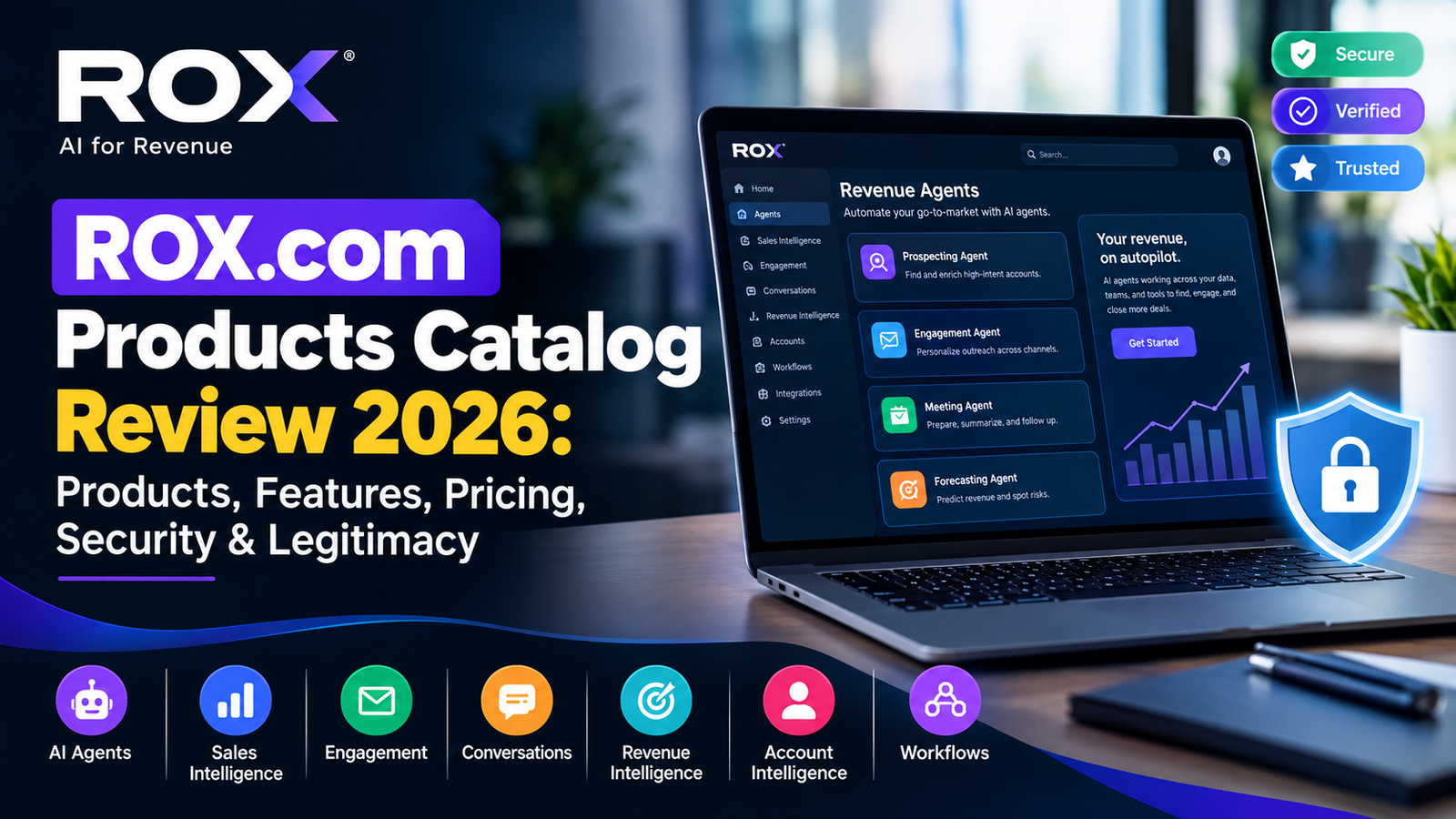
The company’s current platform includes capabilities such as Sales Intelligence, Sales Engagement, Conversation Intelligence, Revenue Intelligence, Account Intelligence, and Agent Workflows.
The underlying idea is relatively straightforward: businesses already have large amounts of customer information spread across CRMs, email systems, calendars, calls, warehouses, documents, and other tools. Rox attempts to bring that information together so AI agents can use it to perform revenue-related tasks.
This makes the ROX catalog closer to a B2B software product ecosystem than a normal ecommerce catalog.
What Does ROX Actually Sell?
The core offering is software access rather than physical inventory.
The platform provides AI-powered capabilities that can research accounts, identify potential buyers, monitor sales signals, generate outreach, summarize conversations, identify deal risks, and support revenue forecasting.
Rox also describes its system as “warehouse-native,” meaning it can work with enterprise data infrastructure rather than relying exclusively on a traditional CRM as the source of truth.
Who Owns ROX.com?
The website is operated by Rox Data Corp, which identifies itself as the company behind the Rox platform.
The company’s official website lists Ishan Mukherjee as Cofounder and CEO, alongside cofounders including Shriram Sridharan, Diogo Ribeiro, and Christopher Ré.
Public corporate-record information also identifies Rox Data Corp as an active corporation associated with San Francisco, with a filing dating to May 10, 2024.
The company’s official materials list its San Francisco address as 251 Rhode Island St, Suite 205, San Francisco, CA 94103.
This is useful because ownership transparency is one of the first things worth checking when evaluating an unfamiliar website.
ROX.com Products Catalog: Main Products and Services
The phrase rox.com products catalog can be misleading because Rox does not organize its offering like a conventional shopping website.
Instead, its catalog is essentially a collection of interconnected software capabilities.
1. Agent Workflows
Agent Workflows are designed to automate repeatable revenue processes.
Rox’s platform allows businesses to create workflows in which an AI agent performs a series of actions based on business rules, data, and triggers.
For example, a company could configure a workflow to generate a recurring sales forecast and deliver it through Slack. The platform demonstrates this type of scheduled workflow directly on its website.
This approach can reduce repetitive administrative work while keeping human employees involved where judgment is required.
2. Sales Intelligence
Sales Intelligence focuses on prospecting, enrichment, and identifying relevant leads.
Rox says its system can find prospects matching an organization’s ideal customer profile and enrich account information automatically.
For a sales representative, that could mean spending less time manually researching companies and more time reviewing qualified opportunities.
The practical value depends heavily on data quality. AI cannot produce reliable prospect recommendations if the underlying customer profile, account information, or external signals are inaccurate.
3. Sales Engagement
Sales Engagement covers outbound communication and pipeline-generation activities.
Rox describes its platform as capable of generating multi-channel sequences and allowing agents to automate parts of the outreach process.
The important distinction is that Rox attempts to connect outreach with account intelligence rather than simply sending generic sequences.
That means an agent can potentially use information about a company, contacts, engagement, and buying signals when determining what action should happen next.
4. Conversation Intelligence
Conversation Intelligence is designed to help teams extract useful information from meetings and sales conversations.
The platform can use conversation information to assist with meeting preparation, insights, follow-ups, and account context.
For larger sales organizations, this can be useful because important customer information frequently remains buried inside calls and emails.
Instead of relying entirely on salespeople to manually update the CRM after every conversation, automated systems can capture and organize relevant information.
5. Revenue Intelligence
Revenue Intelligence focuses on understanding what is happening throughout the sales pipeline.
Rox describes capabilities including deal-risk detection, stakeholder engagement monitoring, revenue forecasting, and pipeline signals.
This is particularly relevant to sales managers who need to understand which opportunities require attention.
Rather than reviewing every opportunity manually, AI-based monitoring can surface accounts or deals showing signals that deserve investigation.
6. Account Intelligence
Account Intelligence provides a broader view of individual companies and customer relationships.
Rox combines information from sources such as CRM systems, email, calendars, documents, public web data, and data warehouses to create a connected view of accounts.
This is one of the more important aspects of the platform because the usefulness of an AI sales agent depends heavily on the context available to it.
How Does the ROX.com Platform Work?
The basic workflow can be understood in several stages.
Step 1: Connect Your Business Data
Organizations connect relevant business systems to Rox.
The platform supports integrations involving systems such as Salesforce, HubSpot, Gmail, Microsoft Outlook, Slack, and other services.
Enterprise deployments can also work with warehouse infrastructure.
Step 2: Build a Unified Customer View
Rox combines information from connected systems and creates a more unified account context.
Its documentation describes integrations with data warehouses and lakehouses, including Snowflake, Databricks, and BigQuery.
Step 3: AI Agents Analyze Signals
Agents can examine account activity, engagement, CRM information, and other signals.
The goal is to identify opportunities, risks, prospects, and actions that deserve attention.
Step 4: Agents Execute Workflows
Depending on configuration, agents can conduct research, prepare outreach, monitor opportunities, update information, and assist with other revenue workflows.
Step 5: Humans Review Important Actions
Despite the term “autonomous,” Rox itself states that automated features operate within user-defined parameters and require initial configuration and ongoing oversight.
That distinction is important.
AI automation should not be interpreted as completely unsupervised business decision-making.
User Experience and Interface Analysis
The current ROX.com website has a product-led B2B software presentation rather than a traditional ecommerce design.
The main navigation emphasizes the platform, research, pricing, customers, resources, company information, and sales contact options.
This structure makes sense for enterprise software because prospective customers typically need to understand the technology, integrations, security model, and business use cases before purchasing.
The platform also extends beyond a standard web interface. Rox lists interfaces and integrations including web applications, Slack, Microsoft 365, Google Workspace, Chrome, mobile applications, APIs, and MCP-related capabilities.
For technical organizations, that broader integration strategy can be important because employees do not necessarily want to switch constantly between separate applications.
ROX.com Pricing
Pricing is one of the areas where the ROX catalog differs from older descriptions found online.
The current official pricing page lists:
- Individual: $100 per month
- Teams: $255 per month
- Enterprise: Custom requirements and pricing
The Individual plan includes 10,000 actions per month, while the Teams plan includes 15,000 actions per month and additional multi-user and CRM functionality.
This is significant for anyone researching the rox.com products catalog, because some older articles describe Rox only as an enterprise “contact for pricing” platform.
The pricing structure has evolved.
Potential customers should therefore check the official pricing page rather than relying on older third-party articles.
Is ROX.com Legit or a Scam?
The available evidence indicates that rox.com is an operating software company rather than an anonymous ecommerce website.
Several factors support that assessment.
First, Rox identifies its corporate entity and leadership team publicly.
Second, public corporate-record information lists Rox Data Corp as an active corporation.
Third, the company publishes detailed product, privacy, and security information.
Fourth, Rox maintains a dedicated security and compliance section that references SOC 2 Type II, GDPR, encryption, and independent security audits.
Its Trust Center also provides information concerning SOC 2 Type II, security policies, penetration testing, access controls, monitoring, and related documentation.
What About SSL?
ROX.com uses HTTPS, which is an important baseline security measure for protecting traffic between a browser and website.
However, HTTPS or an SSL/TLS certificate does not by itself prove that a company is legitimate.
A stronger assessment considers corporate identity, policies, security documentation, contact information, product transparency, and independent records.
In Rox’s case, those additional signals are available.
Domain Age
Domain age should not be treated as the primary legitimacy test here.
The relevant company, Rox Data Corp, has public corporate records dating to 2024, while the website and company have continued developing their product and public presence.
A domain-registration date alone would not establish whether a software platform is trustworthy, so it is better to evaluate the broader evidence.
Pros and Cons of ROX.com
Pros
Broad revenue automation
Rox attempts to cover multiple stages of the revenue lifecycle instead of focusing on only one sales function.
Strong enterprise integration model
The platform can connect CRM, communication, productivity, and warehouse data sources.
Security documentation
Rox publicly provides substantial security and compliance information, including SOC 2 Type II and encryption claims.
Flexible pricing
The current pricing structure gives smaller teams a way to start without necessarily entering an enterprise-only purchasing process.
Automation beyond simple chatbots
The platform is designed around agents that can perform workflows rather than merely answer questions.
Cons
Complexity
A platform covering prospecting, account intelligence, conversations, pipeline management, and automation can require more setup than a single-purpose sales application.
Data dependency
The usefulness of AI recommendations depends on the quality, completeness, and freshness of connected data.
AI still requires oversight
Rox itself states that autonomous features require configuration and ongoing oversight.
Enterprise governance can take time
Companies handling sensitive customer information may need security, legal, privacy, and compliance teams to review the deployment before implementation.
Realistic Use Cases
Who Should Consider ROX.com?
ROX is primarily relevant to:
- B2B sales organizations
- Revenue operations teams
- Sales development teams
- Enterprise go-to-market organizations
- Companies with large CRM datasets
- Businesses seeking automated prospect research
- Organizations interested in AI-assisted pipeline management
It becomes more relevant when a company already has structured sales processes and substantial customer data.
Who May Not Need It?
A small business with only a handful of customers and very limited sales activity may not need a sophisticated revenue-agent platform.
Likewise, companies without reliable CRM or customer data may need to improve their underlying data processes before expecting advanced AI automation to deliver meaningful results.
Alternatives to ROX.com
The appropriate alternative depends on the specific job a company wants to accomplish.
Apollo
Apollo combines prospecting, sales engagement, and contact-data capabilities. It may appeal to organizations primarily looking for outbound prospecting and engagement rather than a broad autonomous revenue operating system.
Salesforce
Salesforce provides a much broader CRM ecosystem, including sales management, customer data, automation, and AI capabilities. It is particularly relevant for companies that want their CRM to remain the central operational system.
HubSpot
HubSpot combines CRM, marketing, sales, customer service, and automation features. It can be relevant to organizations looking for an integrated business platform rather than a specialized AI revenue-agent architecture.
The key distinction is architectural: ROX emphasizes AI agents operating across a connected revenue workflow, while alternatives may center more heavily on CRM, prospecting, marketing, or sales engagement.
Security and Privacy Review
Security is particularly important for a platform that can access sales and customer information.
ROX’s security documentation states that customer data processed through the platform is encrypted in transit and at rest using AES-256 encryption. The company also says customer data is not used to train generalized machine-learning models.
The company’s privacy policy explains that information can be collected directly from users and through connected third-party services.
The policy also explains the use of cookies and third-party data partners for website visitor identification and related activities.
For enterprise deployments, Rox documents approaches involving data sharing and replication, including support for warehouse environments. Its documentation says customer environments can use isolated databases and configurable geographic storage for certain enterprise requirements.
Potential enterprise customers should still conduct their own security review.
A company’s SOC 2 status does not eliminate the need to examine permissions, integrations, data-retention requirements, subprocessors, contractual terms, and the exact data being connected.
Final Verdict
The biggest takeaway from researching the rox.com products catalog is that the keyword does not describe a conventional online shopping catalog.
ROX.com is the official website of Rox Data Corp, an AI revenue software company. Its product ecosystem centers on revenue agents, sales intelligence, engagement, conversation intelligence, account intelligence, revenue intelligence, and automated workflows.
The company provides identifiable corporate information, a public product platform, pricing information, privacy documentation, and a dedicated security and compliance center. These are useful transparency signals when researching an unfamiliar technology provider.
The platform is particularly relevant to businesses that want to connect customer data and automate repetitive sales processes. At the same time, its effectiveness depends on implementation quality, data accuracy, governance, and human oversight.
For anyone searching specifically for a rox.com products catalog, the most accurate interpretation is therefore a catalog of AI-powered revenue software capabilities, not a catalog of physical consumer products.
Frequently Asked Questions
1. What is the ROX.com products catalog?
The ROX.com products catalog refers to the software capabilities and AI-powered revenue tools offered through Rox Data Corp’s platform. It includes sales intelligence, engagement, account intelligence, conversation intelligence, revenue intelligence, and agent workflows.
2. Is ROX.com an online shopping website?
No. The current ROX.com website is primarily a B2B software platform rather than a conventional ecommerce store. It focuses on AI-powered revenue operations and sales automation.
3. Who owns ROX.com?
ROX.com is operated by Rox Data Corp. The company lists Ishan Mukherjee as Cofounder and CEO.
4. What products does Rox Data Corp offer?
Its platform includes revenue agents, Agent Workflows, Sales Intelligence, Sales Engagement, Conversation Intelligence, Revenue Intelligence, and Account Intelligence.
5. How much does ROX.com cost?
The current official pricing page lists an Individual plan at $100 per month and a Teams plan at $255 per month, while enterprise pricing is handled separately.
6. Is ROX.com legitimate?
Public evidence identifies Rox Data Corp as an operating software company, with corporate information, named leadership, published policies, product documentation, and security/compliance materials.
7. Is ROX.com secure?
Rox states that it uses encryption for data in transit and at rest and maintains SOC 2 Type II compliance. Its Trust Center provides additional security and compliance documentation.
8. What is the main purpose of ROX?
The main purpose of ROX is to use AI agents and connected business data to automate and support activities throughout the B2B revenue cycle, from prospecting and engagement through pipeline management, renewal, and expansion.




One thought on “ROX.com Products Catalog Review 2026: Products, Features, Pricing, Security & Legitimacy”