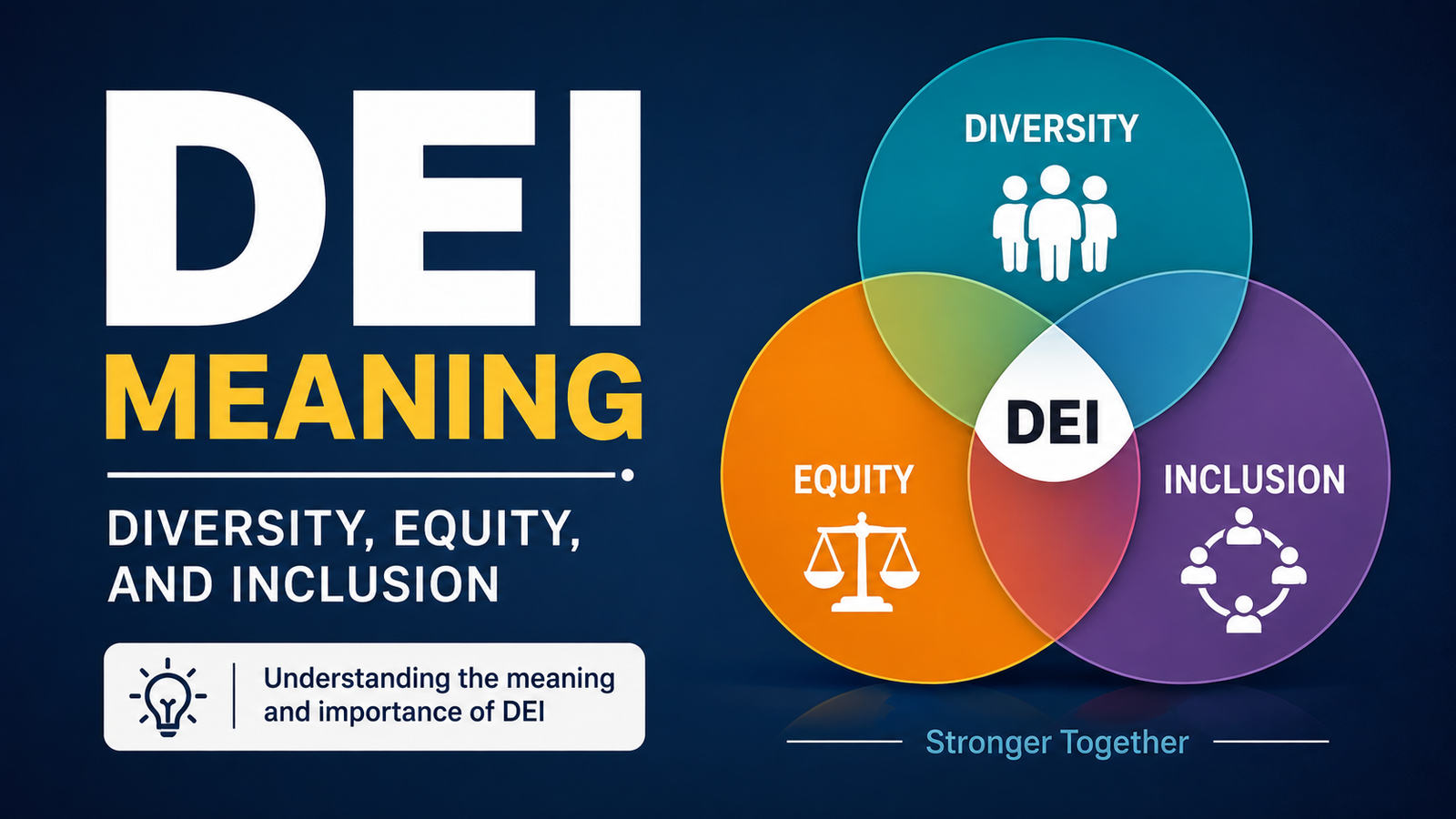
If you have seen DEI on a job posting, company website, social media post, school page, or in the news, you may have wondered what it means. The most common modern meaning of DEI is Diversity, Equity, and Inclusion.
In simple English, DEI describes efforts to make workplaces, schools, organizations, and other communities more welcoming and fair to people from different backgrounds. It focuses on having different perspectives represented, making opportunities fair, and creating an environment where people feel respected and able to participate.
Cambridge Dictionary defines DEI as an abbreviation for diversity, equity, and inclusion, particularly in business and education.
However, “dei” can have other meanings depending on the language and context. In Latin, for example, dei is related to deus, meaning God, and is commonly understood as “of God.”
This guide explains the DEI meaning, pronunciation, origin, individual parts of the term, common usage, examples, related words, and frequently asked questions.
What Does DEI Mean?
DEI stands for Diversity, Equity, and Inclusion.
The three words describe related but slightly different ideas:
- Diversity means having people with different backgrounds, experiences, identities, perspectives, and characteristics represented.
- Equity means recognizing that people may have different circumstances or barriers and working toward fair access and opportunities.
- Inclusion means creating an environment where people are welcomed, respected, heard, and able to participate.
Put simply, DEI is about creating fair and inclusive environments where different people can participate and have opportunities to succeed.
For example, a company might introduce a DEI program to improve hiring practices, make workplace policies more accessible, or encourage employees from different backgrounds to contribute their ideas.
Merriam-Webster similarly defines DEI as an abbreviation for diversity, equity, and inclusion and describes it as an approach intended to reduce barriers and improve access to opportunities.
DEI Pronunciation
DEI is usually pronounced by saying each letter separately:
The pronunciation is “dee-ee-eye.”
It is not normally pronounced as one word. You may also see it written as DE&I, which includes an ampersand between equity and inclusion. Cambridge lists both DEI and DE&I as forms of the abbreviation.
What Does Each Letter in DEI Stand For?
Understanding the three words makes the meaning of DEI much easier.
D = Diversity
Diversity refers to differences among people.
These differences can include background, culture, age, disability, experience, nationality, gender, socioeconomic circumstances, and many other characteristics.
In a workplace, diversity could mean having employees with different life experiences and perspectives working together.
The basic idea is simple: a group does not need everyone to be the same to work effectively together.
E = Equity
Equity is about fairness.
It is sometimes confused with equality, but the two concepts are not always identical. Equality generally means providing the same thing to everyone, while equity recognizes that people can face different circumstances or barriers and may require different forms of support to have fair opportunities.
For example, imagine a workplace where every employee receives the same training material, but some employees need an accessible format because of a disability. Providing that accessible format is an example of trying to create equitable access.
The goal is not necessarily to make everyone’s situation identical. Instead, the focus is on fair opportunity and treatment.
I = Inclusion
Inclusion is about making people feel welcomed, respected, and able to participate.
A company can have a diverse workforce without necessarily having an inclusive culture.
For example, an organization might employ people from many different backgrounds, but if only a small group of employees is encouraged to speak during meetings, diversity alone does not guarantee inclusion.
Inclusion asks a practical question: Do people actually feel that they belong and can contribute?
DEI Meaning in Simple English
If you want the shortest possible explanation, remember this:
DEI means making sure different people are represented, treated fairly, and included.
Another easy way to remember it is:
Diversity = who is present.
Equity = whether opportunities are fair.
Inclusion = whether people are welcomed and involved.
These three ideas work together, which is why organizations often discuss them as one framework.
Origin and History of DEI
The modern use of DEI developed from broader efforts involving civil rights, anti-discrimination, equal opportunity, workplace fairness, education, and representation.
The concept did not suddenly appear as an internet trend. Many of the underlying ideas existed long before the abbreviation became common.
Over time, businesses, universities, nonprofit organizations, government institutions, and other organizations increasingly used terminology related to diversity and inclusion when discussing organizational culture and equal opportunity.
The abbreviation DEI became particularly familiar in American business and educational contexts. Dictionary.com notes that the term’s recorded use dates to the 2015–2020 period, while related expressions such as diversity and inclusion had already been used earlier.
Today, DEI can refer to an organization’s policies, training, recruitment practices, accessibility efforts, workplace culture, or broader approach to representation and participation.
DEI vs. D&I
You may also come across D&I, which means Diversity and Inclusion.
DEI adds Equity as a third component.
The difference is important because diversity asks who is represented, while inclusion focuses on participation and belonging. Equity adds another question: Are people receiving fair access and opportunities despite differences in their circumstances?
Some organizations use DE&I instead of DEI. The meaning is essentially the same.
In the United Kingdom, you may also encounter EDI, meaning Equality, Diversity and Inclusion. Cambridge specifically identifies EDI as a UK form related to DEI.
What Does DEI Mean in the Workplace?
In a workplace, DEI generally refers to practices designed to encourage diversity, fairness, accessibility, respect, and participation.
A company might discuss DEI when talking about:
- Hiring and recruitment
- Employee development
- Workplace accessibility
- Leadership representation
- Equal opportunity
- Company culture
- Employee resource groups
- Training and education
- Fair workplace policies
- Creating channels for employees to provide feedback
For example:
“The company is reviewing its DEI policies.”
This could mean the company is examining whether its hiring, workplace, promotion, accessibility, or employee-support practices provide fair opportunities.
DEI is therefore not simply a synonym for hiring. It can involve many parts of an organization’s culture and operations.
DEI Meaning in Education
DEI is also frequently used in education.
Schools, colleges, and universities may use the term when discussing access, student participation, campus culture, accessibility, representation, or educational opportunities.
For example:
“The university created a DEI program for students and staff.”
This does not automatically describe one specific type of program. The actual meaning depends on what that institution includes under DEI.
Cambridge lists DEI as a specialized term used particularly in business and education.
DEI Examples in Everyday Sentences
Here are some natural examples of how people use DEI:
- “Our company has a new DEI policy.”
- “She works in the organization’s DEI department.”
- “The school is reviewing its DEI initiatives.”
- “The manager said DEI should be part of the company’s long-term culture.”
- “The conference included a discussion about DEI in the workplace.”
- “The company wants its recruitment process to support its DEI goals.”
- “They are offering accessibility training as part of their DEI efforts.”
In each case, the exact meaning depends on the organization’s specific policies and goals.
DEI Meaning in Texting and Social Media
DEI is sometimes searched as though it were internet slang, but DEI is not originally a texting abbreviation like LOL, BRB, or IDK.
When someone uses DEI in a text message, comment, or social media post, they are usually referring to Diversity, Equity, and Inclusion.
For example:
“The company needs to improve its DEI.”
Here, the person is probably talking about the company’s approach to representation, fairness, or inclusion.
The tone can vary. Some people use DEI in a neutral or positive professional context, while others discuss it critically or politically. Therefore, context matters when interpreting the word.
Other Meanings of “Dei”
Capitalization makes a difference.
When written as DEI, the most common modern English meaning is Diversity, Equity, and Inclusion.
When written as lowercase dei, however, it may refer to a different word entirely.
Latin Meaning of Dei
In Latin, dei is the genitive singular form associated with deus, meaning God or god. In context, it can mean “of God.”
You can see this usage in expressions such as Agnus Dei, meaning “Lamb of God.”
Another well-known Latin expression is Dei gratia, traditionally translated as “by the grace of God.” Collins lists this Latin phrase and its meaning.
Therefore, if you see dei in a Latin religious phrase, do not automatically assume it means Diversity, Equity, and Inclusion.
Is DEI an Acronym or an Abbreviation?
DEI is commonly described as an abbreviation or initialism for Diversity, Equity, and Inclusion.
Because the letters are pronounced individually as “dee-ee-eye,” it is more precise linguistically to call it an initialism rather than a conventional acronym pronounced as a single word.
However, everyday dictionaries commonly label DEI as an abbreviation, so calling it an abbreviation is perfectly normal.
Synonyms and Related Terms for DEI
There is no single perfect synonym for DEI because the term combines three concepts.
However, related expressions include:
- Diversity and inclusion
- D&I
- DE&I
- EDI
- Equal opportunity
- Inclusion
- Workplace equity
- Fair treatment
- Inclusive practices
- Representation
- Accessibility
These terms are related but should not always be treated as exact replacements.
For example, equal opportunity focuses strongly on fairness of opportunity, while DEI covers the broader combination of diversity, equity, and inclusion.
Antonyms of DEI
There is no single dictionary antonym for DEI because it is a broad framework rather than an ordinary adjective.
Depending on the context, contrasting ideas may include:
- Exclusion
- Discrimination
- Inequality
- Unfair treatment
- Lack of accessibility
- Marginalization
- Homogeneity
- Barriers to participation
These words describe conditions that DEI efforts may seek to address.
It is better to use the specific opposite term that fits the situation rather than treating one word as the universal antonym of DEI.
Why Do People Use DEI?
Organizations use DEI language for different reasons.
Some want to improve workplace culture. Others want to make recruitment and advancement practices fairer, improve accessibility, broaden representation, or ensure employees have meaningful opportunities to participate.
A DEI strategy may therefore look very different from one organization to another.
For one company, it could focus heavily on accessibility. For another, it could involve recruitment, employee development, or workplace culture.
This is why the phrase “DEI initiative” does not automatically tell you exactly what an organization is doing. You need to look at the specific initiative.
Common Misunderstandings About DEI
One common misunderstanding is that DEI simply means “hiring diverse people.”
That is too narrow.
DEI can involve recruitment, but it can also concern workplace culture, accessibility, employee participation, development opportunities, policies, and organizational practices.
Another misunderstanding is that diversity and inclusion mean exactly the same thing.
They do not.
A workplace may be diverse without being particularly inclusive, just as a workplace can have inclusive policies while still having limited diversity.
Equity adds another layer by considering whether people have fair opportunities given their different circumstances.
DEI vs. Equality: What’s the Difference?
Equality generally means treating people equally or providing equal rights and opportunities.
Equity focuses more specifically on fairness and recognizes that people can face different barriers or circumstances.
A simple example can make the difference clearer.
Imagine three people trying to see over a wall. Giving all three the same-sized platform represents equality. Giving each person the support needed to see over the wall represents an equity-based approach.
Real-world situations are much more complicated than this example, but it illustrates why the two words are not always interchangeable.
How to Use DEI Correctly
Use DEI when discussing diversity, equity, and inclusion in an organizational, educational, workplace, or social context.
For example:
Correct: “The company announced a new DEI initiative.”
Correct: “She is researching DEI in higher education.”
Correct: “The organization wants to improve its DEI practices.”
Avoid assuming that DEI always means the same specific policy. The term is broad, and organizations can define their programs differently.
Frequently Asked Questions About DEI Meaning
What does DEI stand for?
DEI stands for Diversity, Equity, and Inclusion. It describes a framework or set of practices focused on representation, fairness, participation, and belonging.
What is the simple meaning of DEI?
In simple English, DEI means creating environments where different people are represented, treated fairly, and included.
How do you pronounce DEI?
DEI is pronounced “dee-ee-eye.” Each letter is spoken separately.
Is DEI a slang word?
No. DEI is primarily a professional abbreviation or initialism for Diversity, Equity, and Inclusion. It is commonly used in business, education, organizations, and public discussion.
What does DEI mean in the workplace?
In the workplace, DEI generally refers to efforts involving diversity, fair opportunity, inclusion, accessibility, representation, and workplace culture.
What does DEI mean in education?
In education, DEI can refer to efforts related to access, representation, fairness, inclusion, accessibility, and participation among students, faculty, and staff.
Is DEI the same as D&I?
Not exactly. D&I means Diversity and Inclusion, while DEI adds Equity as a third concept.
What does lowercase “dei” mean?
Lowercase dei can have different meanings depending on the language. In Latin, dei is associated with deus and can mean “of God.”
Is DEI still used today?
Yes. DEI remains a widely used term in business, education, organizational policy, and public discussion. Its use and interpretation can vary significantly depending on the organization and social context.
What are examples of DEI?
Examples can include accessibility improvements, inclusive workplace policies, fair recruitment practices, employee development programs, representation efforts, and initiatives designed to improve participation and belonging.
Final Thoughts on DEI Meaning
The most common meaning of DEI is Diversity, Equity, and Inclusion.
The easiest way to understand the three terms is to think of them as three connected questions:
Diversity: Who is represented?
Equity: Are opportunities and treatment fair?
Inclusion: Are people welcomed and able to participate?
DEI is most often used in workplaces, schools, universities, organizations, and discussions about social and professional environments. Major English dictionaries recognize the term and its connection to diversity, equity, and inclusion.
At the same time, context matters. “Dei” can also have a completely different meaning in Latin, where it relates to God or “of God.”
So, if you encounter DEI in a company document or social media discussion, Diversity, Equity, and Inclusion is almost certainly the intended meaning. If you see dei inside a Latin phrase, however, you should consider the linguistic context before interpreting it.
Ultimately, understanding the context is the key to understanding DEI meaning correctly.