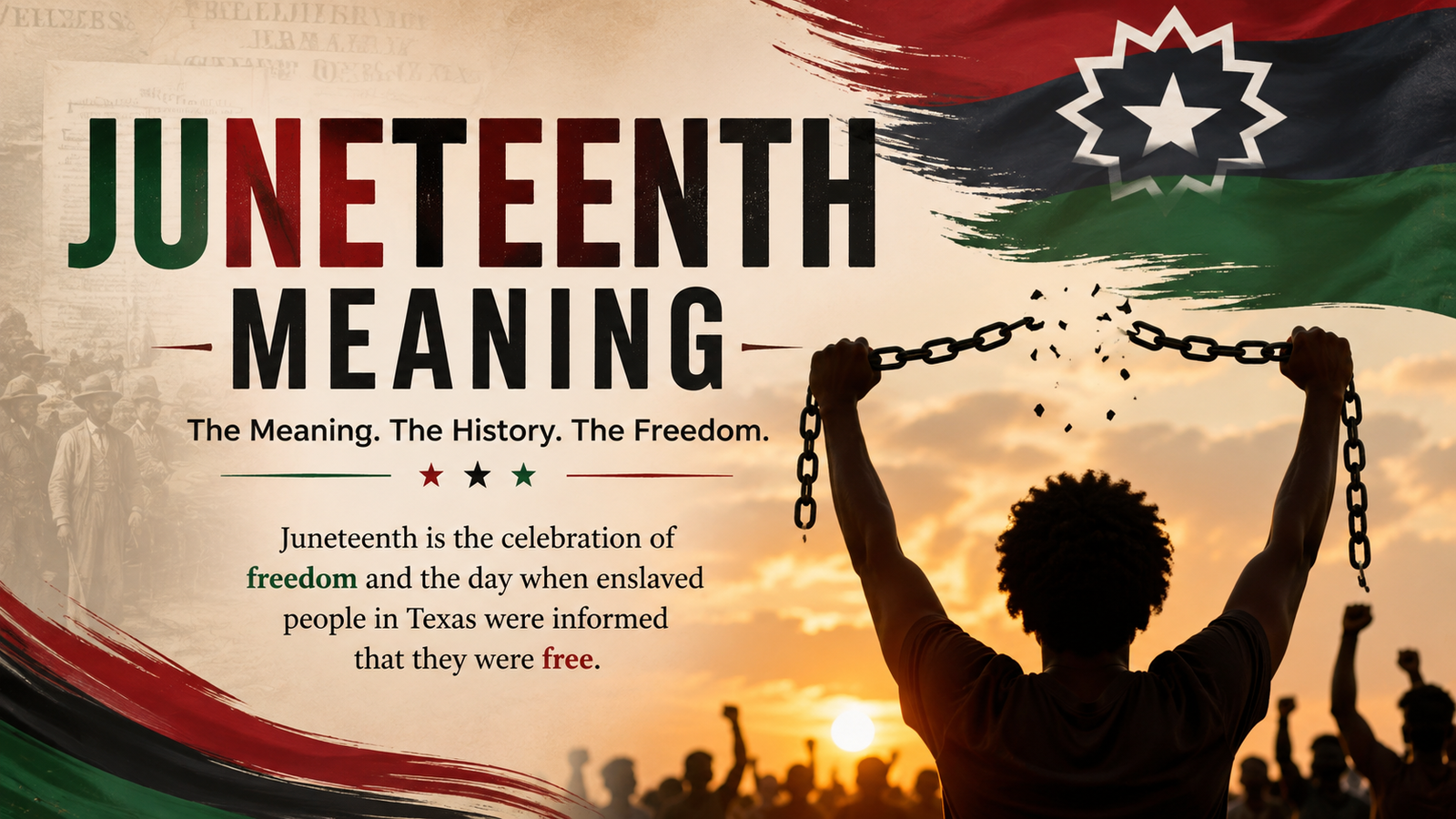
If you have searched for “Juneteenth meaning,” you may already know that the word is connected with freedom and American history. But Juneteenth is more than just a date on the calendar. It represents a major moment in the history of slavery, emancipation, African American communities, and the long struggle for freedom and equality in the United States.
Juneteenth is observed every year on June 19. The name combines “June” and “nineteenth,” referring to June 19, 1865. On that day, U.S. Maj. Gen. Gordon Granger arrived in Galveston, Texas, and issued General Order No. 3, announcing that enslaved people in Texas were free.
Today, Juneteenth is a federal holiday in the United States. President Joe Biden signed legislation establishing it as a federal holiday on June 17, 2021.
In this guide, we will explain the Juneteenth meaning in simple English, including its pronunciation, origin, history, examples, synonyms, common usage, and frequently asked questions.
What Does Juneteenth Mean?
The simple meaning of Juneteenth is a holiday that commemorates the emancipation of enslaved African Americans in Texas and celebrates freedom.
Juneteenth is observed on June 19 because of what happened in Galveston, Texas, in 1865.
Although President Abraham Lincoln had issued the Emancipation Proclamation in 1863, enslaved people in Texas did not immediately experience freedom. On June 19, 1865, General Gordon Granger announced General Order No. 3, informing the people of Texas that enslaved people were free.
This announcement became the historical foundation of Juneteenth.
It is important to understand that Juneteenth does not mean slavery suddenly began or ended everywhere on June 19, 1865. The legal abolition of slavery throughout the United States was completed later, when the 13th Amendment was ratified on December 6, 1865.
Juneteenth Pronunciation
Juneteenth is commonly pronounced:
joo-n-TEENTH
The emphasis is placed on the second part of the word.
It sounds like “June” + “teenth.”
The spelling can look unusual at first, but its construction is quite straightforward. It is a shortened combination of June and nineteenth.
Why Is It Called Juneteenth?
The name Juneteenth comes from combining the words June and nineteenth.
June 19 became an important date after General Order No. 3 was issued in Galveston in 1865. Over time, the date became known as Juneteenth and was also called Emancipation Day or Freedom Day.
This type of word formation is similar to combining parts of two words to create a new term. In this case, the name directly reflects the date at the heart of the celebration.
The Origin of Juneteenth
The origin of Juneteenth goes back to the American Civil War and the history of slavery in the United States.
The Emancipation Proclamation
President Abraham Lincoln issued the Emancipation Proclamation on January 1, 1863.
The proclamation declared enslaved people in the states in rebellion against the Union to be free. However, the proclamation could not immediately enforce freedom everywhere because the Civil War was still taking place.
Texas was particularly difficult to reach and remained under Confederate control for much of the war.
Even after the Emancipation Proclamation, many enslaved people in Texas remained in bondage.
What Happened on June 19, 1865?
On June 19, 1865, Union forces arrived in Galveston, Texas.
Maj. Gen. Gordon Granger issued General Order No. 3, informing the people of Texas that enslaved people were free under the proclamation of the United States. The National Archives preserves the original handwritten record of this historic order.
This announcement became the foundation of the Juneteenth celebration.
According to the National Archives, approximately 250,000 enslaved people in Texas were affected by the announcement.
When Did Slavery Officially End?
Juneteenth is closely connected to emancipation, but it is not technically the date when slavery became illegal throughout the entire United States.
The 13th Amendment abolished slavery across the nation after it was ratified on December 6, 1865.
This distinction matters because Juneteenth specifically commemorates the announcement and enforcement of emancipation in Texas, while the 13th Amendment completed the constitutional abolition of slavery nationwide.
What Is the Historical Significance of Juneteenth?
Juneteenth is significant because it represents the arrival of freedom for enslaved people who had remained unaware of, or unable to fully experience, the freedom promised by the Emancipation Proclamation.
It also highlights an important lesson from American history: declaring freedom and actually achieving freedom were not always the same thing.
The holiday therefore carries several meanings at once.
It represents:
- Freedom
- Emancipation
- African American history
- Resilience
- Community
- Hope
- Reflection
- Progress toward equality
The Smithsonian describes Juneteenth as a significant date in American history and the African American experience.
How Is Juneteenth Celebrated?
Juneteenth celebrations can vary widely from one community to another.
Some communities organize parades, festivals, concerts, educational programs, historical presentations, family gatherings, and community events.
Food is also an important part of many Juneteenth gatherings. Families and communities may share meals and traditional dishes while spending time together.
Other celebrations focus more heavily on education and reflection. Museums, schools, libraries, and cultural organizations may host discussions about slavery, emancipation, African American history, civil rights, and freedom.
The Smithsonian’s Juneteenth programming, for example, emphasizes reflection, creativity, community, and the meaning of freedom.
In 2026, the Smithsonian’s National Museum of African American History and Culture continued its Juneteenth programming with exhibitions, public activities, culinary offerings, and digital resources.
Is Juneteenth a Federal Holiday?
Yes.
Juneteenth is a federal holiday in the United States.
On June 17, 2021, President Joe Biden signed legislation officially establishing Juneteenth as a federal holiday.
It is observed every year on June 19.
When June 19 falls on a weekend, government offices may observe the federal holiday on a nearby weekday according to federal holiday rules.
Juneteenth vs. Independence Day
Juneteenth and Independence Day are both important American holidays, but they commemorate different historical events.
Independence Day, celebrated on July 4, commemorates the adoption of the Declaration of Independence in 1776 and the American colonies’ declaration of independence from Great Britain.
Juneteenth, celebrated on June 19, commemorates the announcement of emancipation to enslaved people in Texas in 1865.
The two holidays therefore represent different chapters in American history.
Independence Day focuses on the nation’s independence.
Juneteenth focuses on emancipation and the struggle to make the promise of freedom meaningful for enslaved African Americans.
Juneteenth Synonyms and Related Terms
Juneteenth does not have perfect synonyms because it is the proper name of a specific historical holiday. However, several terms are closely associated with it.
Freedom Day
Freedom Day is one of the names historically associated with Juneteenth.
The term highlights the holiday’s central theme: freedom from slavery.
Emancipation Day
Emancipation Day is another name associated with Juneteenth, especially in historical and community contexts.
The word “emancipation” means the process of being freed from legal, political, or social control.
Jubilee Day
Jubilee Day has also been used historically in connection with Juneteenth celebrations.
The word “jubilee” can refer to a special celebration or anniversary, particularly one associated with liberation or renewal.
Related Words
Other words commonly connected with Juneteenth include:
- Freedom
- Emancipation
- Liberation
- Equality
- Justice
- Heritage
- History
- Community
- Celebration
- Independence
These are related concepts rather than exact synonyms.
Juneteenth Antonyms
Juneteenth itself does not have a direct antonym because it is the name of a holiday.
However, if you are asking for words opposite to the ideas represented by Juneteenth, possible contrasts include:
- Slavery
- Bondage
- Oppression
- Captivity
- Enslavement
- Subjugation
These words describe conditions that stand in contrast to freedom and emancipation.
For example:
Juneteenth celebrates freedom, while slavery represents the denial of freedom.
Common Usage of the Word Juneteenth
The word Juneteenth is usually used as a proper noun, so it is generally written with a capital J.
Here are some common examples:
Example 1:
“Juneteenth is celebrated on June 19 every year.”
Example 2:
“Our community is hosting a Juneteenth festival this weekend.”
Example 3:
“She learned about the history of Juneteenth in school.”
Example 4:
“Juneteenth is an important part of African American history.”
Example 5:
“The museum created a special exhibition for Juneteenth.”
The word can be used when discussing history, education, holidays, cultural events, community gatherings, and American heritage.
Juneteenth Meaning in Simple Words
If you need a very simple explanation, you can say:
Juneteenth means a celebration of freedom that remembers June 19, 1865, when enslaved people in Texas were informed that they were free.
That is the easiest way to understand the term.
For children, the concept can be explained as a historical day that remembers the end of slavery and celebrates freedom while encouraging people to learn from the past.
Why Is Juneteenth Important Today?
Juneteenth remains relevant because history influences the present.
Learning about the holiday helps people understand the difference between laws, announcements, and real-life experiences. It also provides an opportunity to learn about the experiences of African Americans during slavery, emancipation, Reconstruction, and the civil rights era.
For many people, Juneteenth is both a celebration and a day of reflection.
It can be a time to celebrate progress while remembering the people who endured slavery and those who worked for freedom and equality.
The Smithsonian’s national programming continues to present Juneteenth as an occasion for reflection, creativity, and community.
Juneteenth Meaning in Modern Culture
As Juneteenth has gained national recognition, its presence in American culture has grown significantly.
Schools, businesses, museums, local governments, and community organizations may organize events around June 19.
Modern celebrations can include music, art, food, educational workshops, historical exhibits, speeches, and family activities.
The holiday’s growing visibility also gives people who may not have learned about Juneteenth before an opportunity to explore an important part of American history.
At the same time, understanding the history behind the celebration is essential. Juneteenth is not simply another summer festival. Its roots are connected to slavery, emancipation, military history, African American communities, and the broader struggle for freedom.
Interesting Facts About Juneteenth
1. The name comes from a date
“Juneteenth” combines June and nineteenth.
2. It began in Texas
The historical event associated with Juneteenth took place in Galveston, Texas, on June 19, 1865.
3. General Order No. 3 is central to its history
General Order No. 3 was issued by Maj. Gen. Gordon Granger and announced emancipation in Texas.
4. The Emancipation Proclamation came earlier
Lincoln’s Emancipation Proclamation took effect in 1863, more than two years before the events of June 19, 1865.
5. Juneteenth became a federal holiday in 2021
Federal recognition came when legislation was signed into law on June 17, 2021.
6. The 13th Amendment completed nationwide abolition
The 13th Amendment was ratified on December 6, 1865, legally ending slavery throughout the United States.
Frequently Asked Questions About Juneteenth Meaning
What does Juneteenth mean?
Juneteenth is a holiday commemorating the emancipation of enslaved people in Texas and celebrating freedom. It is observed on June 19.
Why is Juneteenth celebrated on June 19?
June 19, 1865, is the date when Maj. Gen. Gordon Granger issued General Order No. 3 in Galveston, Texas, informing enslaved people that they were free.
What does the word Juneteenth mean?
The word Juneteenth is a combination of June and nineteenth. It refers directly to June 19.
Is Juneteenth a national holiday?
Juneteenth is a federal holiday in the United States. It was officially established as a federal holiday in 2021.
Is Juneteenth the same as the end of slavery?
Not exactly. Juneteenth commemorates the announcement and enforcement of emancipation in Texas in 1865. Slavery was abolished throughout the United States when the 13th Amendment was ratified later that year.
What is another name for Juneteenth?
Juneteenth has also been called Freedom Day and Emancipation Day.
How do people celebrate Juneteenth?
Celebrations can include festivals, parades, family gatherings, music, food, educational programs, museum events, community activities, and historical discussions.
What color represents Juneteenth?
Juneteenth celebrations often feature red, white, and blue imagery, while the Juneteenth flag also has a distinctive design associated with the holiday. However, there is no single color that completely defines every Juneteenth celebration.
Conclusion: The Meaning of Juneteenth
The Juneteenth meaning is ultimately about freedom, remembrance, and the continuing importance of history.
The word refers to June 19, the date in 1865 when General Gordon Granger issued General Order No. 3 in Galveston, Texas, informing enslaved people that they were free.
More than a century and a half later, Juneteenth has become a federal holiday and a widely recognized occasion for learning, reflection, celebration, and community.
Understanding Juneteenth also means understanding the history surrounding it. The Emancipation Proclamation, the Civil War, General Order No. 3, the experiences of enslaved people in Texas, and the 13th Amendment are all important pieces of the story.
In the simplest terms, Juneteenth is a celebration of freedom and a reminder of how important it is to understand the history behind that freedom.