
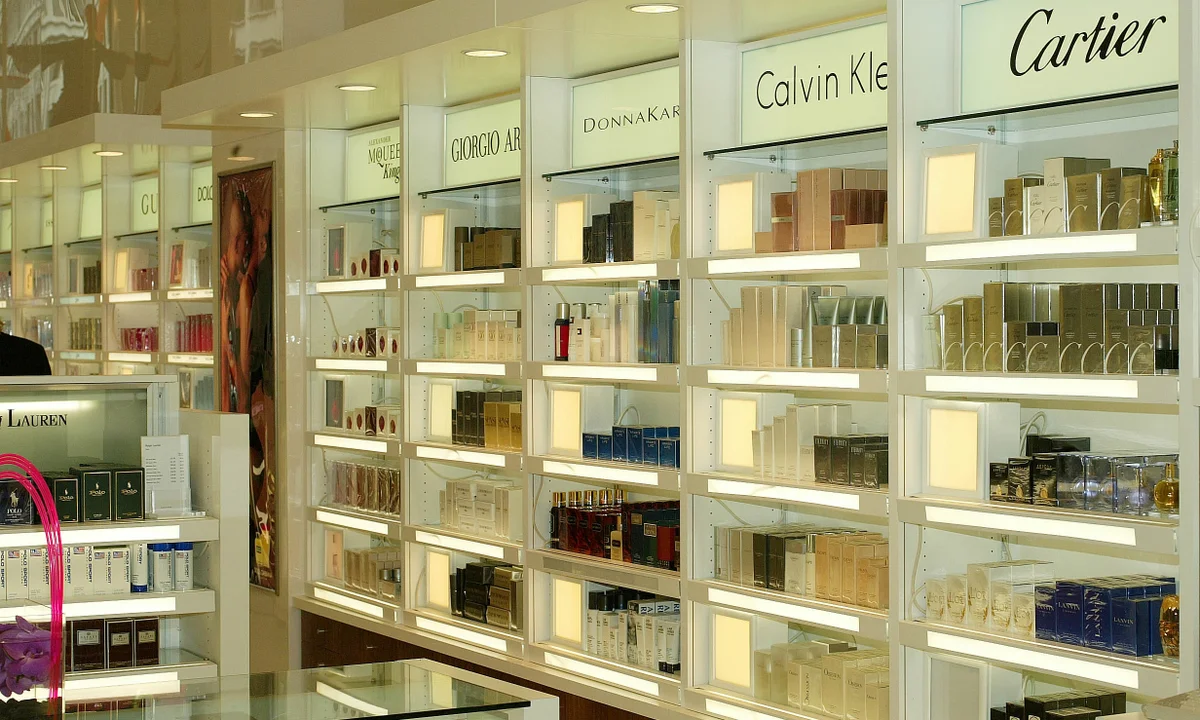
Perfume shops put certain fragrances near the entrance to get them noticed, introduce a campaign and make sampling easy. In department stores, branded beauty counters can also reflect commercial arrangements between the retailer and the fragrance house.
But the first bottle you see is not necessarily the shop’s bestseller, its finest perfume or the right choice for you.
That distinction matters when you walk into a South African shopping centre intending to “just have a look”. An illuminated bottle, a gift box and an offered scent strip can quickly become your whole shortlist. You may not have seen the rest of the fragrance department yet.
The useful question is therefore bigger than “Why is perfume by the door?” It is: what does that position tell you, and what should you check before spending your money?
First, Separate the Perfume Department From the Featured Bottle
There are two different decisions behind an entrance display.
One is where the shop puts its fragrance department. The other is which products receive attention within that space.
A department store might have beauty counters near a main entrance, while a specialist perfume shop might place a promotional table at the front and keep most bottles elsewhere. These arrangements need not have the same explanation.
The department’s position concerns the overall shopping route. The featured bottle’s position concerns what the retailer wants you to notice now.
Neither is a personal recommendation.
A useful way to read the entrance is to look for the message before looking at the bottle. Does the display say “new”, “gift sets”, “exclusive” or “special offer”? That gives you a better starting point than assuming its position means “best”.
Why Those Particular Perfumes Get the Front Spot
The Shop Needs to Introduce Something Quickly
A perfume on an ordinary shelf has to compete with neighbouring bottles. A separate stand, campaign photograph and tester give it a clearer introduction.
That can suit a new launch, a seasonal selection or a product the retailer wants to feature. It can also help returning customers notice something that has changed since their last visit.
The entrance does not have to explain every note or concentration. Its immediate job may simply be to make you stop and ask about the perfume.
There is a limit, though. “Near the entrance” does not mean every product should sit directly in the doorway. Shopify’s retail design guidance describes the threshold as a transition area where shoppers adjust to the store and can miss products or signs. It recommends easing people into space. A display a little farther inside can still be a front-of-store display.
A Tester Turns Passing Interest Into a Comparison
Perfume offers something a boxed product cannot: you can smell it before buying.
An accessible tester and paper strips make it possible to explore without first knowing the brand or asking for a sealed bottle. That is a practical advantage of a visible sampling position, although it does not establish why any particular shop chose that location.
It benefits the shopper too. You might discover a fragrance you would never have searched for online.
The drawback is that an easy first test can become an easy first purchase. Sampling gives you information about the scent; it does not answer every question about how you will enjoy wearing it.
The Front Can Be a Changing Campaign Space
A gift set needs room for its box. A launch might need a large image. A promotion needs a price shoppers can read.
The same front table can serve all three purposes at different times. Its contents may change because the campaign changes, rather than because one fragrance has suddenly become better than another.
Around Christmas, Valentine’s Day or Mother’s Day, ask what the displayed offer actually contains. Is it the concentration you wanted? Would the recipient use the lotion or shower gel? Is the bottle the size you expected?
A neatly presented set solves the problem of finding a present. It does not automatically solve the harder problem of choosing a scent someone likes.
Brand Arrangements Can Influence the Space
Some department-store counters operate through a “store within a store” arrangement.
Knowledge at Wharton’s explanation of this model describes cosmetics manufacturers occupying space inside retailers and employing counter staff. This helps explain why beauty departments can contain distinct branded areas, each with its own presentation.
It is evidence of a retail model, not proof that a particular South African entrance position was purchased.
You cannot tell from a display alone whether its location reflects a concession agreement, a promotional booking or the retailer’s own selection. Nor should you assume that a consultant employed by a brand gives poor advice. Their product knowledge can be useful. Just ask for a comparison beyond the featured range when you need one.
A Real Case: Sephora’s Entrance Tables Were Designed to Change
Display specialist Pilotes publishes a case study of a front-of-store concept for Sephora.
Sephora’s brief concerned replacing entrance furniture in more than 150 stores, improving the concept, controlling costs and moving towards a more sustainable solution.
Pilotes developed three adaptable promotional tables in metal and aluminium. The published case describes a system suitable for new products, gift sets, seasonal campaigns and other featured selections.
The documented outcome is a flexible display solution that allows different assortments to be presented with a consistent appearance. The source does not report a measured sales increase or establish that every planned store received the installation.
The lesson for shoppers is straightforward: a front table can express the current campaign rather than a permanent ranking of products.
This is a supplier’s account of a beauty-retail project, not an independent test of fragrance placement. It nevertheless provides concrete evidence of how an entrance display can be designed around changing needs.
Is the Smell at the Entrance There to Make You Buy?
Sometimes a retailer deliberately scents its environment. That is called ambient scenting: fragrance added to the air to shape the experience of the space.
It is different from displaying perfume bottles or spraying testers.
You might smell a recently demonstrated fragrance, several overlapping tests or a separate room scent. Without confirmation, the perfume pictured on the stand cannot be assumed to be the source.
Ask: “Is that smell from this tester, or is the store using a separate scent?”
It is a small question that can prevent a disappointing purchase. You could love the atmosphere around a counter and still feel differently about its featured bottle on your wrist.
Scent Can Influence Shopping, but There Is No Guaranteed Effect
A field experiment published in Environment and Behavior found that a pleasant ambient fragrance improved shoppers’ emotional reactions, store evaluations and intentions to return in a fashion-store setting. Effects were especially marked among people scoring high on affect intensity, a measure of the strength of emotional responses.
That supports the idea that scent can influence how a shop feels. It does not demonstrate that putting a particular perfume near a door makes people purchase it.
Results also vary. A randomised field experiment in a Canadian bookstore and café found no effect of chocolate scent on bookstore or café sales.
Neither study tested perfume-shop entrance displays. Together, they are a reason to be cautious about sweeping claims that pleasant smells inevitably increase spending.
For your purchase, the relevant distinction is simple: liking the shop’s atmosphere and liking the perfume are separate judgements.
What an Entrance Display Can—and Cannot—Tell You
| What you notice | A reasonable interpretation | What it does not establish |
| A large launch image | The fragrance is receiving campaign attention | It is better than an older release |
| Gift boxes on a front table | The selection is being presented for gifting | The recipient will enjoy the scent |
| A prominent offer price | Price is part of the display’s message | It is the lowest comparable price |
| A dedicated brand counter | The brand has a distinct retail presence | Its range is your only suitable option |
| A strong smell nearby | Fragrance is present in the surrounding air | One displayed bottle caused it |
| A “bestseller” sign | The retailer is making a popularity claim | It is the bestseller everywhere |
The best response is neither to avoid the front display nor to trust it automatically. Use it to discover an option, then compare that option against your needs.
The same judgement applies online. A homepage’s featured section is a useful place to browse, but it is not a personalised shortlist.
How to Shop Without Letting the Entrance Choose for You
1. Give the Assistant a Use, a Preference and a Budget
“I want something fresh for work, I dislike heavy sweetness, and I want to stay below R1,500” gives a consultant something concrete to work with.
“Show me your best perfume” leaves too much open. Best for daily wear? Best for a gift? Most popular in that store?
If the first suggestion comes from the entrance stand, ask for another option elsewhere that meets the same brief. You can then judge the scents rather than their display positions.
2. Compare One Relevant Alternative
You do not need to smell the whole department.
If the featured fragrance appeals to you, compare it with one other perfume intended for the same use and within your budget. An older release can be a useful comparison because it may receive less campaign attention.
Ask what distinguishes them beyond their note lists. Is one less sweet? Does one become woodier as it settles? Which would the assistant suggest for someone wanting a quieter scent?
These questions encourage advice tied to your preferences.
3. Separate the First Sniff From the Buying Decision
Paper strips help you decide what deserves a closer look. They are not a substitute for wearing the fragrance.
The Perfume Society recommends starting with blotters, narrowing the selection and allowing a fragrance to develop on skin before buying. Its advice also includes recording what you applied where.
Write down the full name and concentration. Similar bottles can be easy to confuse later.
If a perfume interests you, try it on skin if appropriate and revisit it during the day. You are checking whether you still enjoy it after the first impression has passed.
4. Consider the South African Setting Where You Will Wear It
A cool mall visit may tell you little about whether you enjoy that scent during your actual routine.
Will you wear it in an air-conditioned office, while commuting, outdoors or mainly in the evening? Durban humidity, a Highveld winter morning and a warm Cape Town afternoon are different situations.
This is a reason to test in your own circumstances, not a rule that South Africans should all wear fresh fragrances. A rich scent might be exactly what you want. The question is whether you enjoy wearing it where you intend to use it.
5. Check the Exact Product Before Comparing Prices
For an online comparison, record:
- The brand and complete fragrance name.
- The concentration, such as EDT or EDP.
- The volume in millilitres.
- Whether the offer is a single bottle or a set.
- Delivery charges and the relevant returns terms.
Do not assume matching fragrance names mean matching products.
Price per millilitre can help when comparing bottle sizes of the same version. It cannot tell you whether a larger bottle is sensible for a scent you have barely tried.
FAQs
Does Front-of-Store Placement Mean a Perfume Is a Bestseller?
No. It may be there for a launch, gift campaign or promotion. If a sign calls it a bestseller, ask whether that means in the store, across the retailer’s range or within a particular category. Placement alone proves none of those things.
Are the Strongest Perfumes Deliberately Put Near the Door?
There is no reliable basis for treating that as a universal rule. Display choices can reflect campaigns, fixtures and brand arrangements. A strong smell nearby might also come from repeated testing or a separate ambient scent.
Is a Consultant at a Branded Counter Independent?
Not necessarily. Some counters use brand-employed staff, as described in the Wharton source. That does not make their advice unhelpful. If you want a wider comparison, ask whether they can discuss other brands or direct you to someone who can.
Should I Ignore Entrance Gift Sets and Look Farther Inside?
Use them as candidates. Check the exact perfume, size and extras against what the recipient likes. A familiar favourite in a useful set can be a sound choice. A striking box containing an unfamiliar fragrance needs more thought.
Can I Identify a Perfume From the Smell Around the Display?
Not confidently. Ask the staff what has been sprayed and test the suggested bottle separately. The smell in the space may be a mixture, so it might not correspond neatly to one product.
Can I Test in a Shop and Buy Online Later?
Yes. Record the exact version so you can compare like for like. Check the seller’s information, final delivered price and returns terms. A familiar name with a different concentration is not necessarily the fragrance you tested.
Let the Display Introduce the Perfume. Let the Test Decide.
Entrance displays can make fragrance shopping easier. They bring options into view, provide a starting point and sometimes introduce something worth trying.
The sensible next step is to choose one promising scent, compare a relevant alternative and see whether you still enjoy it away from the counter.
Once you have a shortlist, browse women’s perfumes or unisex fragrances at Scent Republic and check the exact version you want.
The bottle at the entrance may turn out to be your favourite. Give it the chance to earn that place.
