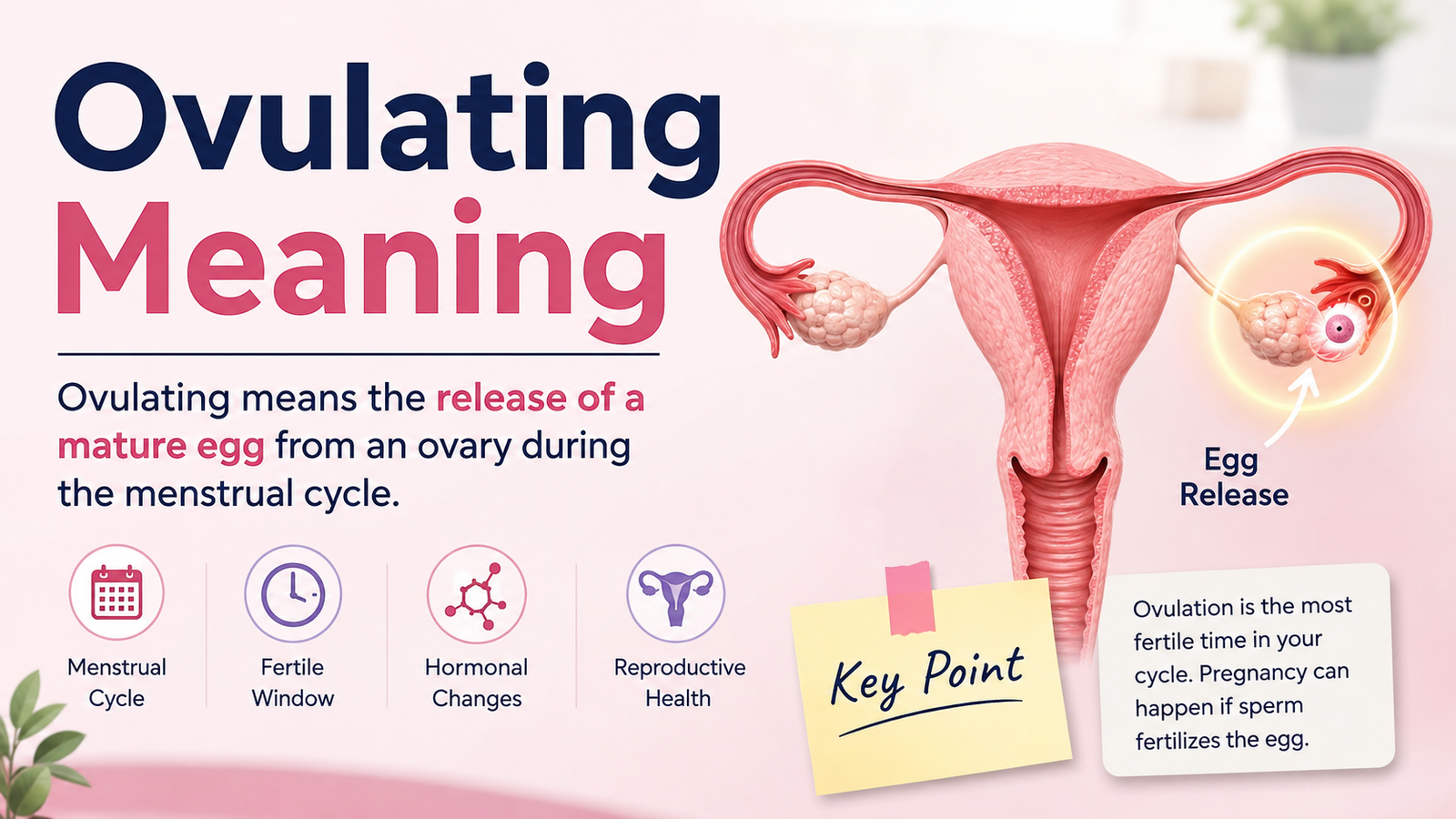
If you have ever wondered about the ovulating meaning, the word is closely connected to the menstrual cycle, fertility, and pregnancy. In simple English, ovulating means releasing an egg from an ovary. This usually happens once during a menstrual cycle in people who are capable of ovulation.
Ovulation is an important part of the reproductive cycle because pregnancy can happen when sperm fertilizes the egg after it is released. Hormones, particularly luteinizing hormone (LH), play a major role in triggering this process.
The word ovulating is commonly used in conversations about periods, fertility tracking, pregnancy planning, birth control, and reproductive health. Understanding it can make many health-related conversations much easier to follow.
What Does Ovulating Mean?
Ovulating means that an ovary is releasing a mature egg.
The verb ovulate describes the biological process, while ovulating describes the process as it is happening.
For example:
- “She is ovulating.”
- “I think I am ovulating today.”
- “Some people track their cycle to find out when they are ovulating.”
- “An ovulation test can help predict when ovulation is approaching.”
During ovulation, a mature egg leaves an ovary and enters a fallopian tube. The egg can potentially be fertilized by sperm there. MedlinePlus explains that LH rises shortly before ovulation and helps trigger the release of the egg.
Ovulating Meaning in One Sentence
Ovulating means releasing a mature egg from an ovary as part of the menstrual cycle.
Ovulating Pronunciation
The word ovulating is pronounced with the main stress on the first syllable of the word’s root.
The related noun is ovulation, while the verb is ovulate.
Ovulating vs. Ovulation: What Is the Difference?
These words are related, but they have different grammatical roles.
Ovulation is the name of the biological process.
Ovulate is the verb describing the action.
Ovulating is the present participle or gerund form of the verb.
For example:
- Ovulation: “Ovulation usually happens during the menstrual cycle.”
- Ovulate: “The ovary releases an egg when a person ovulates.”
- Ovulating: “She may be ovulating.”
A simple way to remember the difference is:
Ovulation = the process
Ovulate = to release an egg
Ovulating = currently releasing an egg
What Happens When Someone Is Ovulating?
Ovulation is controlled by a series of hormonal changes.
Early in the menstrual cycle, follicle-stimulating hormone (FSH) helps stimulate the development of eggs in the ovaries. As the cycle progresses, one follicle generally becomes dominant and the egg inside it matures.
A rise in luteinizing hormone, commonly called LH, then helps trigger the release of the mature egg.
Once released, the egg travels into a fallopian tube. If sperm is present and fertilizes the egg, pregnancy may occur. If fertilization does not happen, the egg eventually breaks down.
This is why ovulation is particularly important for people who are trying to become pregnant.
When Does Ovulation Happen?
There is no single day when everyone ovulates.
A commonly used example is a 28-day menstrual cycle, in which ovulation may occur around the middle of the cycle. However, menstrual cycles can naturally be shorter or longer, so the exact timing varies from person to person.
Ovulation generally occurs before the next menstrual period rather than being tied to one universal calendar date.
For people trying to conceive, identifying the fertile period can be useful because the egg remains available for fertilization for a relatively short time after release, while sperm can survive in the reproductive tract for several days.
Signs You May Be Ovulating
Some people notice physical changes around ovulation, while others notice very little.
Possible signs include:
- Changes in cervical mucus
- A feeling of increased vaginal moisture
- Clear, slippery, stretchy cervical mucus
- Mild pelvic or abdominal discomfort
- Changes in basal body temperature after ovulation
- A positive ovulation predictor test
Cervical fluid often becomes clearer, wetter, and more stretchy around the fertile part of the cycle. Basal body temperature can also rise slightly after ovulation has occurred.
These signs can provide clues, but they do not always tell you the exact moment an egg is released.
How Do Ovulation Tests Work?
An ovulation predictor kit is designed to detect an increase in luteinizing hormone (LH) in urine.
An LH surge generally signals that ovulation is approaching. A positive home test can indicate that ovulation may occur within roughly the next day or so, although the timing is not identical for everyone.
People may use these tests when trying to identify their most fertile days.
However, an ovulation test does not directly prove that an egg was released. It detects the hormonal signal associated with the process.
Why Is Ovulating Important?
Ovulation is important because it makes natural conception possible.
For pregnancy to occur, sperm must meet an egg. Without the release of an egg, there is no egg available for sperm to fertilize during that cycle.
MedlinePlus notes that the released egg can generally be fertilized for less than 24 hours, while sperm can remain in the reproductive tract for several days. This is why the fertile window extends beyond the exact day of ovulation.
Ovulation is therefore one of the central events in the menstrual cycle and human reproduction.
What Does “I’m Ovulating” Mean?
When someone says “I’m ovulating,” they usually mean that their body is around the time when an egg is being released from an ovary.
Depending on the context, the person may be talking about:
- Their menstrual cycle
- Fertility
- Pregnancy planning
- Fertility tracking
- Physical symptoms
- An ovulation test result
For example, someone might say:
“I think I’m ovulating because my ovulation test was positive.”
Here, the person is referring to an LH surge that suggests ovulation may be approaching.
Ovulating Meaning in Texting and Everyday Conversation
Unlike slang terms that develop special meanings online, ovulating generally keeps its medical and biological meaning in texting.
Someone may use it casually when discussing their period or fertility.
For example:
“I think I’m ovulating today.”
This normally means:
“I think my body is releasing, or is about to release, an egg.”
In some social-media conversations, people may use the word humorously when talking about hormones, attraction, or feeling unusually interested in someone. That is a figurative or joking use rather than the literal medical definition.
Examples of Ovulating in a Sentence
Here are several natural examples:
- She is tracking her cycle to find out when she is ovulating.
- The ovulation test suggested that she might be ovulating soon.
- Some people experience mild discomfort while ovulating.
- Knowing when you are ovulating can be useful when trying to conceive.
- Not everyone notices obvious symptoms when they are ovulating.
- Her doctor explained how hormones control ovulation.
- The app estimates when she may be ovulating based on her cycle history.
- A person with irregular cycles may find ovulation harder to predict.
Synonyms and Related Words for Ovulating
There are not many exact synonyms for ovulating, because it describes a specific biological process.
However, these terms are closely related:
- Releasing an egg
- Releasing a mature egg
- Going through ovulation
- Experiencing ovulation
- Being in the ovulatory phase
The simplest everyday alternative is usually “releasing an egg.”
For example:
“She is ovulating.”
can be explained in simpler language as:
“Her ovary is releasing an egg.”
Antonyms of Ovulating
There is no perfect everyday antonym for ovulating.
However, in medical contexts, the term anovulation describes a situation in which ovulation does not occur.
So you can think of the relationship this way:
Ovulating: an egg is being released.
Not ovulating: an egg is not being released.
Anovulation: absence of ovulation.
Failure to ovulate can have several possible causes and can sometimes contribute to difficulty becoming pregnant. MedlinePlus lists several factors that may be associated with infertility, including conditions affecting ovulation.
Ovulating and Fertility
Ovulation is closely connected with fertility because conception requires an egg to be available.
If someone is trying to become pregnant, identifying the fertile window may help them time sexual intercourse. MedlinePlus notes that pregnancy is most likely around the fertile period surrounding ovulation.
However, predicting ovulation is not always straightforward.
Cycle length can vary, and factors such as hormonal changes can affect when ovulation occurs. People with irregular periods may have more difficulty predicting their fertile days using calendar calculations alone.
Can You Ovulate Without Feeling Anything?
Yes.
Not everyone experiences noticeable ovulation symptoms. Some people may notice changes in cervical mucus or mild pelvic discomfort, while others may not feel any obvious difference.
This is important because the absence of symptoms does not necessarily mean ovulation did not occur.
Likewise, having a particular symptom does not always prove that ovulation is happening. A healthcare professional or appropriate fertility testing may be needed when precise confirmation is important.
Can You Ovulate With Irregular Periods?
Yes, it is possible to ovulate with irregular periods, although predicting the timing can be more difficult.
Irregular cycles can have many causes. Some conditions can also interfere with regular ovulation. For example, polycystic ovary syndrome (PCOS) can involve irregular periods and problems with ovulation.
If periods are consistently irregular or there are concerns about fertility, speaking with a qualified healthcare professional can help identify the cause.
Ovulating and Birth Control
Some hormonal contraceptives work partly by preventing ovulation.
For example, combined birth control pills contain hormones that can prevent the ovaries from releasing an egg.
This means the word ovulating can appear in discussions about both getting pregnant and preventing pregnancy.
The exact mechanism varies depending on the contraceptive method, so medical advice or the product’s official instructions should be followed when making contraceptive decisions.
Common Mistakes About the Meaning of Ovulating
Mistake 1: Thinking ovulation means having a period
Ovulation and menstruation are different events.
Menstruation is the bleeding phase of the menstrual cycle, while ovulation is the release of an egg from an ovary.
Mistake 2: Assuming everyone ovulates on the same day
People have different cycle lengths and patterns. Even the same person’s timing can vary between cycles.
Mistake 3: Thinking a positive ovulation test guarantees pregnancy
An LH surge indicates that ovulation may be approaching. It does not guarantee that pregnancy will occur.
Mistake 4: Assuming ovulation always causes obvious symptoms
Some people experience noticeable changes, while others do not.
Ovulating Meaning: Simple Definition
If you need the shortest possible definition:
Ovulating means releasing a mature egg from an ovary.
The process is a normal part of the reproductive cycle and is important for natural pregnancy.
FAQs About Ovulating Meaning
1. What does ovulating mean?
Ovulating means an ovary is releasing a mature egg as part of the menstrual cycle.
2. What does “I am ovulating” mean?
It usually means the person believes they are around the time when an egg is being released from an ovary.
3. Is ovulating the same as having a period?
No. Ovulation is the release of an egg, while menstruation is the shedding of the uterine lining when pregnancy has not occurred.
4. How can you tell if you are ovulating?
Possible clues include changes in cervical mucus, a slight rise in basal body temperature after ovulation, and an LH surge detected by an ovulation test.
5. Can you get pregnant while ovulating?
Yes. Ovulation is the time when an egg becomes available for fertilization, so the days around ovulation are among the most fertile days of the menstrual cycle.
6. Does everyone ovulate every month?
Not necessarily. Ovulation can be affected by various health and hormonal factors. Some people may experience cycles in which an egg is not released.
7. What is the difference between ovulate and ovulating?
Ovulate is the verb, while ovulating describes the action as it is happening.
8. What is the opposite of ovulating?
There is no perfect everyday opposite, but anovulation is the medical term for the absence of ovulation.
9. Does a positive ovulation test mean I am definitely ovulating?
Not necessarily. A positive test detects an LH surge that generally signals that ovulation may be approaching.
10. Why is ovulation important?
Ovulation is important because it releases an egg that can potentially be fertilized by sperm, making natural conception possible.
Conclusion
The ovulating meaning is simple: ovulating means releasing a mature egg from an ovary.
It is a key event in the menstrual cycle and plays an important role in fertility. Hormones such as FSH and LH help coordinate the development and release of the egg, while changes in cervical mucus, basal body temperature, and LH levels can provide clues about the fertile period.
Understanding the word ovulating can also help you understand related terms such as ovulation, fertile window, LH surge, menstrual cycle, and fertility.
Because cycle timing varies from person to person, general calendar estimates should not be treated as a guarantee of when ovulation will occur. If you have persistent cycle irregularities, difficulty becoming pregnant, or concerns about ovulation, a healthcare professional can provide individualized guidance.