The word cisgender appears more often in conversations about gender, identity, health, education, media, and social issues. If you have recently seen the term online and wondered, “What does cisgender mean?”, the basic definition is straightforward.
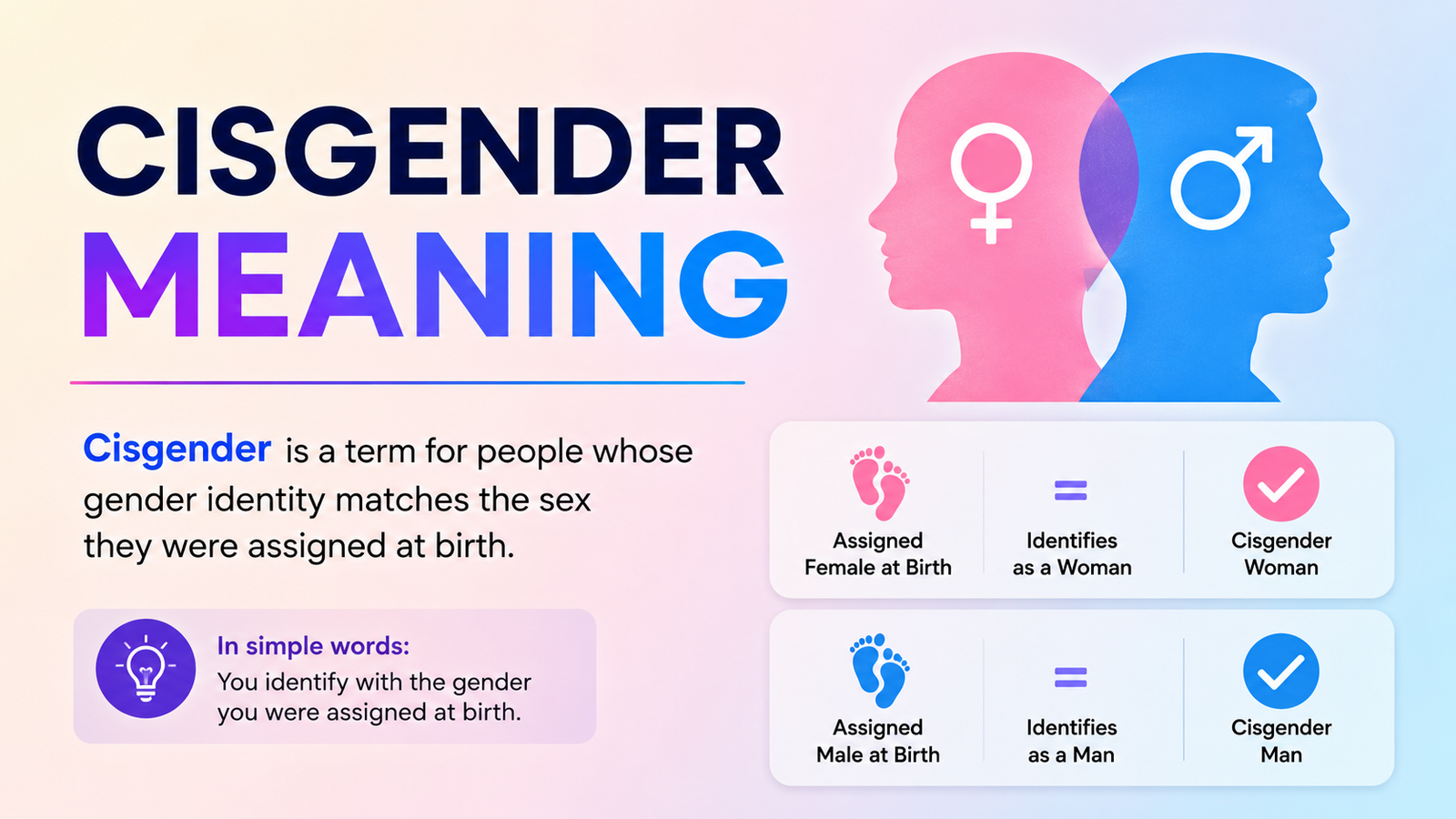
Cisgender describes a person whose gender identity aligns with the sex they were assigned at birth. For example, someone who was assigned female at birth and identifies as a woman may describe herself as cisgender. Someone assigned male at birth who identifies as a man may describe himself as cisgender. The term is commonly shortened to cis.
Understanding the word becomes easier when you separate sex assigned at birth, gender identity, gender expression, and sexual orientation. These concepts are related, but they do not mean the same thing.
What Does Cisgender Mean?
Cisgender means that a person’s gender identity corresponds with the sex they were assigned at birth.
The American Psychological Association describes cisgender as a term for an individual whose gender identity and gender expression align with the sex assigned at birth. Other major reference sources similarly define it as the opposite of transgender.
For example:
- A person assigned male at birth who identifies as a man can be described as cisgender.
- A person assigned female at birth who identifies as a woman can be described as cisgender.
- A person whose gender identity does not align with the sex assigned at birth may describe themselves as transgender.
Being cisgender is about gender identity, not sexual orientation. A cisgender person can be straight, gay, bisexual, asexual, or have another sexual orientation.
Cisgender Meaning in Simple English
In very simple English, cisgender means identifying with the gender associated with the sex you were assigned at birth.
Think of it this way:
Assigned male at birth → identifies as a man → cisgender
Assigned female at birth → identifies as a woman → cisgender
This definition is about how someone identifies themselves. You generally cannot determine whether someone is cisgender simply by looking at them.
GLAAD explains that cisgender people have gender identities just as transgender people do; for cisgender people, their identity aligns with their assigned sex at birth.
Cisgender Pronunciation
The word cisgender is commonly pronounced with the first part sounding like “sis.”
Cambridge gives the American pronunciation as /sɪsˈdʒen.dɚ/ and the British pronunciation as /sɪsˈdʒen.də/.
The main stress falls on the “gen” part of the word.
You may also hear the shorter form cis, which is pronounced like the word “sis.”
Origin of the Word Cisgender
The word cisgender is formed from cis- and gender.
The prefix cis- comes from Latin and means “on this side of.” It is commonly presented as the counterpart of trans-, meaning “across” or “on the other side.”
The term developed as a counterpart to transgender. Etymological sources trace its modern use to gender-related academic and community discussions in the 1990s, with the word becoming more widely used in English in later decades.
Today, cisgender is established terminology in dictionaries, psychology, healthcare, education, journalism, and everyday discussions about gender.
What Does “Cis” Mean?
Cis is simply a shorter form of cisgender.
For example:
- “She is cisgender.”
- “She is cis.”
- “He identifies as a cisgender man.”
- “He is a cis man.”
GLAAD recommends defining cisgender before using the shorter form cis when writing for audiences who may not know the term.
It is generally used as an adjective rather than as a replacement for a person’s identity. For example, “a cisgender woman” is more natural than saying “a cis.”
Cisgender vs. Transgender
The easiest way to understand cisgender is to compare it with transgender.
| Term | Basic meaning |
|---|---|
| Cisgender | Gender identity aligns with sex assigned at birth |
| Transgender | Gender identity differs from sex assigned at birth |
| Cis | Short form of cisgender |
| Trans | Short form of transgender |
The terms describe different relationships between gender identity and sex assigned at birth. They do not tell you someone’s personality, appearance, sexual orientation, or political beliefs.
A transgender person may or may not medically transition, and being transgender is not determined by whether someone has had surgery or takes hormones. GLAAD notes that a person’s transgender identity does not depend on physical appearance or medical procedures.
Cisgender vs. Straight
One of the most common misunderstandings is thinking cisgender and straight mean the same thing.
They do not.
Cisgender describes gender identity.
Straight describes sexual orientation.
For example, a cisgender woman may be heterosexual, lesbian, bisexual, or another sexual orientation. Likewise, a transgender person can be straight, gay, bisexual, or another sexual orientation.
A useful way to remember this is:
Gender identity = who you are.
Sexual orientation = who you may be attracted to.
These are separate parts of a person’s identity.
Cisgender vs. Gender Identity
Gender identity refers to a person’s internal sense of their gender. It may be male, female, nonbinary, or another gender identity.
Cisgender is a descriptive term used when that gender identity aligns with the sex assigned at birth.
For instance, gender identity could be woman, while cisgender describes the relationship between that identity and the person’s assigned sex at birth.
The American Psychological Association emphasizes that terminology surrounding gender can evolve, but the basic distinction remains useful for understanding these concepts.
Cisgender vs. Gender Expression
Gender identity and gender expression are also different.
Gender identity is how a person understands their own gender.
Gender expression refers to how someone presents or communicates themselves through things such as clothing, hairstyle, voice, mannerisms, names, or pronouns.
A cisgender person can have a masculine, feminine, androgynous, or otherwise varied gender expression.
Therefore, clothing or appearance alone cannot tell you whether someone is cisgender.
Examples of Cisgender
Here are some simple examples to make the meaning clearer.
Example 1: Cisgender Woman
A person is assigned female at birth and grows up identifying as a woman. She may describe herself as a cisgender woman.
Example 2: Cisgender Man
A person is assigned male at birth and identifies as a man. He may describe himself as a cisgender man.
Example 3: Sexual Orientation Is Separate
A cisgender woman may be attracted to women. She could identify as a lesbian while also being cisgender.
This demonstrates why gender identity and sexual orientation should not be treated as the same thing.
Example 4: Gender Expression
A cisgender man may enjoy traditionally feminine clothing or have a feminine style. That does not automatically change his gender identity.
Similarly, a cisgender woman may have a traditionally masculine appearance while still identifying as a woman.
How Is Cisgender Used in Everyday Language?
The word cisgender is commonly used in conversations where it is useful to distinguish between people whose gender identity aligns with their assigned sex and those whose identity does not.
You may see it in:
- Healthcare discussions
- Academic research
- Psychology
- Gender studies
- News articles
- Social media
- Workplace policies
- Education
- Surveys and demographic research
- Discussions about transgender experiences
For example:
“The study included both cisgender and transgender participants.”
Or:
“She identifies as a cisgender woman.”
Cambridge lists cis as a synonym or shortened form and transgender as the opposite term.
Synonyms for Cisgender
There are several words or phrases that can communicate a similar idea, although they are not always perfect replacements.
Cis
Cis is the most common shortened form of cisgender.
Non-transgender
Non-transgender can sometimes be used when the context calls for a direct contrast with transgender.
Gender Identity Aligned With Sex Assigned at Birth
This longer phrase explains the concept without relying on specialized terminology.
However, cisgender is generally the most concise standard term when the concept needs to be discussed repeatedly.
Antonym of Cisgender
The most direct counterpart or antonym of cisgender is transgender.
The prefix cis- is commonly contrasted with trans-, which is one reason the terms work as paired descriptions.
That does not mean every person must identify with one of these labels. Some people use nonbinary, agender, or other terms to describe their gender identity, and some people may not use labels at all.
Is Cisgender the Same as “Normal”?
No.
Cisgender does not mean normal, natural, better, or more valid.
It is simply a descriptive term about the relationship between someone’s gender identity and sex assigned at birth.
Similarly, transgender is a descriptive term, not a judgment about whether someone’s identity is valid or invalid.
Using neutral terminology can make conversations about gender more precise and help avoid treating one group as the default.
Is Everyone Cisgender or Transgender?
Not necessarily.
Some people identify as nonbinary, meaning their gender identity does not fit neatly into the traditional categories of only man or woman. Some nonbinary people consider themselves transgender, while others do not. GLAAD specifically notes that nonbinary people may describe their relationship to the transgender label differently.
This is why it is better not to assume someone’s identity based on appearance.
When the distinction matters, people can describe themselves using the terminology that best fits their experience.
Why Is the Word Cisgender Important?
The term provides a way to describe people whose gender identity aligns with their assigned sex without treating that experience as an unnamed default.
Before the word became common, conversations about transgender people often used phrases that implicitly treated non-transgender people as the standard category and transgender people as the exception.
Having terms such as cisgender and transgender creates a more balanced vocabulary. Both are descriptive adjectives that can help researchers, healthcare professionals, educators, journalists, and everyday speakers communicate more precisely.
Common Mistakes About Cisgender
Mistake 1: Thinking Cisgender Means Straight
It does not.
Cisgender refers to gender identity, while straight refers to sexual orientation.
Mistake 2: Assuming Cisgender People Do Not Have a Gender Identity
Everyone has a relationship with gender, although people experience and describe that relationship differently.
Mistake 3: Thinking Appearance Determines Whether Someone Is Cisgender
A person’s clothing, hairstyle, voice, or body does not provide enough information to determine their gender identity.
Mistake 4: Treating Cisgender as an Insult
The word cisgender is generally a neutral descriptive term. It is used in professional, academic, medical, and everyday contexts.
Mistake 5: Assuming Every Nonbinary Person Is Cisgender
Nonbinary identities do not automatically fit the cisgender category. Individual people may describe themselves differently, including whether they use the transgender label.
How to Use Cisgender Respectfully
When using the word cisgender, the simplest approach is to use it as an ordinary adjective when it is relevant.
For example:
“He is a cisgender man.”
“The research compared experiences among cisgender and transgender participants.”
It is also important to respect the terminology people use for themselves. If someone tells you how they identify, using their preferred terminology is generally the clearest and most respectful approach.
Frequently Asked Questions About Cisgender Meaning
What does cisgender mean in simple words?
Cisgender means a person’s gender identity matches the sex they were assigned at birth. The shorter form is cis.
What is an example of a cisgender person?
Someone assigned female at birth who identifies as a woman is an example of a cisgender person. Someone assigned male at birth who identifies as a man can also be described as cisgender.
What is the opposite of cisgender?
Transgender is the usual counterpart to cisgender. A transgender person has a gender identity that differs from the sex they were assigned at birth.
Is cisgender the same as heterosexual?
No. Cisgender describes gender identity, while heterosexual or straight describes sexual orientation. A cisgender person can have any sexual orientation.
What does “cis” mean?
Cis is a shortened form of cisgender. It describes someone whose gender identity aligns with their sex assigned at birth.
Where did the word cisgender come from?
The word combines cis-, a Latin-derived prefix meaning “on this side,” with gender.” The modern gender-related term developed as a counterpart to transgender and became established through academic and community usage beginning in the 1990s.
How do you pronounce cisgender?
It is commonly pronounced with “cis” sounding like “sis,” followed by the word “gender.” Cambridge records the American pronunciation as /sɪsˈdʒen.dɚ/.
Can a cisgender person be LGBTQ+?
Yes. Being cisgender only describes gender identity. A cisgender person can have a sexual orientation that places them within the LGBTQ+ community.
Final Thoughts on Cisgender Meaning
The cisgender meaning is simple once the terminology is separated into its different parts. Cisgender describes someone whose gender identity aligns with the sex they were assigned at birth. It is commonly shortened to cis and is generally used as the counterpart to transgender.
The term does not describe whether someone is straight or gay, how masculine or feminine they appear, or what clothes they wear. Those are separate aspects of identity and expression.
As discussions about gender become more common in education, healthcare, media, research, and everyday life, understanding basic terminology can make communication clearer and more respectful. The most important point is that cisgender is a descriptive term—not a measure of someone’s worth, personality, or sexual orientation.