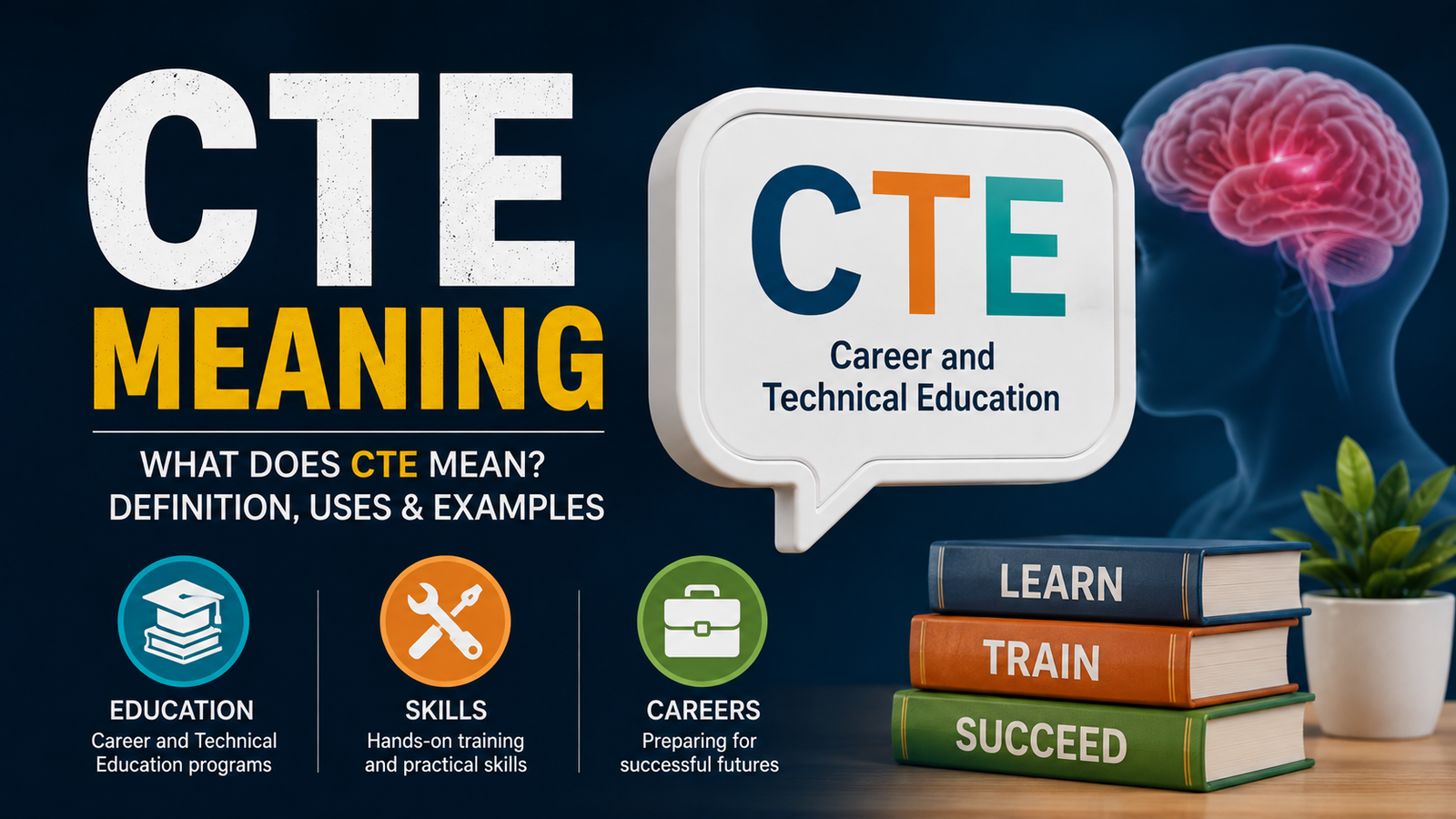
If you have seen the abbreviation CTE in a school brochure, career program, medical article, sports discussion, or online conversation, you may have wondered what it means. The answer depends heavily on the context.
The most common meaning of CTE in education is Career and Technical Education. It refers to educational programs that help students develop practical, technical, and career-related skills. In medical and sports discussions, however, CTE can mean Chronic Traumatic Encephalopathy, a neurodegenerative condition associated with repetitive head impacts.
This guide explains the CTE meaning in simple English, including its pronunciation, origin, common uses, examples, synonyms, antonyms, and frequently asked questions.
What Does CTE Mean?
CTE is an abbreviation with more than one meaning.
In education, CTE usually stands for Career and Technical Education. It describes courses and programs designed to teach students the knowledge and skills needed for particular careers or occupational fields. The U.S. National Center for Education Statistics describes CTE as education focused on skills and knowledge required for specific jobs or fields of work.
For example, a student might take CTE courses in:
- Computer science
- Information technology
- Health care
- Business
- Construction
- Engineering technology
- Agriculture
- Culinary arts
- Manufacturing
- Automotive technology
- Graphic design
- Transportation
CTE is often practical and hands-on. Instead of learning only from textbooks, students may work on projects, use equipment, complete simulations, earn certifications, or participate in workplace learning.
In medical and sports contexts, CTE can mean Chronic Traumatic Encephalopathy. It is a neurodegenerative disease associated with a history of repetitive head impacts. Research into CTE continues, and many questions about the condition remain under investigation.
So, when someone asks “What does CTE mean?”, the best answer is: it depends on the context.
CTE Meaning in Education
The educational meaning of CTE is Career and Technical Education.
It is sometimes connected with the older term vocational education, although modern CTE covers a much broader range of subjects and career pathways. The Institute of Education Sciences notes that CTE has evolved from traditional vocational education and now includes areas such as health care, information technology, business, graphic design, culinary arts, agriculture, and mechatronics.
The main idea is simple: CTE connects education with real-world careers.
A student studying CTE might learn academic concepts while also developing technical and employability skills. This can make education feel more directly connected to future work.
Why Is CTE Important?
CTE can help students understand how classroom learning applies outside school.
For example, a student interested in becoming a computer technician could learn networking and information technology skills through a CTE program. Someone interested in health care could explore medical terminology or health sciences.
Modern CTE programs may also connect students with employers, internships, apprenticeships, industry certifications, and postsecondary education. The U.S. Department of Education describes CTE as a pathway toward high-skill, high-wage, and in-demand careers.
CTE Meaning in Medical and Sports Contexts
Another important meaning of CTE is Chronic Traumatic Encephalopathy.
This term is commonly discussed in connection with sports and repeated head impacts. Research has examined CTE in athletes from sports such as boxing, American football, soccer, rugby, hockey, and other activities involving repetitive head impacts.
The condition is associated with changes in the brain and can involve problems affecting cognition and other functions. However, CTE is a complex research area, and scientific understanding continues to develop.
Because the abbreviation has both educational and medical meanings, context matters.
For example:
“My school offers CTE courses.”
Here, CTE almost certainly means Career and Technical Education.
“Researchers are studying CTE in former athletes.”
Here, CTE refers to Chronic Traumatic Encephalopathy.
How Do You Pronounce CTE?
When CTE is used as an abbreviation, each letter is normally pronounced separately:
C-T-E
The letters are spoken individually rather than as one ordinary English word.
The pronunciation is therefore similar to saying the names of the letters C, T, and E in sequence.
The exact pronunciation can vary slightly with accent, but the abbreviation itself is generally spoken letter by letter.
What Is the Origin of CTE?
The origin of CTE depends on which meaning you are discussing.
Origin of Career and Technical Education
The educational concept developed from earlier forms of vocational and technical education. Traditional vocational education focused heavily on preparing students for specific trades and occupations.
Over time, the field expanded. Modern CTE includes both technical education and broader academic and employability skills.
The U.S. education system now uses the term Career and Technical Education to describe programs that prepare learners for careers while connecting academic learning with technical skills.
Federal support for CTE has also played an important role in shaping programs across the United States. The Carl D. Perkins Career and Technical Education Act is a major federal framework supporting CTE.
Origin of Chronic Traumatic Encephalopathy
The medical use of CTE has a much older history than many people realize.
Research and descriptions of brain problems associated with repeated head impacts have been discussed for decades. Historical accounts connected the condition with boxers, and later research expanded attention to athletes participating in other contact and collision sports.
Today, CTE remains an active area of neurological research.
Examples of CTE in a Sentence
Understanding examples makes the abbreviation easier to recognize.
Examples of CTE Meaning Career and Technical Education
- “My high school offers several CTE programs.”
- “She enrolled in a CTE course to learn computer programming.”
- “CTE helped him develop practical skills for his future career.”
- “The school is expanding its CTE opportunities for students.”
- “Students can earn industry-recognized credentials through some CTE programs.”
- “Her interest in nursing encouraged her to explore a health-care CTE pathway.”
Examples of CTE Meaning Chronic Traumatic Encephalopathy
- “The documentary discussed CTE and repeated head impacts.”
- “Researchers continue to study chronic traumatic encephalopathy.”
- “The article examined the relationship between repetitive head impacts and CTE.”
- “CTE has become an important topic in discussions about sports safety.”
The surrounding words usually make the intended meaning clear.
Common Uses of CTE
The abbreviation CTE appears in several different settings.
1. Schools and Colleges
This is one of the most common uses. Schools may advertise CTE courses, CTE pathways, CTE teachers, or CTE career programs.
2. Career Planning
Career counselors may use CTE when discussing practical routes into occupations such as health care, technology, construction, manufacturing, or business.
3. Workplace Training
Some CTE programs include work-based learning, internships, job shadowing, apprenticeships, or other experiences that connect students with real workplaces.
4. Sports and Medicine
In medical and sports writing, CTE generally refers to Chronic Traumatic Encephalopathy.
5. Research and Education Policy
Researchers and policymakers frequently use CTE when discussing career readiness, workforce development, technical skills, credentials, and education outcomes.
CTE vs. Vocational Education
People sometimes use CTE and vocational education as if they mean exactly the same thing.
They are closely related, but CTE is generally the broader and more modern term.
Traditional vocational education often emphasized preparing people for particular trades. Modern CTE can include technical trades, technology, health care, business, engineering, agriculture, design, and many other career fields.
The focus has also expanded beyond simply getting a job. Modern CTE can combine academic knowledge, technical abilities, employability skills, credentials, and real-world experience.
What Subjects Are Included in CTE?
There is no single list that applies to every school or state, but CTE can cover a wide range of career areas.
Common examples include:
- Agriculture and natural resources
- Business and marketing
- Information technology
- Health sciences
- Engineering and technology
- Architecture
- Construction
- Manufacturing
- Transportation
- Culinary and personal services
- Education
- Public safety
- Legal and public services
- Communications and design
NCES classifications include areas ranging from computer and information sciences to health sciences, construction, manufacturing, transportation, business, and engineering technologies.
Benefits of Career and Technical Education
CTE can offer several advantages for students.
Practical Skills
Students can learn skills that are directly connected to real occupations.
Career Exploration
CTE allows students to explore possible careers before committing to a particular field.
Hands-On Learning
Many programs use projects, laboratories, equipment, simulations, and workplace experiences rather than relying entirely on traditional classroom instruction.
Industry Credentials
Some programs allow students to work toward certifications or other industry-recognized credentials.
Career and College Preparation
CTE does not necessarily mean choosing work instead of college. Students can use CTE as preparation for employment, additional technical education, college, or several of these options.
CTE Synonyms and Related Terms
Because CTE is an abbreviation, it does not have a perfect synonym. However, depending on the context, related terms include:
- Career education
- Technical education
- Vocational education
- Career preparation
- Workforce education
- Occupational education
- Career training
- Skills training
- Career pathways
- Technical training
These terms are related but should not always be treated as exact replacements.
For example, career and technical education is a specific educational approach, while skills training can refer to a much broader range of learning.
CTE Antonyms
There is no exact opposite of CTE.
However, if you are comparing educational approaches, you might contrast career-focused technical education with purely theoretical or general academic study.
That does not mean academic education and CTE are opposites. In fact, modern CTE often combines academic learning with technical and practical skills.
The better comparison is:
CTE: focuses strongly on career-related technical and practical skills.
General academic education: often focuses more broadly on subjects such as literature, mathematics, history, science, and the humanities.
Both can be valuable, and many students benefit from a combination.
Why Is CTE Becoming More Popular?
Career preparation has become an increasingly important part of education discussions because students and employers both want clearer connections between learning and future opportunities.
In 2026, the U.S. Department of Education continues to highlight CTE as a way to connect academic learning, technical skills, employability skills, credentials, and career opportunities.
CTE can also help students understand why certain subjects matter. A student who struggles to see the purpose of classroom mathematics, for example, may understand its value more clearly when applying it to construction, engineering, technology, business, or another career area.
CTE in Everyday Conversation
You may encounter CTE in different ways online.
If someone posts:
“I took CTE in high school.”
They are probably talking about Career and Technical Education.
If a sports article says:
“Former players are being studied for CTE.”
It is referring to Chronic Traumatic Encephalopathy.
This is why searching only for the letters “CTE” without considering the surrounding sentence can sometimes produce confusing results.
Frequently Asked Questions About CTE
What does CTE stand for?
CTE most commonly stands for Career and Technical Education in education. In medical and sports contexts, it can stand for Chronic Traumatic Encephalopathy.
What does CTE mean in school?
In school, CTE usually means Career and Technical Education. These programs teach students academic, technical, and employability skills connected to particular careers.
What does CTE mean in sports?
In sports and medical discussions, CTE usually means Chronic Traumatic Encephalopathy, a neurodegenerative disease associated with repetitive head impacts.
Is CTE the same as vocational education?
They are closely related, but CTE is the broader modern term. Today’s CTE programs can include technology, health care, business, engineering, design, construction, manufacturing, and many other fields.
Is CTE good for students?
CTE can be valuable for students who want practical experience, career exploration, technical skills, industry credentials, or clearer connections between education and employment. The benefits depend on the quality and design of the individual program.
Can CTE students go to college?
Yes. CTE does not automatically mean skipping college. Many CTE pathways can prepare students for postsecondary education, technical credentials, apprenticeships, or employment.
Is CTE only for high school students?
No. CTE can exist at both secondary and postsecondary levels. Programs and opportunities vary by institution and location.
What is another word for CTE?
There is no exact synonym, but related terms include career education, technical education, vocational education, occupational education, and career training.
Final Thoughts on CTE Meaning
The CTE meaning depends on where you encounter the abbreviation.
In education, CTE means Career and Technical Education—a broad approach that combines academic learning with practical, technical, and career-related skills. It can help students explore careers, gain hands-on experience, develop employability skills, and prepare for further education or employment.
In medicine and sports, CTE means Chronic Traumatic Encephalopathy, a completely different term associated with repetitive head impacts and neurological research.
So, if you see CTE in a school or career context, think Career and Technical Education. If you see it in a discussion about athletes, brain health, or repeated head impacts, the intended meaning is likely Chronic Traumatic Encephalopathy.
The surrounding context is the key to understanding which CTE meaning someone intends.