
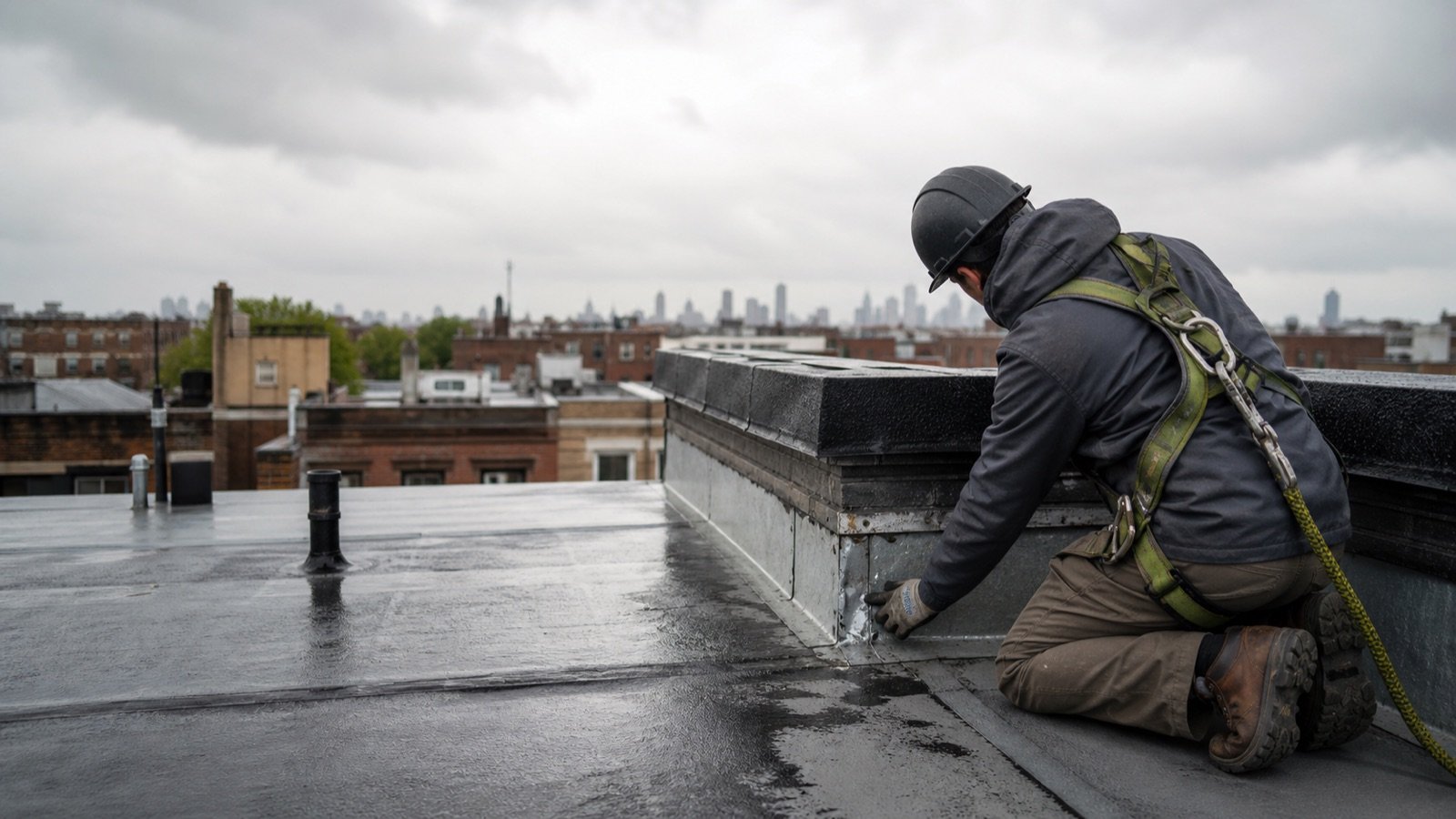
Flat roofs dominate much of the Bronx, topping rowhouses, walk-ups, and one-story commercial spaces. When water shows up inside, the source is not always directly above the stain. Leaks can travel along joists, through parapet walls, or under flashing before they show up. This article focuses on reading what your roof is telling you, tracing the real entry point, and choosing quick stabilizations that do not make matters worse. You will learn where flat roofs typically fail, how New York City weather speeds that failure, and when to plan for a deeper fix instead of another patch. Safety first: if the roof surface is icy, the parapet is low, or access is uncertain, postpone inspection.
- Read the signs: what ponding, blisters, and cracked flashing are telling you
Ponding water that lingers near roof drains or scuppers points to poor slope or a clogged outlet. Circular stains or dirt rings map where water sits and heats up, accelerating ultraviolet damage to modified bitumen and built-up roofs. “Alligatoring” in asphalt surfaces signals oxidation and embrittlement; it rarely leaks immediately, but it can lead to splits. Blisters look like soft domes under a membrane or cap sheet. They are gas or moisture trapped between plies and can rupture under foot traffic or summer heat. Around penetrations, look for shrinkage cracks in sealant at vent stacks, skylight curbs, and HVAC sleepers. Gaps at TPO, PVC, or EPDM seams, especially at inside corners, are red flags for wind and thermal stress.
Parapet walls and edges leak frequently, especially where coping stones or metal coping meet the membrane. Staining below coping joints, loose mortar in brick, or open counterflashing at chimneys can be the real path into the building. On party-wall roofs, failed step flashing under stucco or brick faces often mimics a field leak. If you want to know who handles emergencies nearby while you evaluate the damage, review Bronx roof repair listings to anticipate timing and access needs without pausing your inspection.
- Why NYC weather makes small defects fail fast
Freeze-thaw cycles push water into hairline openings, then expand, turning minor surface checks into open seams around base flashing and termination bars. Wind gusts funnel down avenues and create uplift at corners and edges, prying at laps and edge metal. Summer heat softens asphalt surfaces, so scuffs from foot traffic or dropped fasteners break the mineral cap and invite sun and water in. Airborne grit and leaves clog scuppers and drain domes, causing backflow at parapets during cloudbursts. Ice dams can form at leader heads, forcing water sideways under counterflashing. Building movement also matters: wood decks shrink and swell, and steel decks flex, which can shear sealant around pitch pockets and vent pipes that were never reinforced with fabric.
- Trace the leak path before you open a bucket of mastic
Start inside. Brown rings on plaster, peeling paint near columns, or an opening seam where a ceiling meets a wall suggests water may be traveling along a joist or conduit. Move up to the roof and begin your search uphill of the interior stain, not directly above it. Check base and counterflashing at skylight curbs, roof hatches, and HVAC sleepers. Gently press near suspect seams to feel for a hollow blister. Clear debris from around primary drains, domes, and scuppers using gloved hands or a plastic scoop; metal tools can puncture membranes. Simple aids like a flashlight, chalk to mark suspect areas, and a moisture meter (if available) help you document findings for follow-up.
Two realistic scenarios illustrate the approach. After a sudden downpour, a two-family house with a torch-applied modified bitumen roof develops a drip in the back bedroom. On the roof, a shallow pond by the rear scupper hides a split in the inside-corner flashing where the membrane pulls off the parapet. In a small grocery under a low-slope EPDM roof, a leak appears above a walk-in cooler. The roof inspection finds a clogged leader head and a loose termination bar along the metal edge, letting wind-driven rain push under the sheet. In both cases, confirming the single worst defect prevents smearing mastic everywhere and trapping moisture you will fight later.
- Stabilize today, but plan the right fix for tomorrow
Short-term measures can stop active dripping without creating new problems. For a split in base flashing, embed polyester fabric in cold-applied asphalt mastic and feather the edges. For EPDM, use membrane-specific primer and tape at an open lap, and roll it tight. At a loose pitch pocket, add compatible butyl to reestablish a seal. All of these fail quickly if applied over damp, dirty, or sun-hot surfaces. Avoid the common mistake of coating or patching over a wet substrate; trapped vapor can blister coatings or lift plies when the sun returns. Durable repairs usually mean rebuilding base flashing up the parapet, refastening or replacing edge metal, reseating counterflashing, replacing a corroded drain bowl, or adding tapered insulation sumps to relieve ponding. A key trade-off: high-solids silicone or acrylic coatings can extend the life of a dry, adhered membrane with tight seams, but they won’t fix saturated insulation or rotten decking. In those cases, targeted tear-off and replacement make more sense long term and for the budget.
Prevent repeat leaks with small, regular tasks
Flat roofs reward routine attention. Before leaf season, clear scuppers and drain domes, and after the first hard frost, look again for debris trapped by ice. Walk the parapet and reseal open coping joints; a quarter-inch gap at a joint can feed water behind counterflashing. After strong winds, check termination bars and edge metal for movement, and resecure fasteners that have backed out. Keep tradespeople on walkway pads to protect traffic lanes to mechanical units, and pick up screws and cut-offs that pierce membranes. Photograph each visit and sketch a simple roof plan marking penetrations, drains, seams, and prior patches. Recurring ponding or stress at the same inside corner is your cue to shift from patches to scheduled replacement or an overlay with tapered insulation.
A leak in a Bronx flat roof is rarely random. The first signs, local weather, and building movement often point to one or two predictable weak points. Read the surface, confirm the source, and choose a stabilizing repair that does not trap moisture or hide the real problem. Then plan the durable fix and a simple maintenance rhythm. That way, the next cloudburst becomes a test you are prepared to pass, not the starting gun for ceiling stains and emergency buckets.
